
Radio Technique
George M. Myers
A little game for your club meeting. First, some reference information:
- As of December 20, 1987, the FCC (Federal Communications Commission) mandates that we abandon 72.08, 72.16, 72.24, 72.32, 72.40, 72.96 and 75.640 MHz. During 1987 you will either convert your old wide-band AM (OWB‑AM) sets to one of the existing even-numbered, high-bandwidth channels (RC38–RC56), or you will junk them. Note: You will not convert those old RC systems to the new 1988 low-band channels.
- As of January 1, 1988, the AMA will sanction even-numbered RC channels from RC12 through RC58, less RC36. It is intended that only narrow-band equipment will be used in the low band (RC12–RC34). There is no restriction against using narrow-band equipment in the high band (RC38–RC58); in fact, we recommend that you do.
- As of January 1, 1991, the AMA will sanction use of all channels (RC11 through RC60) in the 72 MHz band for aircraft use only (unless something causes us to change our plans).
The game described here can show you how to get the best use of the population of RC systems owned/operated by your club, and it can assist you in making "what if?" calculations during the next 10 years.
Welcome to the Flight Station Game
Ver 1.0 — 1986 George M. Myers
A Flight Station (FS) is a place to stand when flying RC airplanes. (Most flying fields have several of them.)
Enter the RC channels you use and the number of Flight Stations you want. The program attempts to assign equal groups of channels to FSs on the basis that only one RC channel from each FS group will operate at any given time. No third-, image-, or 20 kHz adjacent-channel pair will exist in any such combination of channels. The program accepts channels in any order, and considers narrow (N) or wide (W) band, and single (S) or dual (D) conversion.
Distributed under license by the Academy of Model Aeronautics, 1810 Samuel Morse Drive, Reston, VA 22090; (703) 435-0050 as "freeware", which means: should you receive a copy from any other source and it is useful, then your conscience should be your guide. If you like a mosquito in the right unit, send a check for $20 to the AMA marked "FOR THE MORTGAGE RETIREMENT FUND." (Humor preserved.)
WANT A DEMONSTRATION? (Y OR N & PRESS 'RETURN')? Y TYPE IN YEAR: 1987, 1988, 1989, or 1995: 1987
So, what effect will these changes have?
- During 1987 we will be mixing OWB‑AM sets in with narrow-band sets at the top of the RC band. The OWB‑AM sets will interfere with everybody (and will suffer interference) as they have been doing since 1983. Actually, things should get a little better (if somebody fixes up 25% of the transmitter population that needs work).
- From 1988 onward, manufacturers will be introducing narrow-band AM and FM sets over the full range of RC channels. These narrow-band sets should reduce interference (that is to say, reduce it relative to the 1983–87 period). The low band (below RC38) should be relatively free of third- and adjacent-channel interference.
- The January 1991 AMA action to sanction all channels RC11–RC60 for aircraft use will introduce 20 kHz adjacent-channel interference problems at the high end of the band above RC38 because holdover converted OWB‑AM sets and lots of pre-1986 sets won't be good enough and will not disappear quickly. (I have arbitrarily selected 1995 as the end of converted sets just to make demonstration interference-free flight station groupings possible.)
Rules and assumptions used by the program
My friend Norm Rosenstock had a Radio Shack lap-size computer and wanted a program to take RC channel numbers of transmitters present at the flying field and spit out flight station groups that would avoid common forms of interference. He wanted the ability to try various numbers of flight stations and data. I wrote the program after making some assumptions and creating definitions:
- Flight Station — a place where you stand to fly an RC airplane.
- All transmitter crystals operate precisely on their assigned frequencies. We make no allowance for tolerances (though it would be nice if the high band should see less drift than before). If new sets have dual‑conversion receivers, then concern for image interference will disappear.
- Only one of the RC channels assigned to a flight station will be operating at any one time. This objective is to be able to take one RC channel from each flight-station group, without restriction, to form a safe grouping for simultaneous flying.
- The program considers a variety of equipment/combinations expected in the 1987–1991 period and includes options to test different scenarios.
- Wide-band sets will suffer from ±20 kHz adjacent-channel interference; narrow-band sets won't. The game accounts for this.
- Wide-band sets will suffer from 31 MHz third‑harmonic (31M) interference; narrow-band sets won't. This is an assumption for the game. Tests and data will be needed to substantiate it; Bob Aberle and I will test (and report on) new narrow-band RC systems as they appear.
- The old, even-frequency channels are:
- Bn/W = RC14.5 (72.080 MHz),
- Bl/W = RC18.5,
- R/W = RC22.5,
- Vt/W = RC26.5,
- Or/W = RC30.5,
- Y/W = RC34.5,
- G/W = RC38.5.
These are simply the midpoint frequencies between the odd RC channels (for example, RC14.5 = midway between RC14 (72.070) and RC15 (72.090)).
- Single-conversion sets will suffer from image interference; dual-conversion sets won't. The channels requiring special protection are the image channels in the high band. If a flight-station group contains one of these channels, the program will not allow the group to contain the channel which images it.
Dual-conversion channels (as assumed) are RC11, RC12, RC13, RC14, RC57, RC58, RC59 and RC60. All of the other channels (RC15 through RC56) can be single-conversion without having an image problem. For 1987 only, also add 14.5 (Blu/W) and 58.5 (Y/W) to that list.
Playing the game
The program is written in Microsoft BASIC-80 and is menu-driven. It should work with practically any other BASIC, given extremely minor changes. Type in the program (or get it from someone on a disk), load your BASIC interpreter on the computer, and run it. The game signs on with an initial screen and offers demonstrations for the years 1987, 1988, 1991 and 1995.
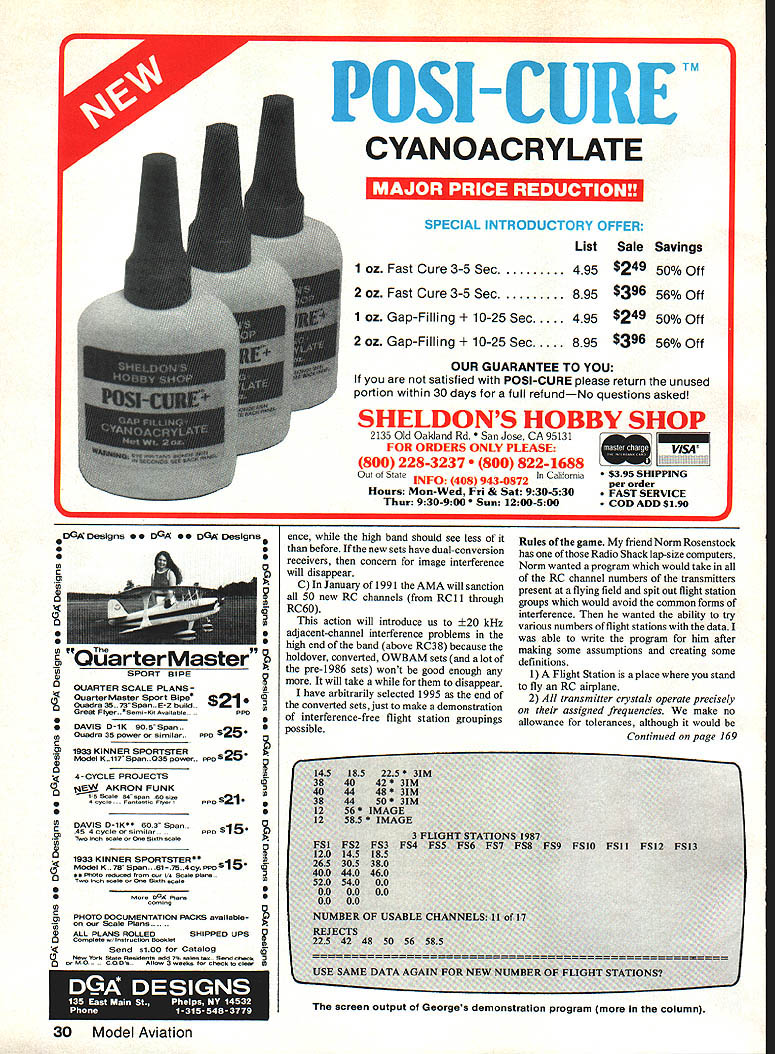
If you choose 1987 as a demonstration year, you will see how mixed equipment (OWB‑AM and narrow-band) distributes across flight stations and where interference problems occur.
Example reasoning from the program output:
- Some OWB‑AM sets suffered interference from RC14.5. The most common IF (intermediate frequency) is 455 kHz (appearing as 45.5 in the program logic). Thus, for RC58.5 to be usable it must be located on the same flight station as RC14.5 and RC13, since 58.5 − 45.5 = 13.
- Given a reasonable bandwidth of ±7 kHz (represented as "7" in a narrow-band entry), interference from RC12 or RC14.5 is possible because 58.5 − (45.5 + 0.7) = 12.3 (46.2 comes from 45.5 + 0.7). If the order of data entered caused RC12 and RC14.5 to be on different flight stations, RC58.5 cannot be used.
Some clear conclusions:
- A 1995 demonstration shows that a club using only narrow-band equipment with dual-conversion receivers on all channels RC11, RC12, RC13, RC14, RC57, RC58, RC59 and RC60 should be able to fly any combination of the 50 channels sanctioned in 1991 with little or no interference.
- The program accepts old channels and shows their effects, useful if some owners insist on using OWB‑AM equipment on the old channels after the FCC has withdrawn them.
Notes on input order:
- The order in which you enter RC channel numbers when examining pre-1995 situations can affect their distribution to flight stations, so you are encouraged to revise the order as necessary to get the best results. The program will not be confused by the number or order of the inputs.
When you play the game with your club's equipment list, you will be asked which options you want: narrow-band (N) or wide-band (W), and single-conversion (S) or dual-conversion (D). The program uses this information in making its group assignments. You can experiment by altering parameters in the program to see the effects. A little "what if?" play will provide your club with a wealth of education.
There will be confusion during the next few years because of the significant changes in the RC environment. You, Dear Reader, are one in 60 (based on 100,000 AMA members in an RC-user population of 6,000,000 — yes, I really mean six million!). You will know what is happening because you read Model Aviation (and many have obtained and used this program). But there are millions of R/Cers out there who don't read it. They will be confused. Teach them.
Copies of this program should be available from AMA HQ on 5.25-inch, single-sided MS‑DOS disks in the nine-sector format or via E‑mail. From that, you should be able to put it on a disk, make whatever small changes are necessary to suit your particular computer, and proceed to become an educator.
George M. Myers 70 Froehlich Farm Rd. Hicksville, NY 11801
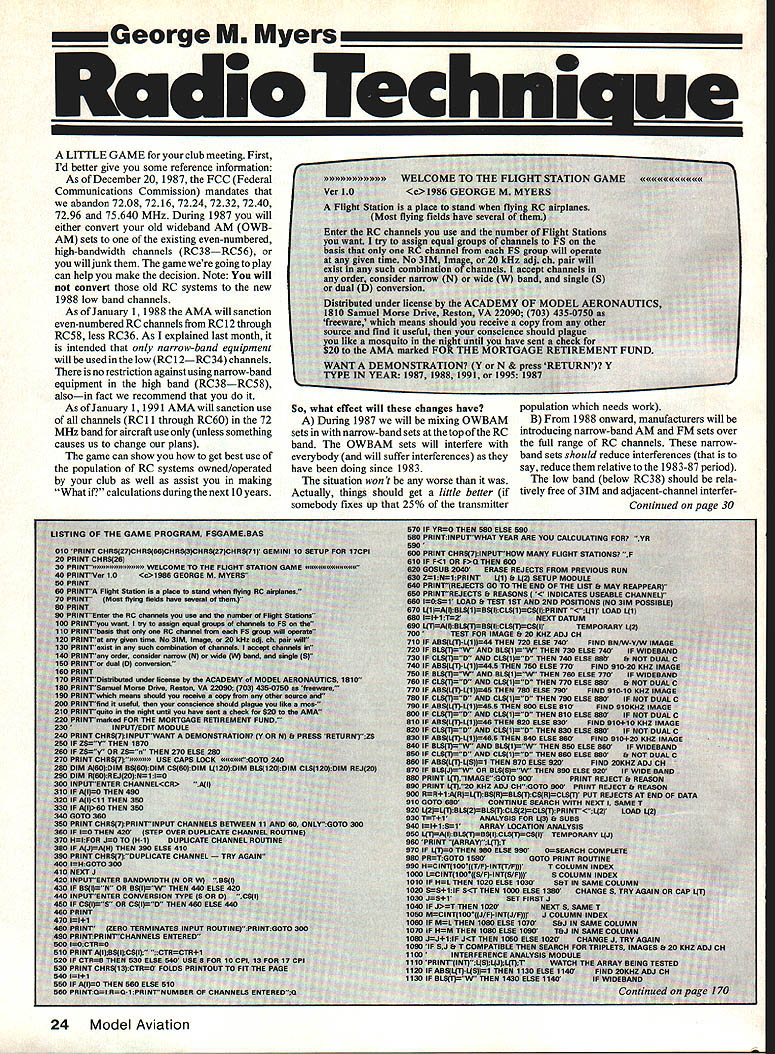
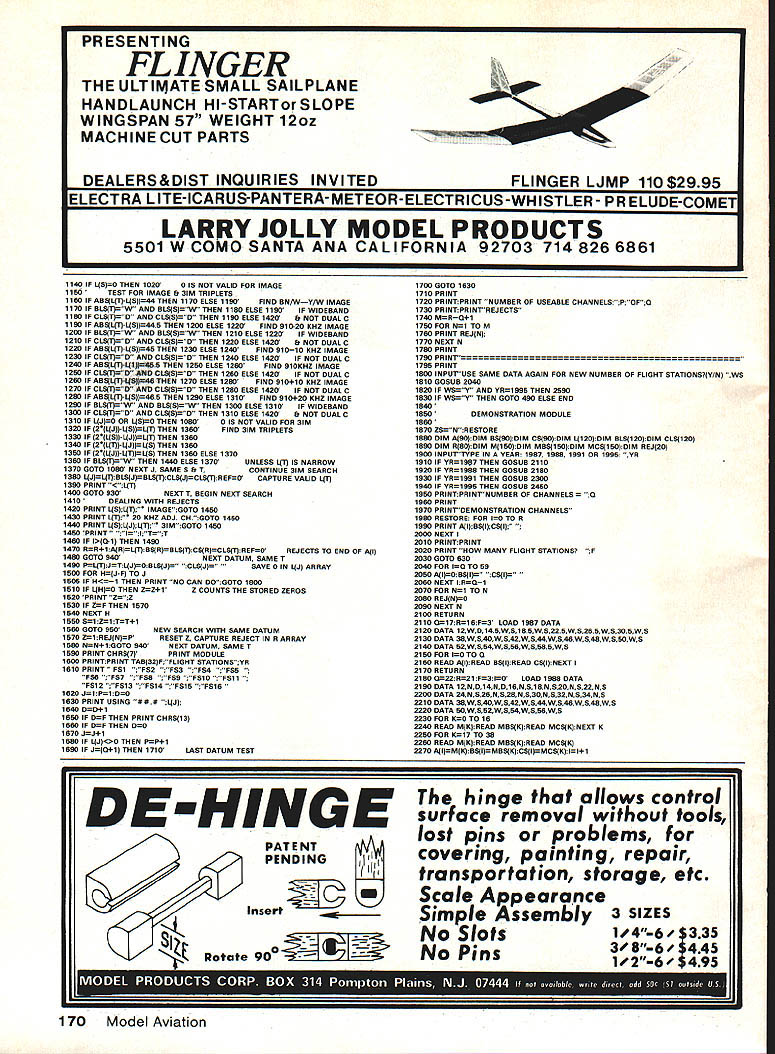
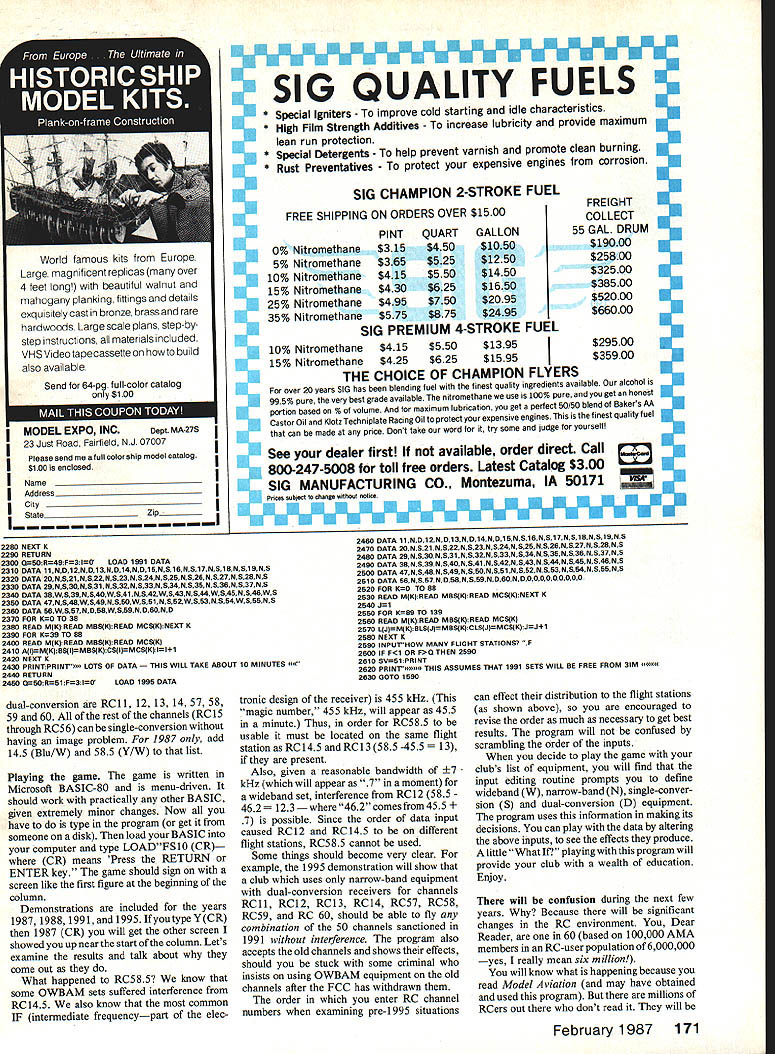
Program (demonstration and data routines — excerpt)
- The program is menu-driven, written in Microsoft BASIC-80. It requests:
- Year (1987, 1988, 1991, or 1995)
- Number of flight stations (F)
- Number of channels in use (Q)
- Channel numbers (1–60)
- Narrow-band flag (1 if narrow-band, else 0)
- Main routine logic (overview):
- Initialize grouping array S(I) = 0 for each channel.
- Check interference between every pair of channels:
- If both channels are narrow-band, allow closer spacing (less restrictive).
- If either is wide-band, enforce ±20 kHz adjacent-channel restriction and third‑harmonic rules.
- Apply image-interference protection based on single/dual conversion and IF considerations.
- Demonstration data includes channel frequency table (72.010, 72.030, ..., 72.990), allowed RC channel lists, and sample input/output logic.
(If you need the complete BASIC listing or an MS‑DOS disk image, AMA HQ should be able to supply it. The program includes DATA statements for channel frequencies and built-in demonstration cases for quick testing.)
Enjoy experimenting with the Flight Station Game and using it to educate club members about interference and channel assignment.
Transcribed from original scans by AI. Minor OCR errors may remain.

