
Radio Technique
George M. Myers
Charging Nicad Batteries
My long-time flying buddy, Karl Birkel, who left the New York rat-race to write me letters about flying every afternoon from a 6-mile-long strip near Port Charlotte, FL, has had some encouraging things to say about the column. He also requested some good words about charging Nicads. Since good friends don't come along very often, I must honor the request. Judging by the newsletters, the subject warrants review.
Nicad batteries are fairly tough items, being made chiefly of metal. When used within their limitations they will yield many charge/discharge cycles, usually anywhere from 1,000 to 30,000 depending on service conditions. The things which will reduce battery life are: High temperatures, time, overstress due to charging and discharging at too high a rate, mechanical damage due to shock and vibration, and persistent usage at very low states of charge. Taking the opposite view, the ways to prolong the useful life of your Nicads are to keep them cool, use them while you've got them, charge and discharge them at rates appropriate for their design (more on that later), protect them from shock and vibration (use foam padding and don't crash) and keep charging them regularly, whether or not you use them, so they don't lie around discharged.
I've been avoiding the subject of Nicads for some time, because I felt that it had been beaten flat during the recent surge of battery dischargers onto the market. Most of the letters I have received requested building instructions for either Fast Chargers (the 15-minute kind) or Standby (or all-winter) Chargers. On the other hand, when I go to the field I find that people generally have more battery packs than chargers, and what they really think they need is enough chargers to do everything at once. That says something about the difference between letter-writers and talkers, but I'm not sure what.
Let's start by defining the four types of chargers generally recognized, and review their characteristics. The names given to them vary with the manufacturer, so I'm going to use the names assigned by the General Electric Company, on the basis that most RC systems I am familiar with use GE products.
Fast Chargers: These chargers will completely charge a discharged pack in less than one hour. They usually require some kind of control to insure that the cells are not damaged by the charger. The controls take the form of a temperature sensor buried in the pack, a voltage sensor that measures the power put into the pack starting from the fully discharged condition, or finally, a pressure sensor in the cell to indicate the cell has gone into overcharge, as evidenced by a rise in cell pressure. The common concern of all fast charging schemes is possible damage from overcharging, due to the rapid evolution of gases within the cell, and they should only be used at or near room temperature, on sintered-plate, ventable Nicads.
Quick Chargers: These chargers will charge a fully discharged pack in three to six hours. Due to lower charge rates, the pressure rise in the overcharge region is slower, and therefore the charging is controllable on a timed basis. GE makes special cells for quick charging that are made slightly larger and heavier, for a given capacity, than the more common "slow-charge" cells. Their greater size lets them stand up to the temperature effects of quick charging more gracefully than other types, and temperature is the major concern of this class of charger.
Slow Chargers: This is the class of charger that you are most familiar with, since it is the type supplied by most RC system manufacturers. Charging times range from 10 to 24 hours, but the 16-hour charge has become practically a standard. Pressure and temperature rises in the overcharge range are low enough so that the recombination elements within the cell can take care of the problem despite prolonged overcharging. Advantages of this method are lowest cost cells and charger, freedom from elaborate charging controls, and the ability to bring cells in a multi-cell pack to the highest possible individual states of charge. That last point is important because in a multi-cell pack a possible cell may become fully discharged while the remaining cells are delivering significant current through it; this reverse charging effect reduces the total power available from the pack and can lead to early failure of the reversed cell. Slow charging is the best way to avoid the problem. Manufacturers who provide packs for quick or fast charging must assemble cells carefully matched in capacity. Most packs supplied by RC manufacturers are pretty well balanced when new but become unbalanced with age.
Standby Chargers: This class of charger will set a fully charged or discharged pack to full charge in a week or less. The rate is so low that they are inefficient as primary chargers but excel as maintenance chargers to keep packs topped off for long periods. There are commercial chargers available for this service, and they are usually part of some emergency device such as fire-warning or burglar alarms. Most often they operate in a two-step mode, providing slow or quick charging whenever the batteries are used, then reverting to the standby rate when the cells are fully recharged.
A Fast Charger
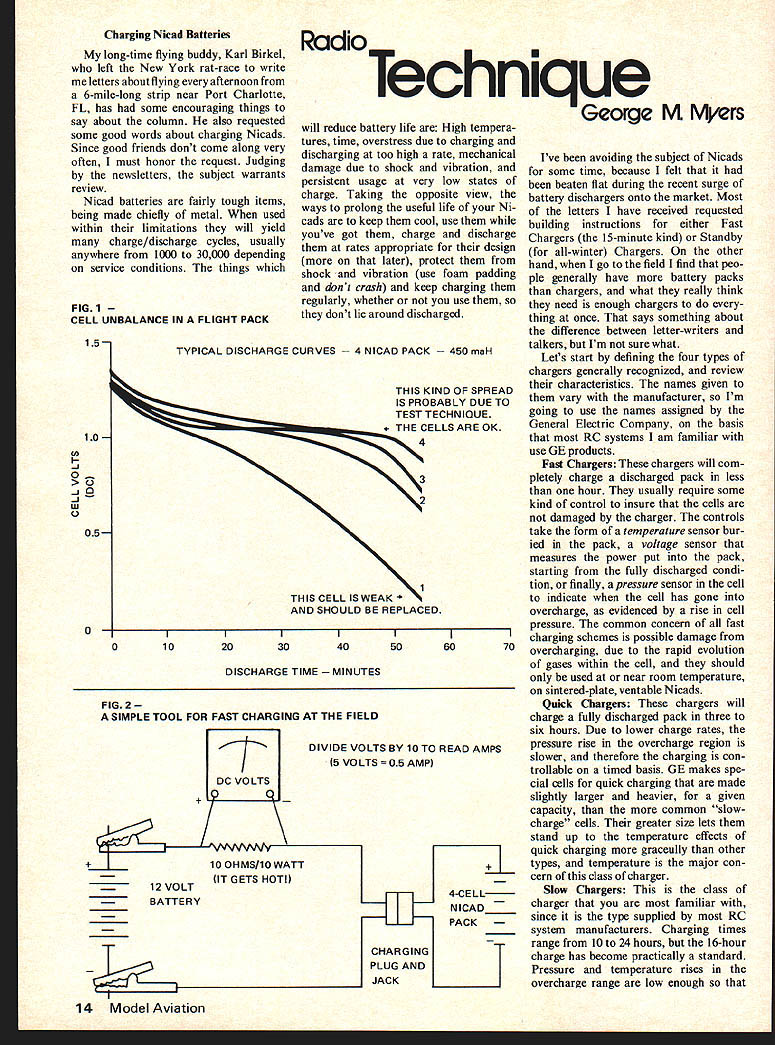
Recognizing the limitations put forth above, you may want to build a fast or quick charger from circuits provided in other magazines. When used with proper understanding, they can be effective and the risks can be controlled. However, before you start using them it would be a good idea to slow-charge your pack, then discharge it by connecting a 10-ohm, 10-watt resistor between the red (+) and black (—) leads. Open up the pack so that you can monitor the voltage of each cell independently. Write down each cell voltage at 10-minute intervals until at least one cell has dropped to 0.5 volts. (Fig. 1) If you find that one or more cells has less capacity than the others in the pack, repeat the charging and the test. If still weak, replace. This unbalance of cells can be a significant problem when you build up a pack from "surplus" or other "cheap" cells. Usually such cells have passed their 10-year shelf life limit, and they're liable to have high and variable internal resistances. While on the subject, you should never fast charge the flat "button" cells, nor any cell that has been constructed without some kind of venting provision.
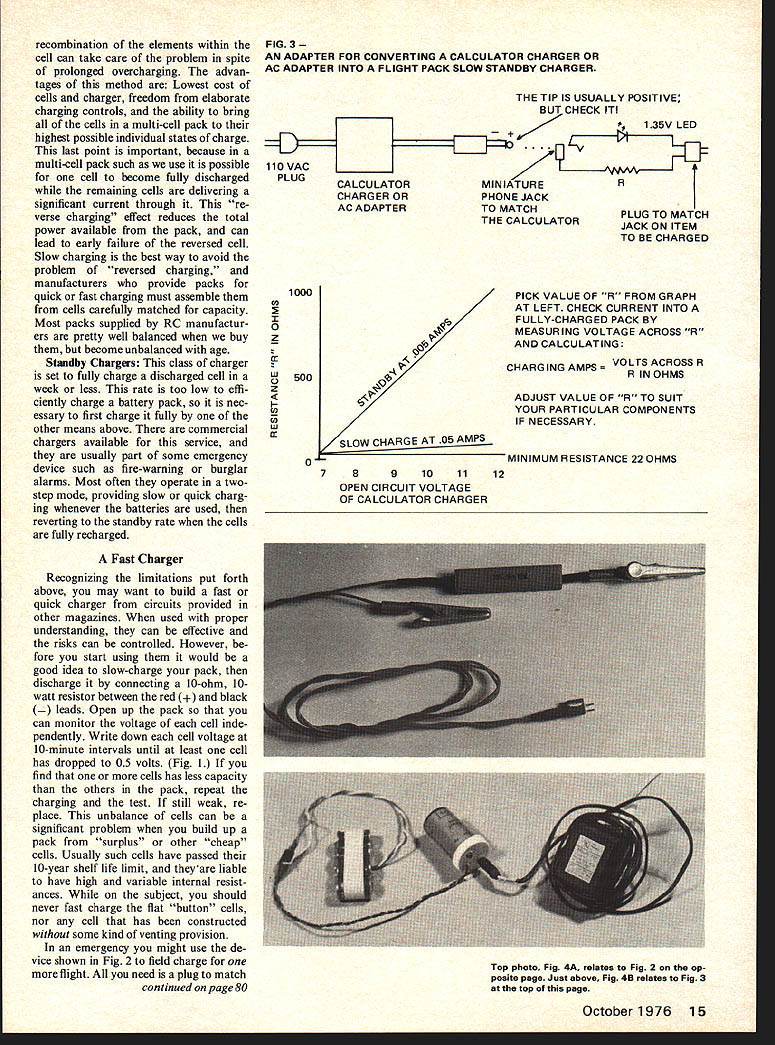
In an emergency you might use the device shown in Fig. 2 to field charge for one more flight. All you need is a plug to match the charging jack on your flight pack, some wire, two clips and one 10-ohm 10-watt resistor. Connect + to + and - to - between your flight pack and a 12-volt battery and charge for 15 minutes. This should put in about 1/3 of a full charge, enough for your tie-breaking contest flight. Keep the resistor away from fingers and inflammables, because it gets hot! Depending on how your transmitter pack is wired, the same device can be used for 15 minutes per 4-cell (450-mAh assumed) pack or 30 minutes per 8-cell pack. You can monitor charging current by connecting your milliammeter across the 10-ohm resistor and reading volts divided by 10 (5 volts = 0.5 amps). You may use this rig for the discharge test described above. If all this "Mickey Mouse" turns you off, and it should, read on a little further for a description of the Astro Flight Inc. R/C System Analyzer-Rapid Charger.
A Slow Charger
Most of you have by now some kind of pocket calculator. Usually, it is accompanied by some kind of AC adapter or charger, rated 6, 7 1/2 or 9 volts DC and 50 to 100 milliamps. An LED and a resistor, built into the top of a medicine bottle as in Fig. 3, makes up a device that converts your calculator into either an extra charger for your spare flight pack, or a standby charger for any flight pack, if you really feel you need it. All that changes is the series limiting resistor. Remember that standby chargers build up memory (probably the only thing that does!) and the memory gets shorter as time goes on. I really don't advise use of standby chargers, but there it is if you insist. The LED is a diode which will rectify (convert AC to DC) as well as light to show the passage of current, so it will work in this adapter regardless of the output of your calculator adapter. The main thing to remember is that you want to charge + to +.
Astro Flight R/C System Analyzer-Rapid Charger
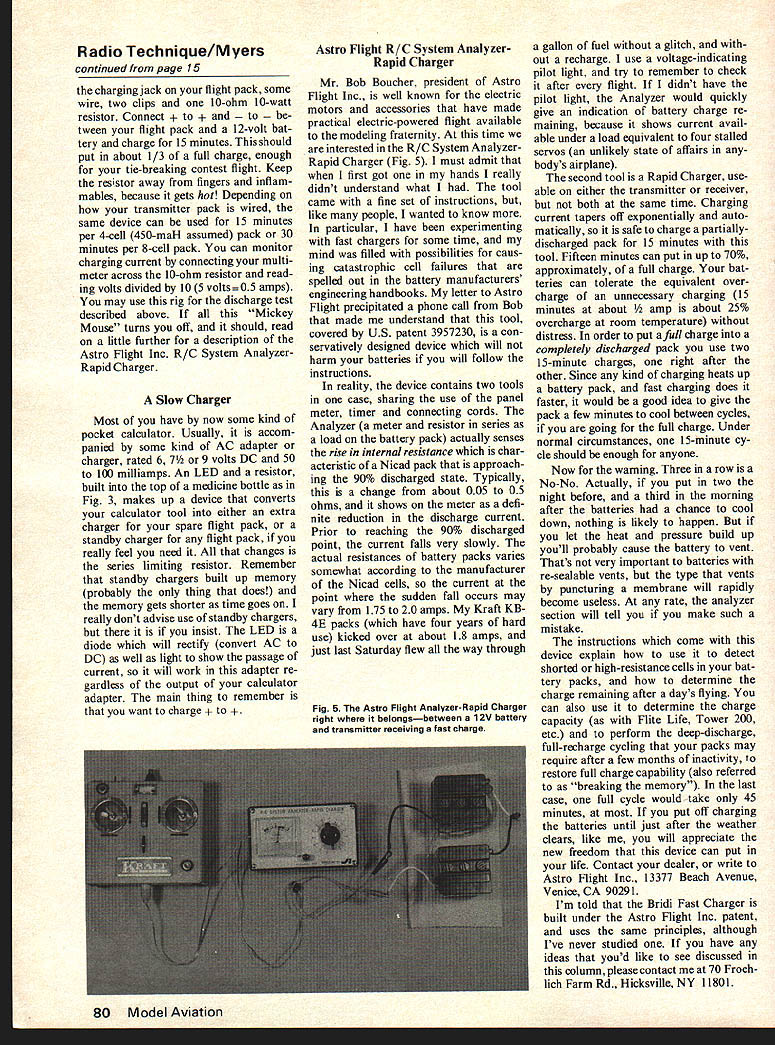
Mr. Bob Boucher, president of Astro Flight Inc., is well known for the electric motors and accessories that have made practical electric-powered flight available to the modeling fraternity. At this time we are interested in the R/C System Analyzer-Rapid Charger (Fig. 5). I must admit that when I first got one in my hands I really didn't understand what I had. The tool came with a fine set of instructions, but, like many people, I wanted to know more. In particular, I have been experimenting with fast chargers for some time, and in doing so was filled with possibilities for causing catastrophic cell failures that are noted in the battery manufacturers' engineering handbooks. My letter to Astro Flight precipitated a phone call from Bob that made me understand that this tool, covered by U.S. patent 3957230, is a conservatively designed device which will not harm your batteries if you will follow the instructions.
In reality, the device contains two tools in one case, sharing the use of the panel meter, timer and connecting cords. The Analyzer (a meter and resistor in series as a load on the battery pack) actually senses the rise in internal resistance which is characteristic of a Nicad pack that is approaching the 90% discharge state. Typically, this is a change from about 0.05 to 0.5 ohms, and it shows on the meter as a definite reduction in the discharge current. Prior to reaching the 90% discharged point, the current falls very slowly. The actual resistances of battery packs varies somewhat according to the manufacturer of the Nicad cells, so the current at the point where the sudden fall occurs may vary from 1.75 to 2.0 amps. My Kraft KBA-4E packs (which have four years of hard use) kicked over at about 1.8 amps, and just last Saturday flew all the way through a gallon of fuel without a glitch, and without a recharge. I use a voltage-indicating pilot light, and try to remember to check it after every flight. If I didn't have the pilot light, the Analyzer would quickly give an indication of battery charge remaining, because it shows current available under a load equivalent to four stalled servos (an unlikely state of affairs in anybody's airplane).
The second tool is a Rapid Charger, usable on either the transmitter or receiver, but not both at the same time. Charging current tapers off exponentially and automatically, so it is safe to charge a partially-discharged pack for 15 minutes with this tool. Fifteen minutes can put in up to 70%, approximately, of a full charge. Your batteries can tolerate the equivalent overcharge of an unnecessary charging (15 minutes at about 1/2 amp is about 25% overcharge at room temperature) without distress. In order to put a full charge into a completely discharged pack you use two 15-minute charges, one right after the other. Since any kind of charging heats up a battery pack, and fast charging does it faster, it would be a good idea to give the pack a few minutes to cool between cycles, if you are going for the full charge. Under normal circumstances one 15-minute cycle should be enough for anyone.
Now for the warning. The unit is not foolproof. No-No. Actually, if you put in one right before, and a third in the morning after the longer charge, and give the battery a chance to cool down, nothing is likely to happen. But if you let the heat and pressure build up you'll probably cause the battery to vent. That's most important to batteries with the resealable vents, but the type that vents by puncturing a membrane will rapidly become useless. At any rate, the analyzer section will tell you if you make such a mistake.
The instructions which come with this device explain how to use it to detect shorted or high-resistance cells in your battery packs, and how to determine the charge remaining after a day's flying. You can also use it to determine the charge capacity (as with Flite Life, Power 200, etc.), and to perform the deep-discharge, full-recharge cycling that your packs may require after a few months of inactivity, to restore full charge capability (also referred to as "breaking the memory"). In the last case, one full cycle would take only 45 minutes, at most. If you put off charging batteries until just after the weather clears, like me, you will appreciate the new freedom that this device can put in your life. Contact your dealer, or write to Astro Flight Inc., 13377 Beach Avenue, Venice, CA 90291.
I'm told that the Bridi Fast Charger is built under the Astro Flight Inc. patent, and uses the same principles, although I've never studied one. If you have any ideas that you'd like to see discussed in this column, please contact me at 70 Froehlich Farm Rd., Hicksville, NY 11801.
Transcribed from original scans by AI. Minor OCR errors may remain.

