
Radio Technique
George M. Myers
Let me introduce George P. Steiner of Sacramento, CA. George is a member of the AMA Frequency Committee, a retired communications engineer, and is well equipped with electronic tools — including his personal spectrum analyzer. George does his RC repairs under the name GSP (for George Steiner Products).
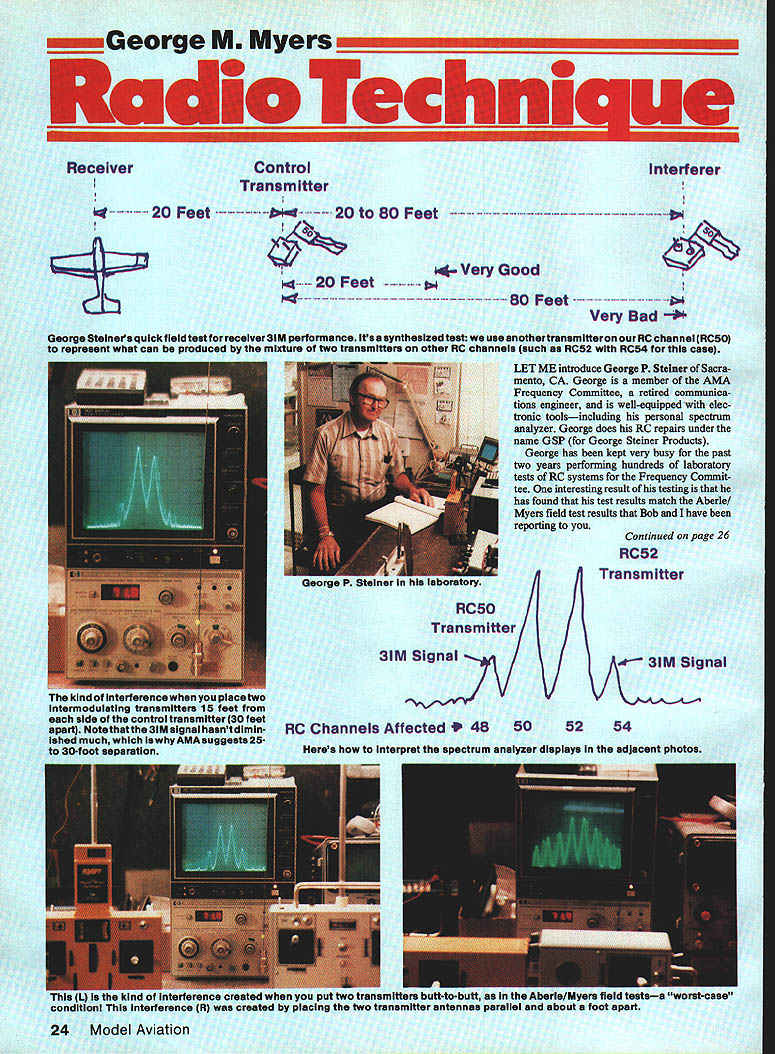
George has been kept very busy for the past two years performing hundreds of laboratory tests of RC systems for the Frequency Committee. One interesting result of his testing is that his test results match the Aberle/Myers field test results that Bob and I have been reporting. After running some of his own field tests to provide data correlations with lab tests, George came up with a whole new test which quickly and easily separates good 3rd-order intermodulation (3IM) performers from bad ones.
The 3IM phenomenon occurs when two transmitters operating on different frequencies generate an interference signal on a third frequency — right on another RC channel. The thing about 3IM that is of great concern and interest is that much depends on the difference between the control RF power and the 3IM RF power. The 3IM RF power must be substantially below the control signal for the receiver to remain safely under control. The very best of today's RC receivers can live with a 4-dB advantage for the control signal; the worst receivers need a full 25-dB advantage. George Steiner has developed a simple field test that illustrates good and bad systems.
George Steiner's simple field test
- Turn transmitter and receiver on; verify good control.
- Place airplane on the ground; engine off.
- Walk 20 ft away and test control response with the antenna extended.
- Have a buddy stand right next to the transmitter on the RC channel being tested; walk away in the direction away from the airplane.
- If you regain control of the plane before 20 ft away, you have a good system.
- If you don't recover control until 80 ft, you have a very bad receiver.
- If you regain control somewhere between 20 and 80 ft, you have visual evidence that 3IM resistance among receivers is on a relative basis.
It has been interesting to watch the comments about my Flight Station Game (January 1987 issue) roll in. The magazine reached the public just before the 1986 Christmas holidays, and I received about a dozen letters and telephone calls about the FSGAME during the holidays. Those who have access to an IBM computer (or a clone) tend to be lukewarm about the FSGAME until they have actually made it work; then they become quite enthusiastic. If you play the game a while you will develop a good understanding of the changes in the way we will use RC which will show up in the next few years. This is because I have included self-starting demonstrations of the combinations of channels which exist for 1983–1987, 1988–1990, 1991–1995, etc. I can’t think of a better way to learn about all of these details than by learning while playing the FSGAME.
If you have some stubborn hardheads in your club who will insist that they have a “right” to continue using their old channels (72.08, 72.16, 72.24, etc.) after January of next year, then you must be willing to include them in any group of channels. FSGAME will, I think, help many of the older fliers make the transition to the new channels. Philosophically, every person has a “right” to a transmitter. Having said that doesn’t protect them from being punished for their crimes.
You might get the idea that FSGAME has the only important changes lurking in the future that will be imposed on transmitters. Wrong, wrong, wrong! The most important changes will be receivers. "The key to the future is a better receiver." I've said that many times since 1983, and it is still true. Some transmitters will have to change — but almost every receiver in use today must be replaced.
A small number of RC systems already satisfy the requirements of the AMA Guidelines, among them:
- Kraft synthesized RF transmitter modules and receivers
- Kraft KPR-8FD (crystal-controlled, fixed-channel receiver)
- Cirrus PCM-9 with the ABS receiver
- Airtronics FM system (includes 92245 receiver, currently available as an accessory part at $64.95)
- Two low-priced imports: the Acoms FM system ($150) and the Futaba Conquest PCM ($250)
You may look at the above list and say, "I'll buy one of those right now and jump right into the new 'narrow-band only' section of the spectrum, where I'll be safe from all that trash in the high end of the band." Not quite! If the manufacturers cooperate, you won't be able to buy crystals for RC14, RC16, RC18, RC20, RC22, RC24, RC26, RC28, RC30, RC32 or RC34 until about September of 1987 (leaving aside the people who already have Kraft SRF modules).
Let's say that you find a way to get the low-band crystals. You can use them during sport flying (away from AMA-sanctioned contests), but you won't be allowed to use them at sanctioned contests unless the Contest Director decides to make some kind of special arrangement for you. Once again, FSGAME will help you assess the problems such a decision might create.
The AMA rule book won't actually require narrow-band performance (as defined by the AMA Guidelines) from RC systems used on the low-band channels until 1988. So what's the point? The rules don't try to prevent you from using narrow-band equipment there, either.
You automatically have AMA permission to use narrow-band equipment (i.e., narrow-band transmitters and receivers) on Bn/W, Blu/W, R/W, etc., as well as on RC38 through RC56, right now. All the advantages of a narrow-band set will be available to you right now, and when January 1988 rolls around all you will have to do is swap a pair of crystals. It is unlikely that retuning will be necessary for a swap from RC18 (Blu/W) to RC18, for example. Eventually all radios from RC11 through RC60 will be required to be narrow-band. If you buy a narrow-band system on RC38 through RC56 today you may be establishing an early claim on the use of that channel, assuming your club works on an "assigned-channel" basis. Quite a few clubs already do that, and it won't surprise me to see a lot more of them doing it when we have 50 channels to work with.
George M. Myers 70 Froehlich Farm Rd. Hicksville, NY 11801
Transcribed from original scans by AI. Minor OCR errors may remain.

