
Radio Technique
George M. Myers
Correction
In response to a recommendation I made in the May 1987 column, Futaba says that the Conquest PCM is not narrow-band at this time. My recommendation was based on the result of testing one sample, which was very good. I apologize for misleading you.
Made in the U.S.A.
If someone were to ask me if there are any RC systems made in the U.S., I'd have to say that only Ace R/C, Inc., Cannon, and Royal Electronics remain to "show the flag" at this time, so far as I know.
- Ace R/C, Inc. is almost ready to release narrow-band AM and FM versions of the excellent Silver Seven systems.
- Bill Cannon has already shown his "Super-Micro" narrow-band system at the WRAM Show.
- We heard at the Toledo show that Pete Waters (District VII VP, Frequency Committee member, and proprietor of Kraft Midwest) will "soon produce a true 1991 system." Pete certainly has the talent and knowledge to do the job, but I wonder where he'll find the time!
I haven't heard anything from Tech R/C or E.K.
Given the tariff changes brought on by Japanese computer chip dumping, and the dropping dollar-to-yen ratio, the price disadvantage that American manufacturers have labored with for so long may soon disappear.
Future trends in RC systems
The next generation of RC systems will almost certainly be computer-controlled and make use of surface-mounted components at the same time as they get away from the present designs which use resistive potentiometers at every point in the man/machine interface.
As an example of what might be done, I have in my hand a piezo-electric film. Talk to it, and it acts like a microphone. Press on it, and it acts like a force-measuring transducer. I can visualize this being used to replace the whole stick assembly on the transmitter — trim pots, too. Some PCM sets use a keypad to enter servo span, direction, offset (trim), control curves, etc. That gets rid of resistive potentiometers as well.
These and other evolutions will lower production costs (once proper 1991 designs are developed) while producing more compact elements and improving quality control. I'm impatient to see how this comes out. It's like watching a good football game!
I also look for interesting new servos to appear. The cost-driver today is the price of all the plastic parts. Reduce the number of plastic parts and the cost goes down. I think that we may see some new "push-pull" linear output designs, perhaps using a worm-and-nut to get around the problems of the usual rack and pinion.
Nobody has even looked at the LIM (linear induction motor), which offers the possibility of a full-digital servo without a feedback potentiometer. My computer printer uses an LIM to position the print wheel — and you know how fast and accurate that operation has to be.
Samarium-cobalt motors seem like a good prospect for use in servos. More torque is possible from a smaller package. Then there is the "pancake" motor and a whole field of stepper motors to look at. If we could get rid of the feedback potentiometer, servos would move to a whole new level of reliability.
Batteries
Batteries are a continuing problem — you know about that. The modern nickel-cadmium battery is a marvel of reliability to those (like me) who remember the "button cells" of the Sixties. But at least half of all system failures in properly maintained RC systems still trace back to batteries.
Perhaps the new rechargeable lithium batteries, or some version of the organic (non-metallic) battery, will provide us with a lighter, more vibration-resistant power source. Meanwhile, redundant battery schemes abound. 2 × 5-pack redundant flight packs (designed by my friend George Steiner) are readily available from Ace R/C, Inc., as are others from Jomar and Ram.
Multiplex, ROMs, and multi-role transmitters
Back in 1984, the West German firm Multiplex Modelltechnik GmbH released their Royal MC system which features plug-in ROMs (read-only memories) that allow one programmable transmitter to serve airplanes or helicopters. It also contains two switch-selectable battery packs for long flights or long days of flying. The transmitter is switchable between PCM and PWM (pulse-width modulation)—the kind most of your existing FM systems use.
B. T. Dryselius, ORBO A.B., Lidgatavägen 20, 51758 Solna, Sweden (agent for Multiplex in Sweden) sent me an info pack back in 1985, and I am only now getting around to thanking him. Multiplex is sold in the U.S.A. by Beemer RC West Distributors, Scottsdale, AZ 85260.
What has been done can be done again. I'm told that Futaba showed a PCM transmitter at Toledo that contained several built-in ROMs to store trims, servo throws, servo directions, mixing, etc., for several airplanes. I think that narrow-band receivers will be relatively expensive, so it will make sense to have one universal transmitter with several flight packs. It will make more sense if that transmitter has switchable or synthesized RF generation.
Synthesized transmitters and monitors
Back in the August 1982 issue of Model Aviation (page 28), I sketched a dream about a new RC system which included a narrow-band receiver and synthesized RF systems with a monitor built into the transmitter. Well, I have used one for years now, thanks to my good friend Jack Albrecht, who pushed Kraft Systems into producing the famous Channel Max systems. Those who were fortunate enough to get synthesized systems when they were available know how good they are. I can't believe that no one will ever produce another one.
After you have put an expanded-scale voltmeter, a stopwatch, and a tachometer into a transmitter, what else can you sell them?
At that time I visualized a three-position transmitter switch which moved Off/Monitor, On/Monitor Off, and Transmitter On. It never reached the market, but there is no reason why it couldn't have happened. I made a prototype by building an RC receiver (fixed crystal) with an audio amp and speaker into my Silver Seven transmitter. I satisfied myself that I could hear interference on my channel before turning on the transmitter, if I wanted to.
Actually, you'll get the same information by simply turning on the airplane's receiver first. Not many people will do that, because in the old days a servo could drive itself to a stalled condition, which would then melt down the servo amplifier. That problem has been fixed for years, but the tradition of "transmitter On First" persists. This produces a number of accidental shut-downs every year.
Redundant radio concept
Then there is the redundant-radio concept, awaiting its chance. Redundant radio means two or more transmitters, on different RC channels, radiating from a single antenna on the transmitter to twin or more receivers in the airplane. Each receiver independently drives the servos in the aircraft, and there can be two or more servos for each control function. The concept works.
I'm told that Calvin Orr will have his system Type Accepted for use on Futaba transmitters using 72 MHz and 50 MHz (Ham license).
My redundant-radio project
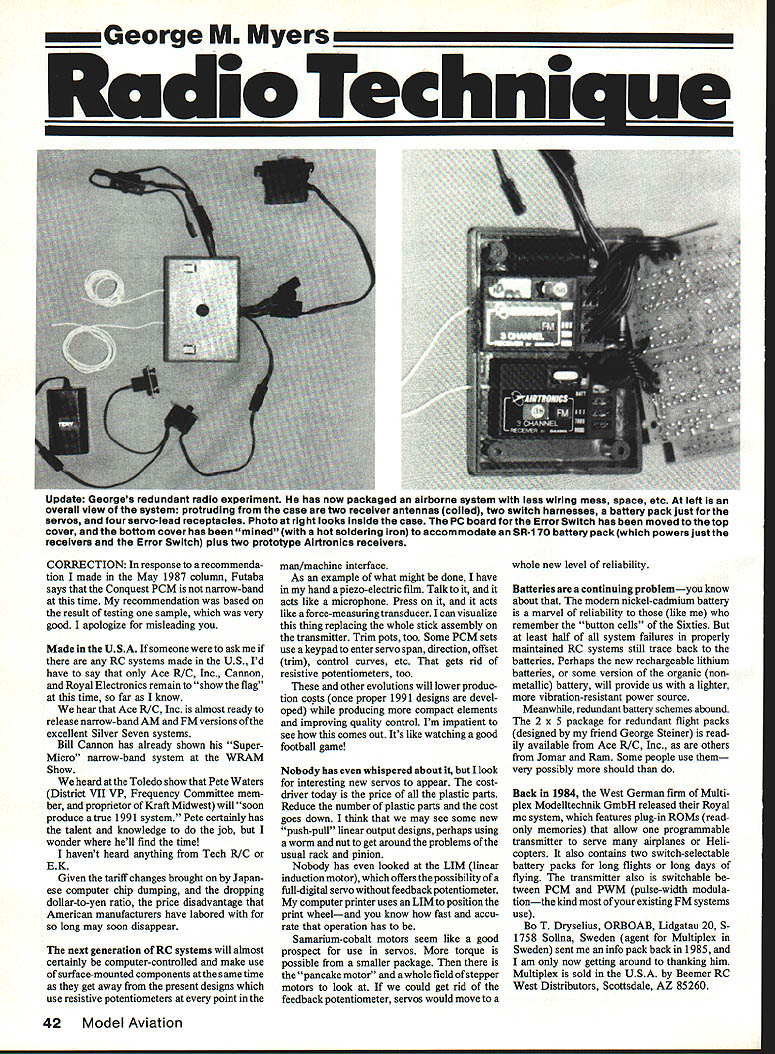
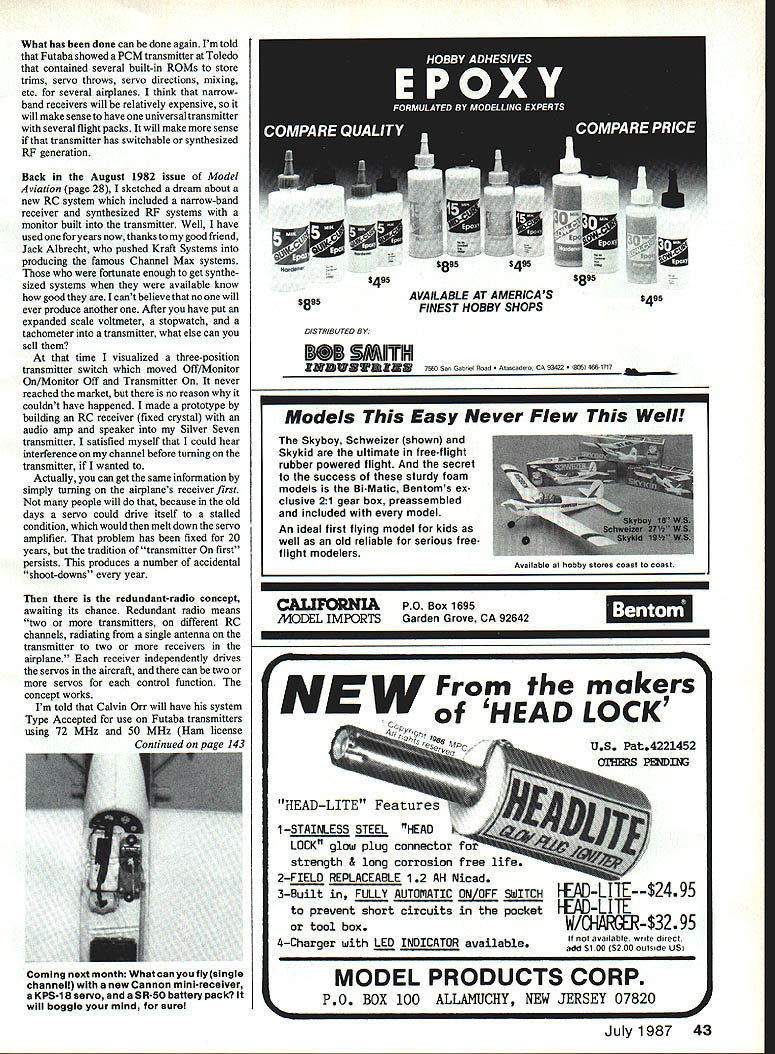
I am still "doing my thing" with redundant radio. I recently purchased an electronic switch from Calvin Orr (Custom Electronics, P.O. Box 1332, Alta Loma, CA 91701). Since it is housed in an oversize plastic box, I decided to see if I could get the two receivers and a battery pack in there with the switch, thereby eliminating a mess of dangling wires.
My buddy Jack Albrecht, Service Manager for Airtronics (11 Autry, Irvine, CA 92718), provided me with a pair of prototype receivers set to match my Kraft Channel 90 transmitter, and I bought some SR170 battery packs from another buddy, Larry Sribnick (SR Batteries, 21 South Country Rd., Bellport, NY 11713). After a little "plastic mining" with a hot soldering iron, everything fit nicely. The electronic switch now mounts in the top of the box, where I cut some holes to "let out" the switch's trim pots, which are the only things you want to access for adjustment, anyway.
I am using a Lanier Javelin for a test bed. This is the unit I bought from Bubba Spivey at the 1986 Nats. It has been modified slightly to function as a tail-dragger, because I fly mostly off grass. Powered by an OS .28 H, it is considerably milder than Bubba's .40-powered missile.
I am using RC38 with RC56, because those are the channels Jack Albrecht provided. Jack is pretty clever. The channel which would complete a 3 AM triplet is RC47, and it looks like that won't be in use before about 1995 (if ever). Nobody has complained about me hogging the two channels—yet.
My crystal ball is tired. Let's see how much of this comes true.
Next month I'll talk about some minimal Electric RC. I have a grandson who has too many younger siblings for me to feel safe about getting him a glow engine.
George M. Myers 70 Froehlich Farm Rd., Hicksville, NY 11801.
Transcribed from original scans by AI. Minor OCR errors may remain.

