
Radio Technique
George M. Myers
Some news about flying over Long Island, NY. The subject matter of my column this month may seem far removed from my usual treatment of technical aspects associated with our hobby, but if you'll bear with it I'll make my point later on.
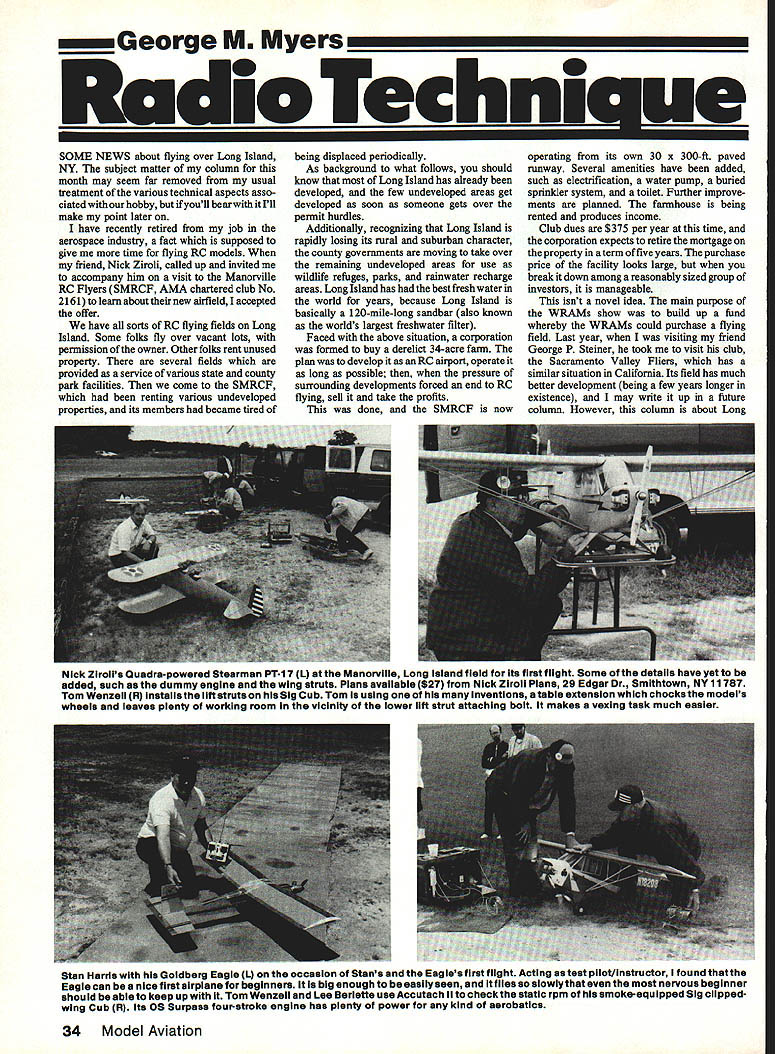
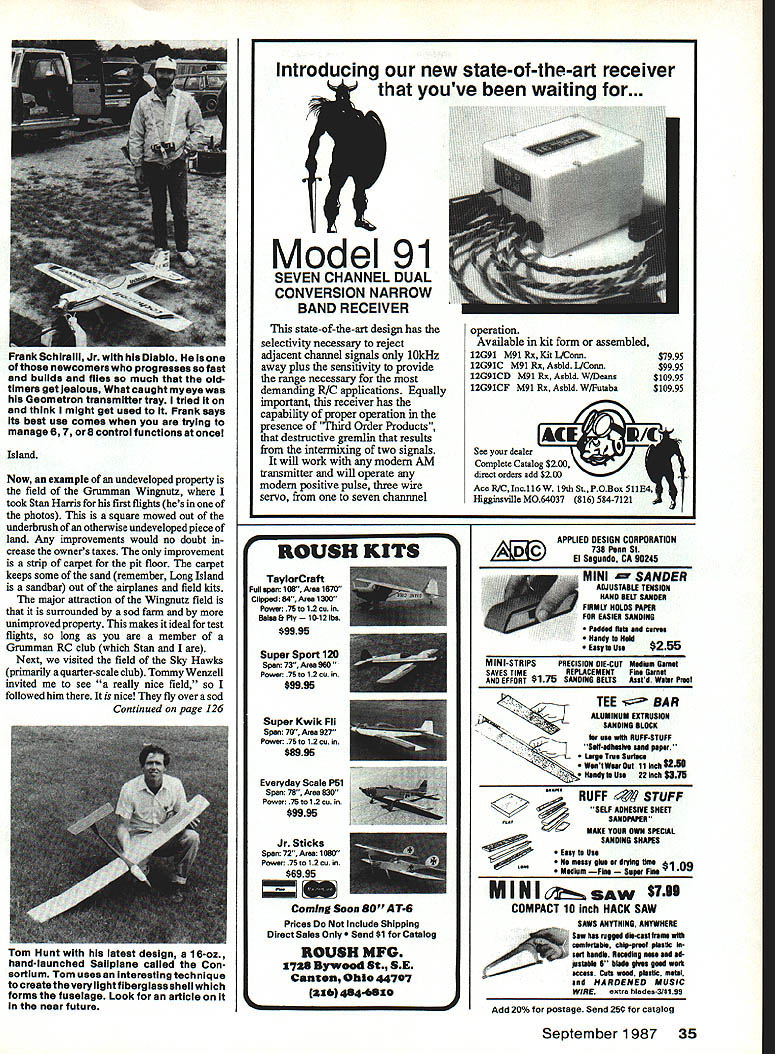
I have recently retired from my job in the aerospace industry, a fact which is supposed to give me more time for flying RC models. When my friend Nick Ziroli called and invited me to accompany him on a visit to the Manorville RC Flyers (SMRCF, AMA chartered club No. 2161) to learn about their new airfield, I accepted the offer.
We have all sorts of RC flying fields on Long Island. Some folks fly over vacant lots with the owner's permission. Others rent unused property. There are several fields provided as a service of state and county park facilities. Then we come to the SMRCF, which had been renting various undeveloped properties and whose members had grown tired of being displaced periodically.
As background, most of Long Island has already been developed, and the few undeveloped areas get developed as soon as someone clears the permit hurdles. County governments are also moving to take over remaining undeveloped areas for wildlife refuges, parks, and rainwater recharge areas. Long Island has had outstanding fresh water for years because it is basically a 120-mile-long sandbar (also known as the world's largest freshwater filter).
Faced with this situation, a corporation was formed to buy a derelict 34-acre farm. The plan was to develop it as an RC airport, operate it as long as possible, then sell it for a profit when development pressures forced an end to RC flying. This was done, and the SMRCF is now operating from its own 30 × 300-ft paved runway. Several amenities have been added: electrification, a water pump, a buried sprinkler system, and a toilet. Further improvements are planned. The farmhouse is rented and produces income.
Club dues are $37.50 per year at this time, and the corporation expects to retire the mortgage in about five years. The purchase price looks large, but when divided among a reasonably sized group of investors it is manageable.
The concept isn't novel. The main purpose was to build a fund whereby a club could purchase a flying field. Last year, when I visited my friend George P. Steiner, he took me to his club, the Sacramento Valley Fliers, which has a similar situation in California. Its field is better developed, being a few years older, and I may write about it in a future column. However, this column is about Long Island.
Other Long Island Fields
- Grumman Wingnutz
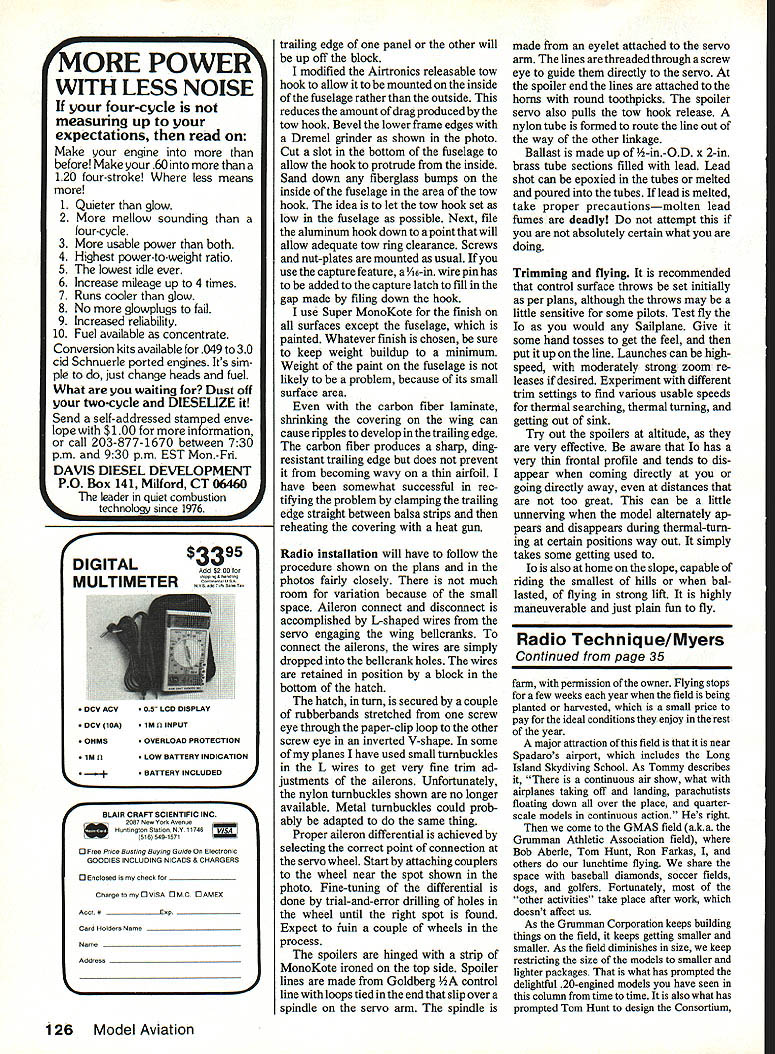
An example of an undeveloped property is the field of the Grumman Wingnutz, where I took Stan Harris for his first flights. This is a square mowed out of the underbrush of an otherwise undeveloped piece of land. Any improvements would no doubt increase the owner's taxes. The only improvement is a carpet strip for the pit floor to keep some of the sand out of the airplanes and field kits. The major attraction of the Wingnutz field is that it is surrounded by a sod farm and more unimproved property, making it ideal for test flights for Grumman RC club members.
- Sky Hawks (primarily a quarter-scale club)
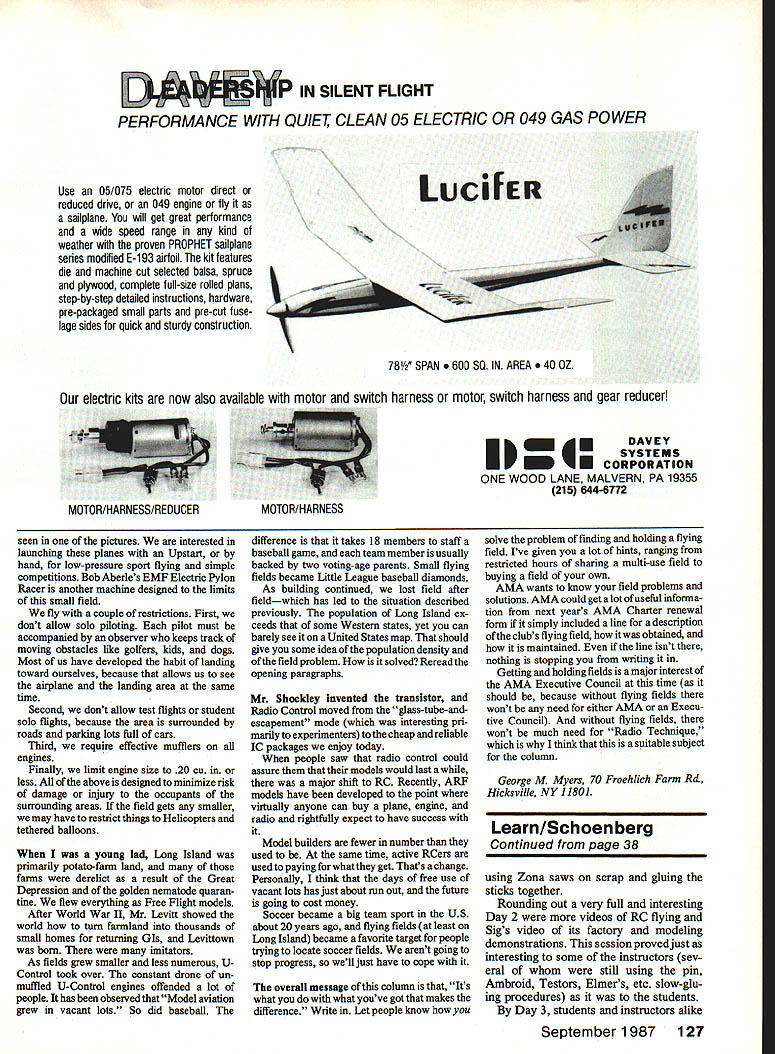
Tommy Wenzell invited me to see "a really nice field." They fly over a sod strip on a farm with the owner's permission. Flying stops for a few weeks each year when the field is being planted or harvested, which is a small price to pay for the ideal conditions the rest of the year. A major attraction is that it is near Spadaro's airport, home to the Long Island Skydiving School. As Tommy describes it, "There is a continuous air show — airplanes taking off and landing, parachutists floating down all over the place, and quarter-scale models in continuous action."
- GMAS (Grumman Athletic Association) field
This is where Bob Abele, Tom Hunt, Ron Farkas, Jr., and others do lunchtime flying. We share the space with baseball diamonds, soccer fields, and golfers. Fortunately, most other activities take place after work and do not affect us much. As Grumman keeps building on the site, the field gets smaller, so we've restricted model sizes and designed lighter aircraft (e.g., Tom Hunt's Consortium — the lighter .20-engined models — and Bob Abele's EMF Electric Pylon Racer) to suit the limited space.
Rules and Restrictions at Shared Fields
To minimize risk to surrounding areas, we operate under a few restrictions:
- No solo pilotage: each pilot must be accompanied by an observer who watches for moving obstacles such as golfers, kids, and dogs.
- No test flights or student solo flights: the area is surrounded by roads and parking lots full of cars.
- Effective mufflers are required on all engines.
- Engine size is limited to .20 cu. in. or less.
All of the above is designed to minimize the risk of damage or injury. If the field gets any smaller, we may have to restrict activities to helicopters and tethered balloons.
A Short History and Trends
When I was young, Long Island was primarily potato-farm land, and many farmers were derelict due to the Great Depression and the golden nematode quarantine. We flew everything as free-flight models. After World War II, Mr. Levitt showed how to turn farmland into thousands of small homes for returning GIs, and Levittown was born; there were many imitators.
As fields grew smaller and less numerous, U-Control (control-line) took over. The constant drone of unmuffled U-Control engines offended many people. It has been observed that "model aviation grew in vacant lots." So did baseball. One consequence is that it takes 18 members to staff a baseball game, with each team member usually backed by two voting-age parents. Small flying fields became Little League baseball diamonds. As building continued, we lost field after field, which leads to the situation described previously.
The invention of the transistor (Mr. Shockley among its inventors) moved Radio Control from "glass-tube-and-escapement" experimenter gear to the cheap, reliable solid-state packages we enjoy today. When people saw that radio control could make models last longer, there was a major shift to R/C. Recently, ARF models have been developed so that virtually anyone can buy a plane, engine, and radio and expect success.
Model builders are fewer than they used to be, and active R/C flyers are used to paying for what they get. Personally, I think the days of free use of vacant lots are nearly over; the future is going to cost money. Soccer became a big team sport in the U.S. about 20 years ago, and flying fields on Long Island became targets for soccer fields. We aren't going to stop progress, so we'll have to cope with it.
Advice and a Call to Action
The overall message is: it's what you do with what you've got that makes the difference. Write in and let people know how you solve the problem of finding and holding a flying field. I've given many hints here, ranging from restricted hours when sharing a multi-use field to buying a field of your own.
AMA wants to know your field problems and solutions. AMA could get a lot of useful information from next year's AMA charter renewal form if it included a line for a description of the club's flying field, how it was obtained, and how it is maintained. Even if the line isn't there, nothing is stopping you from writing it in.
Getting and holding a field is a major interest of the AMA Executive Council at this time (as it should be — without flying fields there won't be much need for either AMA or an Executive Council). And without flying fields, there won't be much need for "Radio Technique," which is why I think this is a suitable subject for the column.
George M. Myers 70 Froehlich Farm Rd. Hicksville, NY 11801
Transcribed from original scans by AI. Minor OCR errors may remain.

