
Radio Technique
George M. Myers
The Question
What low-priced radio should I buy for 1988?
I toured some of the major RC systems suppliers asking that question. Before I give you their answers, let's review what we already know.
- Use of the frequencies 72.08, 72.16, 72.24, 72.32, 72.40, 72.96, and 75.64 MHz for control of model aircraft became illegal by federal regulation, effective December 20, 1987.
Those frequencies were "shared" with other high-powered services that interfered with model aviation so much as to make them useless in some parts of the country. The FCC gave us five years to get our existing equipment converted to RC38 through RC56 (which are exclusively for model aviation).
Converted sets suffer less interference than they had with the canceled channels. You can still get old sets converted, if you want to.
- Effective January 1, 1988 the AMA decrees use of narrow-band transmitters on RC12 through RC34 to replace the above-listed canceled channels.
These new channels are also exclusively for model aviation and are spaced at 40 kHz (as are RC38 through RC56), but a new requirement has been imposed for them: only narrow-band transmitters will be permitted to operate. The term "narrow-band transmitter" has been defined in the AMA Guidelines, which have been discussed at length in previous issues of Model Aviation (see the AMA News section, September through November 1987).
- PCM and many recent FM transmitters meet the AMA Guidelines for bandwidth narrowness. A few AM transmitters also meet the Guidelines.
Everyone I talked to in the RC industry equated AM with the lowest-priced systems.
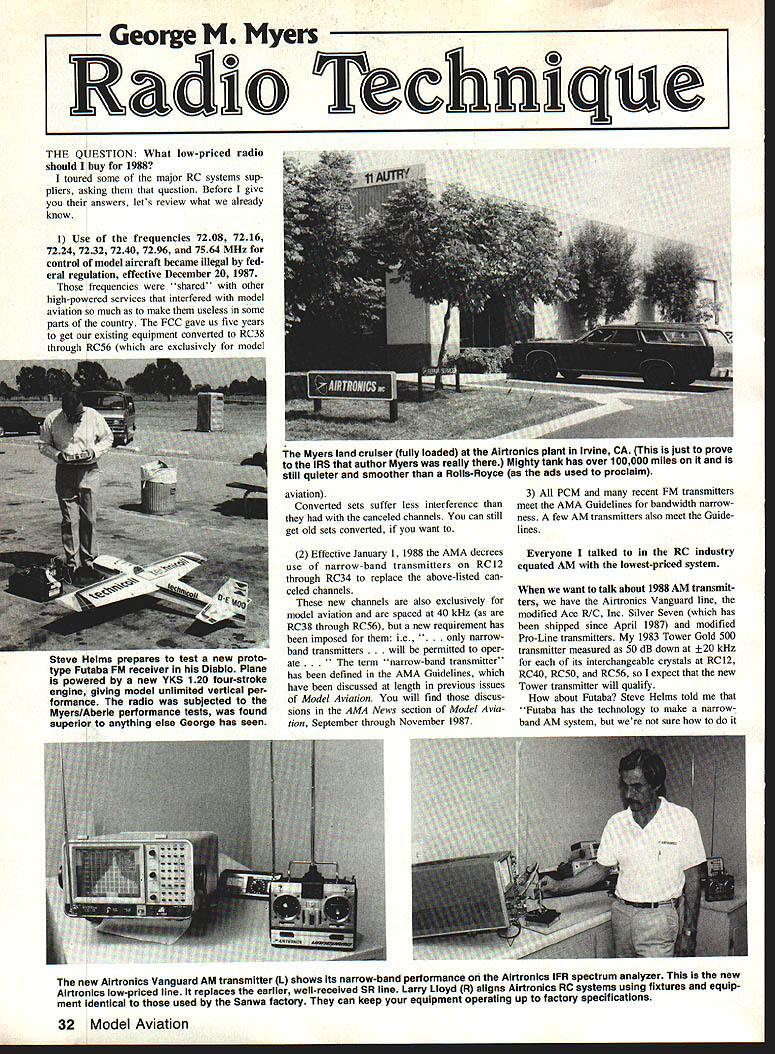
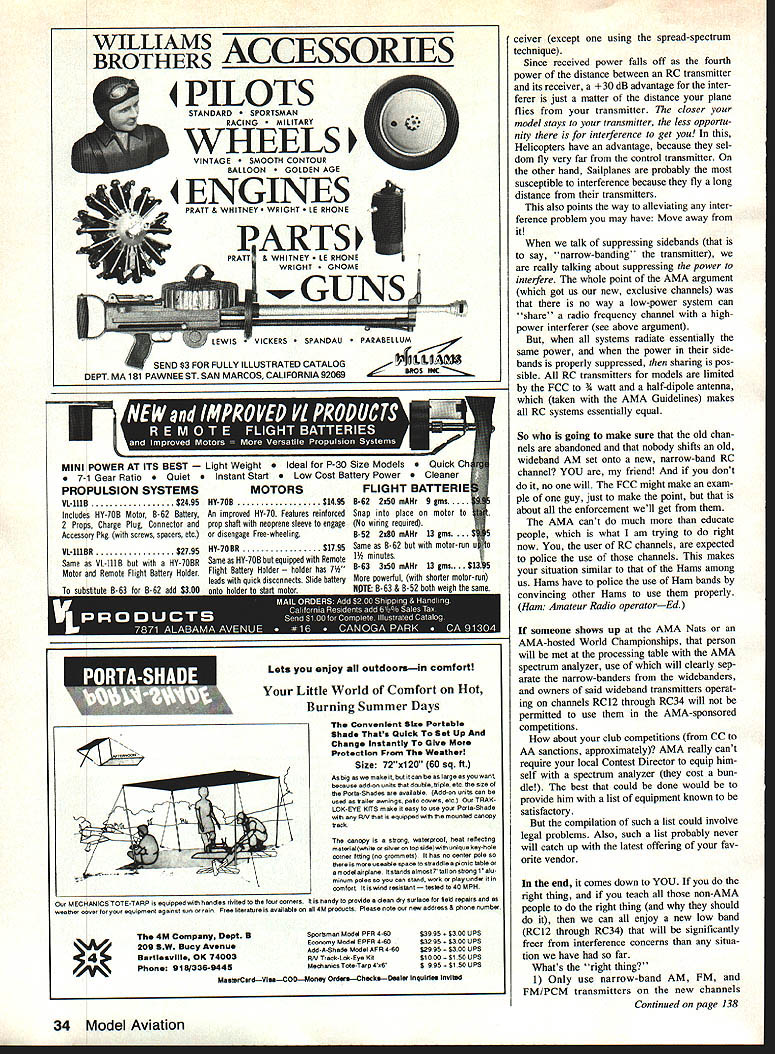
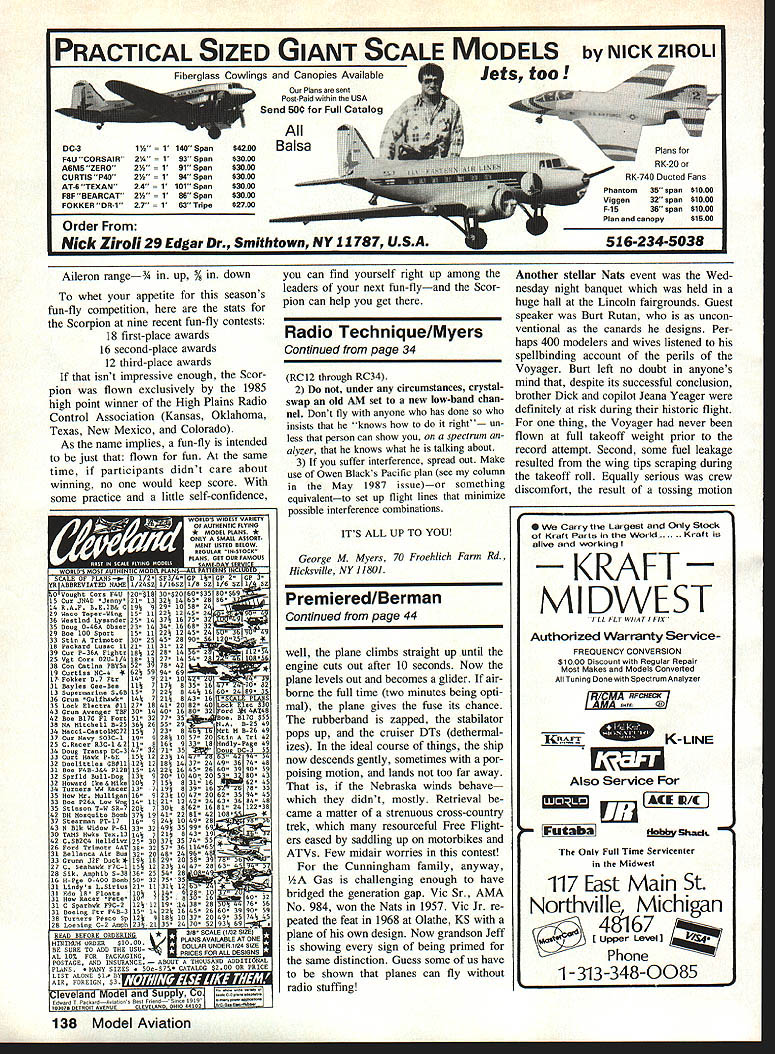
When we want to talk about 1988 AM transmitters, we have the Airtronics Vanguard line, the modified Ace R/C, Inc. Silver Seven (which has been shipped since April 1987), and modified Pro-Line transmitters. My 1983 Tower Gold 500 transmitter measured 50 dB down at ±20 kHz for each of its interchangeable crystals at RC12, RC40, RC50 and RC56, so I expect that the new Tower transmitter will qualify.
How about Futaba? Steve Helms told me that Futaba has the technology to make a narrow-band AM system, but they're not sure how to do it. I'm sure that's a correct statement, because my 1976 Futaba Contest 7 (AM) transmitter met the AMA Guidelines when it was tested.
That carefully phrased answer from the largest supplier of RC systems asks "for the rest of the story" — the receiver.
The 1976 Futaba Contest 7 AM receiver, while one of the most narrow-banded AM receivers I've seen, does not meet the AMA Guidelines for receivers. Neither does any other AM receiver I have tested, even though some of them (like the Acoms receiver) are quite good.
You may have noticed that narrow-band receivers aren't specified by AMA for 1988–1991. But I suspect that Futaba doesn't intend to sell narrow-band AM transmitters for use on RC12 through RC34 without being able to offer matching receivers, hence the qualified answer. That doesn't prevent them from selling the existing lines on RC38 through RC56 (which are not required to transmit narrow-band), which is perfectly acceptable to AMA.
When you go a little above the lowest price you can get excellent narrow-band performance from the Futaba Conquest PCM systems. The same can be said for many FM sets. I have seen some prototype FM receivers that are very narrow band and show amazing resistance to interference, but they are not cheap.
Therein lies the tale: I started this column by asking "What low-priced RC system should I buy for 1988?" and most of the vendors look at AM systems to fill the low-priced end of their catalog. Except, maybe, Polks. Their Aristo-Craft/Hi-Tec 720 receiver is part of a low-priced FM system that is a considerable improvement over the old 620.
The 1988 flying field
Let's get off onto another subject — one which is going to be very important to practically every RC flier.
Fred Marks discovered and publicized the fact that, in order to live together peaceably in a 50-channel, 20-kHz raster (i.e., 1991), AM transmitters must have their sidebands suppressed to better than -55 dB at ±20 kHz from the assigned frequency. The Myers/Aberle (or Aberle/Myers, depending on the magazine you read) test results agree with Fred's findings.
When we do our tests with wide-band transmitters that are only 30 to 40 dB (which is to say, using AM transmitters built before 1982), all receivers show poorer performance against AM interference than against FM. When tested against our pair of narrow-band Tower Gold 500 transmitters, using extra interchangeable crystals, the receiver performance looks better.
That does not mean in the "real world"...
The most important point is that wide-band AM interferes with all types of receivers (AM, FM, and FM/PCM) more than narrow-band FM does. A guy who shifts his old White/Red AM transmitter to a new narrow-band required channel (RC22, for instance) will interfere with your nice new 1988 set on RC20. Who's at fault in that? Should newer 1988 sets be able to reject this interference, regardless of what he does?
If your new receiver could do that, you would have an ideal situation. A spread-spectrum RC system (which does not exist) might give that kind of performance. But for AM, FM, and FM/PCM narrow-band RC, that thought is patently ridiculous. Given enough transmitter power, anything (from a practical standpoint, I'm talking about a signal +30 dB — or about 1,000 times stronger) will interfere with a radio receiver (except one using the spread-spectrum technique).
Since received power falls off as the fourth power of the distance between an RC transmitter and its receiver, a +30 dB advantage for the interferer is just a matter of the distance your plane flies from your transmitter. The closer your model stays to your transmitter, the less opportunity there is for interference to get you! In this, helicopters have an advantage, because they seldom fly very far from the control transmitter. On the other hand, sailplanes are probably the most susceptible to interference because they fly a long distance from their transmitters.
This also points the way to alleviating any interference problem you may have: move away from it!
When we talk of suppressing sidebands (that is to say, "narrow-banding" the transmitter), we are really talking about suppressing the power to interfere. The whole point of the AMA argument (which got us our new, exclusive channels) was that there is no way a low-power system can "share" a radio frequency channel with a high-power interferer.
But when all systems radiate essentially the same power, and when the power in their sidebands is properly suppressed, then sharing is possible. All RC transmitters for models are limited by the FCC to 4 watts and a half-dipole antenna, which (taken with the AMA Guidelines) makes all RC systems essentially equal.
Enforcement and user responsibility
So who is going to make sure that the old channels are abandoned and that nobody shifts an old, wide-band AM set onto a new, narrow-band RC channel? YOU are, my friend! And if you don't do it, no one will. The FCC might make an example of one guy, just to make the point, but that is about all the enforcement power they will get.
The AMA can't do much more than educate people, which is what I am trying to do right now. You, the user of RC channels, are expected to police the use of those channels. This makes your situation similar to that of the Hams among us. Hams have to police the use of Ham bands by convincing other Hams not to use them improperly. (Ham = Amateur Radio operator—Ed.)
If someone shows up at the AMA Nationals or an AMA-hosted World Championships, that person will be cited at the processing table with the AMA spectrum analyzer, one of which will clearly separate narrow-banders from widebanders, and owners of said wideband transmitters operating on channels RC12 through RC34 will not be permitted to use them in the AMA-sponsored contests.
How about your club competitions (from CC to AA sanctions, approximately)? AMA really can't require your local Contest Director to equip himself with a spectrum analyzer (they cost a bundle!). The best that could be done would be to provide him with a list of equipment known to be satisfactory.
But the compilation of such a list could involve legal problems. Also, such a list probably never will catch up with the latest offering of your favorite vendor.
In the end, it comes down to YOU. If you do the right thing, and if you teach all the non-AMA people to do the right thing (and why they should), then we can all enjoy a new low band (RC12 through RC34) that will be significantly freer from interference concerns than any situation we have had so far.
What's the "right thing"?
- Only use narrow-band AM, FM, and FM/PCM transmitters on the new channels.
- Do not, under any circumstances, crystal-swap an old AM set to a new low-band channel. Don't fly with anyone who has done so and insists that he "knows how to do it right" — unless that person can show you, on a spectrum analyzer, that he knows what he is talking about.
- If you suffer interference, spread out. Make use of Owen Black's Pacific plan (see my column in the May 1987 issue) — or something equivalent — to set up flight lines that minimize possible interference combinations.
It's all up to you!
George M. Myers 70 Froehlich Farm Rd. Hicksville, NY 11801
Transcribed from original scans by AI. Minor OCR errors may remain.

