
Radio Technique
George M. Myers
SOME interesting new products have come my way. In 1983, the AMA Frequency Committee took a lot of flak from manufacturers, because we didn't define new RC channel flags early enough for the manufacturers to bring their new flags to market with new RC systems. Consequently, some early transmitters on RC38–RC56 were sold with either "illegal" flags or no flags at all.
When "legal" designs reached the market, they generated the following complaints:
- Some required you to store the transmitter with the thinnest part of the antenna extended to support the frequency flag, which caused damage.
- Some put a lot of weight out at the tip of the antenna, where it unbalanced the transmitter.
- The flag drag tried to pull the transmitter out of your hands when flying in a wind, as in slope soaring.
- Some flags kept getting knocked off and lost.
- Helicopter pilots disliked the idea of 16-in. ribbons out at the end of the transmitter antenna, where they could be sucked into the rotating machinery at a moment when they were concentrating on something else.
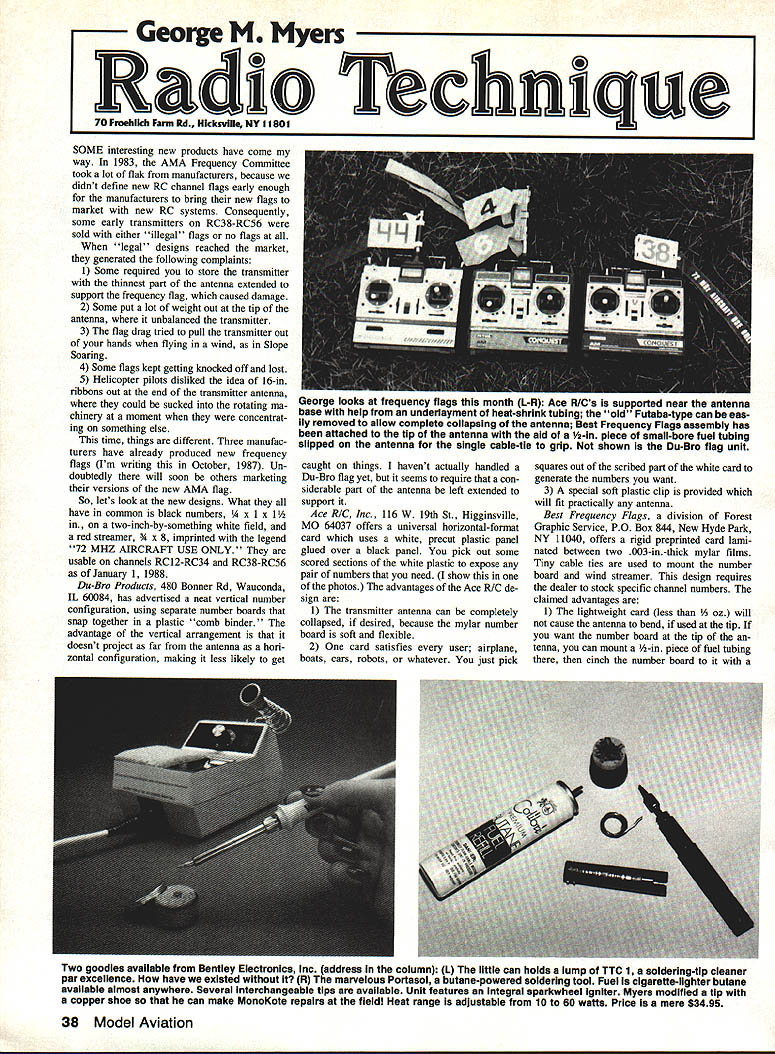
This time, things are different. Three manufacturers have already produced new frequency flags (I'm writing October, 1987). Undoubtedly there will soon be others marketing their versions of the new AMA flag. So, let's look at the new designs.
What they all have in common is black numbers, 3/4 x 1-1/2 in., on a roughly two-inch-by-something white field and a red streamer, 1/4 x 8 in., imprinted LEGEND "72 MHz AIRCRAFT USE ONLY." They are usable on channels RC12–RC34 and RC38–RC56 as of January 1, 1988. The frequency-band ribbon is hot-stamped with white letters for better visibility.
Du-Bro Products
- Du-Bro Products, 480 Bonner Rd., Wauconda, IL 60084, has advertised a neat vertical number configuration using separate number boards that snap together in a plastic "comb binder."
- The advantage of the vertical arrangement is that it doesn't project as far from the antenna as a horizontal configuration, making it less likely to get caught on things.
- I haven't actually handled a Du-Bro flag yet, but it seems to require that a considerable part of the antenna be left extended to support it.
Ace R/C, Inc.
- Ace R/C, Inc., 116 W. 19th St., Higginsville, MO 64037, offers a universal horizontal-format card which uses a white, precut plastic panel glued over a black panel. You pick out some scored sections of the white plastic to expose any pair of numbers that you need.
- The advantages of the Ace R/C design are:
- The transmitter antenna can be completely collapsed, if desired, because the mylar number board is soft and flexible.
- One card satisfies every user; airplane, boats, cars, robots, or whatever — you just pick squares out.
- A special soft plastic clip provided will fit practically any antenna.
Best Frequency Flags
- Best Frequency Flags, a division of Forest Graphic Service, P.O. Box 844, New Hyde Park, NY 11040, offers a rigid preprinted card laminated between two .003-in.-thick mylar films. Tiny cable ties are used to mount the number board to the antenna. The wind-streamer design requires the dealer to stock specific channel numbers.
- The claimed advantages are:
- The lightweight card (less than 1/2 oz.) will not cause the antenna to bend, if used at the tip. If you want the number board at the tip of the antenna, you can mount a 1/2-in. piece of fuel tubing, then cinch the number board to it with a cable tie.
- You punch out squares of the scribed part of the white card to generate the numbers you want.
- A special soft plastic clip is provided which will fit practically any antenna.
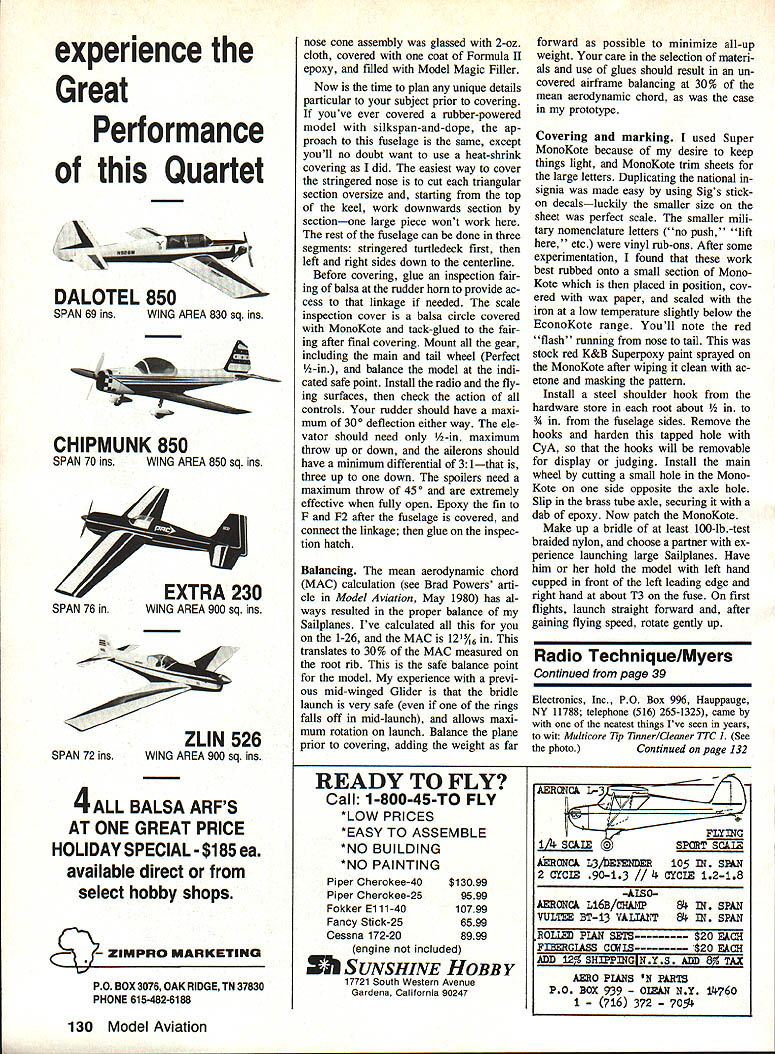
I modified the Ace R/C frequency flag by cutting my own "tracks" in the white overlay to create a "2" (1/2) which was more to my liking than the stock numeral. A cable tie is pulled tight. Leave the lower end free so you can stow the antenna within 1/2 in. of complete collapse. A provision is made for attaching the wind streamer to the number board. (Most of the people I have interviewed prefer to see the number board at the tip of the antenna.)
I am a person who wants the antenna to entirely collapse for storage. None of the above concepts really provide that feature (I don't like the idea of storing the Ace R/C flag in a bent shape).
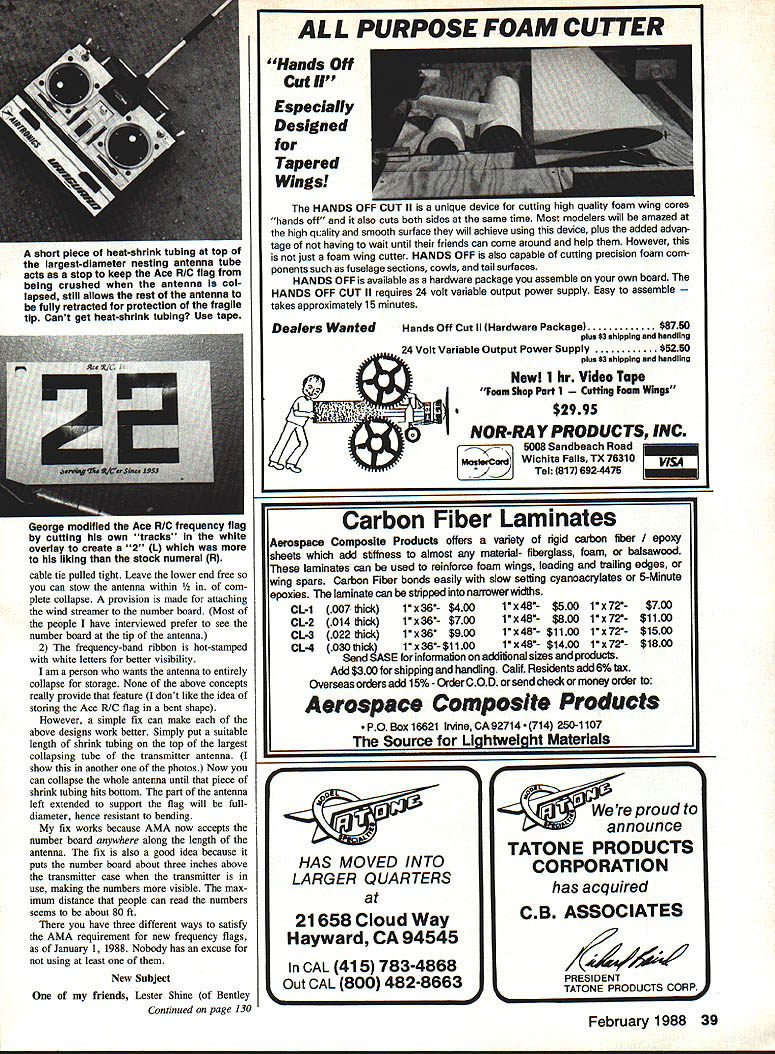
However, a simple fix can make each of the above designs work better. Simply put a suitable length of heat-shrink tubing on the top of the largest collapsing tube of the transmitter antenna. Now you can collapse the whole antenna until that piece of shrink tubing hits bottom. The part of the antenna left extended to support the flag will be full diameter, hence resistant to bending.
My fix works because AMA now accepts the number board anywhere along the length of the antenna. The fix is also a good idea because it places the number board about three inches above the transmitter case when the transmitter is in use, making the numbers more visible. The maximum distance that people can read the numbers seems to be about 80 ft.
There you have it — three different ways to satisfy the AMA requirement for frequency flags, as of January 1, 1988. Nobody has an excuse for not using at least one of them.
New Subject
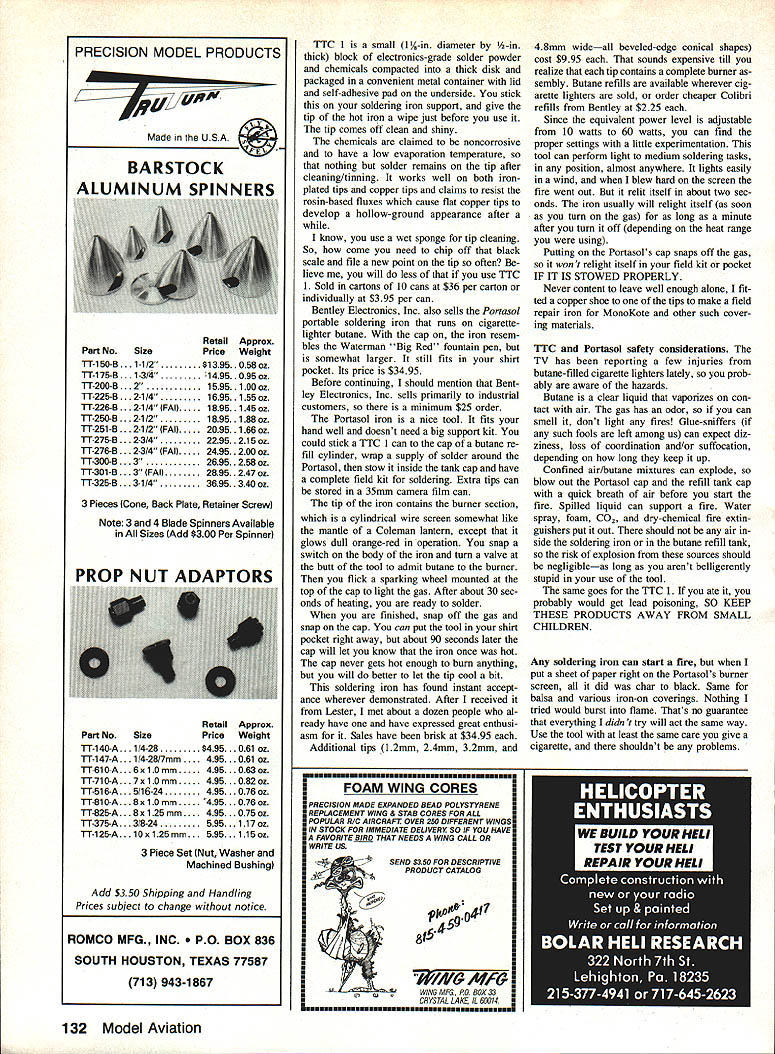
One of my friends, Lester Shine (of Bentley Electronics, Inc., P.O. Box 996, Hauppauge, NY 11788; telephone (516) 265-1325), came by with one of the neatest things I've seen in years, the Multicore Tip Tinner/Cleaner TTC-1 (see the photo).
TTC-1 is a small (1-1/2-in. diameter by 1/2-in. thick) block of electronics-grade solder powder and chemicals compacted into a thick disk and packaged in a convenient metal container with lid and a self-adhesive pad on the underside. You stick this on your soldering-iron support, and give the tip of the hot iron a wipe just before you use it. The tip comes off clean and shiny.
The chemicals are claimed to be noncorrosive and to have a low evaporation temperature, so that nothing but solder remains on the tip after cleaning/tinning. It works well on both iron-plated tips and copper tips and claims to resist the rosin-based fluxes which cause flat copper tips to develop a hollow-ground appearance after a while.
I know, you use a wet sponge for tip cleaning. So, how come you need to chip off that black scale and file a new point on the tip so often? Believe me, you will do less of that if you use TTC-1. Sold in cartons of 10 cans at $36 per carton or individually at $3.95 per can.
Bentley Electronics, Inc. also sells the Portasol portable soldering iron that runs on cigarette-lighter butane. With the cap on, the iron resembles the Waterman "Big Red" fountain pen, but it is somewhat larger. It still fits in your shirt pocket. Its price is $34.95.
Before continuing, I should mention that Bentley Electronics, Inc. sells primarily to industrial customers, so there is a minimum $25 order. The Portasol iron is a nice tool. It fits your hand well and doesn't need a big support kit. You could stick a TTC-1 can to the cap of a butane refill cylinder, wrap a supply of solder around the Portasol, then stow it inside the tank cap and have a complete field kit for soldering. Extra tips can be stored in a 35mm camera film can.
The tip of the iron contains the burner section, which is a cylindrical wire screen somewhat like the mantle of a Coleman lantern, except that it glows dull orange-red in operation. You snap a switch on the body of the iron and turn a valve at the butt of the tool to admit butane to the burner. Then you flick a sparking wheel mounted at the top of the cap to light the gas. After about 30 seconds of heating, you are ready to solder.
When you are finished, snap off the gas and snap on the cap. You can put the tool in your shirt pocket right away, but it takes about 90 seconds before that cap will let you know that the iron once was hot. The cap never gets hot enough to burn anything, but you will do better to let the tip cool a bit.
This soldering iron has found instant acceptance wherever demonstrated. After I received it from Lester, I met about a dozen people who already have one and have expressed great enthusiasm for it. Sales have been brisk at $34.95 each. Additional tips (1.2 mm, 2.4 mm, 3.2 mm, and 4.8 mm wide — all beveled-edge conical shapes) cost $9.95 each. That sounds expensive till you realize that each tip contains a complete burner assembly. Butane refills are available wherever cigarette lighters are sold, or order cheaper Colibri refills from Bentley at $2.25 each.
Since the equivalent power level is adjustable from 10 watts to 60 watts, you can find the proper settings with a little experimentation. This tool can perform light to medium soldering tasks in any position, almost anywhere. It lights easily in a wind, and when I blew hard on the screen the fire went out. It relit itself in about two seconds. The iron usually will relight itself (as soon as you turn on the gas) for as long as a minute after you turn it off (depending on the heat range you were using).
Putting on the Portasol's cap snaps off the gas, and it won't relight itself in your field kit or pocket if it is stored properly.
Never content to leave well enough alone, I tried a copper shoe on one of the tips to make a field repair iron for MonoKote and other such covering materials.
TTC-1 and Portasol safety considerations: the TV has been reporting a few injuries from butane-filled cigarette lighters lately, so you probably are aware of the hazards.
Butane is a clear liquid that vaporizes on contact with air. The gas has an odor, so if you can smell it, don't light any fires! Glue-sniffers (if any such fools are left among us) can expect dizziness, loss of coordination and/or suffocation, depending on how long they keep it up.
Confined air/butane mixtures can explode, so blow out the Portasol cap and the refill tank cap with a quick breath of air before you start the tool. Spilled liquid can ignite instantly. Use extreme care with the Portasol, and follow the manufacturer's instructions.
The same goes for the TTC-1. If you ate it, you would probably get lead poisoning, so KEEP THESE PRODUCTS AWAY FROM SMALL CHILDREN.
Any soldering iron can start a fire, but when I put a sheet of paper right on the Portasol's burner screen, all it did was char to black. Same for balsa and other iron-on coverings. Nothing I tried would burst into flame. That's no guarantee that everything I didn't try will act the same way. Use the tool with care and at least the same care you give a cigarette, and there shouldn't be any problems.
Transcribed from original scans by AI. Minor OCR errors may remain.

