
Radio Technique
By George M. Myers
70 Froehlich Farm Rd., Hicksville, NY 11801
Abstract
World Engines, Inc. Expert seven-channel FM system described, field tested, and compared with Polk's Challenger 720. Transmitter found to meet AMA Guidelines for 1991 R/C systems. World Engines trade-in policy on old systems described.
Introduction
The similarities between Polk's Challenger and the World Engines Expert R/C systems are inescapable: both are manufactured by Hi Tec in Korea. They are not identical, however. Both systems first appeared in 1986 as very low-priced sets with feature-loaded, narrow-band transmitters, low-cost servos, and inferior receivers. A year later, both returned with truly improved receivers and a receiver-exchange program. I described Polk's exchange program in the March 1988 issue; here is World Engines' exchange policy and my evaluation of the Expert FM system.
World Engines Exchange Policy
- Send back ANY old World Engines system (even one on 27 MHz) and receive a complete new gold-stickered seven-channel World Engines Expert FM system for $135.
- Send back your 1986–87 World Expert FM system and receive a new receiver, plus an updated and gold-stickered transmitter, for $40.
- Exchange additional receivers for your Expert FM for $25 each.
- Move an updated Expert FM to a channel in the RC18–RC34 group for $25.
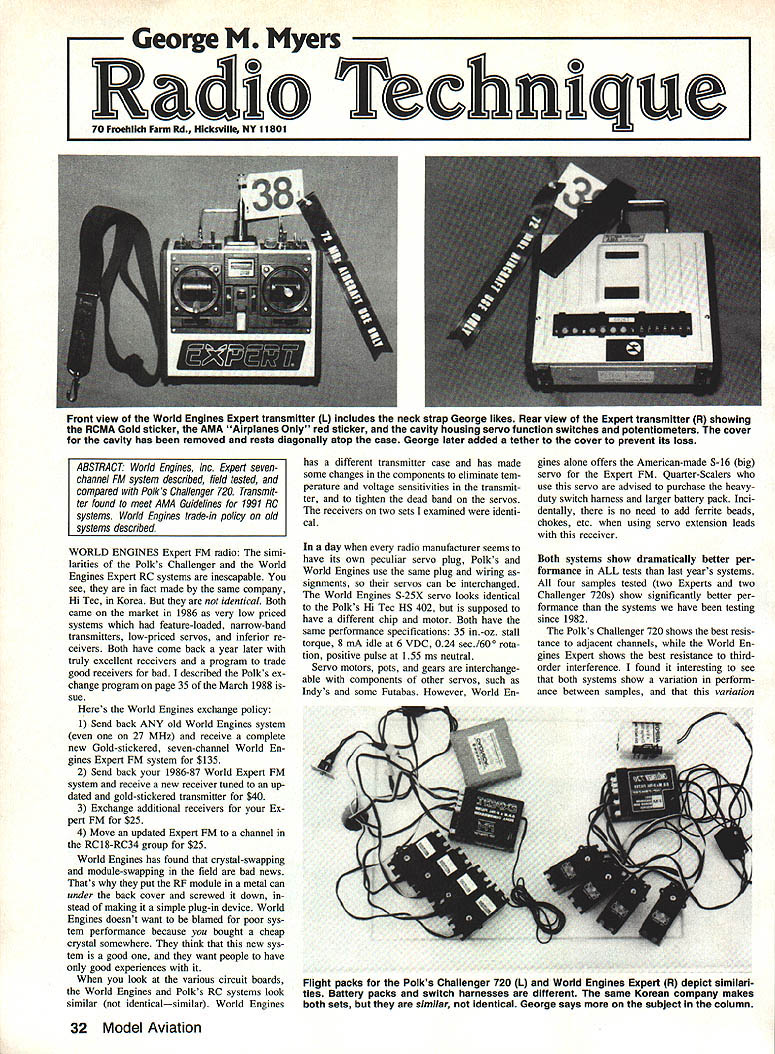
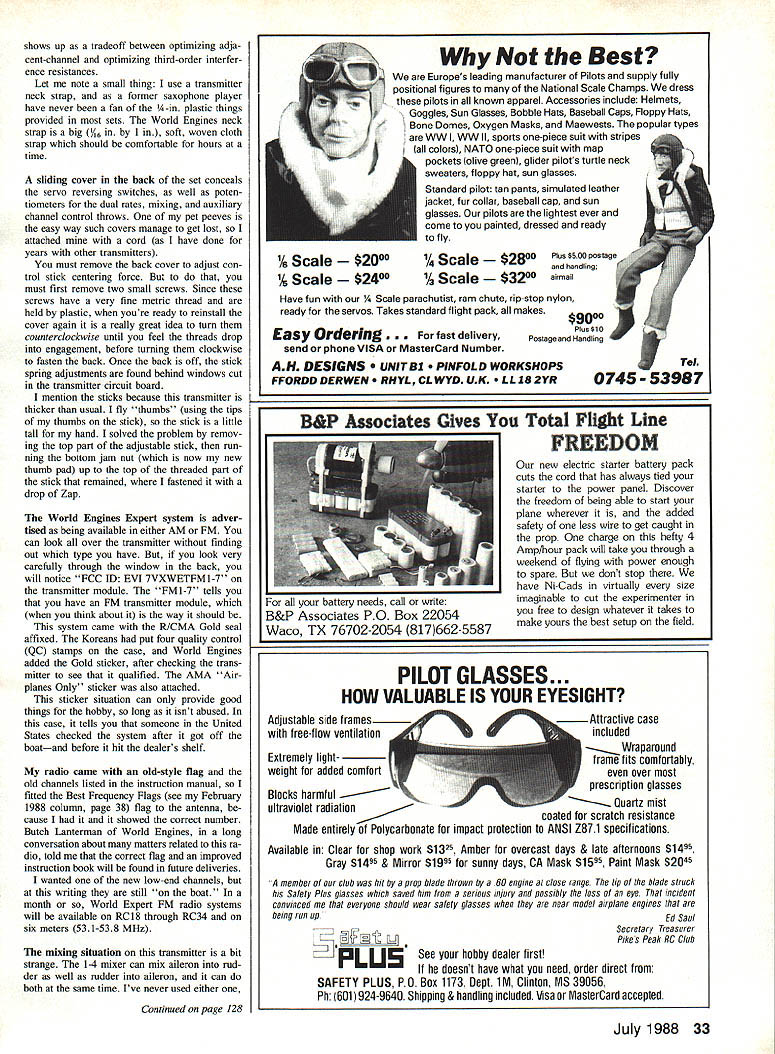
World Engines found that crystal-swapping and module-swapping in the field caused problems. To discourage that, they secure the RF module in a metal can under the back cover with screws instead of making it a simple plug-in device. Their goal is to ensure customers have good experiences with the system.
Construction and Design
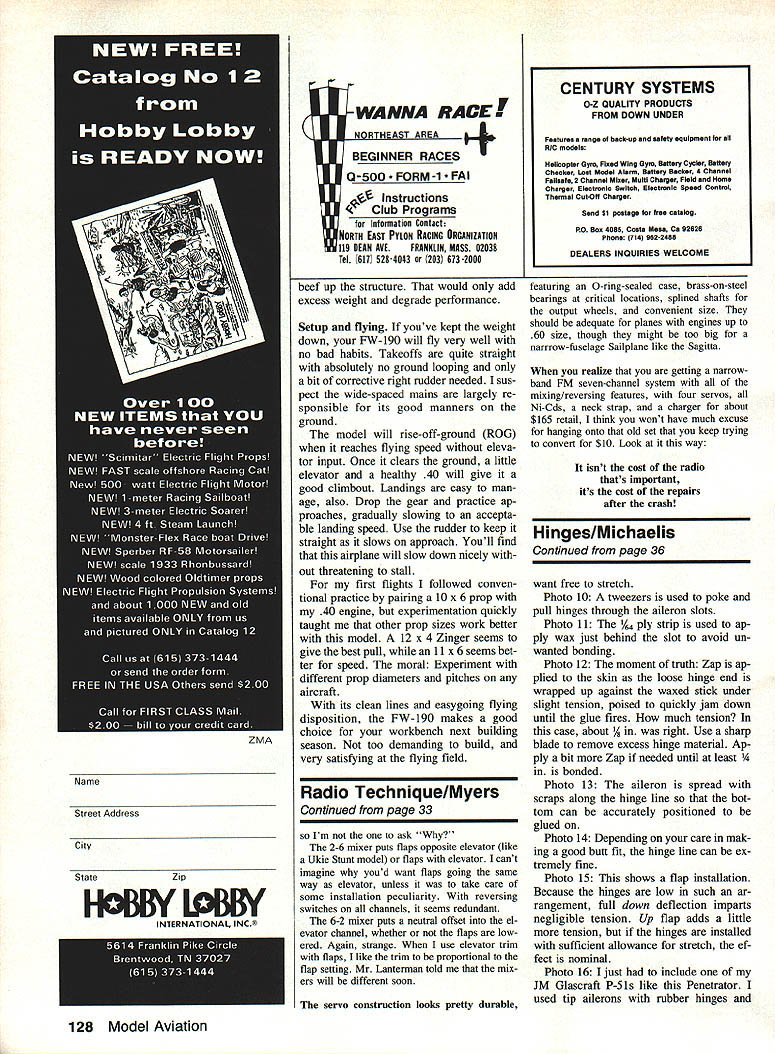
- The World Engines and Polk circuit boards look similar but are not identical. World Engines uses a different transmitter case and has revised components to reduce temperature and voltage sensitivities and to tighten the servo dead band. The receivers I examined were identical between the two sets.
- The RF module is secured under the back cover to prevent unauthorized crystal/module swaps.
- A sliding cover in the back conceals the servo-reversing switches and potentiometers for dual rates, mixing, and auxiliary channel control throws. Because such covers are easily lost, I attached mine with a cord — a practice I recommend.
- The transmitter is thicker than some others. If you fly "thumbs" (using the tips of your thumbs on the sticks), the stick sleeve may feel large. I removed the top part of the adjustable stick sleeve, ran the bottom jam nut up to the remaining threaded stick, and secured it with a drop of ZAP to create a better thumb pad.
Servos and Compatibility
- Polk's and World Engines use the same servo plug and wiring assignments, so their servos are interchangeable.
- World Engines S-25X servo appears identical to Polk's Hi Tec HS-402 but is said to use a different chip and motor. Both are specified as:
- 35 in.-oz. stall torque
- 8 mA idle current at 6 VDC
- 0.24 sec./60° rotation
- Positive pulse at 1.55 ms neutral
- Servo motors, pots, and gears are interchangeable with components from other servos (e.g., Indy and some Futaba models).
- World Engines offers an American-made S-16 (large) servo for the Expert FM; if you use it, consider the heavy-duty switch harness and a larger battery pack.
- There is no need to add ferrite beads, chokes, or similar components when using servo extension leads with this receiver.
- Servo construction is durable: O-ring-sealed case, brass-on-steel bearings at critical locations, splined shafts for output wheels, and a convenient size. They should be adequate for planes with engines up to .60 size, though they may be too large for narrow-fuselage sailplanes like the Sagitta.
Performance
- All four samples tested (two World Engines Experts and two Challenger 720s) show dramatically better performance than the 1986–87 systems and significantly better than systems tested since 1982.
- Polk's Challenger 720 showed the best resistance to adjacent-channel interference.
- The World Engines Expert showed the best resistance to third-order interference.
- Performance varied between samples, indicating a tradeoff between optimizing adjacent-channel rejection and optimizing third-order interference resistance.
Controls and Adjustments
- To adjust stick centering force you must remove the back cover, which requires removing two small screws. These screws have a fine metric thread and are held by plastic — when reinstalling, turn the screws counterclockwise until you feel the threads engage before tightening clockwise to avoid cross-threading.
- The stick spring adjustments are accessible behind windows cut in the transmitter circuit board.
- The transmitter offers a 1–4 mixer that can mix aileron into rudder and rudder into aileron, and it can do both simultaneously. I have not used those mixing options personally.
Identification, Quality Control, and Channels
- The system can be supplied in either AM or FM; inspect the transmitter module window for the FCC ID label. If the module designation includes "FM," you have an FM transmitter module.
- This system carried the RCMA Gold seal. The Koreans applied four quality control stamps on the case, and World Engines added the Gold sticker after checking the transmitter. An AMA "Airplanes Only" sticker was also attached. This U.S. checking is a positive step so long as the labeling is not abused.
- My radio came with an old-style flag and the older channel listings in the manual. I fitted Best Frequency Flags (see my February 1988 column) because I had the correct number flag. World Engines indicated that correct flags and an improved instruction book would be included in future deliveries.
- New low-end channels were being shipped; in a month or so Expert FM systems were to be available on RC18 through RC34 and on six meters (53.1–53.8 MHz).
Accessories and Ergonomics
- The World Engines neck strap is a large, soft woven cloth strap (about 1½ in. by 1 in.) and should be comfortable for extended use. I prefer it to the thin 1/4-in. plastic straps often supplied with other sets.
- The set ships with four servos, Ni-Cad batteries, a charger, neck strap, and other accessories at a very low retail price.
Price and Value
- For a narrow-band FM seven-channel system with mixing/reversing features, four servos, all Ni-Cads, a neck strap, and a charger, the retail price of about $165 (at the time) makes it hard to justify keeping an old, marginal set you keep trying to convert.
- Remember: it isn't the cost of the radio that's most important — it's the cost of repairs after a crash.
Conclusion
World Engines' Expert FM represents a significant improvement over earlier low-cost systems. With the exchange program, better receivers, durable servos, and improved transmitter design, it offers good performance and value. If you need a reliable, budget-minded seven-channel FM system, the Expert FM is worth serious consideration.
Transcribed from original scans by AI. Minor OCR errors may remain.

