
Radio Technique
George M. Myers 70 Froehlich Farm Rd., Hicksville, NY 11801
Abstract
Give up OWBAM systems. TRC Fast Charger and Ace R/C Overnighter for use in recreational vehicles (RVs).
Give up OWBAM systems?
I caught a lot of flak for mis-describing the RCHA Gold and Silver stickers as being "required" in my March 1988 column. Perhaps you will accept my apology for one major gaffe in 145 columns. In my attempt to present the news as soon as possible (considering the built-in three-month publishing cycle delay), I jumped ahead of the AMA Executive Council on a decision which they hadn't made yet. Bad reporting.
The furor over the stickers was nothing compared to the one generated by noting that OWBAM (old wideband AM) systems should be abandoned. Now, let's look at the real world.
Back in 1983 we gave OWBAMs eight years to wear out. Everybody knew what was planned for 1991. So we have now entered the transition phase for the R/C environment. We are moving from the mixed 40/80-kHz raster that existed in 1987 (with OWBAMs included) toward full utilization of the 50 channels that the FCC has given us (where the OWBAMs both give and receive unnecessary interference). Consider this:
- If we do not use the 50 channels as planned, then the FCC will almost certainly start assigning the unused channels to other users. The FCC reassigned the top-end UHF TV channels when the TV industry didn't use them, and the six-meter ham band used to be VHF TV Channel 1. (Didn't you ever wonder why rotary TV tuners always start with Channel 2?)
- If the unused channels are reassigned and we hang onto OWBAM R/C systems, then we can expect to see an increase in interference problems.
Right now we are enjoying reduced interference in a 40-kHz environment, relative to what we had in the 80-kHz environment during the 1980–83 period. This is primarily because so many superior transmitters have been sold in the 1983–87 period. Based on transmitter test results from trade shows and at the past five Nats, I estimate that about half of the transmitters in contest use today can qualify for Gold stickers, and that most of the remainder can qualify for Silver. What's left are the OWBAMs. Perhaps they are used regularly by sport fliers, but I believe that most of them are just sitting on shelves. Can you prove I'm wrong?
Narrow-band transmitters radiate less energy into places where our R/C receivers can interpret that energy as interference. In fact, when combined with intelligent flight-station arrangements and good impound procedures, life is easier for existing receivers; hence the reduced interference. But we can't stop with the job half done! In order to make free use of the 50 channels that have been assigned to us, without resorting to compensating flight-line arrangements like the Pacific Plan, we need to have and use narrow-band transmitters and better receivers. Because our 50 channels are "interstitial" to other users' channels (that is, 10 kHz away from them), what we really need is a receiver that can survive in the real 100-channel/10 kHz environment. I have chosen to call the imaginary receiver of the future a "narrow-band" receiver (which is only a name).
The AMA has paid a consultant to define what we need in engineering terms, and you can find it published in the "AMA Guidelines" (AMA News, September and October 1987). If we all buy and use narrow-band receivers (when available), then free use of all R/C channels will be possible.
What is the alternative? Obviously we can continue to use outdated equipment, if we want to make special provisions for it, such as blanking out (refusing to use) as many other legal channels as is necessary to avoid interfering with the outdated equipment.
That course was chosen in Australia about 15 years ago, and in Canada five years ago. From only a few conversations with people who have been there I received the opinion that the only thing that tactic accomplished was to prolong the use of antiquated equipment, thereby frustrating everybody. Both countries have been looking to us, the United States of America modelers with our vast purchasing power, to force development of better 72 MHz R/C systems.
Field charging of battery packs
I will travel to Alaska this summer and will live in my van as much as possible. For that purpose I have fitted it out with most of the amenities of an RV. As it happens, I have a few Ni-Cd-powered devices to keep charged, such as:
- single-cell glow-plug heater
- two-cell flashlight
- two-cell electric heater
- two-cell electric screwdriver (also usable as a drill)
- two-cell electric soldering iron
- several four-cell flight packs
- a seven-cell electric motor pack for quiet flying
- a couple of eight- and nine-cell transmitter packs
- a 10-cell VCR pack
- a 12 VDC motorcycle battery for engine starting
Obviously each device came with a charger that plugs into a 110 VAC supply. I could bring along that stack of chargers—if I had some 110 VAC source to plug them into. That would work well if I were either visiting friends, at a motel, or at a campsite with a 110 VAC hookup. But what about those other times?
I might use an inverter (which changes 12 VDC into 110 VAC). As it happens, I have one of them—a 200-watt unit. It draws 2.4 amps, even when all it is doing is putting 50 mA into a flight pack. Burn 34 amp-hours to put 1 amp-hour (500 mAh) into a flight pack? I just can't live with that kind of power waste. (Want to buy an inverter—cheap?)
TRC Fast Charger
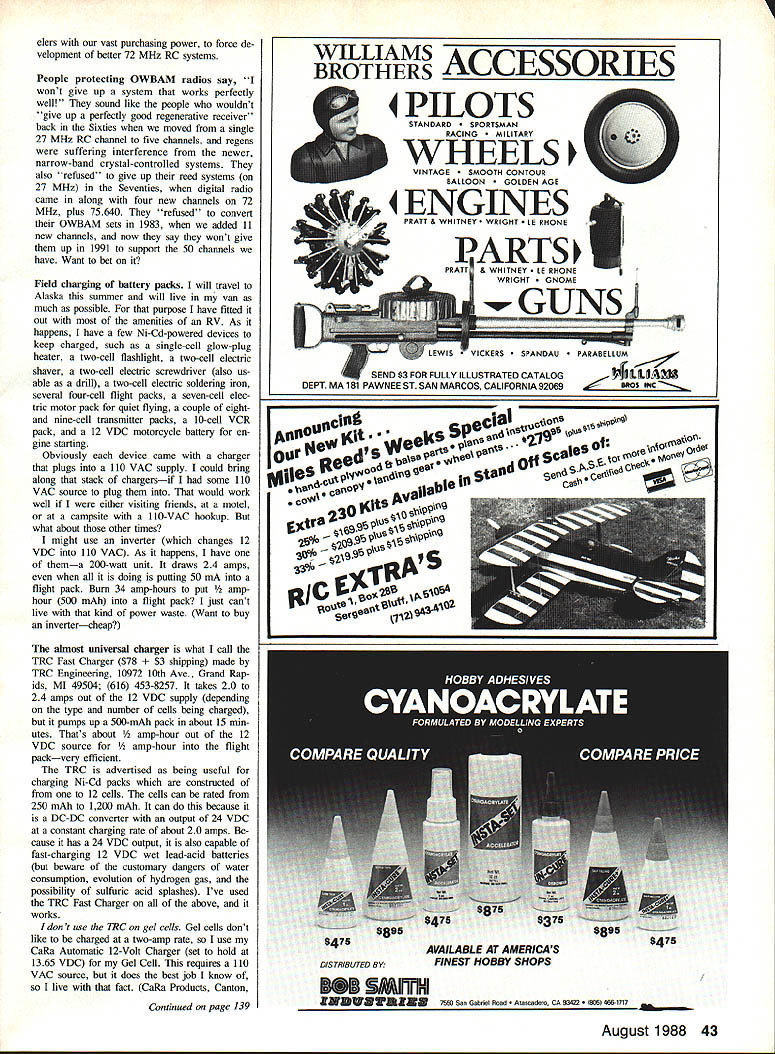
The almost universal charger is what I call the TRC Fast Charger ($78 + $3 shipping) made by TRC Engineering, 10972 10th Ave., Grand Rapids, MI 49504; (616) 453-8257. It takes 2.0 to 2.4 amps out of the 12 VDC supply (depending on the type and number of cells being charged), but it pumps up a 500-mAh pack in about 15 minutes. That's about 1/2 amp-hour out of the 12 VDC source for 1/2 amp-hour into the flight pack—very efficient.
The TRC is advertised as being useful for charging Ni-Cd packs which are constructed of from one to 12 cells. The cells can be rated from 250 mAh to 1,200 mAh. It can do this because it is a DC-to-DC converter with an output of 24 VDC at a constant charging rate of about 2.0 amps. Because it has a 24 VDC output, it is also capable of fast-charging 12 VDC wet lead-acid batteries (but beware of the customary dangers of water consumption, evolution of hydrogen gas, and the possibility of sulfuric acid splashes). I've used the TRC Fast Charger on all of the above, and it works.
I don't use the TRC on gel cells. Gel cells don't like to be charged at a two-amp rate, so I use my CDR Automatic 12-Volt Charger (set to hold at 13.65 VDC) for my gel cell. This requires a 110 VAC source, but it does the best job I know of, so I live with that fact. (Car A Products, Canton, SD 57013; (605) 597-5924.)
The basic thing to know about the TRC Fast Charger is that it monitors the rate-of-charge of the pack while it is being charged. It shuts off:
- when it detects a quick voltage rise (typical of the situation when the pack is fully charged and gas bubbles are starting to form); or
- when it detects a quick voltage drop (typical of a fully charged cell going into overcharge).
Because it uses voltage-change monitoring and does not depend on measuring absolute voltage, the TRC Fast Charger doesn't care how many cells are in the pack. For the same reason, it will not fully charge cells which are old (and have high resistance) or certain cells which have been recharged for a couple of months. Try slow charging, or scrap them.
I have an early model of the TRC Fast Charger, and it can be fooled into shutting off before the pack is fully charged. An easy way to fool the charger is to have the pack connected to some small load (for example, a receiver or a transmitter switched on) while charging. The small load fools the charger into thinking the pack is still accepting charge, and the charge cycle will continue until completion. Naturally, this procedure will cause extra heating in the pack and in the charger. It is not recommended except in emergencies.
Actually I prefer the charger to shut off a little early rather than risk overcharging. Assuming that the pack being charged was exhausted, and that you know the nominal capacity of a cell, you can estimate the amount of charge that has gone into it and decide whether an additional slow top-off charge is warranted.
Charge-time calculation
To estimate how long it should take to pump up the pack, divide the nominal capacity by the charging rate, then multiply the result by 60 minutes/hour. Simplifying the math:
0.03 × mAh = charge time in minutes
Examples of most interest:
Ni-Cd (mAh): 250 — 500 — 900 — 1,200 Minutes: 7.5 — 15 — 27 — 36
Lead-acid cells (not gel-cells) (Ah): 6 — 12 Hours: 3 — 6
So, I use a watch to monitor how long the charging has been going on. If the charger has shut off early, I push the Start button again. If you are worried about overcharging, feel the pack. If it is cool, it is safe to push the Start button. In fact, any time the pack is cool and the VR light isn't glowing, push the Start button.
The Ace R/C Overnighter
Every set of Ni-Cd charging instructions says the same thing: "Charge 24 hours, using the charger provided, before using the device; then charge overnight (14 hours) at least monthly." This is necessary advice, because Ni-Cd cells have to form the ability to hold a charge, and that happens slowly. You will only be successful with a fast charger after the cells have "formed." So, where does that leave me with the TRC?
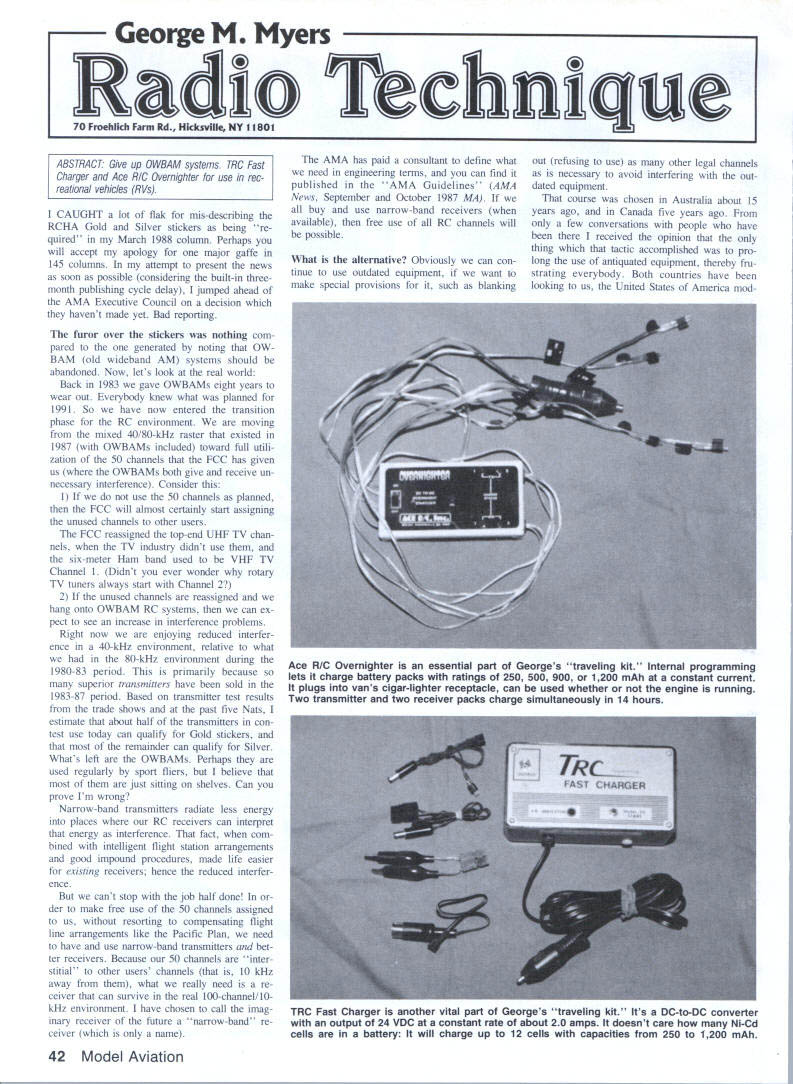
There are times when you want to "set it and forget it" (i.e., slow charge overnight). You don't want to sit there with a stopwatch and monitor the charging process. For those times I am bringing along the palm-size Ace R/C Overnighter. It plugs into the van's 12-VDC cigar lighter on one side, and into two transmitter and two receiver packs on the other. Charging proceeds at the 14-hour rate, whether the van engine is running or stopped. This can be useful, because the TRC Fast Charger instructions specifically prohibit use when the engine is running.
I know what you are thinking now: "How does he handle all of those special charging plugs?" Very simple. I cut them off, then put them back on with Deans connectors (available from Ace R/C). Then all I have to take along with me is the special connector—not the whole 110 VAC charger.
To monitor what's going on, I have the Accu-Tak/22 (described in my column in the April 1988 issue), with my universal adapter, the Ugly Octopus (described in my column in the March 1982 issue). For electronic repairs, I'll carry the Portasol soldering iron (see my February 1988 column).
Conclusion
That's it for now. You know what I plan to do about charging batteries, and why. Don't expect quick answers to your letters for the next few months, because I won't be receiving the mail. I sold the house to my son, and I'm off to see the world! Keep those letters and questions coming.
Transcribed from original scans by AI. Minor OCR errors may remain.

