
Radio Technique
George M. Myers 70 Froehlich Farm Rd., Hicksville, NY 11801
ABSTRACT: Bob Aberle retirement from writing. Crystal-basE short‑circuit fix. Noise philosophy and measurements on K&B Sportster .45.
A Leader Retires
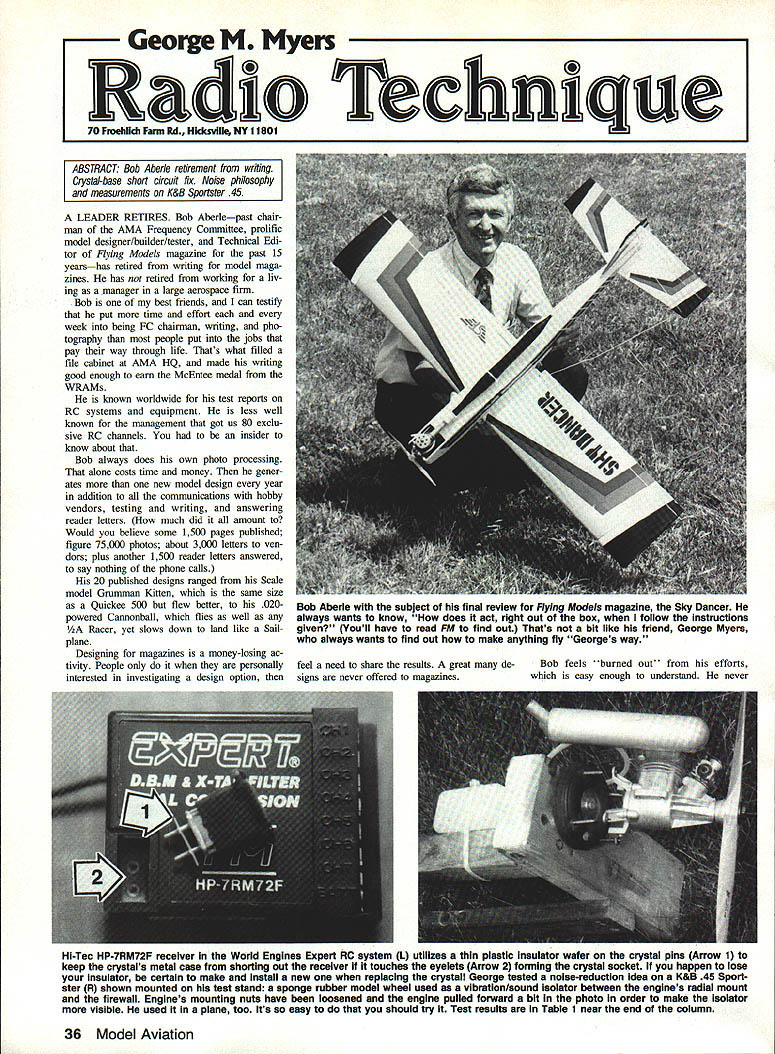
Bob Aberle—past chairman of the AMA Frequency Committee, prolific model designer/builder/tester, and Technical Editor of Flying Models magazine for the past 15 years—has retired from writing for model magazines. He has not retired from working for a living as a manager in a large aerospace firm.
Bob is one of my best friends, and I can testify that he put more time and effort each and every week into being FC chairman, writing, and photography than most people put into the jobs that pay their way through life. That's what filled a file cabinet at AMA HQ, and made his writing good enough to earn the McEntee medal from the WRAMs.
He is known worldwide for his test reports on RC systems and equipment. He is less well known for the management that got us 80 exclusive RC channels—you had to be an insider to know about that.
Bob always does his own photo processing. That alone costs time and money. Then he generates more than one new model design every year in addition to all the communications with hobby vendors, testing and writing, and answering reader letters. How much did it all amount to? Believe it or not: about 1,500 pages published; roughly 75,000 photos; about 3,000 letters to vendors; plus another 1,500 reader letters answered, not to mention the phone calls.
His 20 published designs ranged from his scale model Grumman Kitten, which is the same size as a Quickee 500 but flew better, to his .020‑powered Cannonball, which flies as well as any 1/2A racer yet slows down to land like a sailplane.
Designing for magazines is usually a money‑losing activity. People do it when they are personally interested in investigating a design option and feel a need to share the results. Many worthwhile designs are never offered to magazines. Bob feels "burned out" from his efforts, which is easy enough to understand.
Field service bulletin
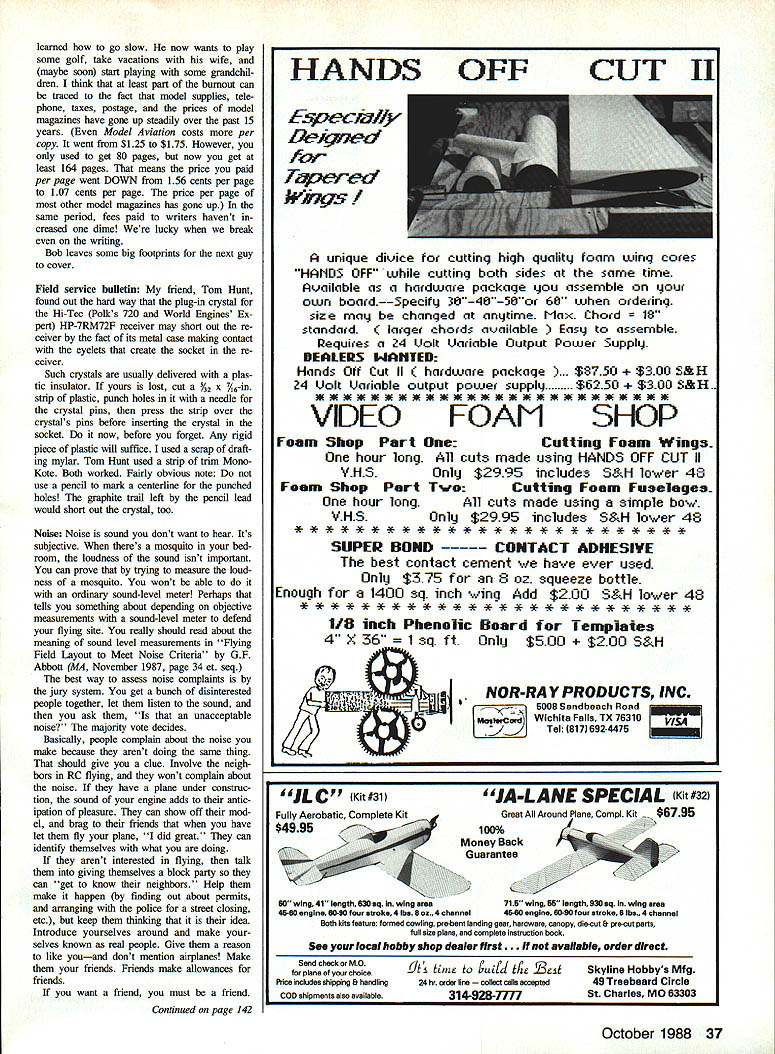
A friend, Tom Hunt, found out the hard way that a plug‑in crystal can short out a receiver. The Hi‑Tec HP‑7RM72F receiver used in the World Engines Expert RC system utilizes a thin plastic insulator wafer on the crystal pins to keep the crystal's metal case from shorting the receiver if it touches the eyelets forming the crystal socket. Such crystals are usually delivered with a plastic insulator. If yours is lost, cut a thin strip of rigid plastic (a small wafer roughly 5/32 x 3/16 in), punch holes with a needle for the crystal pins, and press the strip over the crystal pins before inserting the crystal into the socket. Any rigid piece of plastic will suffice; drafting mylar or a trimmed strip of MonoKote will work.
One fairly obvious note: use a pencil to mark the centerline before punching holes—the graphite left by the pencil lead can create a conductive path and short the crystal. Mark carefully or use a nonconductive marker.
Noise
Noise is sound you don't want to hear. It's subjective; there's a mosquito‑in‑the‑bedroom loudness below which sound isn't important. You can't always prove that by trying to measure loudness with an ordinary sound‑level meter—perhaps that tells something about the danger of depending entirely on objective measurements when trying to defend a flying site. If you must defend a flying site, you really should read about the meaning of sound‑level measurements.
The best way to assess noise complaints is by the jury system: gather a group of disinterested people, let them listen to the sound, and then ask, "Is that an unacceptable noise?" Let the majority decide.
Basically, people complain about the noise you make because they aren't doing the same thing. That should give you a clue. Involve the neighbors in R/C flying, and they won't complain about the noise. If they have a plane under construction, the sound of your engine adds to their anticipation of pleasure. They can see what you're doing and brag to their friends that when you let them fly your plane, "I did great." They can identify with what you are doing.
If they're not interested in flying, help them get to know the club and their neighbors. Suggest a block party, aid with permits, or coordinate with the police for a street closing—keep them feeling it was their idea. Introduce yourselves and be real people. The time to like you is before a problem arises—don't talk airplanes at first; make them your friends. Friends make allowances for friends.
Maybe the old couple living in the house that borders your field would really appreciate someone doing some of the yard work that has "gotten ahead of them." If you want a friend, be a friend.
Recognize that any continuous sound is annoying. The quiet hum of an air conditioner is an annoyance, and there is relief when it stops. Simple steps that give neighbors relief can go a long way:
- Enforce a five‑minute "no engine noise" period in every hour to provide periodic quiet.
- Consider limits on fuel tank size to reduce continuous run times.
- Fly "noiseless" (electric or muffled) airplanes during club meetings or events.
Practical noise‑reduction measures
The thing that got me going on this noise kick was Bob Underwood's K&B Sportster .20 installation; I was amazed by its quiet performance at the 1986 Nats. Then came Don Lowe's report on the noise‑reduction efforts by the Gulf Coast Flyers of Delray Beach, FL. I had visited and observed their club at the Delray Beach contest and was impressed. Their noise‑reduction measures were common sense and practical rather than gimmicky.
Some effective steps:
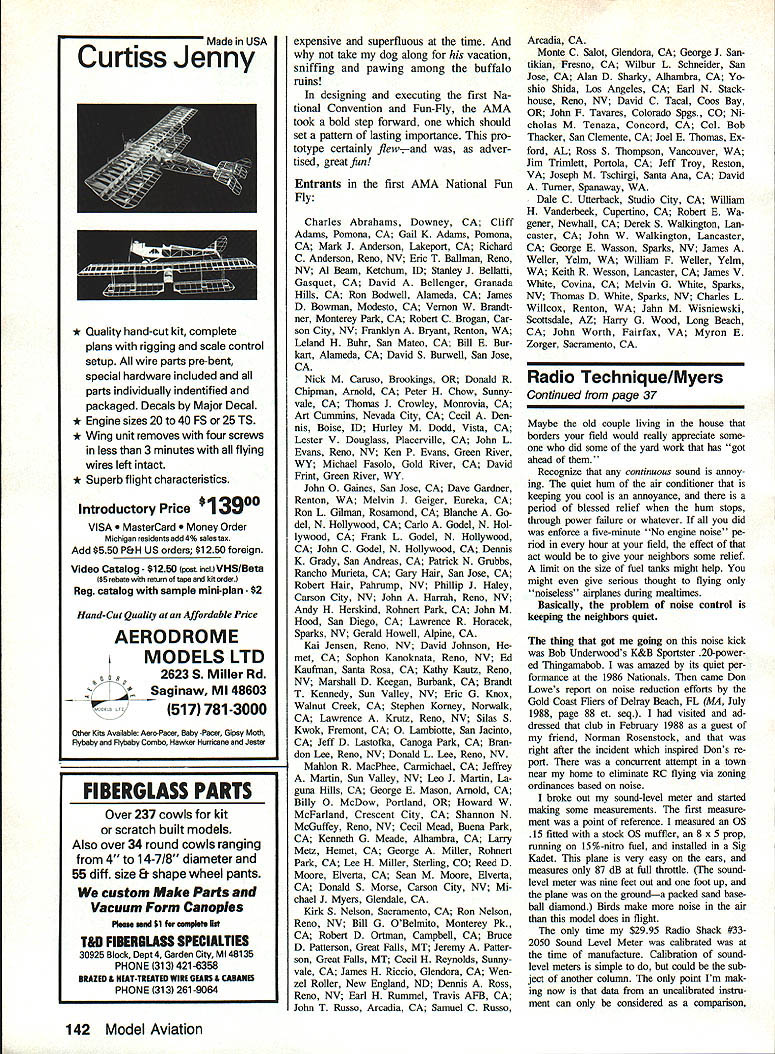
- Vibration isolation between engine and airframe. Engines mounted directly to a firewall transmit structure‑borne noise into the airframe, which then radiates as sound. A simple sponge‑rubber or neoprene isolator between the engine and the firewall can reduce this transmission considerably.
- Opt for a larger‑diameter propeller running at lower rpm. A bigger prop at lower rpm often yields the needed performance while producing less radiated noise than a small, high‑rpm prop.
- Proper muffling, exhaust routing, and good engine tuning will also reduce perceived noise.
Conclusion
The basic problem of noise control is keeping the neighbors pleasant and quiet toward your operation. Practical, commonsense actions—both technical (isolation, props, muffling) and social (involving neighbors, periodic quiet times, community outreach)—work best. Sound is subjective; use both objective measurements and human judgment (the jury system) when evaluating complaints and defending your flying site.
Transcribed from original scans by AI. Minor OCR errors may remain.

