
Radio Technique
George M. Myers 70 Froehlich Farm Rd., Hicksville, NY 11801
Abstract
Reader letters discussing the future RC scene.
YOUR TURN! We need membership discussion of the most important subject to affect the hobby for years: i.e., "How best to use the 50 channels assigned exclusively for RC aircraft?" I have received some thoughtful reader letters which should be shared with you. Let's begin.
Letter 1 — Thomas Wilk
Thomas Wilk, Treasurer, Duluth Radio Control Club, 212 W. Austin St., Duluth, MN 55803:
"Re: your August 1988 column: Who is using OWBAMs? (OWBAM: old wideband AM radios — Ed.) We are, a club of 60 members; about 125 radios. I doubt if 25 are narrow band. I have not seen one on the lower frequencies, nor have I seen a PCM or heard anything good about them.
"If in 1983 we gave (who are 'we'?) OWBAMs eight years to wear out, why are they still being advertised and sold? I bought a Futaba Conquest AM last year. Futaba says I will not be able to get a 1991 Rx for it. I got a silver sticker at Toledo. Today I stopped at the local hobby shop, and he had about six RC sets in stock—none of them narrow-band.
"If the manufacturers know that 1991 will be all narrow band, why aren't they making them available right now? As I read the ads, only Aristo-Craft and World Engines claim 1991 specs. The others do not admit that they do not meet 1991 specs. Why?
"The lower channels: We had members buy sets on Channel 12—they are now told that they can only be used if they are NB. They will have to be converted to the upper band. When I asked my hobby shop about a radio on RC22, he says they are not yet available. What's the holdup? The manufacturers had since 1983 to get ready. How can we, as a club, explain to a new member, who has just bought a system this summer, that it will have to be replaced in 1991? Will the dealer or manufacturer buy it back, or take it as a trade-in on a new set? Do we tell new people to buy Aristo-Craft and/or World Engines only?
"Judging by your writing in MA, you and AMA are not doing the modelers a service by promoting the hobby, then not insisting that 1991 equipment be available now."
Myers' comment: I try to report the news; I don't try to manage the hobby industry.
I have been a modeler since about 1950 — sport flier only; seldom compete even in club fun-flys. I have been club treasurer since 1980 and am a charter member of the club that started in the Fifties. The club feels that AMA and the RC industry are not doing their part to resolve these problems. At Toledo I was told by an AMA VP that clubs can decide to use the upper even-numbered channels and thereby continue to use present equipment. Now AMA seem to be saying that we do lose our insurance. Who is right?
(Some club members are saying, "To hell with AMA—we'll drop our charter and fly by our own rules." I have an AMA AVP who says AMA hasn't kept him informed. I'll still continue to read your columns and MA to see what happens.)
Many of Mr. Wilk's present concerns were addressed by Bob Aberle (then FC chairman) in an open letter to Ted White (then AMA VP), which was written at a time of much debate about the future use of RC frequencies. It was printed in AMA News, p. 78, the June 1981 issue of Model Aviation. Note that date!
Mr. Wilk asks, "Who are 'we'?" Bob wrote: the present RC systems would become obsolete after a 10-year period — this was essentially a consensus of the FC at that time, based on what we knew then and could reasonably predict for the future. At that time the AMA wasn't self-insured, and insurance didn't depend on the Phase-In Plan. Bob said a lot more, but I can't repeat the whole letter because it alone takes space. I recommend obtaining and reading the complete text, which shows how today's problems were anticipated and dealt with in the beginning.
Letter 2 — Robert Morris
Robert Morris, 104 Andover Circle, Oak Ridge, TN 37830. Abstracted comments:
- A good book for radio receiver design is Solid State Design for the Radio Amateur, American Radio Relay League, Newington, CT. This is an easy-to-read book for people with only a modest background in electronics, and the book has good explanations about receiver design.
- Most of the problems we have with the receivers were solved about 15–20 years ago. The trick has been, "How to make them small and cheap?"
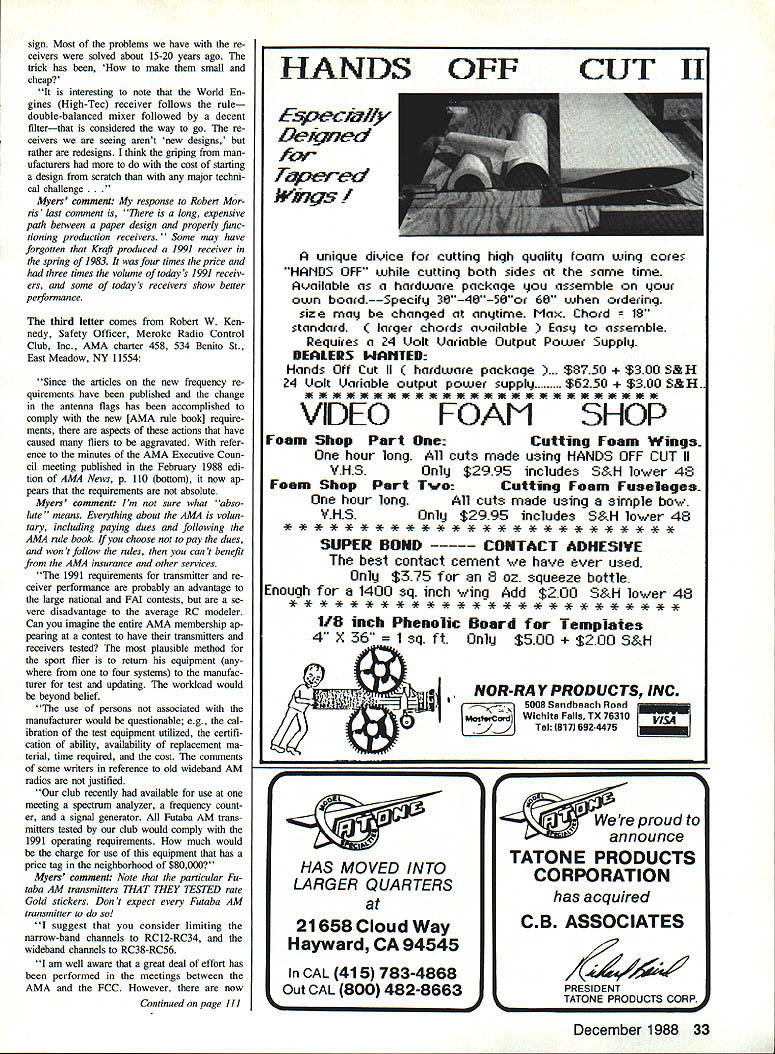
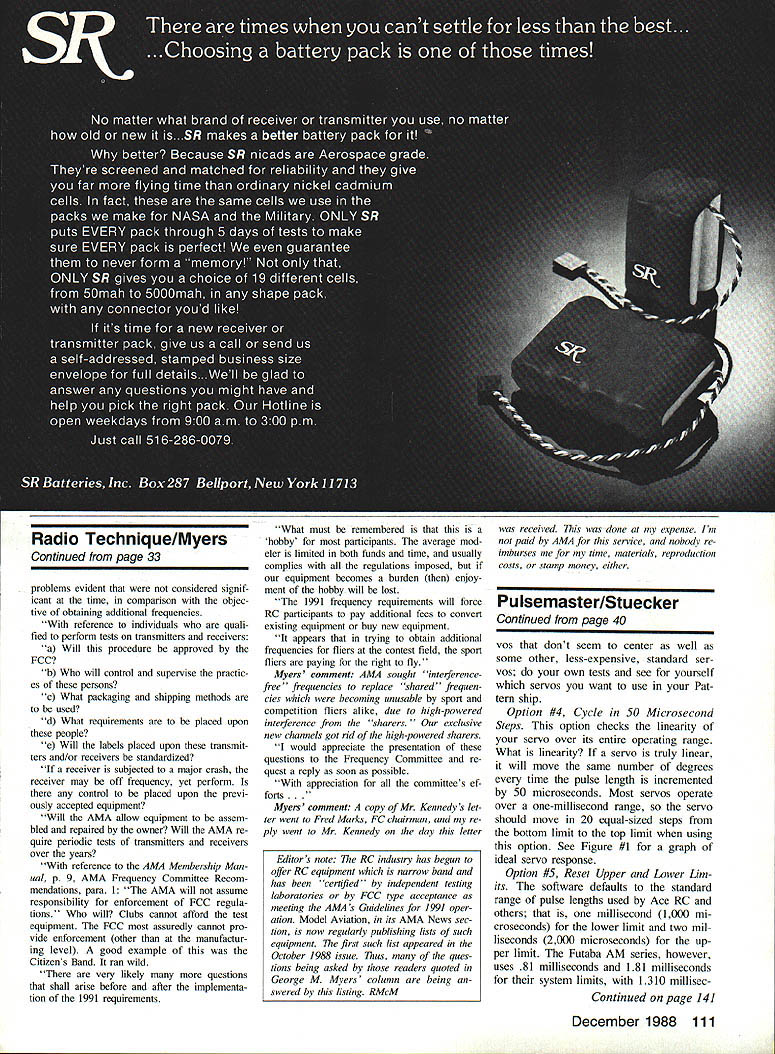
- "It is interesting to note that the World Engines (High-Tec) receiver follows the rule—double-balanced mixer followed by a decent filter—that is considered the way to go. The receivers we are seeing aren't 'new' designs, but rather are redesigns. I think the griping from manufacturers had more to do with the cost of starting a design from scratch than with any major technical challenge."
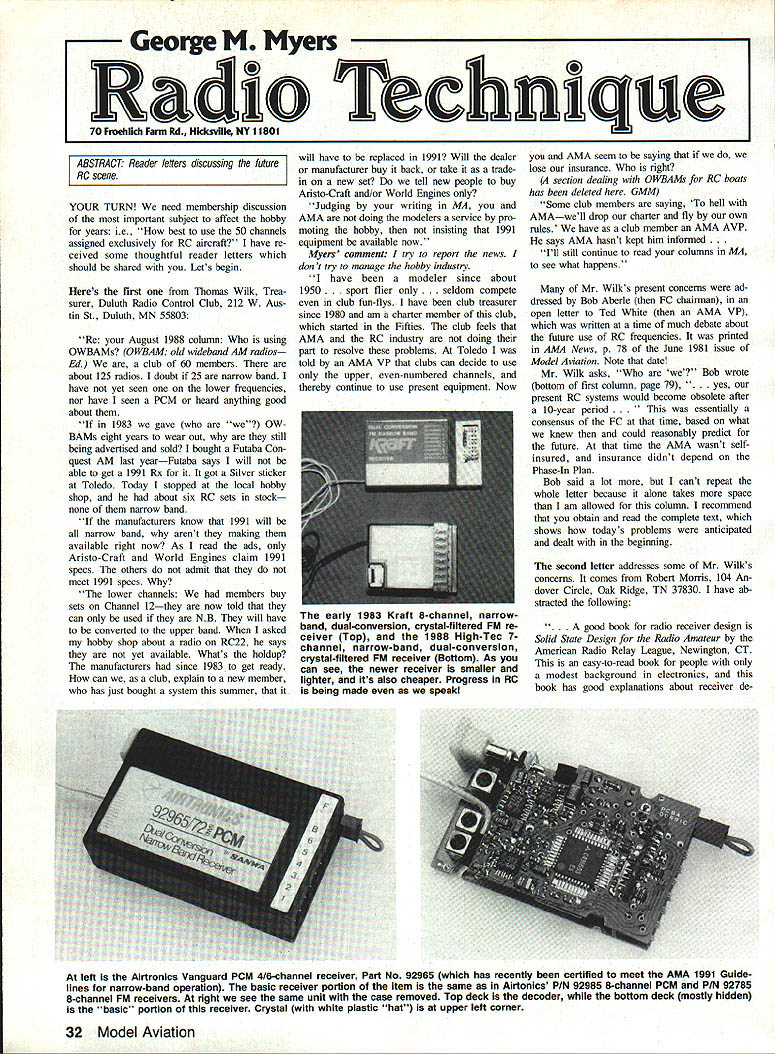
Myers' comment: My response to Robert Morris' last comment is, "There is a long, expensive pain between a paper design and properly functioning production receivers." Some may have forgotten that Kraft produced a 1991 receiver in the spring of 1983. It was four times the price and had three times the volume of today's 1991 receivers, and some of today's receivers show better performance.
Letter 3 — Robert W. Kennedy
Robert W. Kennedy, Safety Officer, Meroke Radio Control Club, Inc., AMA charter 458, 534 Benito St., East Meadow, NY 11554:
"Since the articles on the new frequency requirements have been published and the change in the antenna flags has been accomplished to comply with the new [AMA rule book] requirements, there are aspects of these actions that have caused many fliers to be aggravated. With reference to the minutes of the AMA Executive Council meeting published in the February 1988 edition of AMA News, p. 110 (bottom), it now appears that the requirements are not absolute."
Myers' comment: I'm not sure what "absolute" means. Everything about the AMA is voluntary, including payables and following the AMA rule book. If you choose not to pay the dues, and won't follow the rules, then you can't benefit from the AMA insurance and other services.
"The 1991 requirements for transmitter and receiver performance are probably an advantage to the large national and FAI contests, but are a severe disadvantage to the average RC modeler. Can you imagine the entire AMA membership appearing at a contest to have their transmitters and receivers tested? The most plausible method for the sport flier is to return his equipment (anywhere from one to four systems) to the manufacturer for test and upgrade. The workload would be beyond belief.
"The use of persons not associated with the manufacturer would be questionable; e.g., the calibration of the test equipment used, the certification of ability, availability of replacement material, time required, and the cost. The comments of some writers in reference to old wideband AM radios are not justified.
"Our club recently had available for sale at one meeting a spectrum analyzer, a frequency counter, and a signal generator. All Futaba AM transmitters tested by our club would comply with the 1991 operating requirements. How much would be the charge for use of this equipment that has a price tag in the neighborhood of $80,000?"
Myers' comment: Note that the particular Futaba AM transmitters THAT THEY TESTED here had Gold stickers. Don't expect every Futaba AM transmitter to do so.
"I suggest that you consider limiting the narrow-band channels to RC12–RC34, and the wideband channels to RC36–RC56.
"I am well aware that a great deal of effort has been performed in the meetings between the AMA and the FCC. However, there are now problems evident that were not considered significant at the time, in comparison with the objective of obtaining additional frequencies.
"With reference to individuals who are qualified to perform tests on transmitters and receivers:
- Will this procedure be approved by the FCC?
- Who will control and supervise the practices of these persons?
- What packaging and shipping methods are to be used?
- What requirements are to be placed upon these people?
- Will the labels placed upon these transmitters and/or receivers be standardized?
"If a receiver is subjected to a major crash, the receiver may be off frequency, yet perform. Is any method to be placed upon the previously accepted equipment?
"Will the AMA allow equipment to be assembled and repaired by the owner? Will the AMA require periodic tests of transmitters and receivers over the years?
"With reference to the AMA Membership Manual, p. 9, AMA Frequency Committee Recommendations, para. 1: 'The AMA will not assume responsibility for enforcement of FCC regulations.' Who will? Clubs cannot afford the testing and enforcement. The FCC most assuredly cannot provide enforcement (other than at the manufacturing level). A good example of this was the Citizens Band. It ran wild.
"There are very likely many more questions that shall arise before and after the implementation of the 1991 requirements.
"What must be remembered is that this is a 'hobby' for most participants. The average modeler is limited in both funds and time, and usually complies with all the regulations imposed, but if our equipment becomes a burden then enjoyment of the hobby will be lost.
"The 1991 frequency requirements will force RC participants to pay additional fees to convert existing equipment or buy new equipment."
It appears that in trying to obtain additional frequencies for fliers at the contest field, the sport fliers are paying for the right to fly.
Myers' comment: AMA sought "interference-free" frequencies to replace "shared" frequencies which were becoming unusable by sport and competition fliers alike, due to high-powered interference from the 'sharers.' Our exclusive new channels got rid of the high-powered sharers.
"I would appreciate the presentation of these questions to the Frequency Committee and request a reply as soon as possible."
With appreciation for all the committee's efforts.
Myers' comment: A copy of Mr. Kennedy's letter was sent to Fred Marks, FC chairman, and my reply went to Mr. Kennedy on the day his letter was received. This was done at my expense. I'm not paid by AMA for this service, and nobody reimburses me for my time, materials, reproduction costs, or stamp money, either.
Editor's note
The RC industry has begun to offer RC equipment which is narrow-band and has been "certified" by independent testing laboratories or by FCC type acceptance or meeting the AMA's Guidelines for 1991 operation. Model Aviation, in its AMA News section, is now regularly publishing lists of such equipment. The first such list appeared in the October 1988 issue. Thus, many of the questions being asked by those readers quoted in George M. Myers' column are being answered by this listing.
RM:CM
Transcribed from original scans by AI. Minor OCR errors may remain.

