
Radio Technique
George M. Myers
ABSTRACT: Transmitter stickers required in December 1990. Listing of Airtronics narrow-band receivers. Airtronics exchange policy. FM XTAL swapping. Glossary.
FINALLY: The AMA Executive Council voted at the October 20 Reston meeting to require Gold or Silver stickers on transmitters presented for entry in AMA-sanctioned events, commencing on December 20, 1990. (See announcement on page 135 in this month's "Competition Newsletter." — RMcM)
As I write this month's column (June 30, 1988), I have neither seen nor heard of any EC-approved list of repair stations or service centers qualified to install Gold/Silver stickers on transmitters, nor have I seen any EC-approved statement of what qualifying standards the AMA Guidelines call for: use of a suitably calibrated spectrum analyzer (a requirement that has been the cause of some dispute) in testing a transmitter for compliance. Some people have been putting RCMA/AMA stickers on transmitters since 1988 because they have access to a spectrum analyzer.
Narrow-band systems available now
Airtronics, Inc. offers a new line of super narrow-band Gold label receivers for the U.S. and Canada. Airtronics is also the first manufacturer to submit independent laboratory test results to AMA HQ which demonstrate that both the new receiver and transmitter modules meet and/or exceed the AMA Guidelines for narrow-band (1991 and later) performance. The best part is that these narrow-band receivers and matching transmitter modules are being made available to owners of existing wideband Airtronics equipment.
(Editor's note: Lists of certified Airtronics equipment were published in the October and November 1988 editions of AMA News. — RMcM)
A lot of information follows. I'll try to keep it simple.
First, understand that we are only talking about one FM receiver design: a dual-conversion superheterodyne receiver which meets the AMA Guidelines for narrow-band performance. It can be called a "1991" design. The design is being produced in several forms which are identified by unique stock numbers. The variations reflect different channel counts and whether the receiver includes PCM decoding hardware.
- 92985 — PCM 8-channel receiver. It has an extra printed circuit board which contains the PCM computer. This item is supplied for the Quantum PCM 8P (P stands for a transmitter configured for a powered airplane) and 8H (H stands for a transmitter configured for a helicopter). The same receiver is supplied for the Spectra PCM 7P and 7H, which are 7-channel transmitters.
- 92965 — PCM 6-channel receiver. It contains the low-voltage failsafe "F" plug and has the extra printed circuit board for the PCM computer. It is usable with Vanguard FM/PCM 6-channel and 4-channel transmitters. Note that the Vanguard FM/PCM transmitter is switchable to generate either FM pulse-width modulation (PWM) or FM pulse-code modulation (PCM). The 92965 will work only when the transmitter is used in the PCM mode.
- 92785 — FM PWM 8-channel receiver supplied for the Module series. It works with the MD7P, 7H1, 7H, 7SP, and with the SR, XL, and Championship (FM) transmitters. ("SP" stands for a transmitter configured for sailplanes which has a group of special mixers in it.) This receiver is used in the ATRCS computer-radio system described in Mark Triebes' "RC Slope Soaring" column in the September 1988 issue (page 47) and in Byron Blakeslee's "RC Soaring" column, August 1988 issue (page 54).
- 92765 — FM PWM 6-channel receiver usable with the Vanguard FM 6- and 4-channel transmitters, as well as with the new Vanguard FM/PCM transmitter (FM — i.e., PWM mode). It can also be used with older SR, XL, and Championship FM units, and with converted AM units.
The Airtronics Trade-In Policy
According to information provided to me by Jack Albrecht, Customer Relations Manager for Airtronics, Inc., this is how it works:
- This is an exchange program. You send in only the transmitter RF module with its matching receiver (saves postage).
- You will receive a new Gold-sticker RF module, a new receiver from the above list which has been aligned to the transmitter module, and a new frequency flag.
- For XL, CS, and SR series: Convert transmitter from AM to FM and provide a matching FM receiver — $74.95 + $2 H&S (handling and shipping). — RMcM
- For XL, CS, and Module series FM sets:
- a) Provide and align to the transmitter module a new FM receiver on the existing channel — $59.95 + $2 H&S.
- b) Same thing with change to a new channel — $69.95 + $2 H&S.
- Vanguard only: Convert to narrow-band FM — $59.95 + $2 H&S. (Note that for this change only you must return the complete transmitter and receiver. Pack them in a big box to avoid damage.)
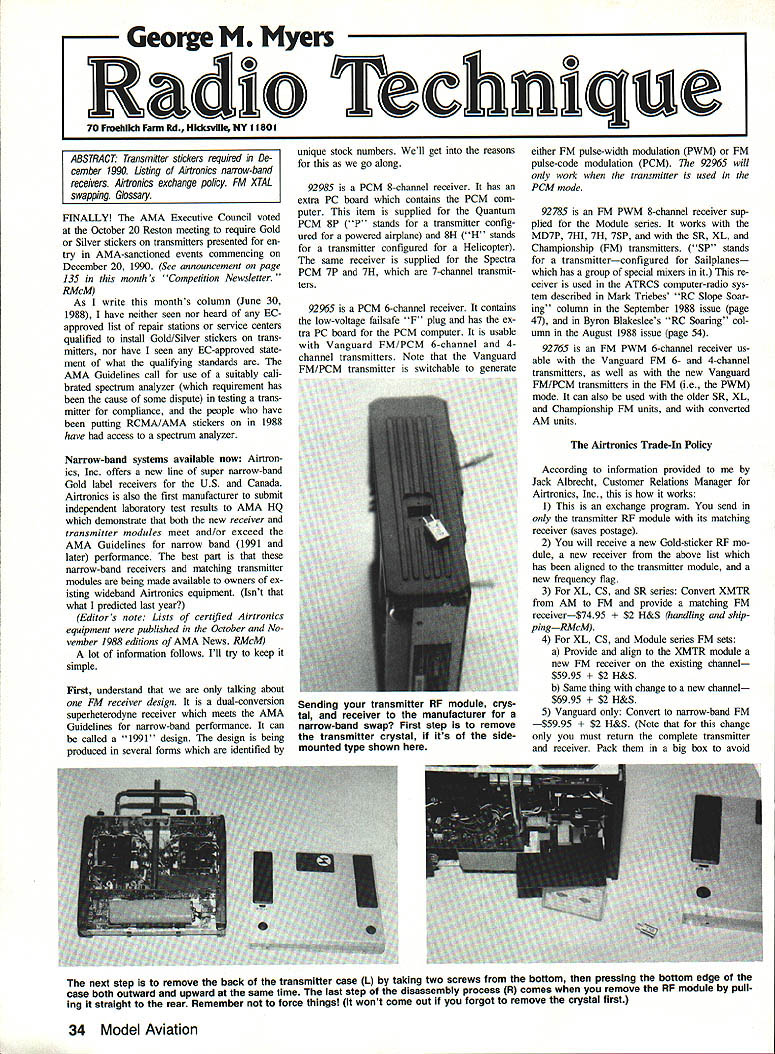
The next step is to remove the back of the transmitter case by taking out two screws from the bottom, then pressing the bottom edge of the case both outward and upward at the same time. The last step of the disassembly process comes when you remove the RF module by pulling it straight to the rear. Remember not to force things! (It won't come out if you forgot to remove the crystal first.)
Pack the transmitter RF module, transmitter crystal, and receiver carefully in a box which is big enough that they won't be lost in the mail. It would be helpful to pack your identification inside the box, too. Make sure you specify what you want done—don't make the people try to read your mind. Do not remove stick or switch handles unless you understand how to reinstall them; improper removal can cause damage.
- If the customer returns the entire system, it will be assumed that a complete system checkout is wanted, and the charges will be increased as necessary.
It should be noted that the Airtronics service and maintenance center is located in California, that the technicians are Americans who live in the L.A. area, and that they are factory trained in repair and maintenance of Airtronics radios. All checkouts are accomplished on factory tooling at Airtronics, Inc., 11 Autry, Irvine, CA 92718.
You may have noticed that all of the above refers only to FM sets, and to exchanging receivers and transmitter modules—but not to interchanging crystals in the field. There is a reason: FM sets must be carefully aligned for frequency deviation after crystals are swapped, because FM receivers measure frequency deviation. Each pair of transmitter/receiver crystals will exhibit a unique difference between the transmitter and receiver crystal frequencies. An FM receiver usually can be aligned to accommodate that, but if the difference is so great that it defies alignment, other crystal pairs can be tried in the shop.
Since a unique frequency difference will be found in every other pair of crystals, when you make a swap in the field the control signal can fall completely outside the receiver's pass-band, or be shifted to the side so the transmitter's signal will be received in a distorted fashion. This effect is critical all by itself, but it becomes even more critical when the effects of narrow-banding are included.
Airtronics, Inc. wants to discourage thoughts of swapping their FM crystals "in the field" (i.e., without using proper laboratory or shop equipment to verify the resulting performance), even though FCC regulations may permit consumer XTAL-swapping.
Glossary
From time to time I have been accused of using too many acronyms. To answer that criticism, I present a glossary of terms I use most frequently.
- AM (Amplitude Modulation) — A system for impressing information on a radio frequency by varying the amplitude (voltage) of the assigned radio frequency. In RC systems for models, the added information is usually the servo pulses which effectively switch the radio frequency on/off.
- AMA (Academy of Model Aeronautics) — National organization of aeromodellers, member of the NAA, representative of the United States in negotiations with the world, publisher of Model Aviation magazine.
- EAA (Experimental Aircraft Association) — National organization of builders of homemade, man-carrying aircraft. Frequent users of RC models to investigate and verify performance of aircraft designs.
- EC (Executive Council) — Governing body of the AMA, consisting of the President, Executive Vice-President, Executive Director, and 11 District Vice-Presidents.
- FAA (Federal Aviation Administration) — Part of the U.S. Federal Government charged with regulating transportation use of the air above the nation.
- FAI (Federation Aeronautique Internationale) — Organization which oversees and coordinates aerospace competitions and records. It is based in Paris, France.
- FC (Frequency Committee) — Advisory body to the AMA Executive Council on matters pertaining to obtaining and using radio frequencies for hobby purposes.
- FCC (Federal Communications Commission) — Part of the U.S. Federal Government charged with regulating radio frequency transmissions.
- FM (Frequency Modulation) — A system for impressing information on a radio frequency transmission by varying the assigned radio frequency in an intelligible manner.
- FSK (Frequency-Shift Keying) — A system for impressing information on a radio frequency transmission by shifting between two radio frequencies in an intelligible manner. This is the system actually used in RC systems described as "FM systems."
- HQ (Headquarters) — In the case of AMA, located at 1810 Samuel Morse Drive, Reston, VA 22090.
- NAA (National Aeronautic Association) — Members include the EAA, AMA, and other U.S. aviation associations. The U.S. national aero club recognized by the FAI.
- PC (Printed Circuit) — A method for connecting electronic components by etched copper foil pathways.
- PCM (Pulse-Code Modulation) — A system for encoding the modulation of a radio frequency by use of computer words that can be decoded into control commands by a computer in the receiver.
- PM (Pulse-Width Modulation) — A system for encoding the modulation of a radio frequency which uses the time between pulses as an analog of the desired control position. This system was the most common system in the years 1969–1988.
- RC (sometimes R/C; Radio-Controlled) — Describes systems in which human commands are delivered to machines by way of a radio link.
- RF (Radio Frequency) — Pertains to systems which generate electromagnetic radiation at radio frequencies.
- RFI (Radio Frequency Interference) — Any electromagnetic radiation that degrades the radio link or an RC system.
- RX — Radio receiver.
- XMTR — Radio transmitter.
- XTAL (sometimes XTL, crystal) — Common frequency-determining element in XMTR and RX.
Transcribed from original scans by AI. Minor OCR errors may remain.

