
Radio Technique
George M. Myers
70 Froehlich Farm Rd., Hicksville, NY 11801
ABSTRACT
XMAS gift tools. Narrow-banding 75 MHz vs. XTAL-swapping.
XMAS Gifts
This issue should reach you in the last stages of the XMAS buying frenzy. Some of the following ideas may be different enough to help you pick a gift for the person who's "hard to buy for."
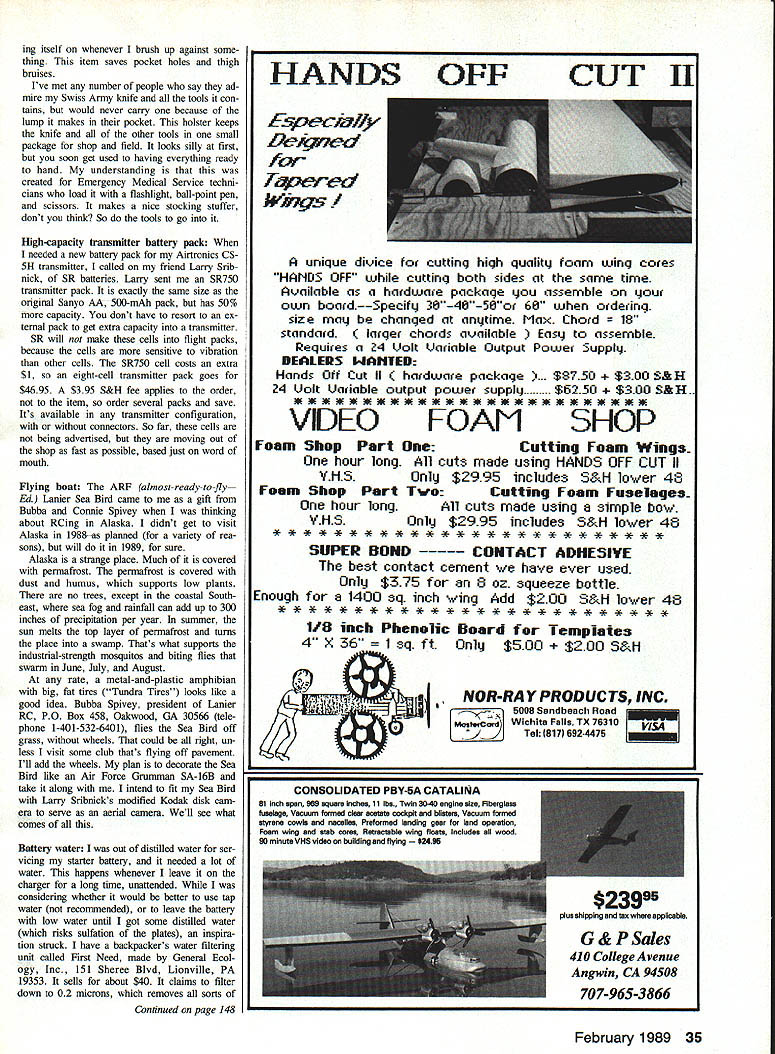
#### Portable power tool kit The Wen Power Tool Task Force, Model 2336, comes in a handy plastic briefcase and contains four 12 VDC tools plus accessories and power supply:
- Jigsaw
- 1/4-in. drill motor
- 14,000-rpm grinder
- 25-watt soldering iron
- Accessories
- 12 VDC, 2-amp power supply that plugs into 110 VAC household current
All of the tools will operate from the cigar-lighter socket in your car; one cigar-lighter plug is provided. I added two more such plugs from Radio Shack, plus a 1-to-2 cigar-socket multiplier, which provides one more plug and two sockets for the power supply. I bought mine for $89 at a discount marine-supplies store, but you should be able to find it at a hobby store.
I’m not going to throw away my Dremel or other tools, but I think I’ll enjoy having this little package in the van when I drive 100 miles or more to go flying. One never knows what kind of repairs will be needed at a distance. Besides, the smaller-size tools (especially the jigsaw) are very handy around models.
#### More portable tools
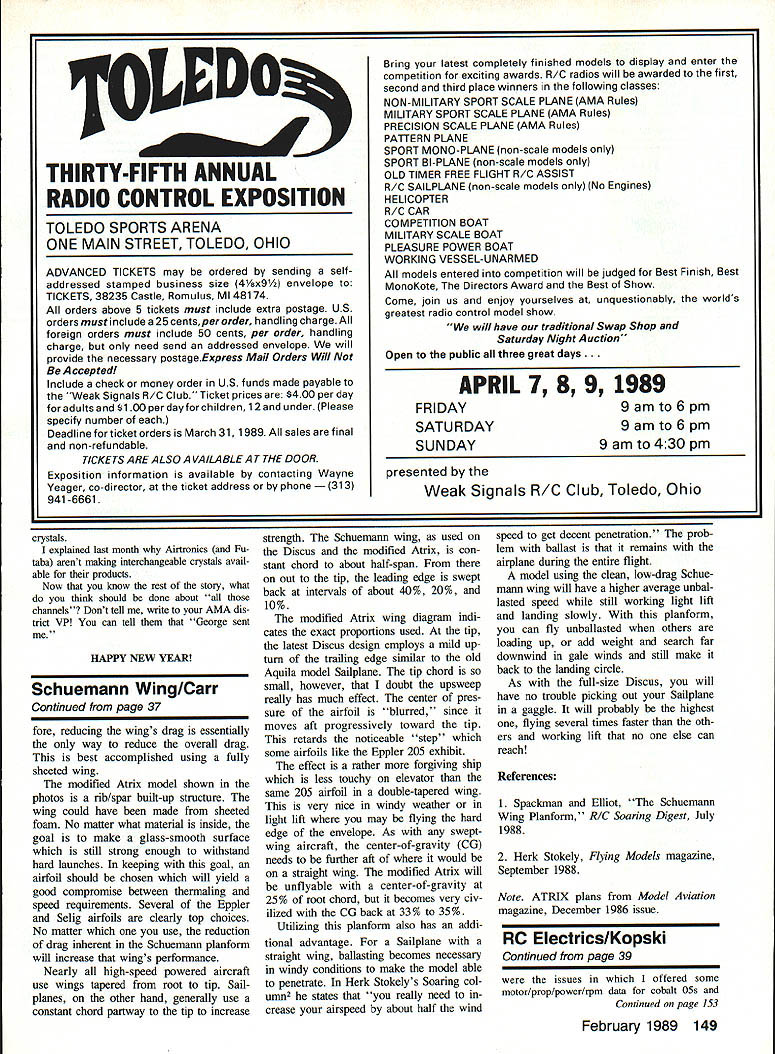
- A Sears reciprocating-saw blade, Super Finish #928761, can be made to fit neatly into an X-Acto #1 handle with a little grinding using a Dremel cut-off wheel. It’s perfect for cutting a slot inside a built-up airplane or cleaning out existing holes—one of those midnight desperation moves that turned out well for me.
- A belt-loop tool holster (Brookstone #7-13061, Peterborough, NH, and other places, $10.95) holds my Magna-Lite flashlight, Swiss Army knife, sharpening stick, ball-point pen, and 4.5-in. Channel-lock pliers. I added a snap cover to protect the flashlight and prevent it from turning on unexpectedly. This item saves pocket holes and thigh bruises.
Many people admire my Swiss Army knife but would never carry one because of the lump in their pocket. This holster keeps the knife and other tools in one small package for shop and field use. It looks silly at first, but you get used to having everything ready to hand. My understanding is that this was created for Emergency Medical Service technicians who load it with a flashlight, ball-point pen, and scissors. It makes a nice stocking stuffer—so do the tools to go into it.
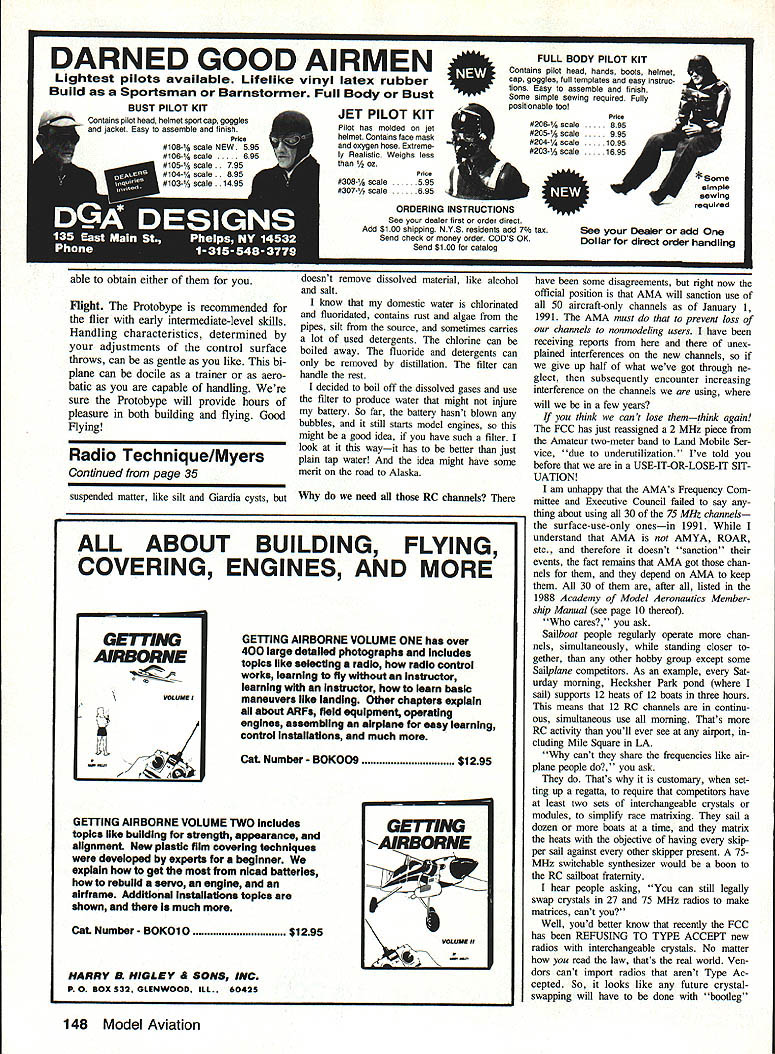
#### High-capacity transmitter battery pack When I needed a new battery pack for my Airtronics CS-5H transmitter, I called my friend Larry Sribnick of SR Batteries. Larry sent me an SR750 transmitter pack. It is exactly the same size as the original Sanyo AA, 500-mAh pack, but has 50% more capacity. You don't have to resort to an external pack to get extra capacity into a transmitter.
SR will not make these cells into flight packs because the cells are more sensitive to vibration than other cells. The SR750 costs an extra $1, so an eight-cell transmitter pack goes for $46.95. A $3.95 S&H fee applies to the order. It's available in any transmitter configuration, with or without connectors. These cells are not being widely advertised yet, but they are moving out of the shop as fast as possible by word of mouth.
Flying boat
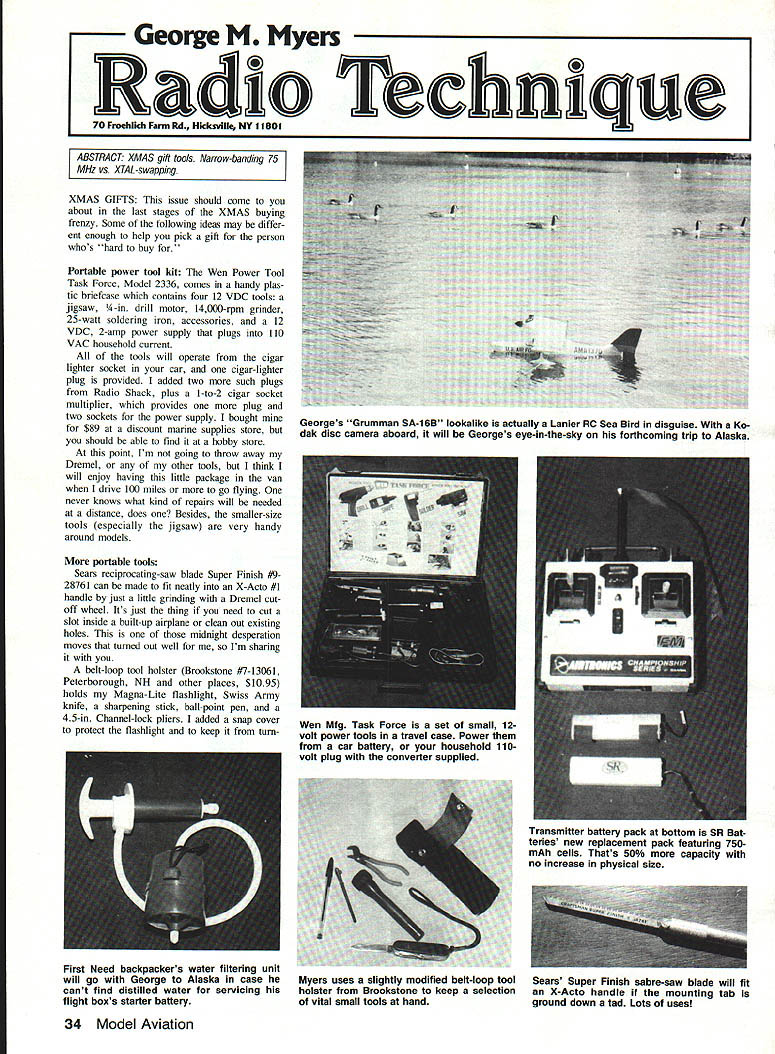
The ARF (almost-ready-to-fly) Lanier Sea Bird came to me as a gift from Bubba and Connie Spivey when I was thinking about RCing in Alaska. I didn't get to visit Alaska in 1988 as planned, but I will do it in 1989 for sure.
Alaska is a strange place. Much of it is covered with permafrost, which is in turn covered with dust and humus that supports low plants. There are no trees except in the coastal Southeast, where sea fog and rainfall can add up to 300 inches of precipitation per year. In summer the sun melts the top layer of permafrost and turns the place into a swamp—hence the industrial-strength mosquitoes and biting flies that swarm in June, July, and August.
A metal-and-plastic amphibian with big, fat tires ("Tundra Tires") looks like a good idea. Bubba Spivey, president of Lanier RC, P.O. Box 458, Oakwood, GA 30566 (telephone 1-401-532-6401), flies the Sea Bird off grass without wheels. That could be all right unless I visit some club that's flying off pavement—I'll add the wheels. My plan is to decorate the Sea Bird like a Grumman SA-16B and take it with me. I intend to fit my Sea Bird with Larry Sribnick's modified Kodak disk camera to serve as an aerial camera. We'll see what comes of all this.
Battery water
I was out of distilled water for servicing my starter battery, and it needed a lot more water. This happens when I leave it on the charger for a long time, unattended. While I considered using tap water (not recommended) or leaving the battery with low water until I got some distilled water (which risks sulfation of the plates), an idea struck.
I have a backpackers' water-filter unit called First Need, made by General Ecology, Inc., 151 Sheree Blvd., Lionville, PA 19353. It sells for about $40. It claims to filter down to 0.2 microns, which removes suspended matter like silt and Giardia cysts, but doesn't remove dissolved material like alcohol and salt.
My domestic water is chlorinated and fluoridated, and contains rust and algae from the pipes, silt from the source, and sometimes a lot of used detergents. Chlorine can be boiled away; fluoride and detergents can only be removed by distillation. The filter can handle the rest.
I decided to boil off the dissolved gases and use the filter to produce water that might not injure my battery. So far the battery hasn't blown any bubbles, and it still starts model engines, so this might be a good idea if you have such a filter. It has to be better than plain tap water, and the idea might have merit on the road to Alaska.
Why do we need all those RC channels?
There have been disagreements, but the official position is that AMA will sanction use of all 50 aircraft-only channels as of January 1, 1991. The AMA wants this to prevail to prevent loss of our channels to non-modeling users. I have been receiving reports of unexplained interference on the channels we are using. If we give up half of what we've got through neglect, then subsequently encounter increasing interference on the remaining channels, where will we be in a few years?
If you think we can't lose them—think again. The FCC has just reassigned a 2 MHz piece from the Amateur two-meter band to Land Mobile Service due to underutilization. We are in a USE-IT-OR-LOSE-IT situation.
I am unhappy that the AMA's Frequency Committee failed to say anything about using all 30 of the 75 MHz channels—the surface-only ones—in 1991. While I understand that AMA is not AMYA, ROAR, etc., and therefore doesn't "sanction" their events, the fact remains that AMA got those channels for those groups, and they depend on AMA to keep them. All 30 of them are listed in the 1988 Academy of Model Aeronautics Membership Manual (see page 10).
Sailboat people regularly operate more channels, simultaneously and standing closer together, than any other hobby group except some sailplane competitors. For example, every Saturday morning Heckscher Park pond supports 12 heats of 12 boats in three hours. That means 12 RC channels are in continuous, simultaneous use all morning—more RC activity than you'll ever see at any airport, including Mile Square in L.A.
"Why can't they share the frequencies like airplane people do?" you may ask. They do. When setting up a regatta, it's customary to require competitors to have frequencies reserved to simplify race-matrixing. They sail 12 boats or more at a time, and the matrix organizers try to have every skipper sail against every other skipper present. A 75-MHz switchable transmitter would be a boon to the RC sailboat fraternity.
I hear people asking, "You can still legally swap crystals in 27 and 75 MHz radios to make matrices, can't you?" You'd better know that recently the FCC has been refusing to Type Accept new radios with interchangeable crystals. No matter how old the law, that's the real world. Vendors can't import radios that are not Type Accepted, so any future crystal-swapping will have to be done with "bootleg" units or by modifying radios after importation—a legal gray area at best. I explained last month why Airtronics (and Futaba) aren't making interchangeable crystals available for their products.
Now that you know the rest of the story, what do you think should be done about "all those channels"? Don't tell me—write to your AMA district VP! You can tell them that "George sent me."
Transcribed from original scans by AI. Minor OCR errors may remain.

