
Radio Technique
George M. Myers 70 Froehlich Farm Rd., Hicksville, NY 11801
Abstract
Predicted 1991 operating conditions, whether or not AMA goes to 50 channels. (Part 1) Single-conversion receivers.
What's Ahead?
I recently received this letter:
"Dear George,
"I just recently joined AMA and am now worrying about '1991 specifications' for radio. Will I be able to use my 1988 AM radio equipment, or for that matter, any other 'non-1991' equipment after 1991?
"Will the manufacturers continue to offer their 'cheaper' line of radios, like four channels for $100 or so? I am very confused on this."
s/Jim Hobelsberger, 2956 Kelly Rd., La Crescent, MN 55947.
My answer to him follows:
Dear Jim,
First, and most important, your 1988 system has a narrow-band transmitter (Tx) and a pretty good receiver (Rx). It will work through 1991 and beyond. The people who are confusing you probably have older equipment which isn't as good as yours.
Now, let's look at the situation of the folks with the old equipment. I am not a lawyer, so this is not "legal advice," but it is the way I understand the situation.
Equipment manufactured to a Type Acceptance certificate issued to the manufacturer by the FCC can be legally used for RC flying so long as it is on one of the 50 "Aircraft Only" 72 MHz channels or six "all models" 27 MHz channels approved for RC use by the FCC. If you have an Amateur Radio Operator's license, you can fly in the ten 50 MHz or eight 53 MHz channels. That's 74 channels available! You have a right to fly Type Accepted equipment until it either wears out or you dispose of it. So, you can fly what you have in 1991 and beyond.
The difficulty here is that Type Acceptances don't have expiration dates on them. If FCC regulations change, production of obsoleted equipment ceases, but you, the owner of the equipment, have no way of knowing about it. All you know is that the transmitter you are holding has a Type Acceptance sticker on it. Therefore, something built in 1970 under Type Acceptance or Type Certification in force then (before the current narrow-band channels existed) is legally usable now. You can see the danger in that, can't you?
There has been talk about asking the FCC to put a time limit on the legal use of obsolete equipment, but nothing has come of it. The sticking point is the definition of "obsolete." The AMA's program to put Gold and Silver stickers on transmitters has been conducted to filter out the dangerously inadequate—but otherwise legal—equipment that is still around. The AMA Radio Guidelines published in the Membership Manual describe performance characteristics radios should meet to work together in a 50-channel 1991 environment. You might guess anything that doesn't conform to the guidelines is obsolete in some sense, and that could be true, but you have to remember that the guidelines are not FCC regulations. Therefore, they can't obsolete anything. As written in the 1988 Membership Manual on page 11, the guidelines are a little vague about single-conversion receivers. That will be corrected.
You can ignore the guidelines until you want to fly in AMA-sanctioned competition; in that case you will need a narrow-band transmitter (as defined in the AMA Radio Guidelines) to enter competition on channels RC12, RC14, RC16, RC34 right now. Wide-band transmitters are acceptable on channels RC38, RC40, RC42 ... RC56 right now.
Beginning in 1991, you'll need narrow-band transmitters, with Gold stickers and whatever other documentation AMA requires, to fly in competition on any channel. There is no distinction between AM and FM—or between PCM and other encoding schemes—in the guidelines. FM isn't the only way to go.
The AMA does not require a narrow-band receiver for competition use at this time, but in my opinion it should. Until narrow-band receivers are required, AMA Contest Directors must be counted on to schedule the use of RC channels in competition events in a way that minimizes modeler-to-modeler interference, taking into account the characteristics of receivers currently in use.
None of the manufacturers' representatives I've spoken to report plans to continue producing what they used to sell. They stopped producing what I would call low-performance equipment five years ago and there has been steady improvement. Expect to see high-performance, narrow-band, four- to six-channel FM sets—and/or five-channel FM/PCM sets—as everybody's "low-cost" model in the immediate future. Since practically all RC equipment comes from the Far East, the price will be a function of the U.S. dollar's value relative to Far East currencies. It is anticipated that future price leaders will cost less than $200.
You know that AMA plans to sanction use of all 50 aircraft channels in 1991. You also know that there is some "40 kHz per transmitter" sentiment intended to prolong the use of old wideband equipment. Let me get out my crystal ball to see what changes of operating conditions will result, depending on which plan is followed.
First, if AMA sanctions only even-numbered channels (40 kHz forever), then the FCC is almost certain to assign the odd-numbered channels to someone else. The critical point to remember is that all 50 of our channels are exclusive to us now, BUT WE ARE ONLY ACCORDED THE STATUS OF "SECONDARY USERS." That means we must accept interference—but can't give any—if we let some other service capture the odd channels. You think that can't happen? The Amateurs have just lost 2 MHz of their 220 MHz band because the FCC believed that they weren't using it.
If you now accept the concept that SOMEBODY will be using all 50 channels in 1991, then the first thing to consider logically follows from that fact and from the mathematics of radio frequencies. Most single-conversion (SC) superheterodyne receivers use a 455 kHz local oscillator (LO) frequency (let's call them "SC455s"). Under the very specific circumstances following, wideband SC455s may see an increase of interference when all 50 channels are used (by somebody). Most old wideband AM radios are SC455s.
Direct Interference
- The SC455's local oscillator (LO) frequency almost coincides with that of any RC transmitter (Tx) 23 channels away. It also almost coincides with any common-carrier transmitter (those in between our RC channels) located 22 channels ± 10 kHz away. Whether or not they cause interference depends upon position in the band (interfering Tx above or below) and receiver (Rx) properties.
One way to avoid most of the bad effects of this situation is to build SC455s for RC11–35 with an LO frequency below the Tx frequency, and SC455s for RC36–60 with an LO above their Tx frequency. The AMA guidelines say the opposite, but they are written around dual-conversion receivers that have no "23-channel problem." A large number of receivers exist which have their LO placed inside the RC band, in accordance with the guidelines. The AMA Phase-In Plan masked the 23-channel consideration for a while by not sanctioning use of any odd-numbered RC channels.
Even with the LO placed correctly, SC455s on RC11, RC12, RC59, or RC60 can be interfered with by Tx on RC34 through RC37, and vice versa.
- The next condition change comes out of the mathematics of frequencies, too. "Image interference" will return for a few of the SC455s. Some folks will remember how 72.96 (Y/W) used to "image" with 72.08 (B/W). Well, only those SC455s on RC11–14 and RC57–60 can be affected by Tx within the band, and even then only if they have their local oscillator on the wrong side. I assume that the manufacturers simply won't sell SC455s on those channels. Besides, the image coincides exactly with common-carrier Tx frequencies, not with RC Tx, which helps. But receivers with low LO have the possibility of imaging with TV4 (the RC44 problem we know and love). So you see, nothing is simple.
One cure for all the above is simple: use a dual-conversion receiver.
Indirect Interference
A condition comes out of the numbers called "Second Order Intermodulation Product Interference (2IM)," which is generated by any pair of transmitters operating 23 RC channel numbers apart. The difference of the two frequencies is a modulated 460 kHz signal that often goes right through an SC455 to be detected as interference.
Think of this: 2IM generated by just one pair of transmitters might hit old wideband AM SC455s on every one of the 50 channels simultaneously, including their own receiver, depending only on signal strength at the receiver antenna and the receiver characteristics. Nobody uses the odd-numbered RC channels (RC11, RC13, RC15, ... RC59) today, so we don't worry about 2IM. But when 50 channels are used, 2IM will be a problem. Can you predict what will happen if we give the 25 odd-numbered channels to another service?
Now remember, we are only discussing receiver problems here, the assumption being that everyone is already using Gold-stickered narrow-band transmitters. Practically every transmitter built since 1987 is good enough to warrant that sticker.
The easiest way to avoid all of the above problems is to use a dual-conversion receiver. Then you don't have to worry about any channels.
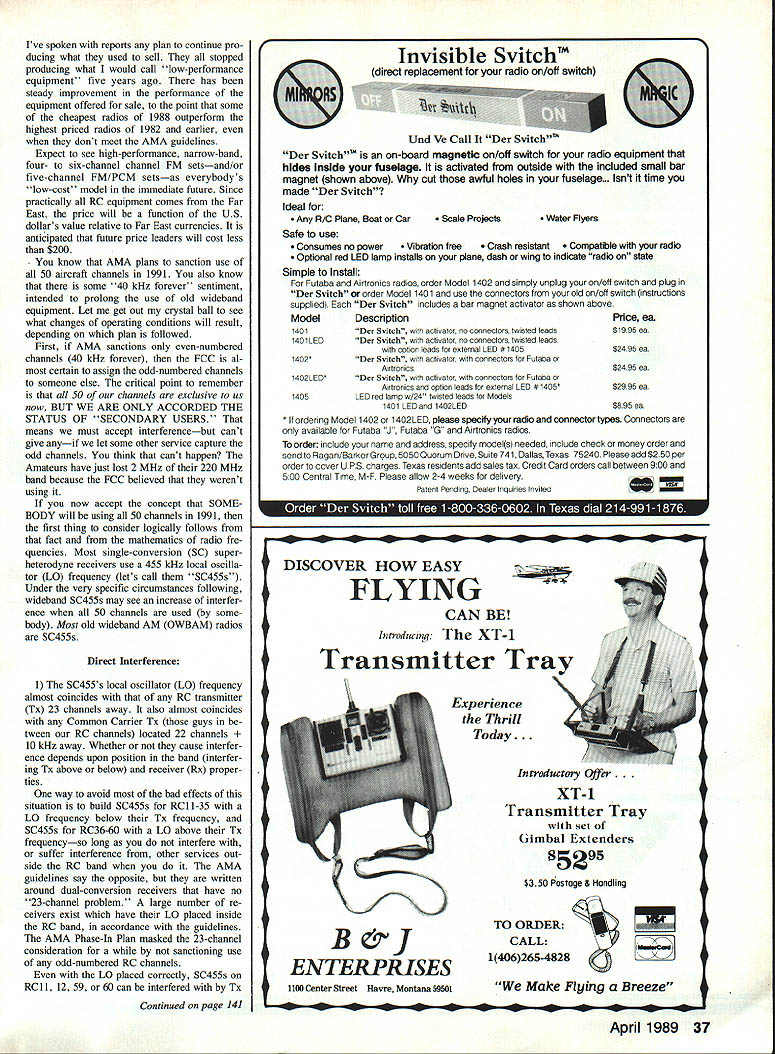
With a control transmitter 200 ft. away, you can lay an RC44 or RC48 transmitter antenna right on the receiver antenna without driving the Merlin PCM system into fail-safe. Under the same conditions, you can bring an RC23, RC45, or RC47 transmitter within 12 ft. of the receiver before causing fail-safe. I think this clearly demonstrates that a narrow-band SC455 can be made to work well. If direct interference from a transmitter 23 channels away is no worse than indirect interference from a transmitter one channel away, then you've got nothing to worry about.
AMA has protected old wideband AM radios for a long time with its carefully selected even-numbered channels—but the protection never was absolute. Now, enlightened self-interest forces AMA to move on to better things.
Prediction #1: Wideband SC455 receivers will not be of much use in the 72 MHz Aircraft-Only band after 1991. They will not be generally useful in the 75 MHz Non-Aircraft band, either, if all 30 of those channels are used. Narrow-band SC455s will work on the right channels, however.
I keep telling you, "THE KEY TO THE FUTURE IS A GOOD RECEIVER." The test results quoted in the next section will demonstrate that all of the manufacturers have responded to the challenge, and good receivers are now available.
For additional study, see "The AMA Phase-In Plan Explained" in the April 1984 edition of AMA News (pages 103–104).
(Continued next month.)
Transcribed from original scans by AI. Minor OCR errors may remain.

