
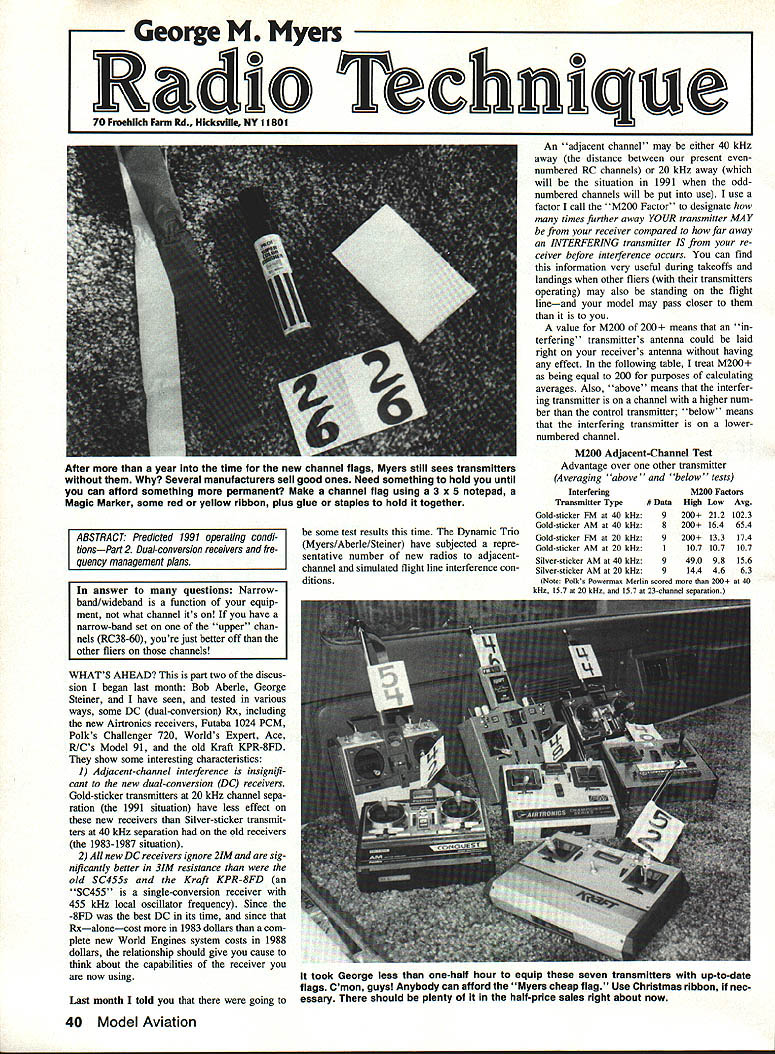
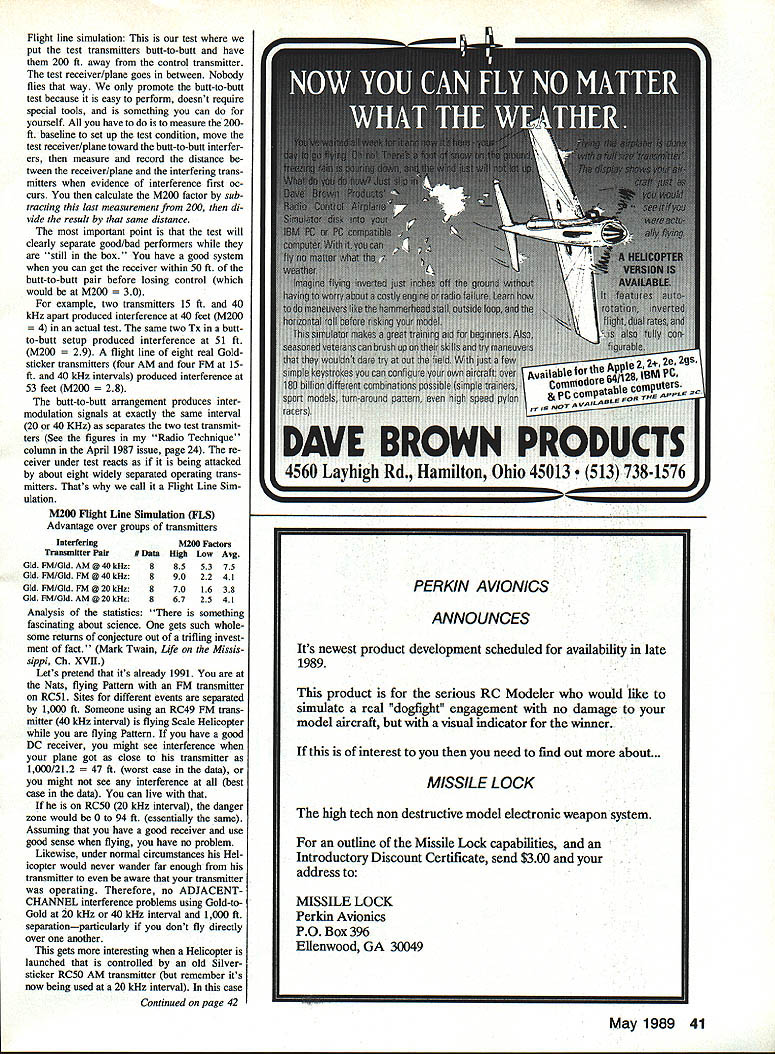
Radio Technique
George M. Myers 70 Froehlich Farm Rd., Hicksville, NY 11801
ABSTRACT: Predicted 1991 operating conditions—Part 2. Dual-conversion receivers and frequency management plans.
In answer to many questions: Narrow-band/wideband is a function of your equipment, not what channel it's on! If you have a narrow-band set on one of the "upper" channels (RC38–60), you're just better off than the other fliers on those channels.
An "adjacent channel" may be either 40 kHz away (the distance between our present even-numbered RC channels) or 20 kHz away (which will be the situation in 1991 when the odd-numbered channels will be put into use). I use a factor I call the "M200 Factor" to designate how many times further away YOUR transmitter MAY be from your receiver compared to how far away an INTERFERING transmitter IS from your receiver before interference occurs. You can find this information very useful during takeoffs and landings when other fliers (with their transmitters operating) may also be standing on the flight line—and your model may pass closer to them than it is to you.
A value for M200 of 200+ means that an "interfering" transmitter's antenna could be laid right on your receiver's antenna without having any effect. In the following table, I treat M200+ as being equal to 200 for purposes of calculating averages. Also, "above" means that the interfering transmitter is on a channel with a higher number than the control transmitter; "below" means that the interfering transmitter is on a lower-numbered channel.
M200 Adjacent-Channel Test
Advantage over one other transmitter (Averaging "above" and "below" tests)
- Gold-sticker FM at 40 kHz — # data: 9; M200 factors (High / Low / Avg): 200+ / 21.2 / 102.3
- Gold-sticker FM at 20 kHz — # data: 8; M200 factors (High / Low / Avg): 200+ / 16.4 / 65.4
- Gold-sticker AM at 40 kHz — # data: 8; M200 factors (High / Low / Avg): 200+ / 13.1 / 47.4
- Gold-sticker AM at 20 kHz — # data: 10; M200 factors (High / Low / Avg): 107 / 10.7 / 10.7
- Silver-sticker AM at 40 kHz — # data: 9; M200 factors (High / Low / Avg): 49.0 / 9.8 / 15.6
- Silver-sticker AM at 20 kHz — # data: 9; M200 factors (High / Low / Avg): 14.4 / 4.6 / 6.3
(Note: Polk's Powermax Merlin scored more than 200 at 40 kHz, 15.7 at 20 kHz, and 15.7 at 23-channel separation.)
WHAT'S AHEAD?
This is part two of the discussion I began last month: Bob Aberle, George Steiner, and I have seen, and tested in various ways, some DC (dual-conversion) receivers, including the new Airtronics receivers, Futaba 1024 PCM, Polk's Challenger 720, World's Expert, Ace, R/C's Model 91, and the old Kraft KPR-8FD. They show some interesting characteristics:
- Adjacent-channel interference is insignificant to the new dual-conversion (DC) receivers. Gold-sticker transmitters at 20 kHz channel separation (the 1991 situation) have less effect on these new receivers than Silver-sticker transmitters at 40 kHz separation had on the old receivers (the 1983–1987 situation).
- All new DC receivers ignore 21M and are significantly better in 31M resistance than were the old SC455s and the Kraft KPR-8FD (an "SC455" is a single-conversion receiver with a 455 kHz local-oscillator frequency). Since the -8FD was the best DC in its time and since the Rx-alone cost more in 1983 dollars than a complete new World Engines system cost in 1988 dollars, the relationship should give you cause to think about the capabilities of the receiver you are now using.
Last month I told you that there were going to be some test results this time. The Dynamic Trio (Myers/Aberle/Steiner) have subjected a representative number of new radios to adjacent-channel and simulated flight-line interference conditions.
Flight-line simulation test: Put test transmitters butt-to-butt and have the control transmitter 200 ft away. The control transmitter's receiver/plane goes between the butt-to-butt interferers. Nobody flies this way—why promote the butt-to-butt test? Because it's easy to perform, doesn't require special tools, and is something you can do yourself. You have to measure a 200 ft baseline, set up the test condition, move the test receiver/plane toward the butt-to-butt interferers, and measure and record the distance between the receiver/plane and the interfering transmitters when evidence of interference first occurs. Calculate the M200 factor by subtracting the last measurement from 200 and dividing the result by the same distance. An important point: the test will clearly separate good and bad performers. If you still have a good system, you can get the receiver within 50 ft of a butt-to-butt pair before losing control. That would be an M200 example: two transmitters 15 ft, 40 kHz apart produced interference at 40 feet in the actual test with the same two Tx butt-to-butt setup.
M200 Flight Line Simulation (FLS)
Advantage over groups of transmitters
- Gold FM / Gold AM @ 40 kHz — # data: 8; M200 factors (High / Low / Avg): 8.5 / 5.3 / 7.5
- Gold FM / Gold FM @ 40 kHz — # data: 8; M200 factors (High / Low / Avg): 9.0 / 2.2 / 4.1
- Gold FM / Gold FM @ 20 kHz — # data: 8; M200 factors (High / Low / Avg): 7.0 / 1.6 / 3.8
- Gold FM / Gold AM @ 20 kHz — # data: 8; M200 factors (High / Low / Avg): 6.7 / 2.5 / 4.1
Analysis of the statistics: "There is something fascinating about science. One gets such wholesale returns of conjecture out of a trifling investment of fact." (Mark Twain, Life on the Mississippi, Ch. XVII.)
Let's pretend that it's already 1991. You are at the Nats, flying Pattern with an FM transmitter on RC51. Sites for different events are separated by 1,000 ft. Someone using an RC49 FM transmitter (40 kHz interval) is flying Scale Helicopter while you are flying Pattern. If you have a good DC receiver, you might see interference when your plane gets as close to his transmitter as 1,000/2/1.2 = 47 ft. (worst case in the data), or you might not see any interference at all (best case in the data). You can live with that.
If he is on RC50 (20 kHz interval), the danger zone would be 80 to 94 ft. (essentially the same). Assuming that you have a good receiver and a good sense when flying, you have no problem. Likewise, under normal circumstances his helicopter would never wander far enough from his transmitter to even be aware that your transmitter was operating. Therefore, no ADJACENT-CHANNEL interference problems using Gold-to-Gold at 20 kHz or 40 kHz interval and 1,000 ft. separation—particularly if you don't fly directly over one another.
This gets more interesting when a helicopter is launched that is controlled by an old Silver-sticker RC50 AM transmitter (but remember it's now being used at a 20 kHz interval). In this case you might see a glitch if your plane comes to 1,000/4.6 = 217 ft. from his transmitter (worst case) or 1,000/14.4 = 70 ft. (best case). It's a little worse, but you could live with it because the CDs would set up flight patterns to prevent your actually getting that close to him. Good receivers would protect both of you.
Now let's say he/she gets the RC50 AM transmitter narrow-banded and Gold-stickered. Better for you, so you're satisfied. But, what if he/she still tries to get by with an SC455 OWBAM receiver (where interference might be seen at 1,000/3.0 = 333 ft.)? He/she WON'T be able to live with it at all in Pattern, and will only be comfortable in Helicopter if the machine is kept in close (and if 2IM or a 23rd channel doesn't get in first).
Prediction #2 (Prediction #1 was in last month's column): Adjacent-channel interference won't be a problem for people who are using Gold-stickered systems with good DC receivers, whether on a 20 kHz or a 40 kHz raster.
Let's say that the person with the AM RC50 we just talked about above pops in a Gold-sticker FM RC50 Tx module and stands beside the Gold-sticker FM RC49 (20 kHz interval). Both of them stand at another Pattern flight station 1,000 ft. away that you might be overflying. You estimate that they could get up at 1,000/1.6 = 625 ft. (from them), if you have a bad receiver, or 1,000/9 = 111 ft. if you have a good receiver. This ought to be enough incentive for you to get a good receiver!
Prediction #3: We will still need FLIGHT LINE DISCIPLINE (frequency pins, flight stations, frequency management plans, transmitter impounds, etc.) to provide safe operating conditions in 1991, particularly for large contests where several events are taking place at the same time on the same site.
People keep asking me for a flight station plan for 1991. We know that 1) a flight station computer program, a white pack, chart, etc. isn't good enough. It avoids adjacent-channel, image, and third-order intermod, but it won't cover "what-if" channels. People really need a plan to use OWBAM/SC455 on all 50 channels. That plan accommodates OWBAMs on most of the even-numbered channels. It has proven to be a good plan.
You might think you can work up a scheme which protects wideband receivers by simply prohibiting simultaneous operation of any two transmitters that are 23 channels apart. But any single, old-channel RC Tx can generate 23M interference with a combo carrier Tx that is operating at a frequency 22 RC channel numbers plus 10 (like RC35 vs. RC72.400, the old Orange/White). If the 10-year-old receiver you are trying to protect is wideband enough to be affected by 2IM (the 23-channel problem), then it can't fly with any odd-channel transmitters.
So, those who will fly a few planes at a time in rural areas that are free from commercial interference have a right to use their OWBAMs on the even-numbered channels using the "Pacific Plan" for as long as they are able. That plan accommodates OWBAMs on most of the even-numbered channels. It has proven to be a good plan.
We learned from FLS testing that the new M200 FLS numbers are better than the old, but not good enough to eliminate the need for flight line frequency management in 1991. You still have to use your head.
I can see that many reasonable plans might be generated for current dual-conversion and narrow-band SC455 receivers, because they are free from adjacent-channel, image, and third-order problems (on a practical basis) when used with appropriate narrow-band transmitters. But I don't see how any plan can safely put old wideband SC455s on all 50 channels, PARTICULARLY IF USED WITH WIDEBAND TRANSMITTERS. You see, such a plan has to consider both transmitters and receivers, mixed up as wide- and narrow-band.
The Canadians, lacking a ready supply of narrow-band equipment, went to a system of blocking out adjacent channels according to "occupied bandwidths" to accomplish that purpose. It works for them, but here in the U.S.A., even without odd-channel Tx to complicate the picture, wideband SC455s on "even channels only" already have difficulty in large groups and in metropolitan areas where they are subject to interference from adjacent-channel commercial radio (as in Sepulveda Basin in LA—see Dave Peltz's "District X Report" in AMA News for January 1989, page 132). These interference problems cannot be controlled by adopting the Canadian scheme.
Maybe there's nothing at all to worry about. But if you don't have a scanner, you're acting like a fisherman drowning worms. You haven't a clue as to what's out there!
There is danger to the hobby as a whole in clinging to obsolete concepts. The AMA knew that obsolete equipment would have to be abandoned by 1991—and told you so in many articles. The hobby industry improved their products, so that every vendor now offers a "1991" radio—whether or not it has been certified to the AMA Guidelines.
Now, if you insist on "even channels only" in an attempt to preserve 10-year-old equipment, your dealers won't stock new equipment on the odd channels. The FCC will notice that, and away will go the odd channels to some other service. Where will that leave you?
Second (but maybe it really should be first), if someone using outdated equipment has a serious accident and loses a lawsuit for that reason, the resulting legal precedent might put an end to the RC hobby. The way the law works, you must do EVERYTHING YOU CAN to avoid injuring others. If they get hurt anyway, you have to pay.
AMA went to self-insurance because premiums were so high. Now, are you doing "the best you can" when you're trying to use outmoded equipment? Can the AMA afford your attitude? Consider the California parks and playgrounds that have been closed because municipalities can't afford the premiums on the liability insurance they would have to have to keep them open. How much would you, as an individual, have to pay for liability insurance to continue your RC flying if the AMA could not insure you?
My sincerest appreciation to George P. Steiner, who pushed me into writing this two-part essay, and to George, Robert F. Aberle, and other friends who criticized and massaged my early drafts until we all were satisfied that this text is saying the correct things. If you see a defect in what has been written above, or have a better way to approach the problems of 1991, PLEASE DON'T KEEP IT A SECRET. Write me a note. Spend the quarter!
Transcribed from original scans by AI. Minor OCR errors may remain.

