
Radio Technique
George M. Myers 70 Froehlich Farm Rd., Hicksville, NY 11801
ABSTRACT
Alaska; single- and dual-conversion receivers explained
Alaska
Alaska: talk about a response! The February issue had only been out for a week when I received five letters and two phone calls from Alaskans, challenging my perceptions of Alaska. In a normal week I would get a couple of letters asking questions about radios.
I had to reread the February 1989 issue (page 35) to see what I said that was wrong. I said "No trees, except in the coastal Southeast." I should have said "No trees in the tundra, north of the Brooks Range." The rest of Alaska has plenty of trees. I also got called on the permafrost statement, but I have to point to the government maps which say that you can find permafrost under literally everything that isn't solid rock. Only the southern rim (including Anchorage) is generally free of permafrost.
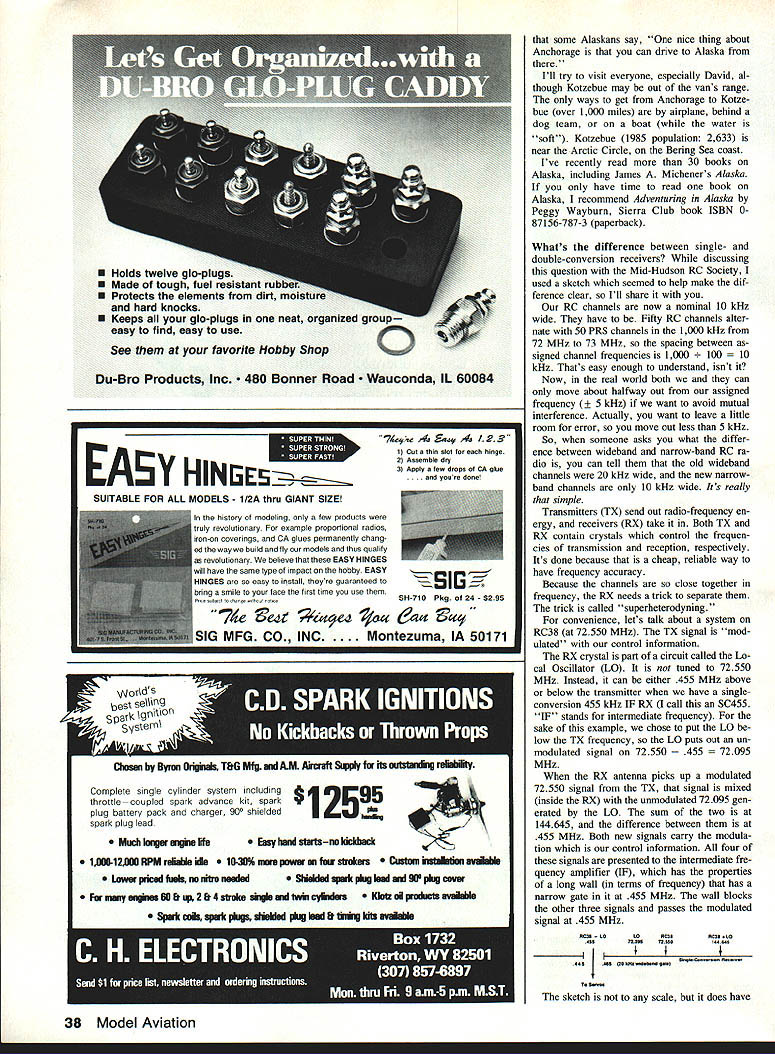
Alaska means "The Great Land." People who live there are intensely proud and protective of it. Alaska has mountains, rivers, forests, lakes, and some of the most fascinating flora and fauna to be found anywhere in the world. Everything about Alaska is different, and it has the largest number of pilots in any state in the U.S.A. When a map of Alaska is overlaid on the lower 48, Alaska spreads from Savannah, GA, to Duluth, MN, to San Diego, CA.
Many thanks to the people who helped with information and hospitality:
- Gary R. Fuller (AMA District XI AVP, Kotzebue) — sent Alaskan facts and the overlay map.
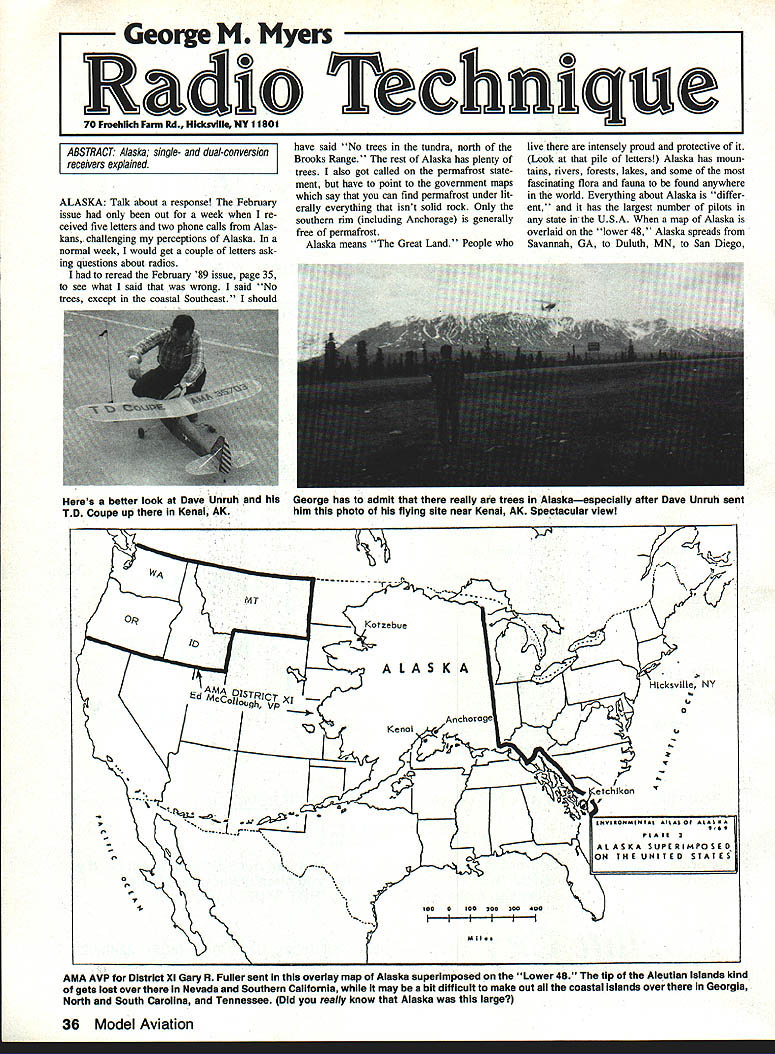
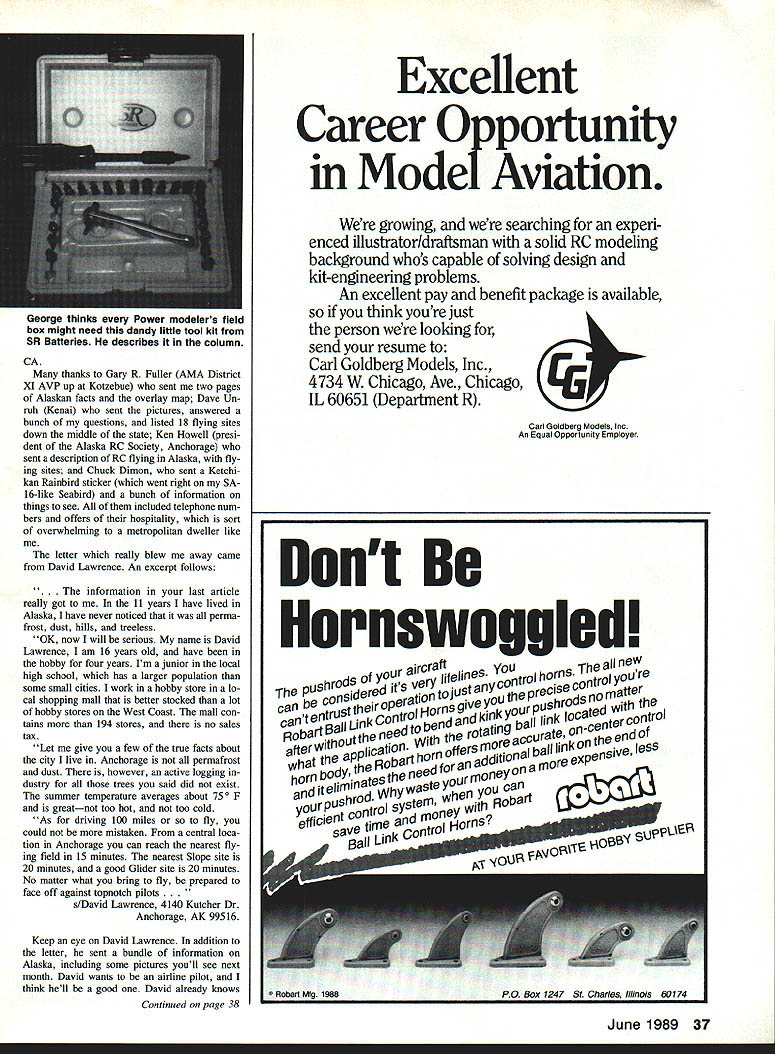
- Dave Unruh (Kenai) — sent pictures, answered questions, and listed 18 flying sites down the middle of the state.
- Ken Howell (president, Alaska RC Society, Anchorage) — sent a description of RC flying in Alaska and flying sites.
- Chuck Dimon — sent a Ketchikan Rainbird sticker (which went on my SA-16-like Seabird) and information on things to see.
All of them included telephone numbers and offers of hospitality, which is sort of overwhelming to a metropolitan dweller like me.
The letter which really blew me away came from David Lawrence. An excerpt follows:
"... The information in your last article really got to me. In the 11 years I have lived in Alaska, I have never noticed that it was all permafrost, dust, hills, and treeless.
OK, now I will be serious. My name is David Lawrence, I am 16 years old, and have been in the hobby for four years. I'm a junior in the local high school, which has a larger population than some small cities. I work in a hobby store in a local shopping mall that is better stocked than a lot of hobby stores on the West Coast. The mall contains more than 194 stores, and there is no sales tax.
Let me give you a few of the true facts about the city I live in. Anchorage is not all permafrost and dust. There is, however, an active logging industry for all those trees you said did not exist. The summer temperature averages about 75°F and is great — not too hot, not too cold.
As for driving 100 miles or so to fly, you could not be more mistaken. From a central location in Anchorage you can reach the nearest flying field in 15 minutes. The nearest Slope site is 20 minutes, and a good Glider site is 20 minutes. No matter what you bring to fly, be prepared to face off against top-notch pilots."
— David Lawrence, 4140 Kutcher Dr., Anchorage, AK 99516
Keep an eye on David Lawrence. In addition to the letter, he sent a bundle of information on Alaska, including some pictures you'll see next month. David wants to be an airline pilot, and I think he'll be a good one. David already knows that some Alaskans say, "One nice thing about Anchorage is that you can drive to Alaska from there."
I'll try to visit everyone, especially David, although Kotzebue may be out of the van's range. The only ways to get from Anchorage to Kotzebue (over 1,000 miles) are by airplane, behind a dog team, or on a boat (while the water is "soft"). Kotzebue (1985 population: 2,633) is near the Arctic Circle, on the Bering Sea coast.
I've recently read more than 30 books on Alaska, including James A. Michener's Alaska. If you only have time to read one book on Alaska, I recommend Adventuring in Alaska by Peggy Wayburn, Sierra Club Books, ISBN 0-87156-787-3 (paperback).
Single- and Dual-Conversion Receivers
Channel spacing and wideband vs. narrow-band
Our RC channels are now a nominal 10 kHz wide. They have to be: fifty RC channels alternate with fifty PRS channels in the 1,000 kHz from 72 MHz to 73 MHz, so the spacing between assigned channel frequencies is 1,000 ÷ 100 = 10 kHz.
In the real world both we and they can only move about halfway out from our assigned frequency (±5 kHz) if we want to avoid mutual interference. Actually, you want to leave a little room for error, so you move out less than ±5 kHz.
When someone asks you the difference between wideband and narrow-band RC radio, you can tell them that the old wideband channels were 20 kHz wide, and the new narrow-band channels are only 10 kHz wide.
Superheterodyning — the RX trick
Transmitters (TX) send out radio-frequency energy, and receivers (RX) take it in. Both TX and RX contain circuits that control the frequencies of transmission and reception. Because the channels are so close together in frequency, the RX needs a trick to separate them. That trick is called superheterodyning.
For convenience, let's label a system on RC38 at 72.550 MHz. The TX signal is modulated with our control information.
The RX crystal is part of a circuit called the Local Oscillator (LO). It is not tuned to 72.550 MHz. Instead it can be either ±455 kHz above or below the transmitted carrier. With a single-conversion 455 kHz IF RX (SC455; "IF" = intermediate frequency), for this example we choose to put the LO below the TX frequency, so the LO puts out an unmodulated signal at 72.095 MHz.
When the RX antenna picks up a modulated 72.550 MHz signal from the TX, that signal is mixed inside the RX with the unmodulated 72.095 MHz generated by the LO. The sum is at 144.645 MHz, and the difference is at 455 kHz. Both now carry the modulation (our control information). All of these signals are presented to the intermediate-frequency amplifier (IF), which has a very narrow pass band. The IF then selects the 455 kHz signal and rejects the others.
If the LO were instead above the TX frequency, the same 455 kHz IF component would be produced. That is why the image frequency can be a problem: an unwanted station at the image frequency can mix with the LO to produce a signal at the IF and cause interference.
Single-conversion (SC455) problems — the 23-channel (2IM) issue
Double modulation problems can occur when another transmitter is nearby on a different channel. For example, suppose someone comes on the air at RC15 = 72.090 MHz with a differently modulated signal. Our example receiver takes that signal in also and mixes it as before. One of the mixtures, RC38 − RC15 (72.550 − 72.090 = 0.460 MHz or 460 kHz), concerns us: the difference is doubly modulated (once by each transmitter). In this process, the RC15 transmitter at 72.090 MHz acts like the LO at 72.095 MHz. Worst of all, the result fits through the old 20 kHz wide gate very nicely.
This illustrates 2IM, the 23-channel problem for wideband SC455: RC38 minus RC15 equals a 23-channel spacing and can fall right into the IF passband. When both modulated signals pass through the IF amp, are decoded, and presented to the servo, the servo is confused by the mixture of modulations, and we have "interference." This becomes a problem for some wideband SC455 RX when the RC15 TX is a few feet closer to your airplane than your RC38 TX (by test, when the RC15 signal is +2 dBm to +5 dBm relative to your RC38 signal).
It is possible to build a narrow-band SC455 receiver, but the gate will have to be narrower than ±5 kHz in order to exclude the unwanted signal at 460 kHz.
There are also additional adjacent-channel mixtures. In the single-conversion example there can be other modulated signals at 445 kHz and 465 kHz that pass through the old wideband 20 kHz gate and cause even more interference.
Dual-conversion receivers — the solution
There is another way to deal with the problem: move the gate. A dual-conversion receiver does this by making the first conversion (first gate) occur at a high first IF, typically 10.700 MHz. The higher first IF moves the image frequency far away so it's easier to filter out. A second conversion then brings the signal down to a low IF (e.g., 455 kHz or lower) for narrow final filtering. Many modern receivers use combinations such as 10.7 MHz and 455 kHz for the two IFs.
With the first IF at 10.700 MHz, the 23-channel problem disappears because using a different LO separates that unwanted mixture signal by 0.510 MHz instead of by 0.005 MHz as before.
For example, the closest unwanted signal might be RC38.5 at 72.560 MHz. Mixing that with the first LO (61.850 MHz) yields 10.710 MHz (72.560 − 61.850 = 10.710 MHz). Assuming the first gate width = 20 kHz, it gets through the first gate. But when it reaches the second stage, the second local oscillator (operating at about 1.155 MHz in this scheme) moves the unwanted signal outside the second gate, which is now a 10 kHz wide narrow-band gate.
Thus the narrow-band, dual-conversion receiver rejects the 23-channel problem and the adjacent-channel problems that exist for the wide-band SC455 receiver. That is why Bob Abele identified a dual-conversion, narrow-band receiver as "the 1991 receiver."
Note that none of the above refers to AM or FM. There is no difference between them as far as this type of interference is concerned.
Tools — SR Batteries kit
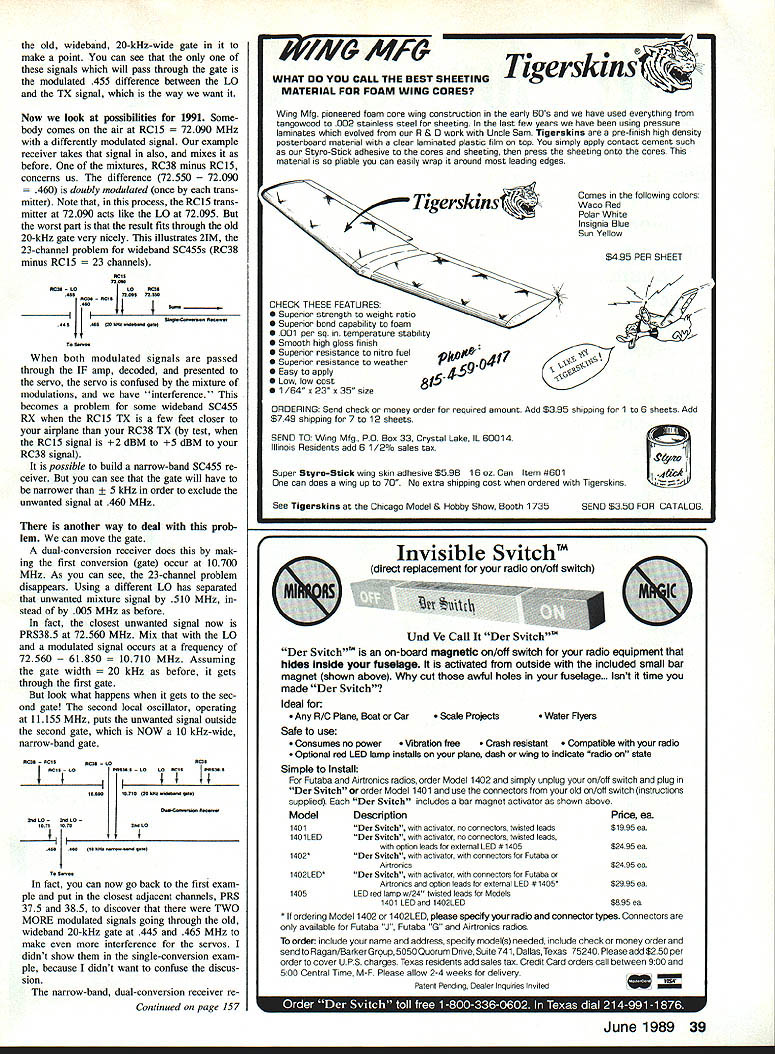
Larry Sribnick has done it again. Larry is a friend, and his firm, SR Batteries, Inc. (Box 287, Bellport, NY 11713; phone 516-286-0079; FAX 516-286-0901), is marketing a handy tool kit that consists of:
- a screwdriver-type ratchet,
- a ratchet handle,
- an assortment of 1/4-inch hex-shaft bits that will also fit a small electric screwdriver,
- two sizes of English hex keys (.050 in., 1/16 in., 3/32 in.),
- six sizes of metric hex keys (1.5 mm through 3 mm),
- an adapter for 1/4-inch square-drive sockets.
All components are hardened and blackened to resist rust, except for the ratchet handle (stainless steel) and the screwdriver handle (plastic). All tool bits have spring-loaded balls to lock them in place. An added setscrew in the socket of the screwdriver handle ensures you won't lose tool bits inside the model.
This is a perfect item for your tool kit so you can handle things like wheel collars, engine-mount bolts, etc. When I got my set I immediately filed two tabs off the screwdriver shaft so I can slip the ratchet handle thereon when I need a little extra torque on stuck screws. Replacement tool bits are available ($1 each) from SR Batteries.
Transcribed from original scans by AI. Minor OCR errors may remain.

