
George M. Myers 70 Froehlich Farm Rd., Hicksville, NY 11801
Radio Technique
Abstract
1989 FAI-CAT and the IAC Judges School described.
Back to school!
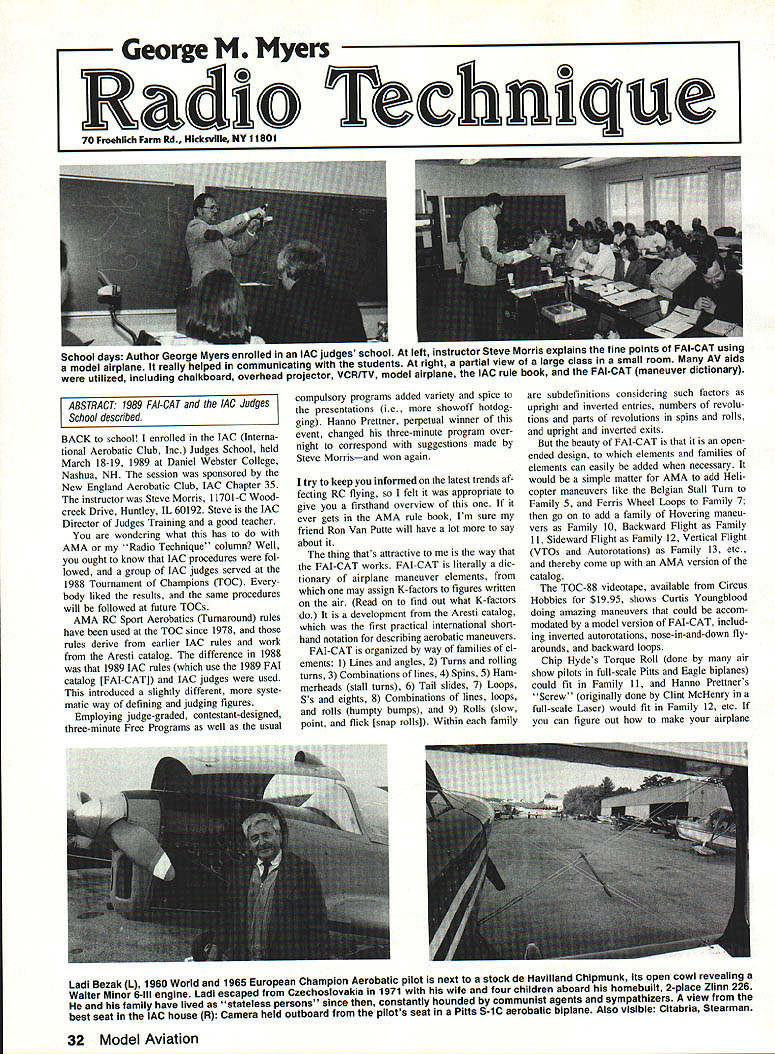
I enrolled in the IAC (International Aerobatic Club, Inc.) Judges School, held March 18–19, 1989 at Daniel Webster College, Nashua, NH. The session was sponsored by the New England Aerobatic Club, IAC Chapter 35. The instructor was Steve Morris, 11701-C Woodcreek Drive, Huntley, IL 60192. Steve is the IAC Director of Judges Training and a good teacher.
You are wondering what this has to do with AMA or my "Radio Technique" column? Well, you ought to know that IAC procedures were followed, and a group of IAC judges served at the 1988 Tournament of Champions (TOC). Everybody liked the results, and the same procedures will be followed at future TOCs.
AMA RC Sport Aerobatics (Turnaround) rules have been used at the TOC since 1978, and those rules derive from earlier IAC rules and work from the Aresti catalog. The difference in 1988 was that 1989 IAC rules (which use the 1989 FAI catalog [FAI-CAT]) and IAC judges were used. This introduced a slightly different, more systematic way of defining and judging figures.
Employing judge-graded, contestant-designed three-minute Free Programs as well as the usual compulsory programs added variety and spice to the presentations (i.e., more showoff hotdogging). Hanno Prettner, perpetual winner of this event, changed his three-minute program overnight to correspond with suggestions made by Steve Morris — and won again.
I try to keep you informed on the latest trends affecting RC flying, so I felt it appropriate to give a firsthand overview. If it ever gets into the AMA rule book, I'm sure my friend Ron Van Putte will have a lot more to say about it.
What is FAI-CAT?
FAI-CAT is literally a dictionary of airplane maneuver elements, from which one may assign K-factors to figures written on the air. It is a development from the Aresti catalog, and is the first practical international shorthand notation for describing aerobatic maneuvers.
FAI-CAT is organized by families of elements:
- 1) Lines and angles
- 2) Turns and rolling turns
- 3) Combinations of lines
- 4) Spins
- 5) Hammerheads (stall turns)
- 6) Tail slides
- 7) Loops & eights
- 8) Combinations (lines, loops, rolls — humpty bumps)
- 9) Rolls (slow point, flick/snap rolls)
Within each family are subdefinitions considering such factors as upright and inverted entries, numbers of revolutions, parts of revolutions in spins and rolls, and upright and inverted exits.
But the beauty of FAI-CAT is that it is an open-ended design, to which elements and families can easily be added when necessary. It would be a simple matter to add the Belgian Stall Turn to Family 5 and Ferris Wheel Loops to Family 7; then go on to add a family of Hovering maneuvers as Family 10, Backward Flight Family 11, Sideward Flight Family 12, Vertical Flight (VTOs and Autorotations) as Family 13, etc., thereby coming up with an AMA version of the catalog.
The TOC-88 videotape, available from Circus Hobbies for $19.95, shows Curtis Youngblood doing amazing maneuvers that could be accommodated by a model version of FAI-CAT, including inverted autorotations, nose-in-and-down fly-arounds, and backward loops. Chip Hyde's Torque Roll (done by many air show pilots in full-scale Pitts and Eagle biplanes) could fit in Family 11, and Hanno Prettner's "Screw" (originally done by Clint McHenry in a full-scale Laser) would fit in Family 12. If you can figure out how to make your airplane skim like a frisbee (which someone did in a Canberra jet, years ago), a way could be found to put a K-factor on it in Family 4.
The 1989 FAI-CAT is designed around capabilities of current, full-size, stiff-winged aircraft. Basically, it fits with variations of the Pitts and Laser theme. It only describes elements in the vertical and horizontal planes of motion, and only considers horizontal, vertical, and 45° lines on the vertical plane. IAC chooses to rule out repetitions of elements, so well-known maneuvers like the Cuban 8, AMA's Figure M, etc., are no longer seen in full-size aerobatic Compulsory or Free programs. For reasons of its own, IAC has also dropped barrel rolls and knife-edge flight from its competitions.
FAI-CAT is also used for full-scale sailplane aerobatic events, with appropriate adjustments in the grading to accommodate the lack of an engine. But since there aren't any full-size helicopter aerobatic competitions, the FAI-CAT for full-size machines doesn't need to consider helicopter maneuvers.
K-factors and examples
Elements vary in difficulty of performance, so relative difficulties (K-factors) are assigned to all elements. For example:
- Upright in a straight line at constant altitude carries a K = 2.
- An outside 1/2 snap roll from an upright attitude in the vertical U line, finishing in the upright attitude, earns K = 19.
- The same element finishing in an inverted attitude would be worth K = 17.
Don't start arguing about whether or not an airplane can adopt upright or inverted attitude on a vertical U line — you learn about such subtleties in the judge's school, and the FAI-CAT is arranged to accommodate them.
Torque rolls, Lomcevaks (I had a long talk with Ladislav Bezák, inventor of the Lomcevak, about the "why and how" of that maneuver), knife-edge spins, etc., are considered "non-judgable maneuvers" by IAC because they require extreme precision in their accomplishment and because small variations "going in" can produce large variations "coming out." Therefore, successful accomplishment of such maneuvers is considered to be a matter of luck as well as skill. The sport of acrobatic flying seeks to judge precision in completing predictable maneuvers, so K-factors are not assigned to the above in FAI-CAT. If AMA members want to judge such maneuvers, they could certainly be added to an AMA maneuver dictionary.
Why would AMA want a maneuver dictionary?
For the same reason that IAC has Free programs, and free skating has Free programs: there is always a desire to show personal creativity after being subjected to the rigors of competition in mandatory "school programs." In essence, all AMA Pattern contests consist entirely of "school figures," and the repetition is boring to spectators. Having an AMA maneuver catalog would encourage contestants to create programs with a wide variety of judgeable figures, creating a more interesting show than endless repetition of mandatory figures.
FAI-CAT tells you how to assign a K-factor to a figure after you have invented it. The IAC rule book tells you how to run a contest and how to grade a figure flown in the contest.
How to prepare for an IAC competition
IAC recognizes categories of proficiency for competitors:
- Basic
- Sportsman
- Intermediate
- Advanced
- Unlimited
A contestant (except in Basic category) constructs "figures" from FAI-CAT elements for his Free Program. For example, the figure commonly called an Immelmann consists of a half-loop up (2.1, K = 6) and a half-roll to exit in upright level flight (9.1.3.2, K = 4) for a total K = 10. The decimal numbers in parentheses are FAI-CAT numbers which locate particular elements in the catalog, and the corresponding K-factors.
Figures are judged in IAC competition, not elements. There is no limit to the number of elements which can be combined to create a figure, so long as you can keep it within the IAC's Aerobatic Zone, which measures 3,300 ft square and extends up to about 3,500 ft above ground level (AGL). The top of the zone is at 3,280 ft AGL for the Unlimited category (only). The bottom of the zone is set by category:
- Basic and Sportsman: 1,500 ft AGL
- Intermediate: 1,200 ft AGL
- Advanced: 800 ft AGL
- Unlimited: 328 ft AGL
An IAC sequence is a list of figures to be performed sequentially during one three-minute Free Program. Note: a sequence has a sum of K-factors appropriate to the category being flown. In order for someone on the ground to be able to judge how well the flier performs his Free Program, the timer must write on paper that which is to be performed. IAC provides Forms A, B, and C for the purpose. One judge must check each competitor's Free Program on Forms A, B, and C before the event. That involves a lot of work with FAI-CAT and an adding machine — for the judge and the competitor. The judge has to be familiar with FAI-CAT.
All IAC categories must fly Known Compulsory sequences, which are made up for each category and published early by the IAC. The difficulty in flying the Known Compulsory sequences increases from Basic to Unlimited. The first flight for each competitor is a Known Compulsory and is also a qualifying flight. If a majority of the judges votes that the competitor has not demonstrated the ability to safely control his aircraft, the competitor shall be disqualified from that category. AMA could do likewise.
A note: Model Aviation's "Competition Newsletter" section in the June 1989 issue (pages 139–140) describes the IMAC (International Miniature Aerobatics Club) and its compulsory sequences for 1989. Aresti diagrams are given with names of figures and K-factors. What I am discussing here has been used in the RC model world since 1974 — it's only new if you haven't heard about it before.
The IAC has no compulsory advancements in categories for competitors. The category a pilot flies is sometimes dependent on his airplane, because many airplanes are too weak (structurally) and lack sufficient power to perform Advanced and Unlimited category figures. The Unknown Compulsory is constructed by IAC headquarters and supplied to contest organizers for a particular contest.
Only pilots in the Unlimited category are allowed to perform a Graded Unlimited Four-Minute Free Program. This program is judged on:
- Originality (K = 60)
- Variety (K = 60)
- Harmony & Rhythm (K = 60)
- Execution (K = 0)
At modeling's TOC-88, figures such as the Hanno Screw, Torque Roll, Lomcevak, Knife-Edge Figure 8, and similar figures were used.
Contest logistics and insurance
With all the paperwork done, you can have an IAC contest — provided you have insurance. IAC has insurance, but the contest organizers must purchase air meet insurance, which covers the IAC, EAA (Experimental Aircraft Association), and NAA (National Aeronautic Association) as named insured. IAC is a division of EAA, which is a division of NAA — just like AMA.
After purchasing air meet insurance, the organizers must gather a few judges (a minimum of three judges is required for each category; five judges is the standard number; any larger number is acceptable), get a waiver from the FAA, arrange parking for contestants' airplanes, arrange lodging for contestants, provide snacks and a banquet, set up a computer, send out corner judges, check communications, post a schedule, heat up the coffee, and start the competition — if the weather cooperates.
Are your judges qualified?
The IAC Judges School consists of two long sessions (totaling about 15 hours in class), which give an overview of the contents of the IAC Official Contest Rules (105 pages), the 1989 FAI-CAT (which lists about 10,000 maneuver elements, with K-factors), and late revisions and amendments. At the end of the session, a videotape of actual aircraft doing maneuvers is shown to give the students some judging practice. Then there is a final exam, after which students receive Certificates of Attendance and the Judge's Home Study Course.
The final exam isn't really "final." The home study course contains the real final. Working with Ruth and Augie Bohne (who provided me lodgings during the school), we spent another 15 hours or so with the books, after which we completed our official final exams, which had to be mailed to the IAC Judges' Certification Chair, Chuck Mann, in Memphis, TN. Our exams were subsequently graded and returned to us.
So your next step is to join the IAC, and you are then a full-fledged judge, right? Wrong. Now you are qualified to be an assistant judge. An assistant judge must have:
- attended an approved judges' school or completed the home study course for the current year, or
- have previous competition aerobatic experience,
and must have the ability to read aerobatic competition sequences rapidly, be able to look up FAI-CAT numbers, and be able to follow the judge's instructions (which implies a language qualification).
You must perform as an assistant to a Grading Judge at three IAC-sanctioned events within 18 months before completing an application for a Regional Judge rating. Then you fill out a Regional Judge Application and request a National Judge, and/or another IAC judge (both of whom must be currently qualified) to administer an oral/written test, then sign and date your application. When that is done, your name is added to the IAC roster of Regional Judges, and you are issued a Regional Judge patch and card.
After you have served as a Regional Judge in at least seven contests within the previous 30 months (two of which must have included judging of Advanced or Unlimited categories), you fill out another Judge's Application Form, sit down with two National Judges for another oral/written exam, send in the signed and dated application to the IAC Judges' Certification Chairman, get added to the list of National Judges, and receive a patch, card, and copy of the "Guidelines for Chief Judges." (A Chief Judge is like a Contest Director in AMA.)
To retain certification as a judge, you must serve as a Grading Judge at two sanctioned events per year and pass the current year's "IAC Judges Revalidation and Currency Examination." The IAC current year begins January 1.
How much do you get paid for performing as an IAC-qualified and certified judge? Please take note that four stints of judging will involve travel to/from the event, meals and lodging, and sitting on the ground, staring up into the sky for about eight hours a day on a long weekend, plus the time spent before the event checking competitors' sequences with the FAI-CAT. You get ZIP! This is an all-volunteer effort. Everybody in the IAC is a volunteer except the editor of Sport Aerobatics (the newsletter of the IAC), just as Model Aviation is the newsletter of the AMA.
How the judging works
Each figure of a sequence starts with 10 points. Each Grading Judge deducts for changes in heading, changes in radius of loops, failure to follow the proper sequence, etc. The Chief Judge deducts for flying out of the Aerobatic Zone (commonly called "the box"), crossing the Deadline (which is also an FAI rule), etc. The result of these deductions is the raw score for each figure (from 0 to 10 points) recorded at the flight line. Later the raw score is multiplied by the appropriate K-factor to arrive at a raw score for the performance. The sum of the raw scores is the raw score for that flight sequence. Each judge also enters a judgment and signs the scorecard.
A separate factor called "Positioning" relates to where each figure was placed in the box. Positioning errors deduct points from the raw score.
In order to mitigate "favorite son" judging practices observed in certain Eastern Bloc judges at world competitions, the raw scores are next subjected to the IAC/Tarasov/Bauer-Long (TBL) statistical averaging system to produce the contestant's Final Score. Yes, this requires a desktop computer — and somebody knowledgeable to run it.
If you haven't already read the AMA 1988–89 Competition Regulations handbook (a.k.a. "the rule book"), available on request from AMA HQ, then you won't know how much of the above already exists in AMA competition. Take my word that FAI-CAT represents a logical extension — not a replacement for — the AMA's book.
A final word
"In conclusion, remember that you, as a Judge, are expected to grade only against one standard, and that is perfection. The performance of the aircraft or the difficulty in performing a figure (on the basis of your personal experience) in any given type of aircraft is not to be considered in formulating your grade.
"Do not be afraid to find fault with a competitor's flying, regardless of his or her name or reputation. As a Judge, this is your job."
Transcribed from original scans by AI. Minor OCR errors may remain.

