
Radio Technique
George M. Myers
ABSTRACT: Failsafe Flight System (FFS)
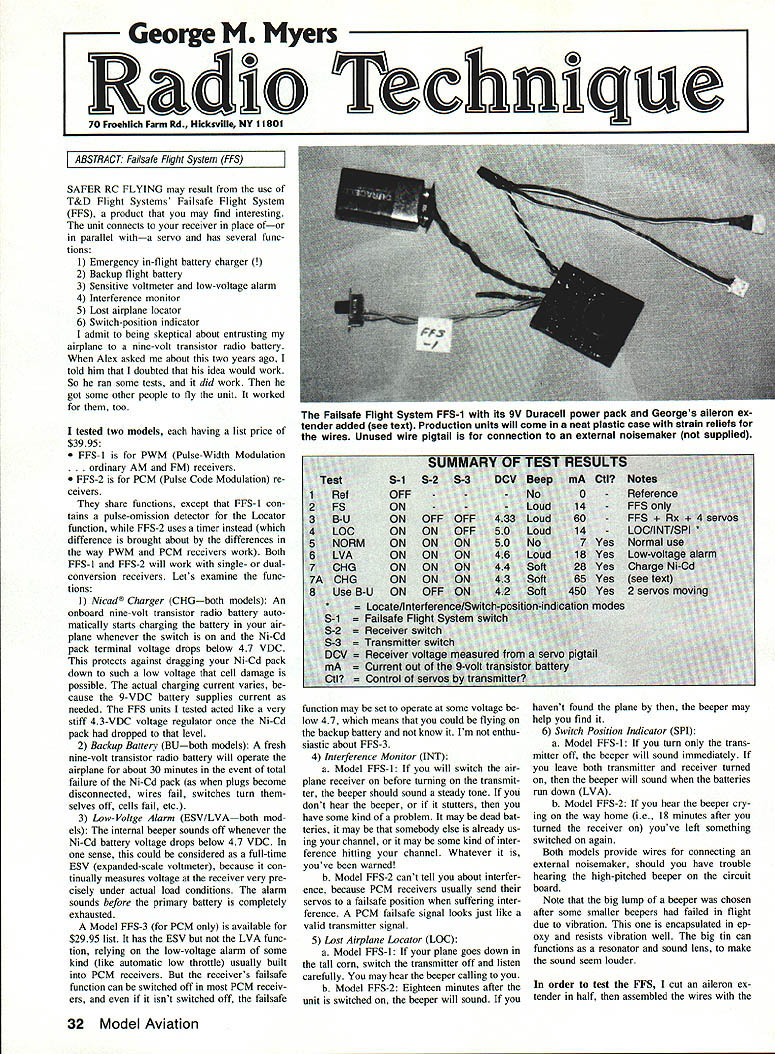
SAFER RC FLYING may result from using T&D Flight Systems' Failsafe Flight System (FFS). The unit connects to your receiver in place of—or in parallel with—a servo and provides several safety functions.
I tested two models (list price $39.95):
- FFS-1: for PWM (Pulse-Width Modulation — ordinary AM and FM) receivers.
- FFS-2: for PCM (Pulse Code Modulation) receivers.
They share most functions. FFS-1 contains a pulse-omission detector for the Locator function; FFS-2 uses a timer instead, reflecting differences in PWM vs. PCM receiver behavior. Both models work with single- or dual-conversion receivers.
Functions
- Nicad® Charger (CHG — both models)
- An onboard nine-volt transistor-radio battery automatically starts charging the airplane's Ni-Cd pack whenever the Ni-Cd pack terminal voltage drops below about 4.7 VDC. This helps prevent damaging deep discharge.
- Actual charging current varies; the 9 V battery supplies current as needed. In my tests the FFS units behaved like a stiff ~4.3 V regulator once the Ni-Cd pack fell to that level.
- Backup Battery (BU — both models)
- A fresh nine-volt transistor-radio battery will operate the airplane for roughly 30 minutes in the event of total primary-pack failure (e.g., disconnected plugs, wiring failure, switch off, cell failure).
- Low-Voltage Alarm / Expanded-Scale Voltmeter (ESV/LVA — both models)
- An internal beeper sounds whenever the Ni-Cd battery voltage drops below ~4.7 VDC. This serves as a continuous, load-tested voltmeter and warns before the primary battery is completely exhausted.
Model FFS-3 (PCM only, list $29.95) contains the ESV but not the LVA: it relies on the PCM receiver's own low-voltage/failsafe behavior. I am not enthusiastic about FFS-3 because some PCM receivers can mask a backup condition (failsafe signals can mimic valid transmitter signals), and receiver failsafe settings may be at voltages below the FFS alarm threshold.
Interference Monitor (INT)
- FFS-1: If you turn the airplane receiver on before the transmitter, the beeper should sound a steady tone. If the beeper is silent or stutters, that indicates a problem (dead batteries, another operator on your channel, or interference).
- FFS-2: Cannot reliably indicate interference because PCM receivers typically drive servos to a failsafe position when interference occurs; a PCM failsafe looks like a valid signal.
Lost Airplane Locator (LOC)
- FFS-1: If the plane goes down (e.g., in tall grass), switch the transmitter off and listen — the beeper may call you to the airplane.
- FFS-2: The beeper will sound about 18 minutes after the unit is switched on (or after the receiver is turned off, per the timer). This may help locate a downed airplane.
Switch-Position Indicator (SPI)
- FFS-1: If you turn only the transmitter off, the beeper sounds immediately. If both transmitter and receiver remain off, the beeper will sound when the batteries run down (LVA).
- FFS-2: The beeper will sound approximately 18 minutes after the receiver is left off or when something "twitches" again, alerting you that a switch has been left in the wrong position.
Both models provide leads for connecting an external noisemaker if the on-board high-pitched beeper is hard to hear. The large metal-can beeper was chosen after smaller units failed from vibration; it is epoxy-encapsulated for vibration resistance and uses the tin can as a resonator for louder sound.
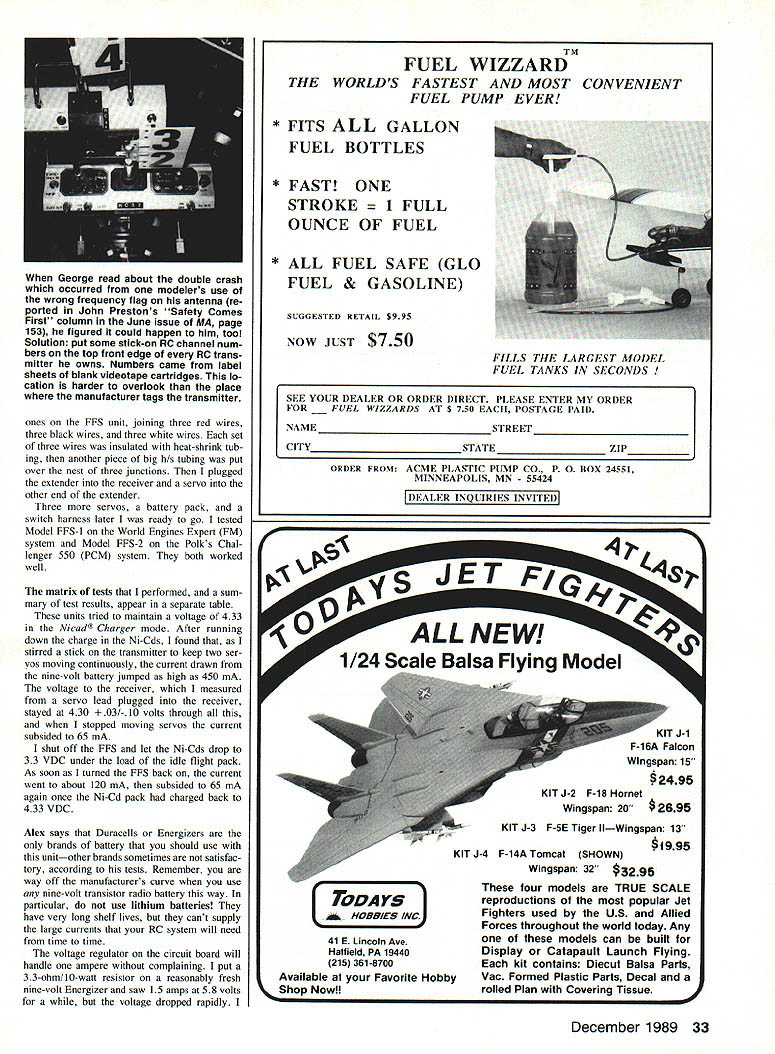
SUMMARY OF TEST RESULTS
Each test entry shows modes S-1/S-2/S-3, measured receiver voltage (DCV), beeper level, current draw from the 9 V battery (mA), whether transmitter controlled servos (Ctl?), and notes.
- Test 1 — Reference
- S-1: OFF, S-2: OFF, S-3: OFF
- DCV: 3.3 V
- Beep: No
- mA: 0
- Ctl?: —
- Notes: Reference
- Test 2 — Failsafe
- S-1: ON, S-2: ON, S-3: ON
- DCV: 3.3 V
- Beep: Low
- mA: 14
- Ctl?: Yes
- Notes: Reference
- Test 3 — Backup (B-U)
- S-1: ON, S-2: OFF, S-3: OFF
- DCV: 4.33 V
- Beep: Loud
- mA: 60
- Ctl?: —
- Notes: FFS + Rx + 4 servos
- Test 4 — Locator/Interference/SPI
- S-1: ON, S-2: ON, S-3: OFF
- DCV: 3.3 V
- Beep: Low
- mA: 14
- Ctl?: —
- Notes: LOC/INT/SPI
- Test 5 — Normal use
- S-1: ON, S-2: ON, S-3: ON
- DCV: 5.0 V
- Beep: No
- mA: 7
- Ctl?: Yes
- Notes: Normal use
- Test 6 — Low-voltage alarm (LVA)
- S-1: ON, S-2: ON, S-3: ON
- DCV: 4.6 V
- Beep: Loud
- mA: 18
- Ctl?: Yes
- Notes: Low-voltage alarm
- Test 7 — Charging Ni-Cd (CHG)
- S-1: ON, S-2: ON, S-3: ON
- DCV: 4.4 V
- Beep: Soft
- mA: 28
- Ctl?: Yes
- Notes: Charge Ni-Cd
- Test 8 — Use Backup with servos moving
- S-1: ON, S-2: OFF, S-3: OFF
- DCV: 4.2 V
- Beep: Soft
- mA: 45
- Ctl?: —
- Notes: 2 servos moving
Abbreviations:
- S-1 = Locate / Interference / Switch-position indicator modes
- S-2 = Failsafe Flight System switch
- S-3 = Receiver switch
- DCV = Receiver voltage measured from a servo pigtail
- mA = Current out of the 9-volt transistor battery
- Ctl? = Control of servos by transmitter?
Test procedure and observations
- Installation: I prepared an aileron extender by cutting it in half, wiring the FFS pigtail, and plugging into the receiver and a servo. I added three more servos, a battery pack, and a switch harness.
- Systems tested: FFS-1 on a World Engines Expert (FM) system; FFS-2 on a Polk's Challenger 550 (PCM) system. Both worked well.
- Voltage regulation and current: In Nicad Charger mode the units tried to maintain ~4.33 V. Under continuous two-servo motion the 9 V battery current spiked as high as ~450 mA; receiver voltage (measured at a servo lead) stayed about 4.30 V with variations within a few hundredths to a few tenths of a volt. When servos stopped, current dropped to ~65 mA.
- Restart behavior: After discharging the Ni-Cd pack to about 3.3 V and switching the FFS back on, current climbed to ~120 mA while the pack recharged, then subsided to ~65 mA when the pack reached ~4.33 V.
Battery recommendations and capacity notes
- Use Duracell or Energizer nine-volt alkaline batteries—other brands may be less satisfactory. Do not use lithium nine-volt batteries; they have high shelf life but cannot supply the high current bursts the RC system may require.
- Do not substitute rechargeable nine-volt batteries blindly. Some rechargeables deliver higher surge current but lower usable capacity and will run down faster.
- The FFS board regulator will handle about 1 A continuously. In one bench test I saw ~1.5 A briefly with a heavy load, but voltage fell rapidly under that strain.
- Duracell MN1604 data (as provided by the manufacturer) indicate about 552 mAh capacity under light loads; typical quoted behavior was ~14 mA average into a 510-ohm load for ~40 hours. From test data, a fresh nine-volt should run the FFS ~40 hours in Lost Airplane Locator mode.
- Alex Kronfeld's claim of ~30 minutes emergency operation on a fresh battery is a conservative and reasonable estimate for powering servos in backup mode under typical loads.
- Battery replacement guidance: the unit will show backup servos slowing as nine-volt voltage approaches the seven-volt level—use this as a practical cue to replace the battery. If you want to preserve at least five minutes of backup time, retire the battery when it drops to ~7.2 V.
Options, variants, and scaling
- Units tested were configured to support up to four Ni-Cd packs. If you use five-cell packs or higher-capacity servos, T&D will configure cutoff voltages or a larger regulator accordingly.
- Planned variant: B-5-1 (boat failsafe) — list $39.95 — will include a two-amp regulator and a jumper for four/five Ni-Cd cells, but will omit locator and PCM-specific functions; usable with PWM or PCM.
Conclusions and final notes
The Failsafe Flight System is small (about 1.5 in. square), light (less than one ounce), inexpensive, and has low operating current (~7 mA). Used with fresh nine-volt alkaline batteries and with normal preflight checks (servo and rate checks, interference check), the unit performs as claimed and can provide useful backup charging, backup power, low-voltage warning, interference monitoring (PWM models), lost-airplane locating, and switch-position indication.
Failsafe Flight System — $39.95 list from T&D Flight Systems, P.O. Box 1782, Staten Island, NY 10314. For additional information call Alex Kronfeld at 1-718-894-9121.
Transcribed from original scans by AI. Minor OCR errors may remain.

