
Radio Technique
George M. Myers
70 Froehlich Farm Rd., Hicksville, NY 11801
Abstract
- Safe practices for water flying.
- Waterproofing RC systems.
- Solar flares in 1991.
This is a true story. The RC flier is a young man, in excellent physical condition, a strong swimmer, and trained in water rescue techniques.
"It had been raining fairly steadily, and I was getting pretty wet, as was my transmitter. Suddenly, my model rolled over and spun down into the salt water, where the tide was going out at full flow. The opposing wind kept the model essentially stationary, and only about 30 ft. out.
"The temptation was too much, so I waded out towards my model. Suddenly, I was really in over my head. While it was an easy swim out to the model, I discovered that I was being carried out to sea very rapidly, because the wind wasn't helping me at all. The channel widens as it approaches open water, which made it imperative that I get back to shore, pronto! Remember, I started only 30 ft. from shore, but my strongest rescue stroke was inadequate to get me back while pushing the plane.
"The recent death of a windsurfer flashed through my mind. He, in similar circumstances but dressed in a full dry suit, was swept out to sea on his board. Apparently he kept paddling until exhausted, then perished from hypothermia.
"After discarding the model, I easily made the beach, though several hundred feet downstream from my point of entry. I made my way back to my abandoned clothing, dressed, and turned off the transmitter. Then I turned it on again and observed that the needle pegged full right, and sagged down to midscale. After doing this a few times, the needle wouldn't move at all.
"The next day, after recharging the batteries, I found that they checked out okay, but the transmitter was defunct. My theory is that the rain got into the transmitter and shorted something. What do you think?"
I don't know what caused the crash, but at least four possibilities come to mind. The first is battery exhaustion or failure. Failure happens. Exhaustion also happens, but a little routine testing and charging can keep it under control.
The next possibility is that water got into the transmitter, as the reader suggests. The standard prevention for that is to carry some plastic garbage bags in your field kit. When it rains, punch a small hole in the bottom of a bag, then slip it over your transmitter's antenna. A little tape around the hole can seal out water. Now the transmitter will stay dry so long as you keep the antenna up and your hands (which go inside the bag to work the sticks) dry.
Waterproofing and corrosion protection
If the modeler makes a regular practice of flying off salt water, then both the transmitter and the airborne systems must be protected from corrosion. Corrosion is insidious. Salt water can get inside the plastic insulation on your wiring, which then acts like a capillary to wick the salt up inside your equipment. Then you find corrosion in all sorts of unexpected places.
You can use Krylon spray on most printed circuit boards without creating any problems. Don't spray any Krylon on the little brushes that are supposed to ground the back of your transmitter to the rest of the circuit, or on any plugs or sliding contacts (like trim and control potentiometers on the PC board, or on the control sticks).
It is remotely possible that too much Krylon on the heat sink for your power transistors might cause them to overheat. So, mask the fins with tape before spraying.
You can spray WD-40 on the plugs to keep water out and still permit them to be unplugged when necessary. I have used WD-40 on my boats for at least 10 years and have yet to see a first-contact corrosion problem. I have also seen unprotected wiring on other boats corrode away in a week. Switches are particularly susceptible to fuel and saltwater corrosion damage. I generally dislike working an internal switch by way of a pushrod that sticks out of the fuselage. For seaplanes, another way to protect them (compliments of my friend Wally Zober) is to put a wad of ordinary modeling clay or Plasticene over the switch after you turn it on. A wad over the charging jack, if you have it mounted in the fuselage side, is also a good idea.
If you even think that there might be a possibility that you will use your RC equipment in a corrosive environment, the time to install protection is right after you have flown the system and are satisfied with the way it works, and/or the warranty has expired. If the warranty hasn't expired but you are installing the equipment in a seaplane, then waterproof it first. Remember to check every function after you waterproof your equipment — something might not work.
If you are unfortunate enough to dunk your equipment in salt water, the next thing to do is soak it in clean fresh water to get the salt off. Then carefully dry it before you turn it on.
Drying, handling, and checking equipment
Let me make a point about the sensitivity of modern electronics: CMOS (complementary metal-oxide-semiconductor) chips—those black, multipronged things on the circuit board—are so sensitive that they can be destroyed by just the static electricity on your body, should you pick one up the wrong way. Once they are installed in a PC board they are less susceptible to such damage, so you can handle the board from any source of electric power (i.e., DON'T TURN IT ON!) while it is wet with salt water.
A proper job of drying will take days, not hours. There are many ways to do things. You can use a hair dryer . . . very carefully. Too much heat is worse than none at all. A safer way would be to open up the boxes and let an electric fan blow over them for a while. So long as no parts blow away, the potential for creating further damage is minimal.
When things are dry (a couple of days later, remember), check the parts out, one at a time. Practically all modern servos are gasketed, so they probably wouldn't get wet in a casual dunking. But remember about salt water wicking up inside the pigtail wires. WD-40 will help prevent that. Receivers, battery packs, and switch harnesses in particular get wet all the time and should be carefully checked.
As for the reader's transmitter that died, I have no idea when or why it died. It may well be that it died just before the crash; and it may be that it would have done so, rain or no rain. We've heard of acid rain killing lakes and trees. Who knows? Maybe it kills transmitters, too. Acid conducts electricity, you know. Think about the lead/acid battery in your car. That little bit of sulfuric acid conducts a lot of electricity!
Retrieving the model and personal safety
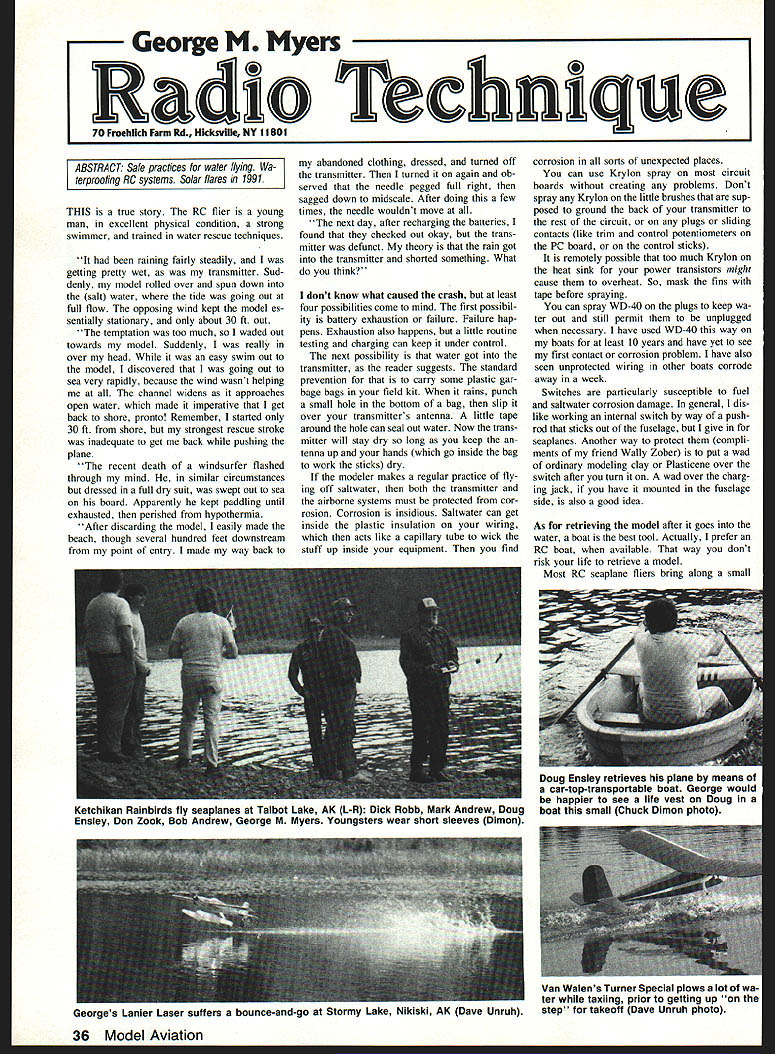
As for retrieving the model after it goes into the water, a boat is the best tool. Actually, I prefer an RC boat, when available. That way you don't risk your life to retrieve a model.
A boat can be carried on a car top and rowed out to the plane. Any boat small enough to be put on a car top is also a boat a man can fall out of. Wear a life jacket in a small boat. Nobody breathes water.
Some people depend on inflatable life-raft-type boats. In cold, wet, slow, or severely disturbed wind they are miserably poor. For rowboats a life jacket is particularly necessary.
It may seem like overkill, but when I go water flying I have (and wear) a fisherman's life vest, which has pockets and special reflective fabric patches. The pockets contain a set of emergency signaling tools:
- aerial flares
- smoke bomb
- dye marker
- mirror
- whistle
- 50 ft. of 1/8-in. nylon cord (for throwing to a boat or to people on shore)
People can be awfully slow-witted when they see someone in trouble. A little emphatic signaling can get them in the mood to help you. Think what my reader could have done with 50 ft. of cord.
Solar flares and radio interference (1991)
Solar flares are nuclear explosions in the sun. They emit radio waves. This goes on all the time, but our atmosphere and the magnetic field of the earth protect us from most of the effects. People in Alaska see the effects as northern lights (aurora borealis).
Darrel Kline (AMA 84898, out in Everett, WA) sent me a clipping to remind me that every 11 years the solar flare activity of the sun reaches a peak. According to NOAA (the National Oceanographic and Atmospheric Administration), solar flare activity will peak in 1991.
We can expect interference complaints from all sorts of RC'ers in 1991. Part of the reason is that the AMA will then sanction use of all 60 RC channels for aircraft. Therefore, the frequency spacing between RC transmitters in use will be 20 kHz, instead of the 40 kHz between RC systems that is now.
Part of the complaints will come from people clinging to outmoded wideband equipment. Other complaints will be traceable to interference from commercial transmitters that are (and have been since 1983) only 10 kHz away from all of our RC channels.
What's left may be traceable to solar flare emissions. You may notice glitches. People watching TV on channels TV2, TV4, and TV5 will be seeing snowy pictures, loss of color, and wavelike interferences crawling over the screen.
For what it is worth, you could take a portable TV to the field with you and use it as a monitor. If you see the above disturbances on the screen, it might serve as a warning not to fly that scale model that you have spent a year decorating.
Our RC channels are located, frequency-wise, between broadcast TV channels TV4 and TV5 (which should not be confused with cable channels 4 and 5).
Cable TV will be affected by occasional blackouts during the year of the solar flares.
Transcribed from original scans by AI. Minor OCR errors may remain.

