
George M. Myers 70 Froehlich Farm Rd., Hicksville, NY 11801
Radio Technique
ABSTRACT: Battery and charger basics.
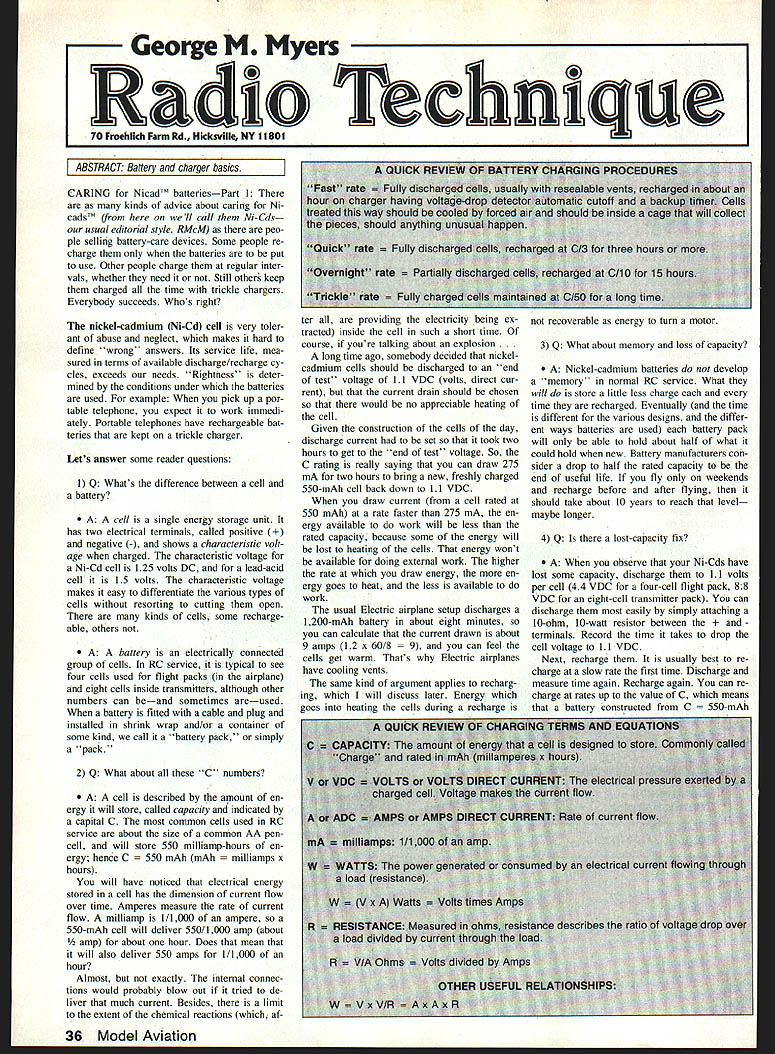
Caring for Ni-Cd batteries — Part 1: There is as much advice about caring for nickel‑cadmium (Ni‑Cd) batteries as there are people selling battery‑care devices. Some people recharge them only when the batteries are to be put to use. Others charge them at regular intervals, whether they need it or not. Still others keep them charged all the time with trickle chargers. Everybody succeeds. Who's right?
The Ni‑Cd cell is very tolerant of abuse and neglect, which makes it hard to define a single "wrong" answer. Its service life, measured in available discharge/recharge cycles, exceeds most needs. "Rightness" is determined by the conditions under which the batteries are used. For example, when you pick up a portable telephone, you expect it to work immediately. Portable telephones have rechargeable batteries that are kept on a trickle charger.
Let's answer some reader questions:
- Q: What's the difference between a cell and a battery?
A: A cell is a single energy storage unit. It has two electrical terminals, called positive (+) and negative (–), and shows a characteristic voltage when charged. The characteristic voltage for a Ni‑Cd cell is about 1.25 V DC, and for a lead‑acid cell it is about 1.5 V. The characteristic voltage makes it easy to differentiate cell types without cutting them open. There are many kinds of cells, some rechargeable and some not.
A battery is an electrically connected group of cells. In radio control (RC) service, it is typical to see four cells used for flight packs (in the airplane) and eight cells inside transmitters, although other numbers can be used. When a battery is fitted with a cable and plug and installed in shrink wrap and/or a container, we call it a "battery pack," or simply a "pack."
- Q: What about all these "C" numbers?
A: A cell is described by the amount of energy it will store, called capacity and indicated by a capital C. The common AA‑sized cells used in RC service will typically store about 550 milliamp‑hours; hence C = 550 mAh (mAh = milliamps × hours).
Electrical energy stored in a cell has the dimension of current flow over time. Amperes measure the rate of current flow. A milliamp is 1/1,000 of an ampere, so a 550‑mAh cell will deliver 550/1,000 amp (about 0.55 A) for about one hour. That does not mean it will deliver 550 A for 1/1,000 hour — internal connections and the limits of the chemical reactions prevent that, and extreme currents can cause damage or explosion.
Historically, Ni‑Cd cells were discharged to an "end‑of‑test" voltage of 1.1 V DC. The discharge current was chosen so there would be no appreciable heating of the cell; given the cell construction of the day, the current was set so it took two hours to reach 1.1 V. Thus, the C rating implies that you can draw 275 mA for two hours from a new, fully charged 550‑mAh cell to bring it down to 1.1 V DC. If you draw current faster than that, some energy is lost as heat and the available capacity is reduced. The higher the discharge rate, the more energy is wasted as heat.
Example: In a typical electric airplane, a 1,200‑mAh battery discharged in about eight minutes draws approximately 9 A (1,200 × 60 / 8 = 9,000 mA = 9 A). Cells will feel warm; over short times the energy recoverable to turn the motor is reduced, hence the need for cooling vents.
- Q: What about memory and loss of capacity?
A: Ni‑Cd batteries do not develop a "memory" in normal RC service. What happens is gradual loss of capacity: each recharge cycle may leave the battery holding a little less charge. Eventually — depending on design and usage — a pack may only hold about half of its original capacity. Manufacturers consider a drop to half the rated capacity the end of useful life. If you fly every weekend and recharge before and after flying, it might take around ten years to reach that level, perhaps longer.
- Q: Is there a lost‑capacity fix?
A: Yes. When your Ni‑Cd pack has lost capacity, discharge it to 1.1 V per cell (for a four‑cell pack this is 4.4 V DC; for an eight‑cell pack, 8.8 V DC). You can discharge by attaching a 10‑ohm, 10‑watt resistor between the + and – terminals and recording the time to reach 1.1 V per cell. Then recharge — usually best at a slow rate for the first time. Discharge and measure again; recharge and repeat. You can recharge at rates up to the value of C (for a 550‑mAh cell that means 550 mA). Repeat the discharge/recharge cycle five times.
If you record battery capacity each time you discharge, you may see recovery: a pack that held 50% of rated capacity before the procedure may hold 75% to 95% afterward. This recovery is normal but usually will not return a pack to 100% of its original capacity. New packs always hold more than used packs. If you start at 50% and see no recovery after the cycles, the cells should be discarded.
- Q: How about the "neglect factor"?
A: Cells left idle for a long time (for example, over the winter) may not accept a full charge on the first recharge. Cycle them as described above and many will recover.
Example: I recently reactivated several "carpet racer" packs that had been idle for at least ten years. The packs were six‑cell, 1,200‑mAh packs. After repeated cycles (charge/discharge) the typical progression was: 10 minutes after the first charge, 30 minutes after the second, 60 after the third, 80 after the fourth, and 90 minutes after the fifth. Ninety minutes' discharge at an average ~8 V into a 10‑ohm resistor equals about 1,200 mAh, so these idle packs recovered to rated capacity in five cycles. For those tests, recharging was done at about 900 mA for ~90 minutes using a fast charger with VDD (voltage‑drop detection, also known as "peak detection").
- Q: How about the "overcharging factor"?
A: Repeated overcharging is a common cause of Ni‑Cd pack failure in RC service. Evidence of overcharging is visible when a pack is taken apart: the seal and end of an overcharged cell will have white, green, or brown powder in the grooves. That powder indicates the plastic seal under the end cap has been punctured, usually from excessive internal gas pressure caused by overcharging — particularly at high rates.
Once the seal is punctured, moisture can escape and cause corrosion of internal wires inside the insulation. This corrosion can prevent solder from sticking when repairing cells. In severe cases, plug pins and connectors will corrode (often green through the plating). Replace the battery cable whenever you replace a battery.
- Q: Which is the right charger to use?
A: Simple: use the charger that came with the system. Overcharging is more likely with "fast" chargers (those that recharge a cell in less than an hour), but even an "overnight" charger can overcharge if you keep putting back more than you take out.
Chargers are rated by the current they deliver, not by how long they take to recharge a battery. To know what you’re doing, use an ammeter: put one charger lead in series with the pack and read charging current.
Example calculations:
- A charger that puts out 45–55 mA would be rated about C/10 for an AA‑sized pencell pack rated 450–550 mAh (450/45 = 10; 550/55 = 10). Such a charger is called a C/10 or "overnight" charger.
- The same charger on a 100‑mAh micro‑pack would be C/2 (100/50 = 2).
- On a 4,000‑mAh D‑cell, the same charger would be C/80 (4,000/50 = 80).
Historically, a C/10 charger left connected overnight (on the order of 15 hours) would fully charge a discharged cell. Modern Ni‑Cd cells tolerate some overcharge; a little overcharge helps "level" the pack so all cells reach the same final voltage. Charging at C/10 over a weekend generally did not damage cells. However, leaving a cell at C/10 for months can show signs of overcharging; at C/50 (trickle) the pack retains charge without the bad effects. A proper trickle charger must be applied only to a fully charged pack, because its rate is only fast enough to make up self‑discharge losses.
Fast charging (C/3 or higher) was developed to shorten charging times. Charging at C/3 will recharge cells in about three hours without producing signs of overcharge. Very high‑rate "dump" chargers can be dangerous; sealed cells can vent or explode. Consumer cells have resealable vents to reduce explosion risk, but severe overcharging will permanently eject electrolyte and reduce capacity.
Fast‑charge cells were developed with spring‑loaded resealable vents and can be recharged very quickly (for example, 15 minutes at 4C), but they self‑discharge more rapidly and are still vulnerable to severe overcharge. Rechargeable cells are electrochemical devices using a potassium hydroxide electrolyte and reversible chemistry. Slow charging (C/3 or less) allows evolved gases to be reabsorbed; overcharging produces oxygen faster than it can be reabsorbed, increasing pressure and venting, which reduces cell capacity.
To avoid overcharging, most fast chargers specify use only on discharged cells and include timers that cut off before a full overcharge. Many chargers include VDD (voltage‑drop detection or peak detection) to sense the small terminal voltage drop when a cell finishes charging; VDD adds protection against overcharging.
A Quick Review of Battery Charging Procedures
- Fast rate: Fully discharged cells (usually with resealable vents) recharged in about an hour on a charger with voltage‑drop detector automatic cutoff and a backup timer. Cells treated this way should be cooled by forced air and should be inside a containment cage to collect pieces if anything unusual happens.
- Quick rate: Fully discharged cells recharged at C/3 for three hours or more.
- Overnight rate: Partially discharged cells recharged at C/10 for ~15 hours.
- Trickle rate: Fully charged cells maintained at about C/50 for a long time.
A Quick Review of Charging Terms and Equations
- C = capacity (mAh)
- V or VDC = volts, direct current
- A or ADC = amps, direct current
- mA = milliamps (1/1,000 of an amp)
- W = watts (power)
- W = V × A (watts = volts times amps)
- R = resistance (ohms)
- R = V / A (ohms = volts divided by amps)
Other useful relationships:
- W = V × V / R = A × A × R
Cells can be recharged at rates up to C (for a 550‑mAh cell, that is 550 mA). Repeat the discharge/recharge procedure five times when attempting capacity recovery.
Next month we will discuss some real‑life chargers of the fast, quick, and trickle persuasions.
Transcribed from original scans by AI. Minor OCR errors may remain.

