
George M. Myers
70 Froehlich Farm Rd., Hicksville, NY 11801
ABSTRACT: CaRa Automatic Cycler-Charger; danger of "even channels only" thinking; caring for Ni-Cd batteries — Part 3, Quick Chargers.
Radio Technique
By way of review
There are four types of chargers for Ni-Cd batteries: Fast, Quick, Over-night, and Trickle. You can't know what kind of charger you are dealing with until you know two things:
- The current the charger is putting into your battery.
- The capacity of a cell, represented by C and measured in ampere-hours (or milliampere-hours for small cells).
Charge rates in the range C/3 to C/6 define the Quick Charge situation. A Quick Charger will recharge a Ni-Cd pack in three to six hours. This rate is preferred by some engineers because it is faster than normal, yet produces less heat and presents less risk of damaging Ni-Cd cells by causing them to vent than does Fast Charging.
Charging is an electrochemical process that generates gas and is exothermic (it gives off heat). Both gas pressure and heat are functions of the charging rate, and maximum pressures and temperatures are determined in part by the way the cells are constructed. The higher the rate, the greater the risk.
Simply stated: if you don't know how your cells are constructed, then Quick Charging is safer than Fast Charging when you are in a hurry.
As a general rule, battery packs should always be removed from the equipment whenever they are being charged. Things can go wrong with the best equipment. Removing the batteries during charging limits the possibility of contingent damage.
I remember when a friend bought five fancy new chargers. One day he came home to find five transmitters with distorted cases because something had happened to all five chargers while he was away. We later figured out that his chargers were on the same line as the washing machine, and line surges had damaged the electronics in the chargers. It was a generic weakness and happened in the days before cheap surge suppressors were available.
Today you can buy good surge suppressors practically anywhere for less than $20 — and you should. Surge suppressors aren't just to protect computers. Use them for any kind of electronic equipment: VCRs, automatic battery chargers — even the simple charger that came with your RC system provides virtually no protection against surges. A lightning strike on the power lines near your house while you have everything plugged into the charger could damage the whole RC system.
It is also a good idea to add fused and grounded plugs to metal-cased equipment that doesn't provide adequate internal fuses. If you work over a concrete floor or near grounded metal (like a water pipe), then a ground-fault interrupter (GFI) 110-VAC wall socket is a good investment. It will cost about $12 at Sears but could save your life. I have them in my bathroom and in the kitchen over the metal sink.
That said, the CaRa Automatic Cycler-Charger is internally protected against surge currents.
CaRa Automatic Cycler-Charger
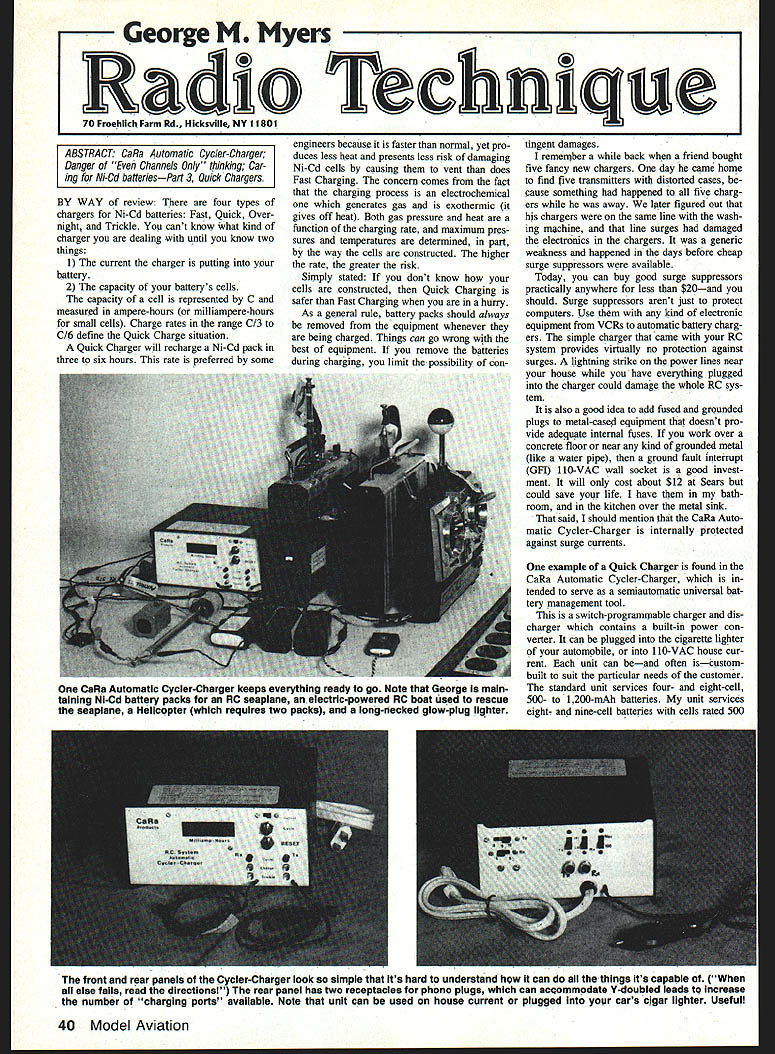
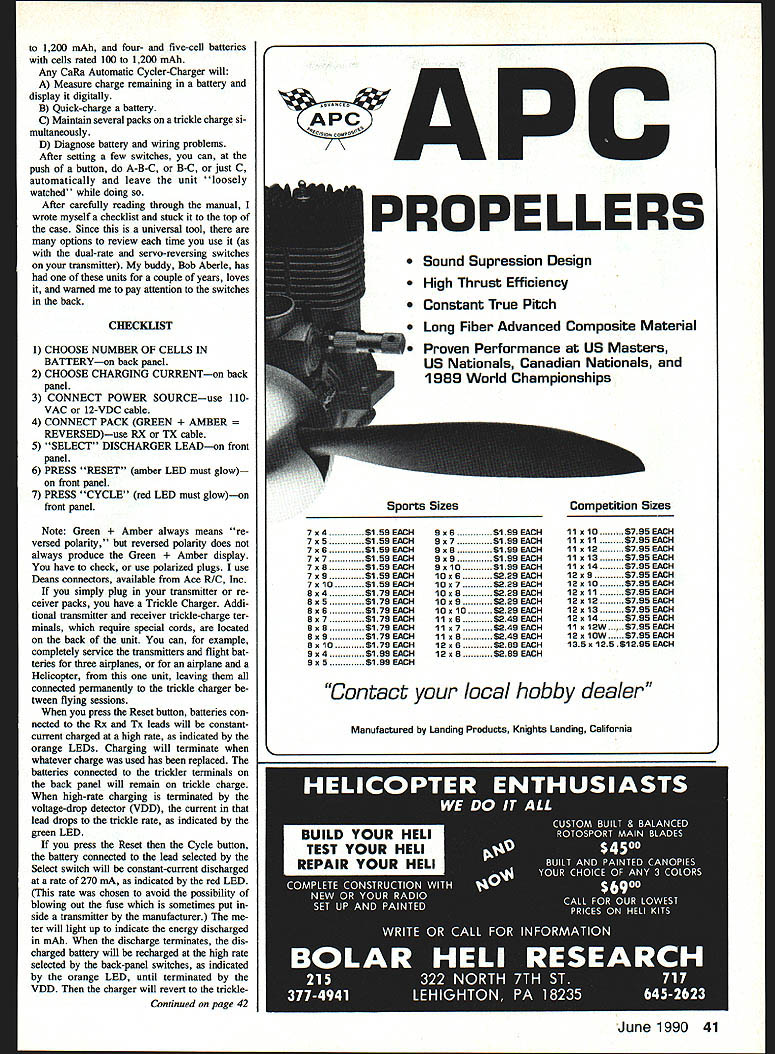
One example of a Quick Charger is the CaRa Automatic Cycler-Charger, intended as a semiautomatic universal battery management tool.
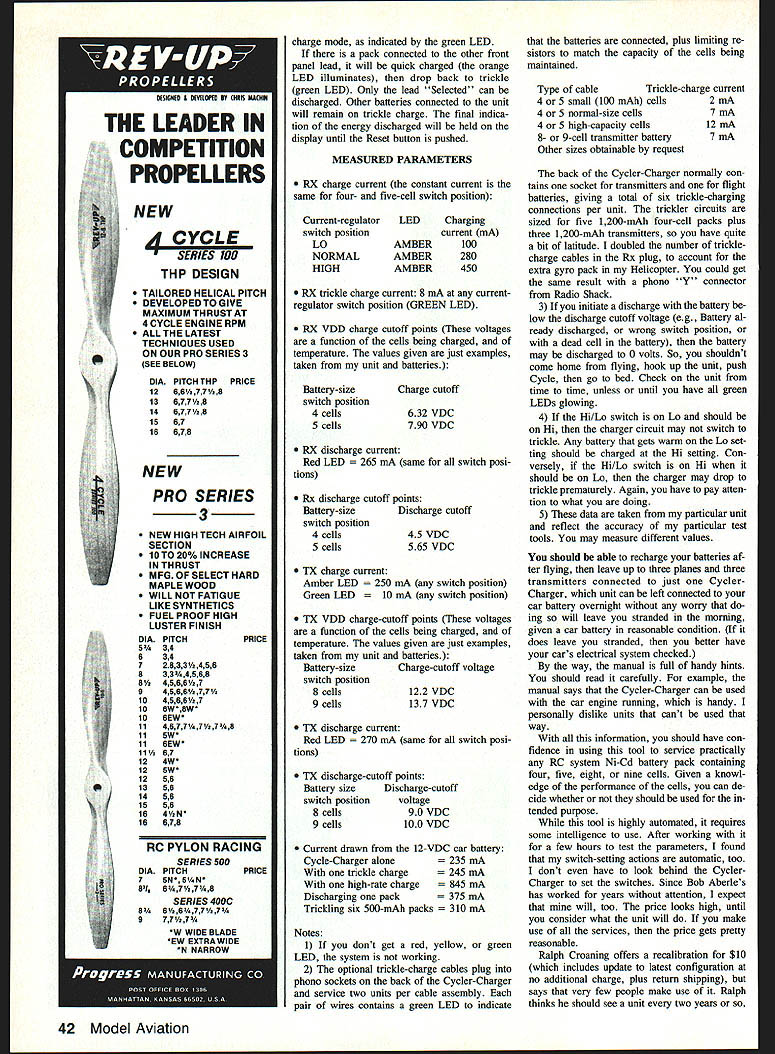
This is a switch-programmable charger and discharger containing a built-in power converter. It can be plugged into your automobile cigarette lighter or into 110-VAC house current. Each unit can be — and often is — custom-built to suit the customer's needs. The standard unit services four- and eight-cell, 500–1,200 mAh batteries. My unit services eight- and nine-cell batteries with cells rated 500–1,200 mAh.
Any CaRa Automatic Cycler-Charger will:
- A) Measure charge remaining in a battery and display it digitally.
- B) Quick-charge a battery.
- C) Maintain several packs on a trickle charge simultaneously.
- D) Diagnose battery and wiring problems.
After setting a few switches, you can, at the push of a button, do A–B–C, B–C, or just C automatically and leave the unit "loosely watched" while doing so.
After carefully reading the manual, I wrote myself a checklist and stuck it to the top of the case. Since this is a universal tool, there are many options to review each time you use it (as with the dual-rate and servo-reversing switches on your transmitter). My buddy Bob Aberle has had one of these units for a couple of years, loves it, and warned me to pay attention to the switches in the back.
CHECKLIST
- CHOOSE NUMBER OF CELLS IN BATTERY — on back panel.
- CHOOSE CHARGING CURRENT — on back panel.
- CONNECT POWER SOURCE — use 110-VAC or 12-VDC cable.
- CONNECT PACK (GREEN + AMBER = REVERSED) — use RX or TX cable.
- "SELECT" DISCHARGER LEAD — on front panel.
- PRESS "RESET" (amber LED must glow) — on front panel.
- PRESS "CYCLE" (red LED must glow) — on front panel.
Note: Green + Amber always means "reversed polarity," but reversed polarity does not always produce the Green + Amber display. You have to check, or use polarized plugs. I use Deans connectors, available from Ace R/C, Inc.
If you simply plug in your transmitter or receiver packs, you have a Trickle Charger. Additional transmitter and receiver trickle-charge terminals, which require special cords, are located on the back of the unit. You can, for example, completely service the transmitters and flight batteries for three airplanes (or for an airplane and a helicopter) from this one unit, leaving them all connected permanently to the trickle charger between flying sessions.
When you press the Reset button, batteries connected to the Rx and Tx leads will be constant-current charged at a high rate, as indicated by the amber (orange) LEDs. Charging will terminate when the charge that was used has been replaced. Batteries connected to the trickle terminals on the back panel will remain on trickle charge. When high-rate charging is terminated by the voltage-drop detector (VDD), the current in that lead drops to the trickle rate, as indicated by the green LED.
If you press Reset then Cycle, the battery connected to the lead selected by the Select switch will be constant-current discharged at a rate of 270 mA, as indicated by the red LED. (This rate was chosen to avoid the possibility of blowing out the fuse that is sometimes put inside a transmitter by the manufacturer.) The meter will light up to indicate the energy discharged in mAh. When the discharge terminates, the discharged battery will be recharged at the high rate selected by the back-panel switches, as indicated by the amber LED. When recharging is terminated by the VDD, the charger will revert to trickle charge.
If there is a pack connected to the other front-panel lead, it will be quick-charged (amber LED), then drop back to trickle (green LED). Only the lead selected can be discharged. Other batteries connected to the unit will remain on trickle charge. The final indication of the energy discharged will be held on the display until the Reset button is pushed.
Measured Parameters
- RX charge current (constant current same for four- and five-cell switch position):
- Current-regulator switch position LO — AMBER LED = 100 mA
- NORMAL — AMBER LED = 280 mA
- HIGH — AMBER LED = 450 mA
- RX trickle charge current:
- 8 mA at any current-regulator switch position (GREEN LED).
- RX VDD charge cutoff points (voltages depend on cells and temperature; values given are examples from my unit and batteries):
- 4 cells — 6.32 VDC (charge cutoff)
- 5 cells — 7.90 VDC (charge cutoff)
- RX discharge current:
- Red LED = 265 mA (same for all switch positions).
- RX discharge cutoff points:
- 4 cells — 4.5 VDC (discharge cutoff)
- 5 cells — 5.65 VDC (discharge cutoff)
- TX charge current:
- Amber LED = 250 mA (any switch position)
- Green LED = 10 mA (any switch position)
- TX VDD charge-cutoff points (examples from my unit and batteries):
- 8 cells — 12.2 VDC
- 9 cells — 13.7 VDC
- TX discharge current:
- Red LED = 270 mA (same for all switch positions).
- TX discharge-cutoff points:
- 8 cells — 9.0 VDC
- 9 cells — 10.0 VDC
- Current drawn from the 12-VDC car battery:
- Cycler-Charger alone = 235 mA
- With one trickle charge = 245 mA
- With one high-rate charge = 845 mA
- Discharging one pack = 375 mA
- Trickling six 500-mAh packs = 310 mA
Notes:
- If you don't get a red, yellow (amber), or green LED, the system is not working.
- The optional trickle-charge cables plug into phono sockets on the back of the Cycler-Charger and service two units per cable assembly. Each pair contains a green LED to indicate that the batteries are connected, plus limiting resistors matched to the capacity of the cells being maintained.
- Type of cable — Trickle-charge current
- 4 or 5 small (100 mAh) cells — 2 mA
- 4 or 5 normal-size cells — 7 mA
- 4 or 5 high-capacity cells — 12 mA
- 8- or 9-cell transmitter battery — 7 mA
- Other sizes obtainable by request
The back of the Cycler-Charger normally contains one socket for transmitters and one for flight batteries, giving a total of six trickle-charging connections per unit. The trickle circuits are sized for five 1,200-mAh four-cell packs plus three 1,200-mAh transmitters, so you have quite a bit of latitude. I doubled the number of trickle-charge cables in the Rx plug to account for the extra gyro pack in my helicopter. You could get the same result with a phono "Y" connector from Radio Shack.
- If you initiate a discharge when the battery is already below the discharge cutoff voltage (e.g., battery already discharged, wrong switch position, or a dead cell in the battery), then the battery may be discharged to 0 volts. So don't come home from flying, hook up the unit, push Cycle, and go to bed. Check the battery from time to time, unless or until all green LEDs are glowing.
- If the Hi/Lo switch is on Lo when it should be on Hi, the charger circuit may not switch to trickle. Any battery that gets warm on the Lo setting should be recharged with the Hi setting. Conversely, if the Hi/Lo switch is on Hi when it should be on Lo, the charger may drop to trickle prematurely. Pay attention to what you are doing.
- These data are taken from my particular unit and reflect the accuracy of my test instruments. You may measure different values.
You should be able to recharge your batteries after flying, then leave up to three planes and three transmitters connected to one Cycler-Charger, which can be left connected to your car battery overnight without worry that the unit will leave you stranded in the morning, give or take a battery in reasonable condition. (If it does leave you stranded, have your car's electrical system checked.)
By the way, the manual is full of handy hints. Read it carefully. For example, the manual says the Cycler-Charger can be used with the engine running, which is handy. I personally dislike units that can't be used that way.
With this information you should have confidence in using this tool to service practically any RC-system Ni-Cd battery pack containing four, five, eight, or nine cells. Given knowledge of the cells' performance, you can decide whether or not they should be used for the intended purpose.
While this tool is highly automated, it requires some intelligence to use. After working with it for a few hours to test the parameters, my switch settings and actions became automatic, too. I don't even have to look behind the Cycler-Charger to see the switches. Since Bob Aberle has worked for years without accident, I expect mine will, too. The price looks high until you consider what the unit will do. If you make use of all the services, the price gets pretty reasonable.
Ralph Croan offers recalibration for $10 (which includes postage to return the unit), but very few people make use of it. Ralph thinks he should see a unit every two years or so.
Compendium: CaRa Automatic Cycler-Charger
- CaRa Products, Canton, SD 57013 — $239.95
- Trickle-charge cables (each assembly services two identical batteries) — $5 each
- Other options — $15 each
Channel policy and AMA
Several reader letters have asked, "What is AMA going to do in 1991?" Your crystal ball is as good as mine. All I know is that it plans to authorize all 50 channels, RC11 through RC60, for use in AMA-sanctioned events as of January 1, 1991. But the ultimate decision rests with the Executive Council. That body has until the closing date for the 1991 Membership Manual (September 1990) to make up its mind if it hasn't done so already.
As this is written (February 1990), the FCC's Type Acceptance criteria still pass what we describe as "wideband RC systems." The AMA leadership has been talking for years about asking the FCC to change to what we call "narrowband criteria," but nothing has come of it. (Editor's note: The AMA has submitted a petition on this to the FCC — and the FCC's answer is expected at any time. RCM)
If you want my opinion, it looks to me as if narrow-band transmitters will be required by AMA for sanctioned events in 1991, but not narrow-band receivers — which is like no requirement at all. Virtually every transmitter now in production is already narrow-band. Most wideband transmitters still in service can be narrow-banded at the manufacturer's shop for about $15, which is great. But logic shows you really need a dual-conversion, narrowband receiver to survive in a 50-channel environment, regardless of what the Membership Manual says. It was obvious in 1982, it still is, and I've been saying so in this column for eight years.
Some people want to cling to "even-numbered channels only." They have a legal right to do that at their home fields. But the AMA can't afford to do that at the national level, as I have explained several times. The AMA must sanction all 50 channels, or we will certainly lose all 50 of them.
Recently, some members of the American Model Yachting Association (the boaters' equivalent of our AMA) proposed "even channels forever" as AMYA policy. That's like inviting the fox into the henhouse!
For the skeptics: Robinson Engineering Company has already applied to the FCC for use of 75-MHz "non-aircraft" channels to control overhead cranes and has received a temporary waiver good until 1993. The AMA has opposed — and continues to spend your money to oppose — continuation of that waiver. Why? Because it ratifies prior illegal use of those channels, which were given for the exclusive use of modelers (as Secondary Users) on December 20, 1981.
You know what will happen if that waiver continues. First, Robinson Engineering will apply for Primary User status, and they might get it. Then there will be complaints about the dangers inherent in letting us continue to use "their" channels. If we let that go unchallenged, we will lose those channels for model use.
You know about Primary and Secondary Users, don't you? We are, and always have been, Secondary Users. That means that if we interfere with anybody, we must stop transmitting. On the other hand, if they interfere with us, we have no rights.
Whatever inspires your club skeptic to doubt that there are people eyeing "aircraft-only" unused channels and trying to figure out how to take them away from us? If your local skeptic says, "So what?" point out that the reason he wants to keep "even channels forever" is so he can continue to use obsolete equipment that will see interference from anybody else using the odd-numbered channels. By keeping fellow RCers off the odd-numbered channels, he doesn't protect his old equipment — he gives away the hobby.
"Even channels forever" thinking presents the same risks to us as it does to the boaters.
Transcribed from original scans by AI. Minor OCR errors may remain.

