
George M. Myers
Radio Technique
70 Froehlich Farm Rd., Hicksville, NY 11801
Abstract
- Reader letters; intimate Ni-Cd details; capacity formulas; caring for Ni-Cd batteries; Part 6 — Ni-Cd peculiarities.
Letters
- Walter H. Rady (Newport, N.H.)
"Dear George— I am just getting started in electric flight. Charging the batteries properly was the single most important thing I was confused about, but your articles have spelled out the requirements in a very understandable way.
"My charger only had a timer cutoff, so the batteries were overcharged many times. The resultant decrease in capacity was evident over the months that I flew the model. I already know what happens when the charger fails and sends AC through the batteries all night. You are left with seven stainless steel tubes and a fuselage full of white stuff.
"The class I want to compete in doesn't allow battery charging during the contest, so I will only be charging overnight at the C/10 rate. My question is, 'Can I put a pot in the leads of the Polk's Multi‑Charge‑A‑Matic, so that the charging current can be cut to 90 mA, and will the voltage drop detector still function if I do?'"
Dear Walt: Due to Ni-Cd cell chemistry, a voltage drop detector (VDD) only works with a fast charger. Even if you could reduce the current, the built‑in timer would keep interrupting the charge. There is no need for a VDD on an overnight charger, so why complicate things?
It would be more practical for you to use something like the Ace R/C DMVC for the purpose. The DMVC can be powered by 110 VAC or 12 VDC and will charge two packs of up to 10 cells each, independently, at any rate that you select up to 250 mA. It contains a meter, so you can set the current accurately. (Part No. 34K32C, $54.95, Ace R/C, Inc., P.O. Box 511E, Higginsville, MO 64037.)
You will find much of the information you need in Bob Kopski's "R/C Electrics" column, which appears a few pages further on.
- Tom McCowen (Valley Eagles RC Club, Anchorage, AK 99752)
"I had a flyaway during our 'Forty Below—This Must Be Fun' Fly in January. Everything seemed normal when we got the plane back. What can you tell me about the effects of low temperature on Ni‑Cds?"
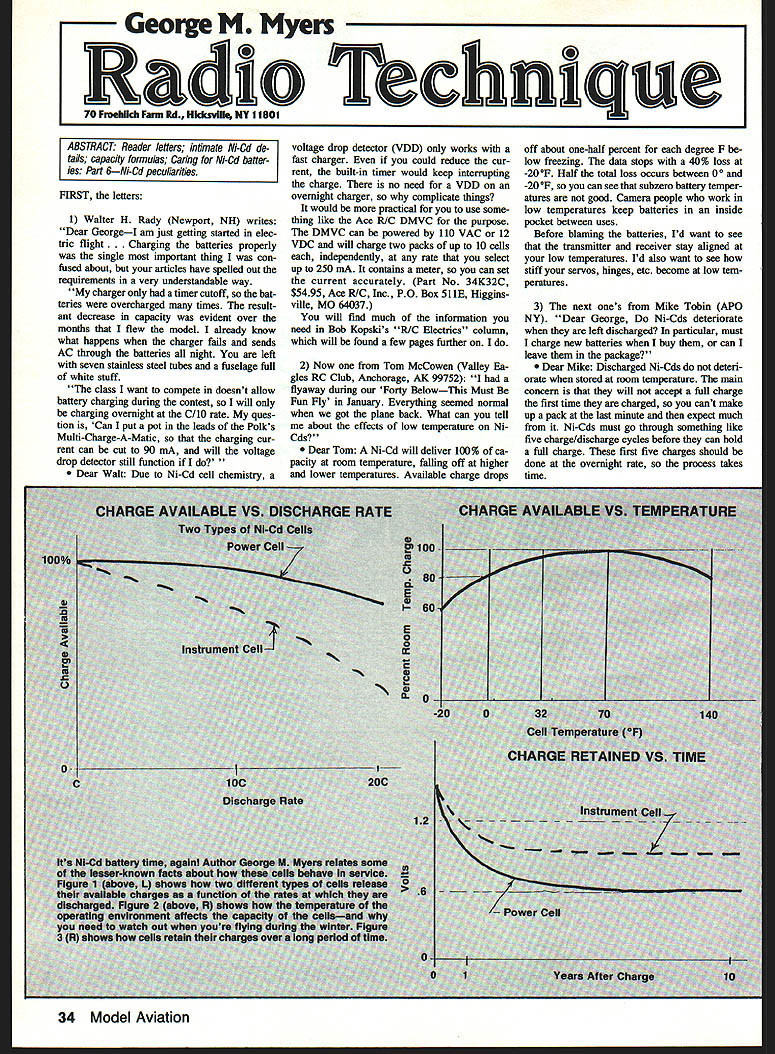
Dear Tom: A Ni-Cd will deliver about 100% of capacity at room temperature, falling off at both higher and lower temperatures. Available charge drops by roughly 0.5% for each degree F below freezing. Data show about a 40% capacity loss at −20°F; roughly half of the total loss occurs between 0°F and −20°F. So subzero battery temperatures are not good. Photographers who work in low temperatures keep batteries in an inside pocket between uses.
Before blaming the batteries, check that the transmitter and receiver remain aligned at low temperatures. Also check servos, hinges, linkages and control surfaces — they can stiffen and affect control at cold temperatures.
- Mike Tobin (APO N.Y.)
"Dear George, Do Ni‑Cds deteriorate when they are left discharged? In particular, must I charge new batteries when I buy them, or can I leave them in the package?"
Dear Mike: Discharged Ni‑Cds do not deteriorate quickly when stored at room temperature. The main concern is that new batteries often will not accept a full charge the first few times. Ni‑Cds generally need about five charge/discharge cycles before they can hold a full charge; the first five charges should be done at the overnight (C/10) rate, so the process takes time.
- How long can Ni‑Cd batteries be stored?
Nobody knows the sure answer; it depends strongly on how the batteries were used and stored. Stored cells age: plate and separator material deteriorates and electrolyte evaporates. It may take ten years or more of idle storage before separator deterioration shows up as loss of capacity. You can't inspect the separator, but deterioration does show up as reduced capacity.
Battery cyclers measure charge capacity. My practice is to label each pack, test them every spring, and write the test results and date on the sticker. If capacity has dropped significantly, I cycle the pack a few times. If it won't come back to at least 90% of rating, I won't fly with it.
Others recommend replacement at 50%–80% of rated capacity. That may be fine for a flashlight or electric screwdriver, but consider the risk: replacing a $25 battery pack every three years to ensure full radio control in a $1,000 model may be reasonable. Decide according to your risk tolerance.
Ni‑Cd Practical Notes
Charging and fast chargers
- Fast chargers with VDD (voltage drop detection) and timer cutoff are common in competitive circles. Many include cooling fans to blow on packs while charging.
- Ni‑Cd batteries accept the most charge at room temperature; both higher and lower temperatures reduce charge acceptance.
- Any heating of cells during charging is harmful. Some high‑end chargers use a temperature sensor buried in the pack to cut off fast charging when the cell temperature rises a set amount (for example, 5°C).
Cell testing and balancing
- Carpet-race drivers often assemble "balanced packs" from cells that show similar capacity and discharge behavior. Some use computer-controlled testers and buy batteries in bulk to pick the best cells. Balanced packs can be purchased commercially at higher cost.
- Some users short exhausted packs with a resistive load or use a "battery bug" (LED, diode, resistor assembly) to take the pack down to about 1 V. This is intended to keep packs balanced, but manufacturers generally advise against routine shorting.
- Manufacturers sometimes perform a "short‑down/spring‑back" test to weed out weak cells: individual cells are shorted to 0 V for 24 hours, then removed. If a cell does not "spring back" to at least ~0.6 V, it is discarded.
Why not short cells to zero?
- Cell terminal voltage exists because of chemistry even before charging. A fresh, usable Ni‑Cd cell will typically show 0.6–0.9 V at rest. Shorting a cell to 0 V promotes "creep leakage" of electrolyte from the cell and is harmful for long-term life.
Discharge behavior and testing
- The manuals say that apparent loss of capacity at high discharge rates is a function of cell design and chemistry. The full capacity may still exist but is only deliverable at lower discharge rates.
- Battery discharge curves never go to zero volts; voltage recovers rapidly after removing heavy loads, supporting the idea that chemistry and internal resistance affect apparent capacity.
- Battery tests are only meaningful if they duplicate end-use conditions. A hobby charger that discharges to ~1.0–1.1 V per cell at C/2 to 2C rates will yield a capacity number useful for transmitter/receiver use, but that number may not predict performance for propulsion use at high currents. Test at the load conditions you expect in service.
Cell construction and accessories matter
- Different cell constructions yield different performances. For example, Sanyo cells with different label colors may behave differently: one color may perform better at high-current discharge, another may retain more capacity after storage.
- Using the wrong plugs, undersized wires, or poor soldering can reduce power delivered to the motor by up to one‑third. Overheating cells while soldering is also harmful.
Practical Formulas
- Estimate average current drawn by a motor from observed run time:
Average current (amps) ≈ 0.06 × (mAh / minutes run)
Example: 800 mAh pack running 6 minutes: Average current = 0.06 × (800 / 6) = 8 amps (approx.)
(The 0.06 factor is 60 minutes/hour ÷ 1000 mAh/amp.)
- Rearranged to estimate useful capacity from observed current and run time:
Capacity (mAh) ≈ (amps × minutes) / 0.06
Example: 10 amps average, 5 minutes run: Capacity = (10 × 5) / 0.06 = 833 mAh
- For radio batteries: if a 500 mAh pack runs for 120 minutes, average current ≈ 0.06 × (500 / 120) = 0.25 amps.
These formulas are valid regardless of the number of cells in the battery.
Radio System Considerations
- Transmitter current draw is nearly constant; receiver current varies from a minimum (all servos quiet) of about 0.10 A to a maximum of several amps when servos are active. The number and type of servos and how aggressively they are used determine peak receiver current.
- After a low-battery warning, minimize control inputs to reduce current draw and increase the likelihood of a safe landing.
Resources
- How do you set up an Airtronics Vision 8 Sailplane transmitter? My friend John Clarke made a step-by-step videotape demonstrating the process. To order: John F. Clarke, 911 Cove Ave., New Hyde Park, NY 11040. Price: $19.95 plus $3.50 R&H (New York residents add sales tax).
Transcribed from original scans by AI. Minor OCR errors may remain.

