
Radio Technique
George M. Myers 70 Froehlich Farm Rd., Hicksville, NY 11801
Abstract
Reader letters, extra batteries, cellular telephones, spread-spectrum in the future, interpreting battery test results, AM/FM interactions.
Reader Letters — Categories
Reader letters generally fall into a few categories:
- Question 1: "I am retired, and have eight working radios that I really can't afford to discard. What should I do?"
- Have the transmitters converted to narrow-band, and then buy new dual-conversion, narrow-band receivers for them. This is particularly important if you'll be flying at public facilities where frequency control may be minimal and odd-numbered RC channels are commonly used.
- I am preparing a column that will list places and prices for updates. Manufacturers and service providers are invited to send prices, schedules, and services for inclusion.
- Question 2: "What radio should I buy?" (Sometimes phrased, "Which is the better manufacturer?")
- I won't answer, because I don't need the grief.
- Question 3: "What went wrong?"
- I do my best to answer based on the information you give me.
- Question 4: "This is what happened. What do you make of it?"
- These letters usually concern radio interference. I suggest methods to identify probable sources and describe known solutions.
- Question 5: "What frequency management plan should we use?"
- I give the latest information I have. Don't expect such plans to disappear quickly; they remain useful for a long time.
- Question 6: "This is the bad thing that happened when I bought (something) that you described."
- I feel bad when you think I misled you, but I can't offer much help when a product is unsatisfactory. The sample I tested worked as described. The manufacturer provides warranty and service — you'll need to talk to them.
- I won't act on complaints about unsatisfactory merchandise unless I believe I was lied to or manipulated when I wrote the column describing the product.
- I don't do product reviews as such, but I will describe systems to illustrate points.
- Question 7: "Here is an idea for your column."
- Many thanks for your suggestion. It tells me two things: (1) you read the column and think I might have the answer; (2) you might be trying to get me to do your homework (the Tom Sawyer maneuver).
- If the subject interests me, I may write a column stimulated by such letters.
- Question 8: "Since you are coming to Alaska you must stop in for a visit."
- I did, and the hospitality was magnificent.
Brainteasers (Teasers)
Teaser 1: Can you plug an extra battery into an unused servo socket to get extra power for the servos in a 1/4-scale model, and will it cause damage? (William Zartman, Downingtown, PA)
You may put an extra battery into an unused servo channel if you do it correctly. When you plug a battery into a servo channel, it will power the system in the usual way and should not damage the receiver if the connection is correct. However:
- You will not be able to shut off the extra battery unless it has its own switch harness plug or you unplug its harness from the receiver. If the receiver is buried in the airplane, plugging/unplugging will be difficult.
- Connecting two Ni-Cd battery packs directly in parallel is a bad idea. Unless both packs are precisely matched in charge characteristics and state of charge, the stronger battery will rapidly charge the weaker one. That charge current can damage cells and the receiver's PC board.
- In general, do not connect Ni-Cd packs in parallel. If you must, use a battery isolator such as an Ace R/C 2x5 or a similar isolating device. I don't like a mechanical switch for this purpose because it can hang up and leave you with no battery.
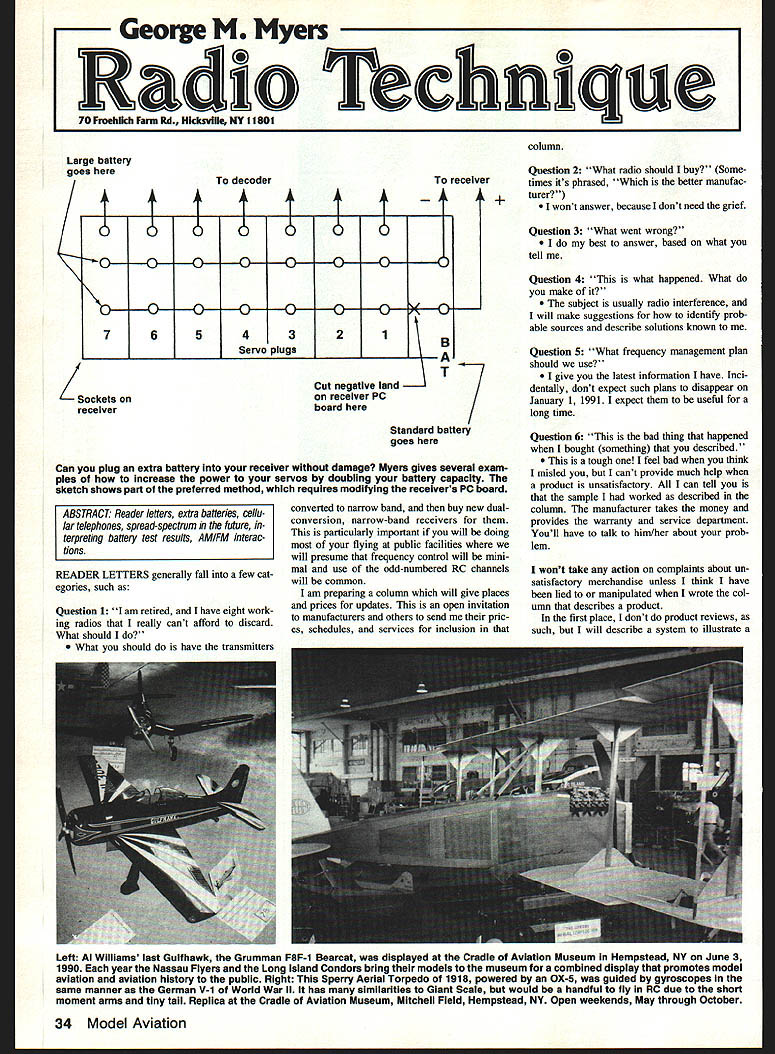
A better method is to modify the receiver: cut the positive (+) land on the PC board so there is no positive voltage connection to the servos. Then:
- Keep the regular 500-mAh battery pack connected normally to power the receiver (runs the receiver for eight to ten hours depending on usage).
- Plug a 1,200-mAh battery-and-switch harness into an unused servo receptacle. Because the + lines are isolated, there will be no cross-charging. The negative leads remain common, providing a common reference for control pulses to the servos.
- The servos draw power from the 1,200-mAh battery.
Advantages:
- No cross-charging between packs.
- Noise on servo leads (e.g., from long extenders) will be shunted through the 1,200-mAh battery and will have less effect on the receiver.
Teaser 2: "Last Sunday a fellow told me it soon would not be safe to fly at Sepulveda Basin (Los Angeles area) on 53 MHz and that I should switch to 50 MHz. What is he talking about?" (M.A. Fallandy, Canoga Park, CA)
This is puzzling. California hams have proposed changes to the six-meter band that would reserve the top end for repeaters, but those changes haven't been accepted by the ARRL. The ARRL never formally recognized the 53 MHz spots used for RC, though it did recognize 50 MHz spots. It's possible some hams in Los Angeles are pushing RC off parts of the band in their area. More local clarification is needed.
Teaser 3: "Will there be any problem with cellular phones showing up in many cars?"
Cellular phones operate in the 840–900 MHz band, so they are unlikely to affect 72 MHz radios, unless someone with a cellphone stands right next to your transmitter/receiver during a ground-range check. Generally, they shouldn't be a problem.
Separately, the FCC has approved digital spread-spectrum use in the 902–928 MHz ham band. Spread-spectrum techniques can improve RC performance, and this development will likely spur tools and methods that could be useful in the future if 72 MHz becomes crowded. Don’t expect immediate displacement; the evolution of technologies and user demand will drive changes over time.
Teaser 4: "For years I thought it was safe to fly if batteries had been recharged recently. Now I hear you need to know the mAh capacity. What's the real story? After a full charge and about an hour of flight, a receiver battery discharged on an L.R. Taylor Power Pacer shows an mAh reading. What is the lowest reading necessary to ensure safe flying? Some say 250, some 350, some 450." (L.T. Woodard, West Palm Beach, FL)
Whether a partially discharged battery is 'safe' depends on the airplane and the pilot. A half-full tank is adequate only if it gets you through the mission.
Practical guidance:
- Charge and discharge the battery five times, recording the mAh recovered each discharge.
- If a pack rated 500 mAh won't recover to at least about 400 mAh, it may have high internal resistance and should be replaced.
- Don't rely on simple flashlight or small consumer chargers for Ni-Cd packs — they may not fully charge the pack.
- I would scrap any battery rated 500 mAh that tested at only 250 mAh.
Teaser 5: "Can AM transmitters fry FM receivers, and vice versa?" (From several readers)
RC systems encoded as AM produce large amplitude variations; FM systems shift frequency by a few kHz (e.g., about 5 kHz). Because AM transmitters have more power in their sidebands than narrow-band FM transmitters, FM receivers are often more susceptible to off-channel AM than to off-channel FM.
Additional points:
- Natural and man-made interference sources (lightning, power-line corona, arc welders, engine ignition systems, etc.) typically generate AM-type noise.
- Whether an AM transmitter will control an FM receiver (or vice versa) depends on encoding/decoding methods:
- PCM receivers: off-channel transmissions usually force the receiver into fail-safe because code is wrong.
- PWM receivers: they may be controlled by the "other" type of transmitter, depending on decoder design, frame times, pulse positions, and channel count.
- Some FM receivers (e.g., the Airtronics 22XX in our tests) have been effectively immune to AM transmitters.
- George Steiner's tests show that FM RC receivers can be more sensitive to off-channel AM transmitters than to off-channel FM transmitters due to sideband power differences.
Notes
- Be cautious when paralleling battery packs; isolators are recommended.
- Receiver modification (isolating + to servos) is a reliable method to use a separate servo power pack without cross-charging.
Transcribed from original scans by AI. Minor OCR errors may remain.

