
George M. Myers
Radio Technique
Abstract
Narrow-band transmitter NPRM discussed. Lead-acid battery charging.
Correction
In the October 1990 issue of MA we ran a schematic illustrating how to boost power to your servos by plugging in a second battery to the receiver. The pix of the PC board was okay, but our callout wasn't. It's the positive lead that should be cut. —Ed.
Narrow band in '93
The long-awaited NPRM (FCC Notice of Proposed Rule Making regarding narrow-band transmitters for RC systems) has finally been published. So how does that affect you? I have greatly simplified the language to illustrate the changes.
Type acceptance criteria prior to March 1, 1993 (wideband):
- Maximum sideband power = (-43 + kP) dB
- Frequency precision = 0.005% (about ±3,600 Hz)
Type acceptance criteria after March 1, 1993 (narrow band):
- Maximum sideband power = (-56 + kP) dB
- Frequency precision = 0.002% (about ±1,500 Hz)
You can see that the maximum permitted power in the interference-producing transmitter sidebands must be reduced by about 13 dB. The kP refers to an additional reduction that is proportional to the power of the transmitter. Since most RC transmitters have about the same power, the effect of the kP reduction will be relatively moderate and equitable for fliers. It will, however, reduce the sidebands of the high-powered PRS stations that are between our channels, 10 kHz away. Safer flying conditions are coming.
Frequency tolerance has been narrowed by 60%. You need greater precision in the narrow-band environment. Incidents traceable to off-frequency transmitters should diminish.
Summary of proposed changes:
- Import and U.S. manufacture of wideband transmitters ends March 1, 1992.
- U.S. sales of wideband transmitters ends March 1, 1993.
- Through March 1, 1993, 0.005% XTALS may be sold in RC systems.
- After March 1, 1993, 0.002% XTALS will be required in RC systems.
- Wideband RC transmitters in service before March 1, 1993 may be used afterward (grandfather clause).
Ref.: NPRM RM-6683, RM-6746, PR Docket 90-20554.
Most manufacturers (foreign and domestic) have been meeting these transmitter requirements since 1988. That's why you see so many gold-stickered transmitters around. Everybody knows that the proposed changes will work and that transmitters conforming to them can be produced economically. The NPRM creates safe conditions for input to the 50-channel spectrum.
Obtaining safe output from the spectrum is another matter. Note that the NPRM says nothing about receivers. The AMA Guidelines (in your membership manual) have quite a bit to say about receivers. In order to make best use of what we have been given we will need narrow-band receivers. Dual-conversion receivers will reject interference that can be found in the RC bands. Single-conversion receivers can also be designed to resist such interference; but our old wideband AM (OWBAM) single-conversion receivers won't. OWBAM users must now watch out for 21-MHz image from a pair of transmitters 23 channels apart; imaging affects RC channels 11 through 14 and 57 through 60.
Prior to January 1, 1991, the AMA phase-in plan blocked out half of the 50 channels to avoid 21-MHz imaging, a known problem for OWBAMs. During the protected period dual-conversion narrow-band FM systems have developed and been brought to market to make use of the FCC's planning.
The NPRM specifically authorizes continued use of OWBAMs. If you and your friends want to use them with some type of arrangement that avoids modeler-to-modeler interference, go ahead and do it. You can use your unstickered OWBAM transmitter at your club field for as long as your club will accommodate it.
If you fly at a public facility it is very likely that AMA membership will be required (for the insurance) and that the AMA Safety Code will be posted and enforced. The first entry under "Safety Code, Insurance" in the 1990 membership manual reads: "Model flying must be in accordance with this code in order for AMA liability protection to apply." Item Three of the Safety Code states: "Where established, I will abide by the safety rules for the flying site I use . . ." If a public park requires narrow-band equipment and you use an OWBAM and have an accident, you not only will be in violation of the park rules but also may be without AMA liability protection.
I think it's likely that an informed public authority will soon require the use of narrow-band equipment within park grounds. Narrow-band equipment is available and is safer; requiring it reduces the chance of lawsuits and is an easy decision for park management.
Lead-acid batteries
Previous columns have discussed the charging of nickel-cadmium batteries. This month I'll discuss lead-acid cells.
The acid used is sulfuric acid, which is very corrosive. You can tell what kind of cell you have by measuring the voltage. If a fully charged cell shows about 2.2 volts in an open-circuit (no-load) test, then the cell is a lead-acid type. If the cell has a removable cover, you must add distilled water from time to time to make up for water dissociated into hydrogen and oxygen in the charging process. These gases are explosive, so any lead-acid charging site must be well ventilated. If the cell doesn't have removable covers, then it is a sealed cell and may contain gelled electrolyte. You don't have to (and can't) add water to a sealed cell. One big advantage of the sealed lead-acid battery is that you won't find corrosion in unexpected places—or holes in your garments after they are washed.
The discharge characteristic of a lead-acid cell shows a shallow slope, with the terminal voltage falling about 8% as 80% of the charge is depleted. Voltage is relatively flat toward the end of discharge. If the cell is discharged at a C/10 (10-hour) rate, the usable capacity will be approximately the value marked on the case (e.g., 12 ampere-hours). If the discharge is done at a C (one-hour) rate, the voltage will start at about 2.1 VDC per cell and the available capacity will be about 70% (8.4 ampere-hours). Raising the discharge current to the 10C (six-minute) rate drops the starting voltage to about 1.85 VDC per cell and the available capacity to about 35% (4.2 ampere-hours) at that rate. That's why automobile batteries are rated both in total capacity and in cranking amps. A weak battery isn't really lost, but if you want to recover it you must discharge and recharge it at a lower rate.
Small lead-acid batteries are frequently used to start model airplane engines, and the electric starter motors used can easily draw 30 amps when working against a stiff or flooded engine. So you should pick a battery large enough for the job.
It is common to see lead-acid batteries in automobiles and in electric-powered vehicles (like golf carts), because they're cheaper than nickel-cadmium batteries, provide similar service, and can be kept charged. On the other hand, nickel-cadmium batteries are common in airplanes, where freedom from the necessity of frequent water maintenance and lack of corrosion problems are more important. Ni-Cads are energy-dense and keep a good state of charge.
Retained capacity is strongly affected by temperature. At the freezing point (32°F, 0°C), lead-acid charge storage time is about a year. At 140°F (60°C)—an unreasonably high temperature to see inside the trunk of your car—the charge storage time drops to about four days. The discharge cutoff is taken to be 1.98 volts per cell in an open-circuit (no-load) room-temperature measurement. Remember this number because you can't measure specific gravity on sealed/gelled cells as you can with wet lead-acid cells.
It is important to keep lead-acid batteries charged, because letting the cell voltage drop below 1.8 VDC per cell causes permanent cell damage. Overcharging, even at the regular rate (C/10), can permanently damage lead-acid cells. Lead-acid cells aren't as tolerant as nickel-cadmium cells of abuse.
As with nickel-cadmium chargers, the market offers a large variety of charger types.
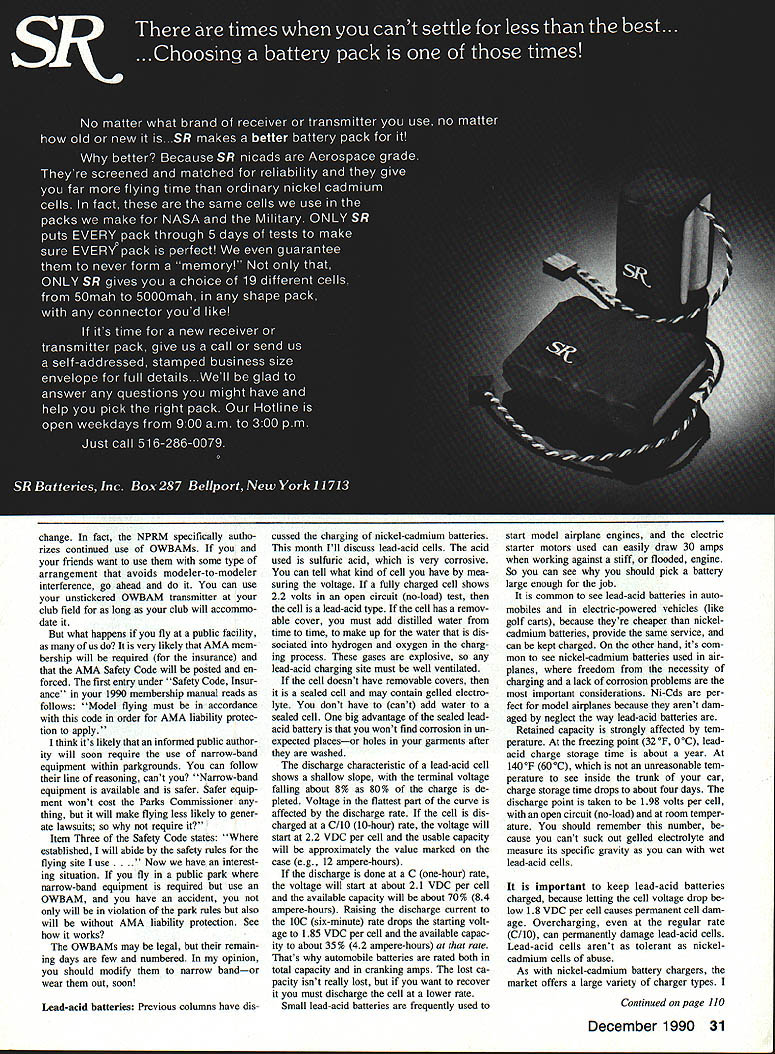
CaRa 12-volt automatic charger
I remember that my father owned a service station in the 1930s, and his charger consisted of a selenium rectifier and a light bulb. The rectifier converted AC to DC, and the light bulb regulated the current put into the battery. When the battery was discharged, the bulb glowed brightly and showed high resistance, limiting the current. When the battery became fully charged, the light went out and the current into the battery was reduced to a trickle. Dad's charger was basically a constant-voltage type, with the voltage chosen to produce a trickle charge into charged batteries.
This leads directly into the CaRa 12-volt automatic charger. The standard model (1/2 amp) is designed to charge lead-acid batteries with capacities in the 6 to 12 ampere-hour range. A heavy-duty model (2 to 2.5 amp) is available for sailplane winch batteries, electric-powered-plane mass-charger batteries, etc. You plug either one into 110 VAC and leave it connected to the battery whenever the latter is not in use. It will automatically restore the charge, then hold the battery in a constant state of readiness at 13.2 VDC at room temperature. Both models are available preadjusted to hold a constant 13.2 VDC. Wet motorcycle batteries are extremely variable, so instructions are included for matching the charger to whatever you have.
Either charger can be used for any properly sized 12-volt lead-acid battery—wet, maintenance-free (sealed), or gelled electrolyte types. The water level of wet cells should be checked every six months; the pulsed charge-holding current of the CaRa dissipates less water from your battery than many constant-current trickle chargers. From personal experience, gelled cells last longer on this charger than on other types. I have six years' experience with one Gel-Cell on a CaRa charger. I have the same six years' experience with a motorcycle battery on the CaRa charger, though I've had to keep adding water to the wet motorcycle battery; I add less water than I did with a constant-current charger.
The CaRa automatic 12-volt charger puts out pulses of charging current, measuring battery voltage with a very precise internal voltmeter between the pulses. As the battery voltage rises near the maximum allowable 13.2 VDC, the pulses get shorter and the off time gets longer, producing a charge-holding rate that just compensates for self-discharge. An LED on the front panel glows steadily when the battery contains little charge, and pulses as the battery goes into charge-holding.
My thanks to Ralph Cronan, of CaRa, and to the Gates Battery Manual. Both contributed much of the information for this column.
The standard-rate charger (1/2 amp) for 6- to 12-ampere-hour sealed or wet batteries costs $46.95, plus $3 P&H. The high-rate charger (2 to 2.5 amps) for winch batteries costs $58.95, plus $4 P&H. Order from CaRa, Canton, SD 57013.
Transcribed from original scans by AI. Minor OCR errors may remain.

