
Radio Technique
George M. Myers
OK, GEORGE, your propeller equations are fine, but I don't have a P.G.F. Chinn report on my engine. So, how do I determine the horsepower my engine is putting out? This theme has run through several communications that I have received since preparing the February, 1977 column.
Strictly speaking, you would need a test stand to measure torque and rpm under carefully calibrated and controlled conditions. However, I will now describe a field test that only requires a tachometer and a calculator. The advantage of this field test is that it measures everything (engine wear, fuel, muffler effects, needle-valve technique, density altitude, etc.), without requiring you to quantify anything. The disadvantage is that the results are only approximate.
The first step is to run your engine in the airplane and measure rpm. The second step is to calculate horsepower, using the equation:
H = (R / K)^2.63
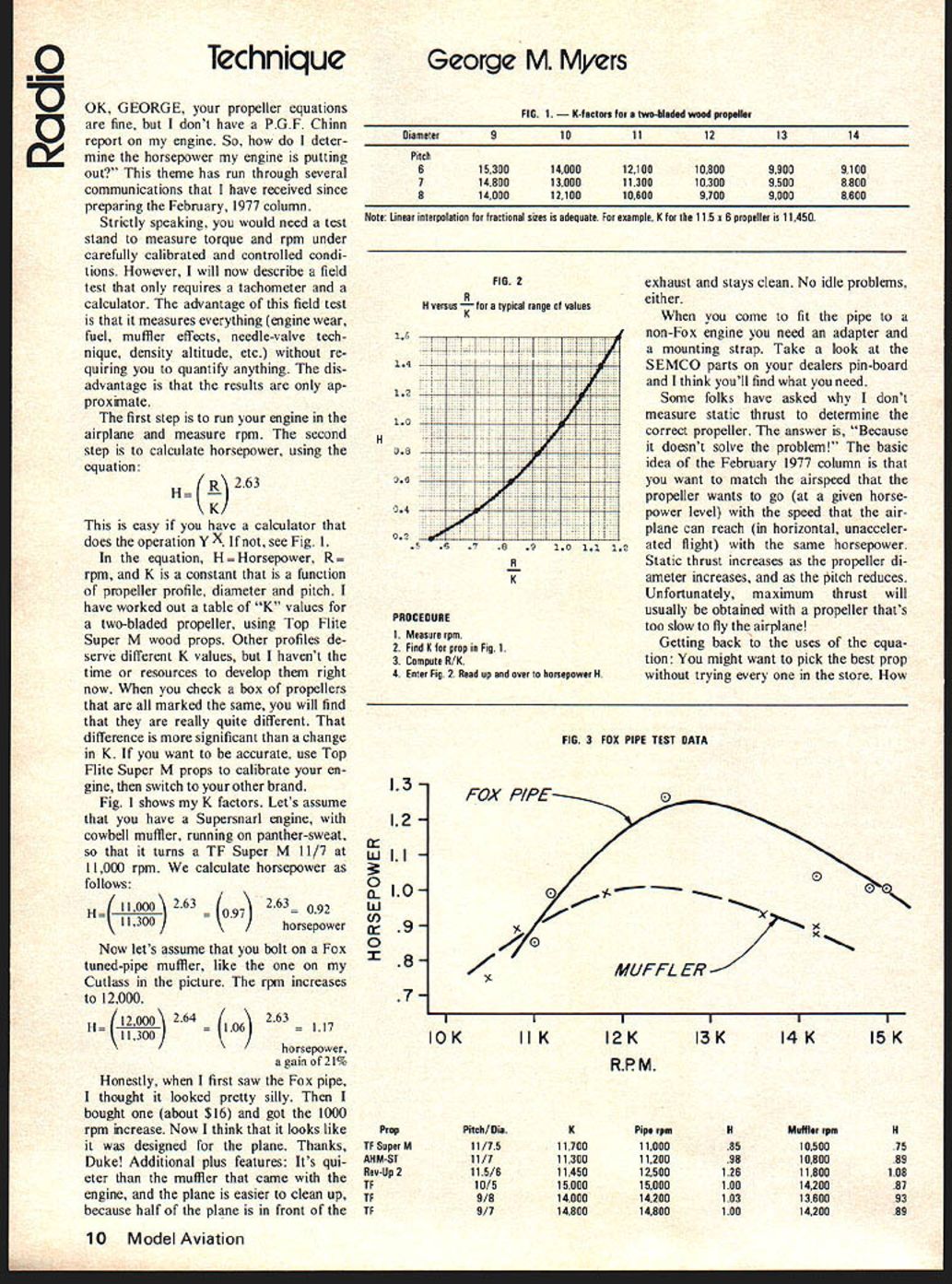
This is easy if you have a calculator that does the operation Y^X. If not, see Fig. 1.
In the equation, H = Horsepower, R = rpm, and K is a constant that is a function of propeller profile, diameter and pitch. I have worked out a table of "K" values for a two-bladed propeller, using Top Flite Super M wood props. Other profiles deserve different K values, but I haven't the time or resources to develop them right now. When you check a box of propellers that are all marked the same, you will find that they are really quite different. That difference is more significant than a change in K. If you want to be accurate, use Top Flite Super M props to calibrate your engine, then switch to your other brand.
Fig. 1 shows my K factors. Let's assume that you have a Supersnarl engine, with cowbell muffler, running on panther-sweat, so that it turns a TF Super M 11/7 at 11,000 rpm. We calculate horsepower as follows:
H = (11,000 / 11,300)^2.63 = (0.97)^2.63 = 0.92 horsepower
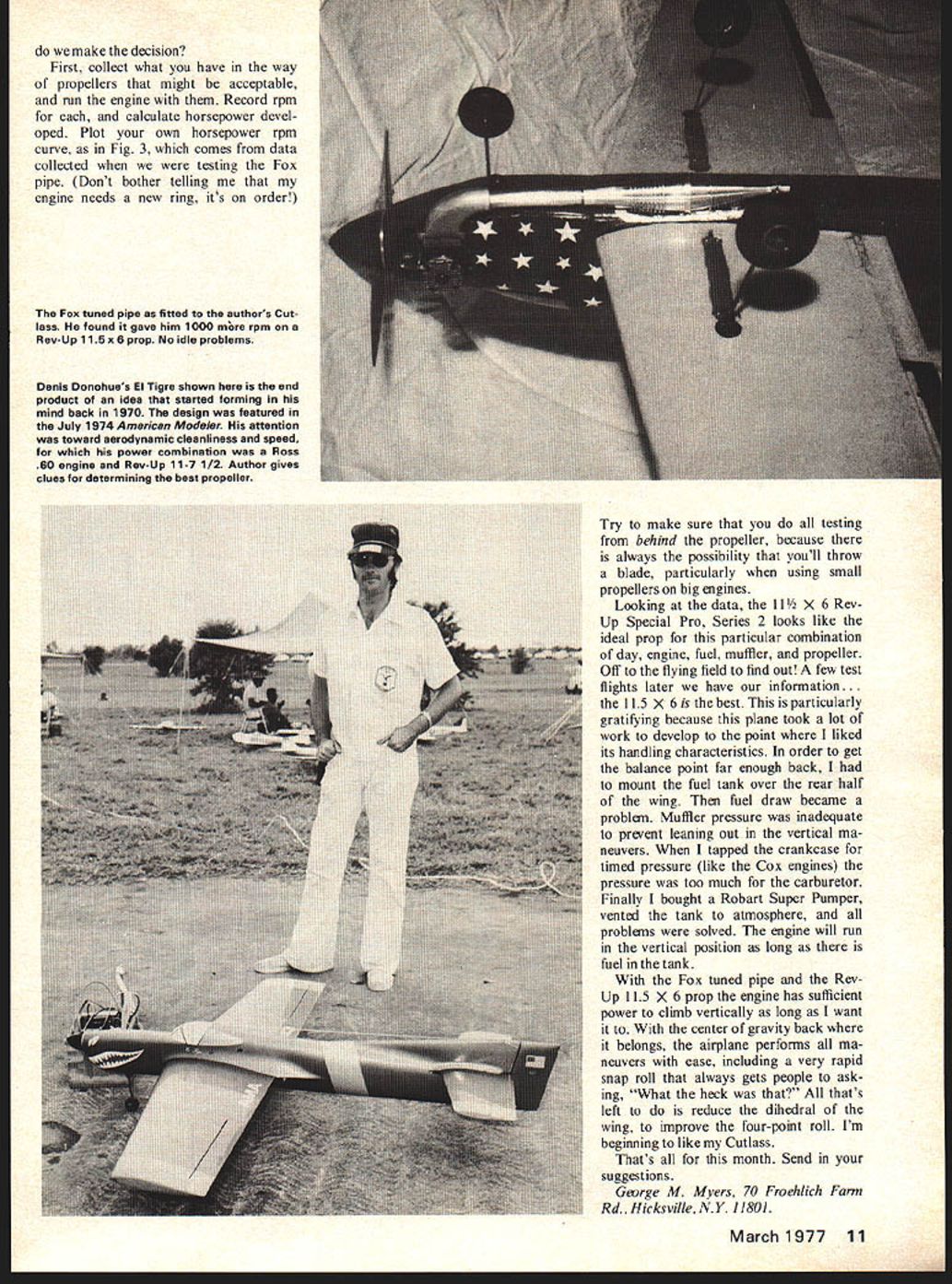
Now let's assume that you bolt on a Fox tuned-pipe muffler, like the one on my Cutlass in the picture. The rpm increases to 12,000.
H = (12,000 / 11,300)^2.63 = (1.06)^2.63 = 1.17 horsepower, a gain of 27%
Honestly, when I first saw the Fox pipe, I thought it looked pretty silly. Then I bought one (about $16) and got the 1,000 rpm increase. Now I think that it looks like it was designed for the plane. Thanks, Duke! Additional plus features: It's quieter than the muffler that came with the engine, and the plane is easier to clean up, because half of the plane is in front of the exhaust and stays clean. No idle problems, either.
When you come to fit the pipe to a non-Fox engine you need an adapter and a mounting strap. Take a look at the SEMCO parts on your dealer's pin-board and I think you'll find what you need.
Some folks have asked why I don't measure static thrust to determine the correct propeller. The answer is, "Because it doesn't solve the problem!" The basic idea of the February 1977 column is that you want to match the airspeed that the propeller wants to go (at a given horsepower level) with the speed that the airplane can reach (in horizontal, unaccelerated flight) with the same horsepower. Static thrust increases as the propeller diameter increases, and as the pitch reduces. Unfortunately, maximum thrust will usually be obtained with a propeller that's too slow to fly the airplane!
Getting back to the uses of the equation: You might want to pick the best prop without trying every one in the store. How?
- First collect what you have in the way of propellers that might be acceptable for running the engine.
- Record rpm and calculate the horsepower developed.
- Plot your own horsepower vs. rpm curve.
Fig. 3 comes from data collected testing the Fox pipe. Don't bother telling me the engine needs a new ring; it's ordered. The Fox tuned pipe fitted the author's Cutlass and gave him 1,000 more rpm. Rev-Up 11 x 6 prop. No idle problems. Try to make sure testing is done behind the propeller because there is always the possibility you'll throw a blade, particularly when using small propellers on big engines.
Looking at the data, 11 x 6 Rev-Up Special Pro Series 2 looks like the ideal prop for that particular combination of day, engine, fuel, muffler and propeller. Off the flying field, after a few test flights, you have the information. 11.5 x 6 was best — particularly gratifying because the plane took a lot of work to develop to the point I liked its handling characteristics. In order to get the balance point far enough back, I had to mount the fuel tank over the rear half of the wing. Then fuel draw became a problem. Muffler pressure was inadequate to prevent leaning out in the vertical maneuvers. When I tapped the crankcase for timed pressure (like the Cox engines) the pressure was too much for the carburetor. Finally I bought a Robart Super Pumper, vented the tank to atmosphere, and all problems were solved. The engine will run in the vertical position as long as there is fuel in the tank.
With the Fox tuned pipe and the Rev-Up 11.5 X 6 prop the engine has sufficient power to climb vertically as long as I want it to. With the center of gravity back where it belongs, the airplane performs all maneuvers with ease, including a very rapid snap roll that always gets people to asking, "What the heck was that?" All that's left to do is reduce the dihedral of the wing, to improve the four-point roll. I'm beginning to like my Cutlass.
That's all for this month. Send in your suggestions.
George M. Myers, 70 Froehlich Farm Rd., Hicksville, N.Y. 11801.
Transcribed from original scans by AI. Minor OCR errors may remain.

