
Radio Technique
Nostalgia
On August 26, I attended the Sussex, NJ Airshow. While there, I met Steve Maciag, 530 Allentown Rd., Parsippany, NJ 07054, who resells aviation memorabilia. I perused his old books and bought the March 1936 issue of Flying Aces magazine. Many happy hours of my youth were spent with Flying Aces (15 cents per copy).
A watercolor painting provided the cover art. There was an article on the Flying Aces wind tunnel, which was located in the Casey Jones School of Aeronautics. That article was written by Avrum Zier, a fellow employee at Grumman Aeronautical Engineering Corporation (best known now for the F-14 Tomcat of Top Gun fame; Grumman also built the lunar module that took Buzz Aldrin to the moon). The Casey Jones School of Aeronautics still exists, across the Parkway from LaGuardia Airport in the borough of Queens.
Other contents of the issue included:
- William Winter: how to build a model of the China Clipper.
- Frank Zaic: an article on indoor flying.
- A. D. Booton and R. Pickard: plans for a rubber-powered Speed model of Howard Hughes's racer (now hanging in the Smithsonian). The plans showed a fuselage made by hollowing out a block of balsa; the short wings (the HR-1 also had long wings for transcontinental air racing) were covered with balsa sheet and included automatic anti-torque aileron control.
- Full-size plans for a sticks-and-tissue model of the Romanian I.A.R. 14 pursuit plane and the Flying Aces Tractor, a sliced-rib, tissue-covered indoor model.
- Three-view drawings of the Messerschmitt M29, the Vultee Attack Ship, and the Westland Pterodactyl (a tailless design).
There were also pages of cartoons, jokes, contest reports, flight instructions, vignettes of WW I, and ads for models, engines, Fleischmann's Yeast, and Charles Atlas. It takes your breath away to realize all of that was in just one issue, and they did this every month!
Flying Aces — fiction and world politics
This issue contained three pieces of flying fiction:
- A Phineas Pinkham story by Joe Archibald (a character similar in persona to today's Bart Simpson).
- A war/action piece by Donald Keyhoe.
- A Kerry Keen aviation detective story by Arch Whitehouse.
More striking now are four serious pieces on world politics:
- Lt. H. Latane Lewis II — "Can Our AA Guns Defend Us?" — detailed equipment and procedures used for anti-aircraft warfare.
- David Martin — "Russia Power Enigma" — summarized what was known about the Russian Air Force (which wasn't much).
- C. B. Mayshark — postulated a conflict with Japan and its development (a scenario that never happened because Adolf Hitler attacked Russia first).
- Lt. Arch Whitehouse — "Happy Landings" — explained how Pan American Airways and the "China Clipper" had extended America's influence westward and argued that this extension created a need for an expanded Pacific Navy, requiring many more men and equipment.
Everything Whitehouse discussed became extremely important for America just five years later. Hawaii, Wake, and the Philippines contained bases for the China Clipper. There was patriotism in that magazine and open discussion of another war and how we would meet the test.
Battery Management System One (RK Electronics)
What it is
RK Electronics offers Battery Management System One at $189.95 through hobby shops and by mail. It is a true constant-current battery charger/cycler (see the August '90 RT for discussion). The unit charges three groups of from one to nine cells for a precise 17 hours and 4 minutes (derived from the 110 VAC, 60 Hz line current), then drops to a trickle charge. System One uses MOSFETs, comes with a well-written manual, and is logically designed and well-constructed for battery maintenance.
Key features and capabilities
- Three outputs:
- Transmitter (TX)
- Receiver (RX)
- AUX (third output for gyro pack, on-board glow driver, or single-cell glow plug battery)
- Can charge one to nine cells per output.
- Simultaneous charging possibilities (examples):
- Two 4-cell 1200 mAh flight packs in series on the AUX lead.
- Two 600 mAh packs in series on the RX cable (take care not to push the discharge button).
- Can effectively charge a transmitter and up to four flight packs at the same time if wired appropriately.
- Discharge capability:
- Discharges 4- or 5-cell receiver batteries at switch-selected 300 or 500 mA to an end point of 1.1 VDC per cell.
- Discharges 8- or 9-cell transmitter batteries at 300 mA to an end point of 1.1 VDC per cell.
- Displays discharge time on a red LED display, then reverts to overnight charging and eventually to trickle charging.
Charging and current settings
- Transmitter charging: 50 mA overnight, 10 mA trickle.
- Receiver charging: adjustable 0 to 200 mA, with 10 mA trickle.
- AUX output: 125 mA overnight, 25 mA trickle.
- LEDs indicate activity; if no current is flowing, the LEDs do not light.
- If charging is interrupted (e.g., house current failure), the system resumes at the overnight rate for 17 hours and 4 minutes, then reverts to trickle. This ensures a full charge if there is sufficient time. (Note: in some cases you could get a 34 hour and 7 minute charge if interruptions occur.)
Safety and construction
- Being an overnight charger, it is very safe compared with some fast chargers that can prematurely force shutoff and damage packs.
- Momentary shorts of the charging cable do no damage; an internal 4 amp fuse protects against major errors.
- Plastic case and isolation from the 110 VAC line by a remote transformer reduce shock hazard.
Price and ordering
Battery Management System One, RK Electronics, 304 Fox Run, Hudson, NH 03051 — $189.95 + $5 P&S.
Diode on charging jacks and the Deans Charge Connector
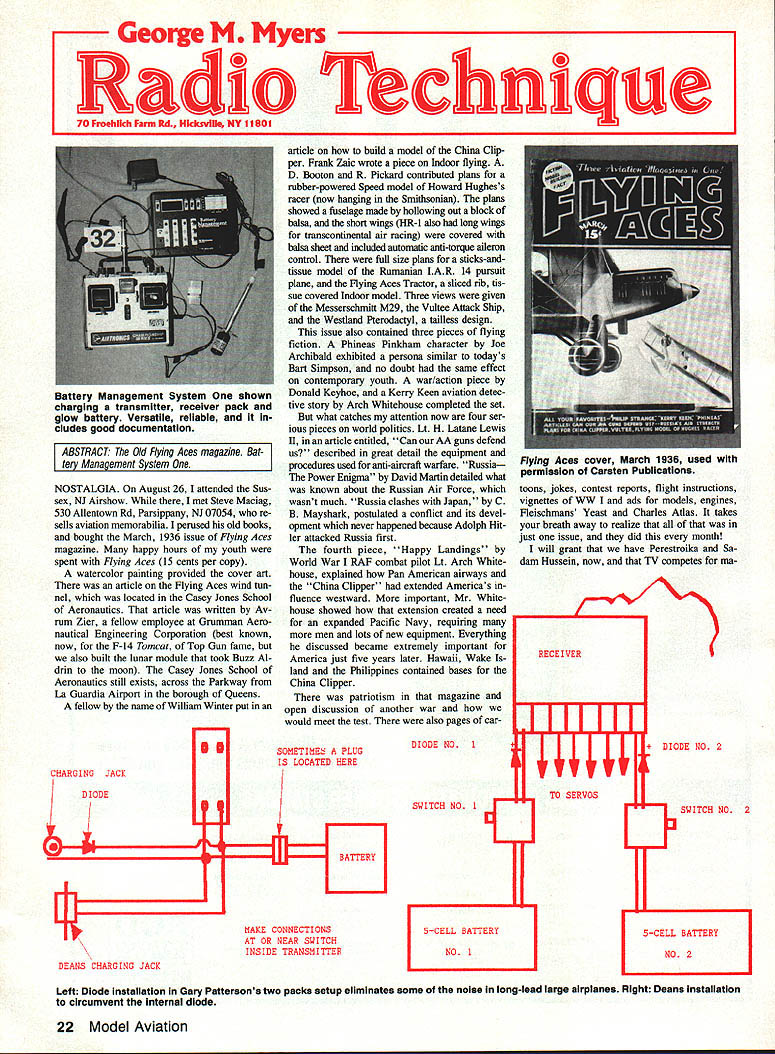
Mr. Howard Decker, Reno, NV, has a Tower RC system and noted that a diode on the charging system prevents use of his ESV (expanded scale voltmeter). The purpose of the diode is to protect against a small bit of metal (like a hex wrench or screwdriver point) from getting into the charging jack and discharging your transmitter battery. Two bad consequences of such a short are:
- The charge will have to work its way down through the pack (which is detectable if you check the meter before takeoff).
- The bit of metal can get very hot and could burn you or start a fire in your field box.
Options:
- You can short the diode inside the transmitter by soldering a wire across it — not recommended.
- A better approach is to buy a Deans Charge Connector set from ACE R/C (Part 19K55) and install it in the side of your transmitter, making direct connections to the battery pack inside. You can then charge and test through the Deans connector. The Deans pins are protected from external shorts and are handy for fast charging at the field.
Reader Tips
Apparently the October 1990 column struck a few chords with readers. Several letters commented on items mentioned.
Gary Patterson, Patterson's Hobbies, 103 North Jeffers, North Platte, NE 69101, sent this hint for noise elimination on long-lead large airplanes:
- Gary uses two five-cell 800 mAh packs with two separate switch harnesses, both plugged into the receiver, to power airframe servos.
- Each pack has its own switch and the two batteries are connected to one another.
- He reports good results with a redundant battery arrangement.
- Gary uses six servos and places the elevator servo in the tail and the aileron servos in the wings, which requires long leads.
When responding to advertisers, mention that you read about them in Model Aviation.
Transcribed from original scans by AI. Minor OCR errors may remain.

