
Radio Technique
George M. Myers
SIMPLE seasonal maintenance: The wind is blowing, the snow is snowing and now is the time to service your faithful friend, the RC system. The simplest way to go about it is to pack everything neatly in a box and ship it back to the manufacturer. If you are going to do that, there is no point in reading any further. But, if you are one of the large group that is "going to get around to it," now is the time.
Step 1: Charge all of your batteries.
Do this on the first of each month, whether or not you use the system. It will prevent your expensive nickel-cadmium batteries from developing short circuits, which they do very easily when left discharged too long. At the same time, add water to your lead-acid starting batteries, because batteries left for any long period with the fluid below the "minimum" level will develop insoluble sulfate coatings on the exposed plates. This causes permanent loss of capacity. You folks using dry-battery systems, take out those batteries.
Step 2: Clean all of your equipment:
What do we use for cleaning? Let's start by listing the things that you never use. For openers, keep dope and lacquer thinner away from anything made of plastic. The damage caused by such solvents ranges from etching the surface to totally dissolving the parts. Another good thing to stay from is all of those miracle spray cleaners that are advertised as being good for "everything in the house." Most of them leave some kind of film behind, and some of those films make a slow but continuous attack on plastic paints and films, and on the adhesives used in manufacturing iron-on coverings. You know they've done it when the edges start lifting.
Next on the list of no-no's is gasoline, and all of the family of petroleum distillates. They are hard on both people and plastics, and may explode when you least expect it.
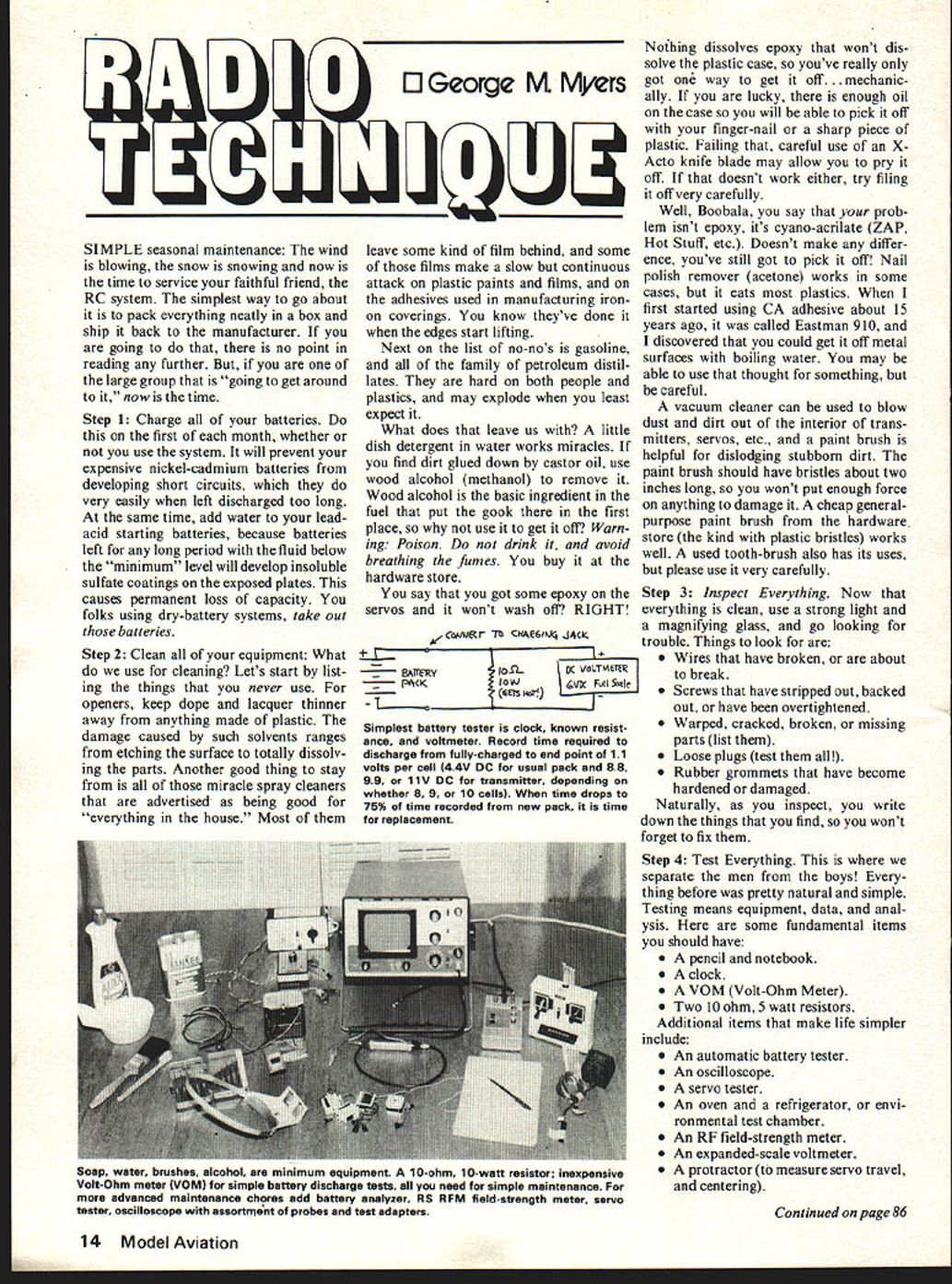
What does that leave us with? A little dish detergent in water works miracles. If you find dirt glued down by castor oil, use wood alcohol (methanol) to remove it. Wood alcohol is the basic ingredient in the fuel that put the gook there in the first place, so why not use it to get it off? Warning: Poison. Do not drink it, and avoid breathing the fumes. You buy it at the hardware store.
You say that you got some epoxy on the servos and it won't wash off? RIGHT!
Nothing dissolves epoxy that won't dissolve the plastic case, so you've really only got one way to get it off...mechanically. If you are lucky, there is enough oil on the case so you will be able to pick it off with your finger-nail or a sharp piece of plastic. Failing that, careful use of an X-Acto knife blade may allow you to pry it off. If that doesn't work either, try filing it off very carefully.
Well, Boobala, you say that your problem isn't epoxy, it's cyano-acrilate (ZAP, Hot Stuff, etc.). Doesn't make any difference, you've still got to pick it off! Nail polish remover (acetone) works in some cases, but it eats most plastics. When I first started using CA adhesive about 15 years ago, it was called Eastman 910, and I discovered that you could get it off metal surfaces with boiling water. You may be able to use that thought for something, but be careful.
A vacuum cleaner can be used to blow dust and dirt out of the interior of transmitters, servos, etc., and a paint brush is helpful for dislodging stubborn dirt. The paint brush should have bristles about two inches long, so you won't put enough force on anything to damage it. A cheap general-purpose paint brush from the hardware store (the kind with plastic bristles) works well. A used tooth-brush also has its uses, but please use it very carefully.
Simplest battery tester is clock, known resistance, and voltmeter. Record time required to discharge from fully-charged to end point of 1.1 volts per cell (4.4V DC for usual pack and 8.8, 9.9, or 11V DC for transmitter, depending on whether 8, 9, or 10 cells). When time drops to 75% of time recorded from new pack, it is time for replacement.
Step 3: Inspect Everything.
Now that everything is clean, use a strong light and a magnifying glass, and go looking for trouble. Things to look for are:
- Wires that have broken, or are about to break.
- Screws that have stripped out, backed out, or have been overtightened.
- Warped, cracked, broken, or missing parts (list them).
- Loose plugs (test them all!).
- Rubber grommets that have become hardened or damaged.
Naturally, as you inspect, you write down the things that you find, so you won't forget to fix them.
Step 4: Test Everything.
This is where we separate the men from the boys! Everything before was pretty natural and simple. Testing means equipment, data, and analysis. Here are some fundamental items you should have:
- A pencil and notebook.
- A clock.
- A VOM (Volt-Ohm Meter).
- Two 10 ohm, 5 watt resistors.
Additional items that make life simpler include:
- An automatic battery tester.
- An oscilloscope.
- A servo tester.
- An oven and a refrigerator, or environmental test chamber.
- An RF field-strength meter.
- An expanded-scale voltmeter.
- A protractor (to measure servo travel, and centering).
Radio Technique/Myers
- An ammeter (to measure charging, discharging and operating currents).
- A turntable or drum-type chart feeder (to measure servo transmit time).
- A shaker (to find intermittent problems).
- A heat lamp.
- A can of Freez-it, or similar chiller, to locate temperature-sensitive components.
- Special tools of various types, like desoldering irons.
You've seen a lot of the items listed under "additional" in advertisements, and in all probability, you should leave them there. I will describe some simple, non-destructive tests that you should perform.
Transmitter Tests:
First, we do the obvious. Try every switch, knob, pushbutton, control stick, and trim lever, to find out if it is doing what it should. Then take the system outside and perform the range check described in the manual that came with the system. In general, I dislike range checks that cover less than about 50 feet of ground range, because it's too hard to detect changes in shorter ranges. If you have one of those systems that calls for a 9- or 10-foot ground range, test it with the antenna on the transmitter, but collapsed as much as possible. If the antenna disappears inside the transmitter case, test with the first section pulled all of the way out. Measure ground range in terms of paces (the length of your stride when walking normally). See last month's column for additional details.
Next, charge the transmitter pack fully, then extend the antenna full length, note the time, and turn on the transmitter. Do this at night, when you won't be shooting someone down, or when it's raining or snowing. Note the output meter reading. Now go do something else for a while. Check the output meter every hour. Note the time when it falls to half-scale, and calculate elapsed time. If a new system operates for 4 hours, you can expect a moderately-used system to drop to about 3 hours after 5 years.
When that happens, buy yourself a new transmitter battery pack. If the time shortens that much in less than 5 years, you probably have at least one shorted cell in the pack, which should be replaced.
Recharge the transmitter, and set it aside.
Receiver and Servo Tests:
While you were testing the transmitter, you should have noticed if any of the servos were jumping, sticking, or running noticeably slower than the others. If you find any, mark a piece of tape with a description of the problem and stick it on the servo. Try swapping the servos around to prove that the trouble is in the servo and not in the transmitter or receiver.
If you have a servo tester, it can help you to pinpoint troubles. Repairs are a matter of deciding who's going to do it — you, the factory, or the local service center.
In the event that you are convinced that the receiver needs retuning (which it might), check the circuit to discover which two coils are on the output end of the circuit. These are the ones most likely to need adjustment. The antenna coils rarely shift enough to warrant readjustment. Make a tuning wand like that described on page 12 of the September 1977 column and tune for best ground range.
One very important point about retuning! There is no value in attempting to retune a receiver that is being disturbed by a noisy servo. If you have a jittery servo, the most probable cause is a loose or dirty wiper on the potentiometer on the feedback potentiometer. The electrical noise which results from such a condition can easily cut your ground range in half. Without getting technical about it, the reason for the range reduction is AGC (Automatic Gain Control) action within the receiver, in response to the servo noise. Therefore, use only good servos when tuning.
Receiver Battery Tests:
This subject has been done to death in recent years. Buy or borrow a battery analyzer and test every battery pack. If performance is 25% below normal, find out why, and fix or replace the pack. A new battery pack is the cheapest insurance you can buy for continued happy flying.
Summary:
This discussion has been deliberately kept very simple, just to convince you that you can do it. If you will perform the simple maintenance chores described above, I guarantee that you will fly longer and better next year, and have more fun doing it. You don't have to be an electronics technician to take proper care of your equipment. Do it.
George Myers, 70 Froehlich Farm Rd., Hicksville, NY 11801.
Transcribed from original scans by AI. Minor OCR errors may remain.

