
Radio Technique
George M. Myers
OLD EQUIPMENT: Every month someone approaches me with an obsolete piece of equipment. The conversation usually starts with a description of how this unit has just destroyed another fine airplane. It continues with tales of how "the equipment has been back to the manufacturer six times, and it doesn't work any better now than it did when I first bought it!" Additional models are described that were snuffed out by the same system. Finally we get to the punch line. "The manufacturer has gone out of business. Can you fix it?"
My standard advice is as follows: First, carefully unsolder the crystal and cut off the pigtails for the servos. Then, holding the receiver by its antenna, at least six inches from the receiver case, place the receiver on a flat piece of concrete. Finally, using a 12-ounce carpenter's hammer, smash it three times, so you won't be tempted to use it any more.
After the initial giggle, the usual reaction is anger. Obviously I have too much money and not enough sense. Actually, I'm a pragmatist. Modern equipment is so much better than the stuff produced only ten years ago that there is no justification in trying to fix the old stuff.
By way of example, most of the older equipment (particularly single-channel and reed types) were on 27-MHZ channels and made extensive use of canned germanium transistors. 27 MHZ is completely unsafe for model airplanes in the face of the numerous citizen-band outlaws operating on the band. While I'm not a lawyer, it seems to me that, if a model airplane on 27 MHZ injured someone, the complainant could make a pretty good case by charging contributory negligence on the part of the operator, in that he (or she) knowingly operated a dangerous piece of equipment in the presence of widely known and understood factors that could cause a loss of control. That's why I gave up 27 MHZ for aircraft years ago. On the other hand, it seems to be quite adequate for boats and cars, which operate on the earth's surface, where they are shielded somewhat from the above outlaws.
Germanium transistors were once prized for the fact that they consumed only 25% of the power of silicon transistors, but putting them inside cans where they were supported only by welded leads made them very open to damage from vibration and shock. That's one of the reasons that the old sets need to be repaired more often. Today's construction technique, wherein the silicon chip is encapsulated in epoxy, is almost immune to shock and vibration. Integrated circuits, which are now widely used, improve on the situation by encapsulating some of the resistors and capacitors that used to stand alone on the circuit board, where they were more easily damaged.
Finally, the price of engines, balsa, kits, and supplies has been rising steadily, while the cost of good radios has been falling. We can no longer afford unreliable radios. Putting a doubtful radio in a new airplane is like putting old, worn-out tires on a 1978 car.
Actually, the problem is memory. We keep remembering the price we paid for the equipment. We should be looking at the cost of the next crash that it will cause. You put the money into the hobby so you could learn to fly, but you can't do any learning or flying with broken equipment. Discard the obsolete stuff as you would a worn-out pair of shoes, and get on with the fun of flying.
The previous sermon has left some people unsatisfied. Sometimes, all you need is a new servo-motor, batteries, plugs, switches and other bits of hardware. Where does one get them? The best sources today are RC kit manufacturers. Here are some addresses, and an outline of what you can get:
ACE R/C, Inc., Box 511, 116 W. 19th St., Higginsville, MO 64037. (Resistors, capacitors, transistors, servo-motors, plugs, servo parts, for the lines that they service).
Royal Electronics Corp., 3535 S. Irving, Englewood, CO 80110. (Same supplies as ACE R/C, but for different lines.)
You really should write to both of the above manufacturers to obtain their catalogs before placing any order. Men- tion my name. Once you have the catalog it's usually quite easy to find what you want.
Another source of supply is Heathkit. In this case, you have to find what you want in the parts list of one of their kits, which means that you either borrow a manual from someone who has it, or you must make a trip to one of their retail stores so you can study a manual from their files. If I didn't have one practically in my back yard, and if the Heath equip- ment didn't have many things in common with Kraft, I probably wouldn't bother. (Heath Company, Benton Harbor, MI 49022.)
The electronics parts houses have vir- tually abandoned RC as a source of busi- ness, so I wouldn't waste any time with them.
Within limits, you can mix components of the RC systems from various manu- facturers. Royal, for example, lists servo-amplifiers in their catalog that are compatible with specifically-named manu- facturers, such as Kraft, Pro-Line, Heath, Royal, and the various Japanese sets. ACE R/C describes necessary adjustments and modifications to their lines for the pur- pose of adapting to other manufacturers' products. I have discussed in previous columns some of the limitations, such as pulse polarity, neutral pulse-width, 3-, 4- and 5-wire systems, etc.
Transmitters: In general, you can drive any flight pack from any transmitter on the same frequency. There are some limitations.
Radio Technique
You cannot mix encoding schemes, such as the old single-channel pulse scheme, reed systems, and modern "digital proportional." The Variant is another system that only works its own transmitter/receiver combinations.
The total number of channels in the transmitter has to be within two or three of the number in the receiver, or you can have trouble with the "reset" pulse. I wasted some time trying to operate a 2-channel receiver from a 6-channel transmitter, so I speak from experience.
Another problem area can be the "neutral-pulse time." The new Kraft KP-4A system components are not interchangeable with other Kraft systems, primarily because they use a 1.7ms neutral, instead of the customary 1.5ms. They also moved one of the wires in the Multicon connector so the servos can't be connected when plugged into the wrong receiver.
Receivers: Subject to the discussion above, you can exchange receivers among various systems. The primary difficulty will be plugs. A set of plugs to make the necessary adapters for a 4-channel system will cost 7 to 10 dollars, or more. If you are forced to cut up aileron extender cables at $3 apiece, it's more. Remember, you'll need two plugs for each servo if the receiver plugs are to be used. The cost argument is cumulative. Still, if you can get a good receiver for a bargain price, it may be worth the expense. Make certain that receiver is fully functioning before making adapters or permanently modifying wiring.
Switches and leads: Switches used in the past were designed for high power at low frequency and are frequently inadequate for the low-current, high-frequency pulses in modern gear. Use switches designed for radio control use. The leads between servos and receiver should be shielded three-conductor cable. Do not improvise with lamp cord. The ground and signal wires should be distinct from the power wire.
Servos: A common error is to assume that all servos have the same neutral pulse width and travel. They don't. Some servos expect a 1.5ms center pulse, others 1.7ms. The travel for a given pulse change can vary widely. Mechanical linkage and servo arm length will affect control throw. If you are replacing servos, try to get matched units, or at least adjust linkages to compensate.
Batteries: Nicad cells are still the best choice for most modelers. Use fresh cells and keep them charged properly. Old cells with poor capacity will cause brownouts and erratic operation. Use charging units intended for NiCad packs and observe proper charging rates. Do not leave batteries on charge unattended.
Grounding: Avoid ground loops and twisted wiring. Keep power wiring separate from signal wiring. Use proper connectors and make sure piercings or solder joints are clean and secure.
Final checks: Before flying, check range on the ground with the intended antenna positions. Try to duplicate as closely as possible the flying configuration. If you can, have someone hold the plane while you walk away to see when control begins to degrade. Because conditions vary, don't rely on indoor checks alone.
Radio Technique
Servos: We've already mentioned neutral pulses and plugs. That leaves only mounting hardware and the various dimensions of servos as a problem when you start mixing systems. You may also have to contend with 3-, 4- and 5-wire systems.
Battery Packs and Switch Harnesses:
Plugs are the main problem.
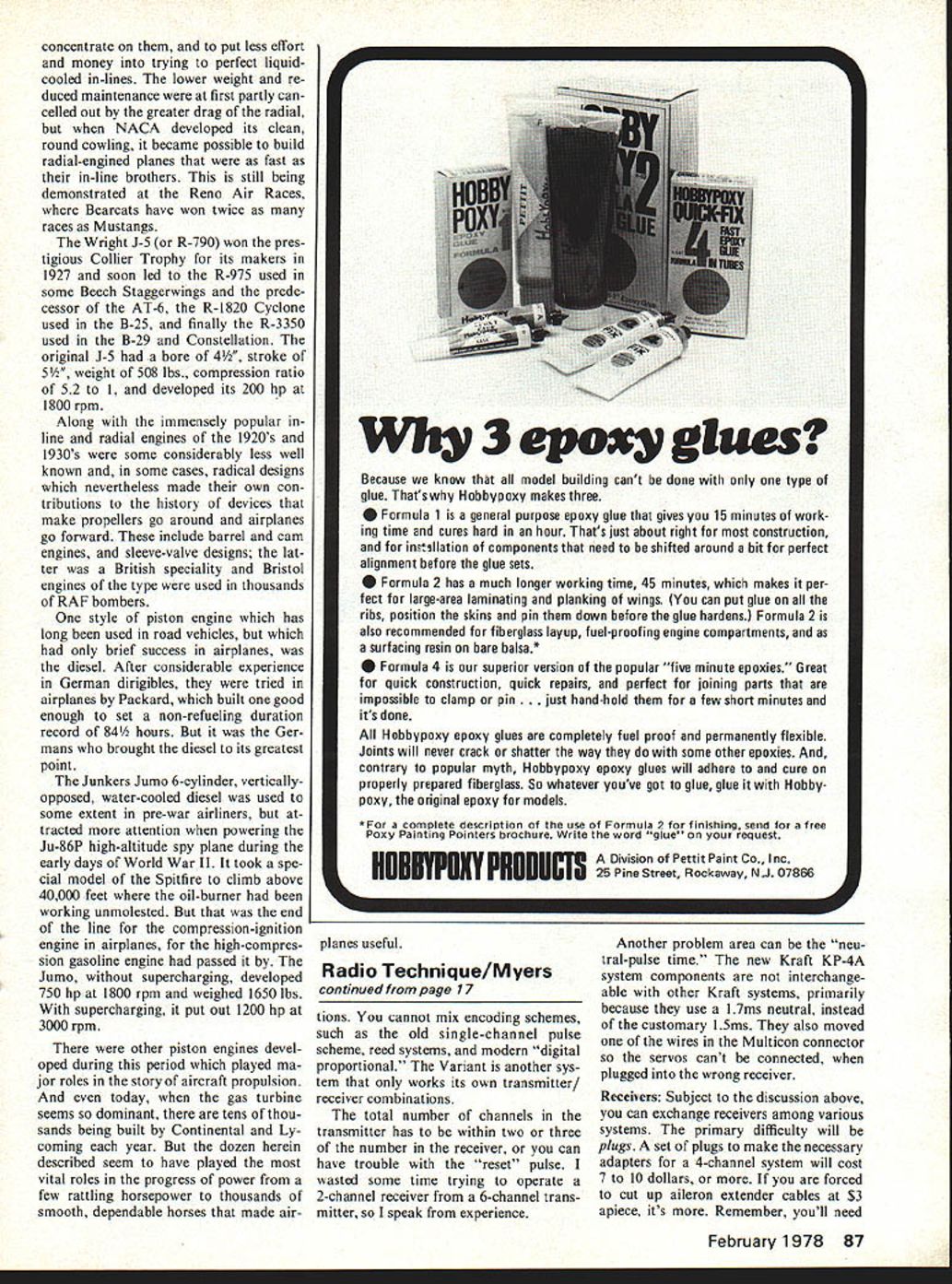
Chargers—Plugs again! In addition, you must consider charging current. I have discussed this in previous columns. You really should insert a milliammeter and measure what you get when you mix systems. Then estimate the time required to reach full charge by using Fig. 1.
Many people do all of their flying with a mixed collection of parts in the flight pack and do quite well with it. My son's Sunflite A-20 is a case in point. The flight pack consists of a Royal 1/2A 2-ch. receiver, upgraded to four channels (M.A., 9/77, pp. 12, 13, etc.), powered by a Kraft KB-4M battery pack through a home-made switch harness, and the servo group consists of the following Cox/Sanwa items: Throttle 80322 (miniature), Aileron and Elevator 80312 (large regular), Rudder/Nosewheel 80306 (large waterproof). The transmitter is a Cox/Sanwa 8060, although we used a Kraft series 72 transmitter at first. The plane has about 75 flights on it, over a five-month period, and has always worked perfectly. Oh, yes, we usually charge the flight pack with an ACE R/C metered varicharger. Go ahead and mix them up, if you know how. It works.
See you at the trade shows, where I hope to get ideas for future columns.
George M. Myers, 70 Froehlich Farm Rd., Hicksville, NY 11801.
Transcribed from original scans by AI. Minor OCR errors may remain.

