
Radio Technique
George M. Myers
HERE I sit at the typewriter, again. Christmas is over, and I've just completed another frustrating session in the darkroom (actually it's the bathroom, with a piece of plywood over the tub for a working surface). Spend some time trying to make prints from color negatives, and you will gain a new appreciation for Polaroid, believe me! Anyway, the radio tells me that the Dollar hit a new low in December, relative to the Yen and Mark, so guess where hobby prices are going? Right, up-and-away! If you are now contemplating a purchase of a new radio system, perhaps this is a good time to take another look at the "Buy American" idea.
Foreign manufacturers have been competing on the American market on the basis of good quality at low prices. The first response of domestic producers was to "cut out the frills" in order to meet the price. All that proved was that though the American buyer may be fickle, one thing is constant... he'll buy quality every time.
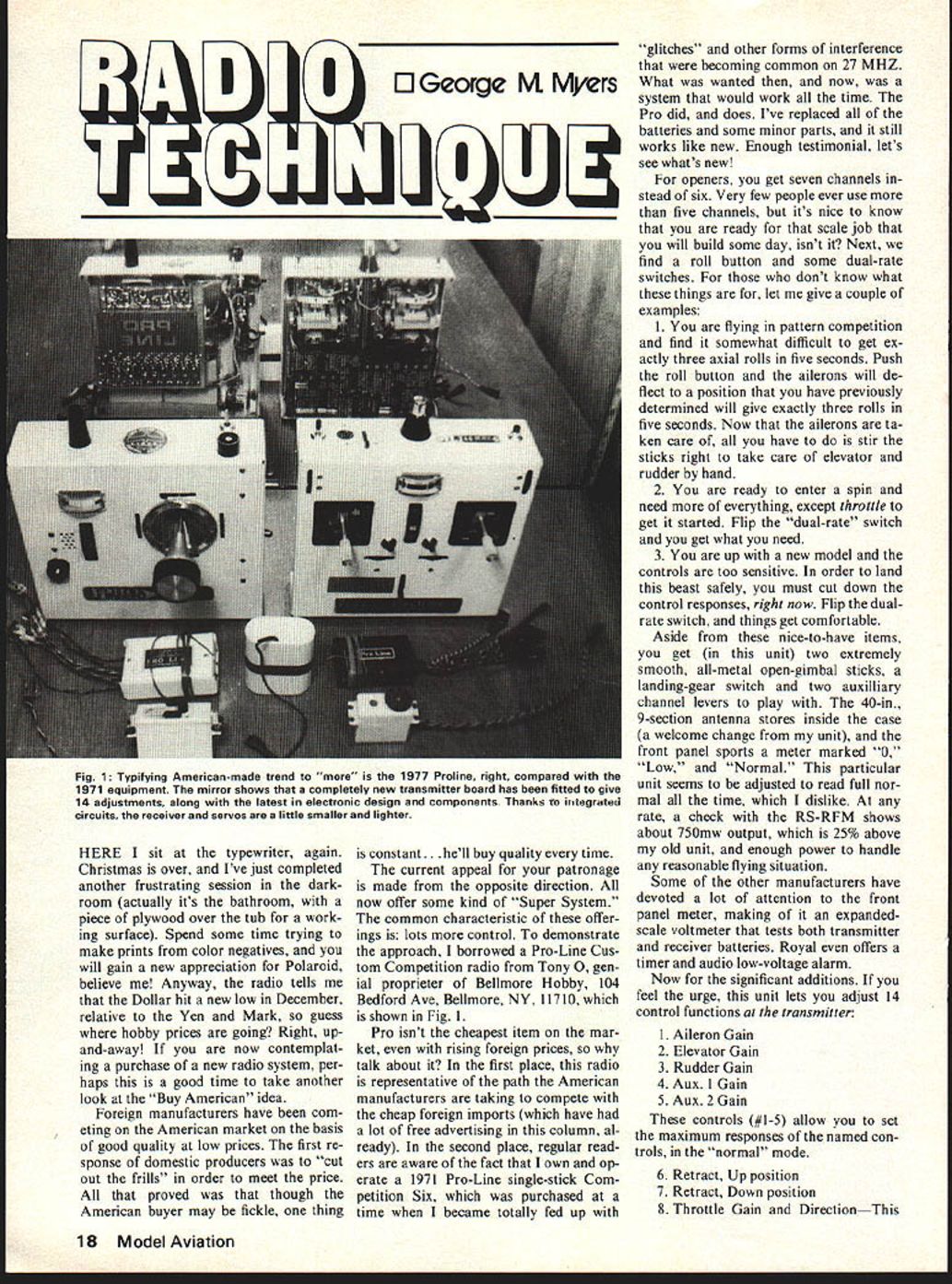
The current appeal for your patronage is made from the opposite direction. All now offer some kind of "Super System." The common characteristic of these offerings is: lots more control. To demonstrate the approach, I borrowed a Pro-Line Custom Competition radio from Tony O., genial proprietor of Bellmore Hobby, 104 Bedford Ave., Bellmore, NY, 11710, which is shown in Fig. 1.
Pro isn't the cheapest item on the market, even with rising foreign prices, so why talk about it? In the first place, this radio is representative of the path the American manufacturers are taking to compete with the cheap foreign imports (which have had a lot of free advertising in this column, already). In the second place, regular readers are aware of the fact that I own and operate a 1971 Pro-Line single-stick Competition Six, which was purchased at a time when I became totally fed up with "glitches" and other forms of interference that were becoming common on 27 MHZ. What was wanted then, and now, was a system that would work all the time. The Pro did, and does. I've replaced all of the batteries and some minor parts, and it still works like new. Enough testimonial, let's see what's new!
For openers, you get seven channels instead of six. Very few people ever use more than five channels, but it's nice to know that you are ready for that scale job that you will build some day, isn't it? Next, we find a roll button and some dual-rate switches. For those who don't know what these things are for, let me give a couple of examples:
- You are flying in pattern competition and find it somewhat difficult to get exactly three axial rolls in five seconds. Push the roll button and the ailerons will deflect to a position that you have previously determined will give exactly three rolls in five seconds. Now that the ailerons are taken care of, all you have to do is stir the sticks right to take care of elevator and rudder by hand.
- You are ready to enter a spin and need more of everything, except throttle to get it started. Flip the "dual-rate" switch and you get what you need.
- You are up with a new model and the controls are too sensitive. In order to land this beast safely, you must cut down the control responses, right now. Flip the dual-rate switch, and things get comfortable.
Aside from these nice-to-have items, you get (in this unit) two extremely smooth, all-metal open-gimbal sticks, a landing-gear switch and two auxiliary channel levers to play with. The 40-in., 9-section antenna stores inside the case (a welcome change from my unit), and the front panel sports a meter marked "0," "Low," and "Normal." This particular unit seems to be adjusted to read full normal all the time, which I dislike. At any rate, a check with the RS-RFM shows about 750 mw output, which is 25% above my old unit, and enough power to handle any reasonable flying situation.
Some of the other manufacturers have devoted a lot of attention to the front panel meter, making of it an expanded-scale voltmeter that tests both transmitter and receiver batteries. Royal even offers a timer and audio low-voltage alarm.
Now for the significant additions. If you feel the urge, this unit lets you adjust 14 control functions at the transmitter:
- Aileron Gain
- Elevator Gain
- Rudder Gain
- Aux. 1 Gain
- Aux. 2 Gain
These controls (#1-5) allow you to set the maximum responses of the named controls in the "normal" mode.
- Retract, Up position
- Retract, Down position
- Throttle Gain and Direction
- Aileron Dual Rate
- Elevator Dual Rate
- Rudder Dual Rate
Controls #9-11 allow you to set the maximum responses of the named controls in the "dual-rate" position.
- Aileron Push-button Trim
- Elevator Push-button Trim
- Throttle Push-button Trim
Push-down aileron, elevator and throttle push-buttons can adjust fixed control surface deflections to produce automatic snap-rolls or spins. The last three controls seem like a waste of time—that's man's opinion. I would like to see permitted co permitted in competition, because the rationale that would justify their use would also permit a tape recorder to play a pre-recorded routine into the transmitter, and this, coupled with Maynard Hill's atmospheric-potential sensing device, could lead to contests where everybody could stay home and watch their toys play with themselves, on television. Who needs that?
I'm of the school that believes one should learn to fly, because there is great pleasure in learning to deal with a situation that has so many independent variables, and great satisfaction in learning to master yourself so you can master the situation. Even though I program computers in my work, it's only a means to an end, not an end in itself.
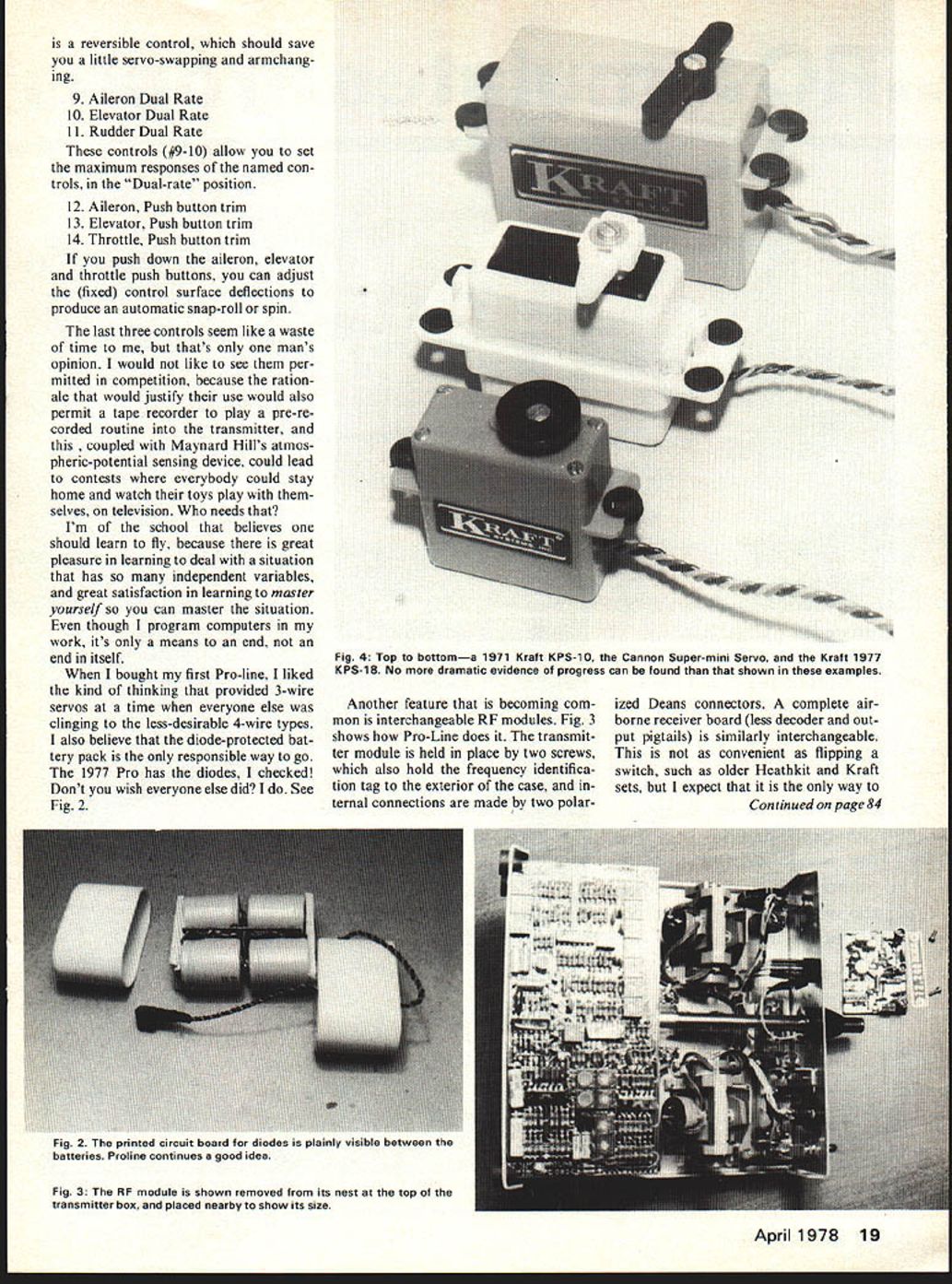
When I bought my first Pro-line, I liked the kind of thinking that provided 3-wire servos at a time when everyone else was clinging to the less-desirable 4-wire types. I also believe that the diode-protected battery pack is the only responsible way to go. The 1977 Pro has the diodes, I checked! Don't you wish everyone else did? I do. See Fig. 2.
Another feature that is becoming common is interchangeable RF modules. Fig. 3 shows how Pro-Line does it. The transmitter module is held in place by two screws, which also hold the frequency identification tag to the exterior of the case, and internal connections are made by two polarized Deans connectors. A complete airborne receiver board (less decoder and output pigtails) is similarly interchangeable. This is not as convenient as flipping a switch, such as older Heathkit and Kraft sets, but I expect that it is the only way to retain the well-known and highly-regarded Pro-line fine tuning.
A variety of servos are offered. This system has the PLS-1, which is a great general-purpose size. They are small and light enough to be satisfactory in a 1/2A racer, yet strong enough to control a piped-.60 pattern model. All older Pro-line servos are compatible with the new system, so they aren't obsolete just because a newer system is being manufactured. Which is a nice way to treat the customers.
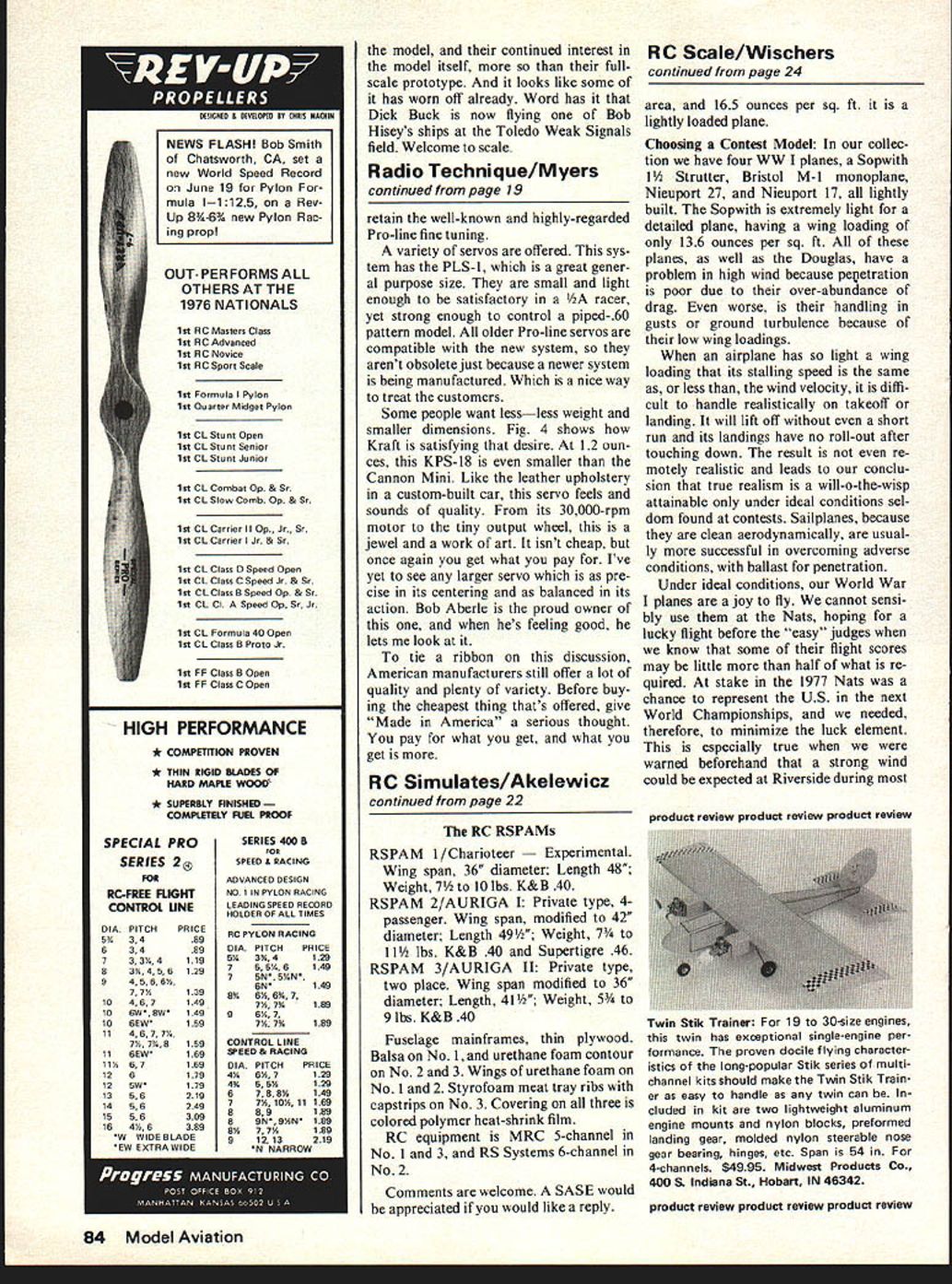
Some people want less—less weight and smaller dimensions. Fig. 4 shows how Kraft is satisfying that desire. At 1.2 ounces, the KPS-18 is even smaller than the Cannon Mini. Like the leather upholstery in a custom-built car, this servo feels and sounds of quality. From its 30,000-rpm motor to the tiny output wheel, this is a jewel and a work of art. It isn't cheap, but once again you get what you pay for. I've yet to see any larger servo which is as precise in its centering and as balanced in its action. Bob Aberle is the proud owner of this one, and when he's feeling good, he lets me look at it.
To tie a ribbon on this discussion, American manufacturers still offer a lot of quality and plenty of variety. Before buying the cheapest thing that's offered, give "Made in America" a serious thought. You pay for what you get, and what you get is more.
Transcribed from original scans by AI. Minor OCR errors may remain.

