
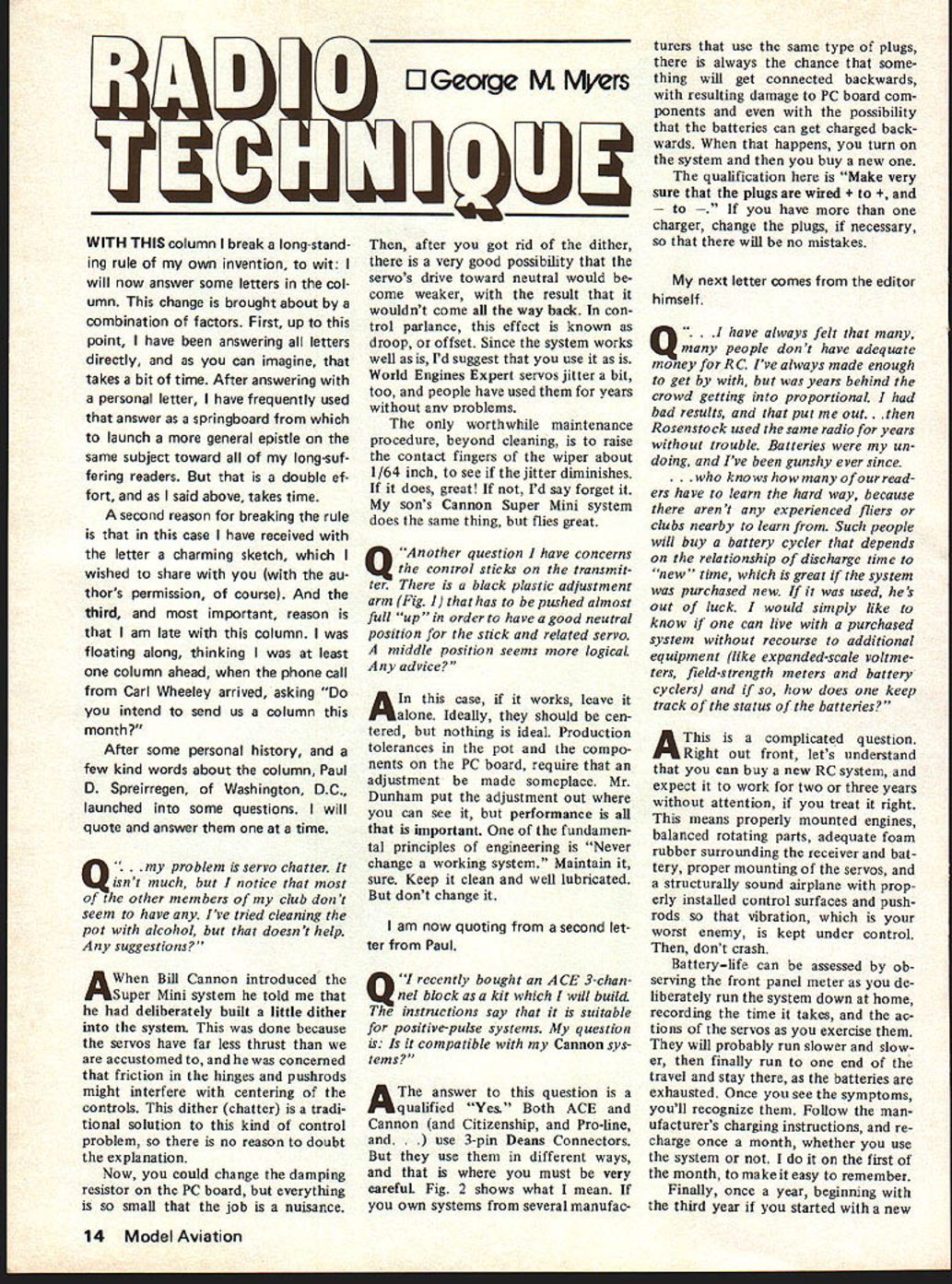
Radio Technique
George M. Myers
WITH THIS column I break a long-standing rule of my own invention, to wit: I will now answer some letters in the column. This change is brought about by a combination of factors. First, up to this point, I have been answering all letters directly, and as you can imagine, that takes a bit of time. After answering with a personal letter, I have frequently used that answer as a springboard from which to launch a more general epistle on the same subject toward all of my long-suffering readers. But that is a double effort, and as I said above, takes time.
A second reason for breaking the rule is that in this case I have received with the letter a charming sketch, which I wished to share with you (with the author's permission, of course). And the third, and most important, reason is that I am late with this column. I was floating along, thinking I was at least one column ahead, when the phone call from Carl Wheeley arrived, asking "Do you intend to send us a column this month?"
After some personal history, and a few kind words about the column, Paul D. Spreirregen, of Washington, D.C., launched into some questions. I will quote and answer them one at a time.
Q: "... my problem is servo chatter. It isn't much, but I notice that most of the other members of my club don't seem to have any. I've tried cleaning the pot with alcohol, but that doesn't help. Any suggestions?"
A: When Bill Cannon introduced the Super Mini system he told me that he had deliberately built a little dither into the system. This was done because the servos have far less thrust than we are accustomed to, and he was concerned that friction in the hinges and pushrods might interfere with centering of the controls. This dither (chatter) is a traditional solution to this kind of control problem, so there is no reason to doubt the explanation.
Now, you could change the damping resistor on the PC board, but everything is so small that the job is a nuisance.
Then, after you got rid of the dither, there is a very good possibility that the servo's drive toward neutral would become weaker, with the result that it wouldn't come all the way back. In control parlance, this effect is known as droop, or offset. Since the system works well as is, I'd suggest that you use it as is. World Engines Expert servos jitter a bit, too, and people have used them for years without any problems.
The only worthwhile maintenance procedure, beyond cleaning, is to raise the contact fingers of the wiper about 1/64 inch, to see if the jitter diminishes. If it does, great! If not, I'd say forget it. My son's Cannon Super Mini system does the same thing, but flies great.
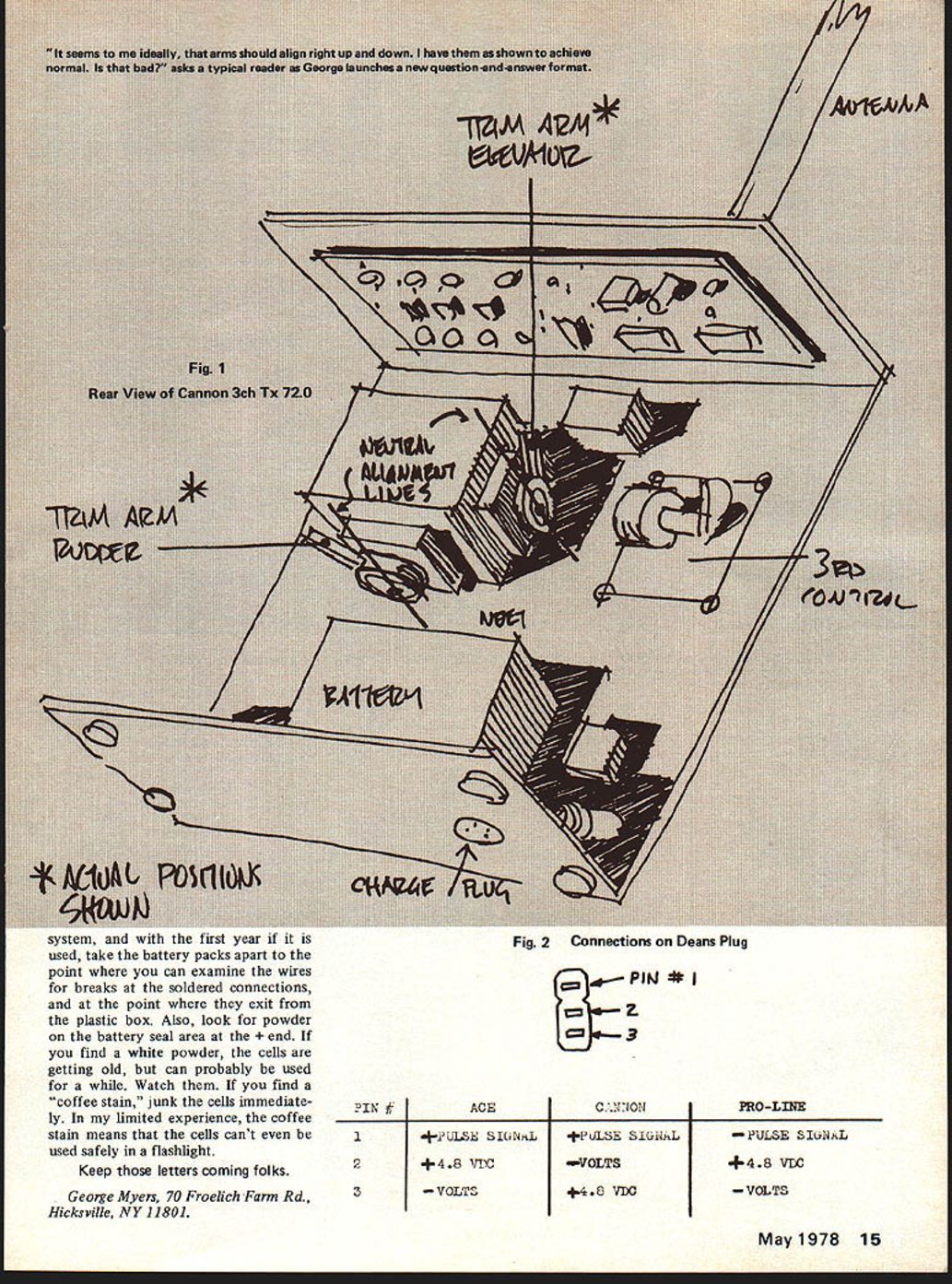
Q: "Another question I have concerns the control sticks on the transmitter. There is a black plastic adjustment arm (Fig. 1) that has to be pushed almost 'up' in order to have a good neutral position for the stick and related servo. A middle position seems more logical. Any advice?"
A: In this case, if it works, leave it alone. Ideally, they should be centered, but nothing is ideal. Production tolerances in the pot and the components on the PC board require that an adjustment be made someplace. Mr. Dunham put the adjustment out where you can see it, but performance is all that is important. One of the fundamental principles of engineering is "Never change a working system." Maintain it, sure. Keep it clean and well lubricated. But don't change it.
I am now quoting from a second letter from Paul.
Q: "I recently bought an ACE 3-channel block as a kit which I will build. The instructions say that it is suitable for positive-pulse systems. My question is: Is it compatible with my Cannon systems?"
A: The answer to this question is a qualified "Yes." Both ACE and Cannon (and Citizenship, and Pro-line, and ...) use 3-pin Deans Connectors. But they use them in different ways, and that is where you must be very careful. Fig. 2 shows what I mean. If you own systems from several manufacturers that use the same type of plugs, there is always the chance that something will get connected backwards, with resulting damage to PC board components and even with the possibility that the batteries can get charged backwards. When that happens, you turn on the system and then you buy a new one.
The qualification here is "Make very sure that the plugs are wired + to +, and - to -." If you have more than one charger, change the plugs, if necessary, so that there will be no mistakes.
My next letter comes from the editor himself.
Q: "... I have always felt that many, many people don't have adequate money for R/C. I've always made enough to get by with, but was years behind the crowd getting into proportional. I had bad results, and that put me out... then Rosenstock used the same radio for years without trouble. Batteries were my undoing, and I've been gunshy ever since... who knows how many of our readers have to learn the hard way, because there aren't any experienced fliers or clubs nearby to learn from. Such people will buy a battery cycler that depends on the relationship of discharge time to 'new' time, which is great if the system was purchased new. If it was used, he's out of luck. I would simply like to know if one can live with a purchased system without recourse to additional equipment (like expanded-scale voltmeters, field-strength meters and battery cyclers) and if so, how does one keep track of the status of the batteries?"
A: This is a complicated question. Right out front, let's understand that you can buy a new R/C system, and expect it to work for two or three years without attention, if you treat it right. This means properly mounted engines, balanced rotating parts, adequate foam rubber surrounding the receiver battery, proper mounting of the servos, and a structurally sound airplane with properly installed control surfaces and pushrods so that vibration, which is your worst enemy, is kept under control. Then, don't crash.
Battery-life can be assessed by observing the front panel meter as you deliberately run the system down at home, recording the time it takes, and the actions of the servos as you exercise them. They will probably run slower and slower, then finally run to one end of the travel and stay there, as the batteries are exhausted. Once you see the symptoms, you'll recognize them. Follow the manufacturer's charging instructions, and recharge once a month, whether you use the system or not. I do it on the first of the month, to make it easy to remember.
Finally, once a year, beginning with the third year if you started with a new system, and with the first year if it is used, take the battery packs apart to the point where you can examine the wires for breaks at the soldered connections, and at the point where they exit from the plastic box. Also, look for powder on the battery seal area at the + end. If you find a white powder, the cells are getting old, but can probably be used for a while. Watch them. If you find a "coffee stain," junk the cells immediately. In my limited experience, the coffee stain means that the cells can't even be used safely in a flashlight.
Keep those letters coming folks.
George Myers, 70 Froelich Farm Rd., Hicksville, NY 11801.
Transcribed from original scans by AI. Minor OCR errors may remain.

