
Radio Technique.. GeorgeMyers
GEL CELLS are lead-acid batteries! Once we have that firmly in mind, we understand why we must follow some simple rules for their use: 1) Keep them fully charged, 2) Charge them at the correct rates, 3) Don't overcharge them.
Why pay a premium price for something you have already? To answer that question, look at your battery charger, field kit and pants. If you find corrosion, peeled paint, and unexplained holes, you are looking at evidence of the fact that the sulfuric acid in conventional "wet" lead-acid batteries has a habit of getting out of its shell when you least expect it. The electrolyte of a gel cell is jellied sulfuric acid, which tends to stay put. For this, and other chemical reasons, the jellied electrolyte can be sealed in its little plastic box. However, when you overcharge the battery it still evolves hydrogen and oxygen gas, which pushes open a resealable safety vent and escapes. There is no way to put water back, so don't overcharge the battery.
Most of the gel cells sold to the hobby are made in the USA by Globe Battery Div., Globe-Union Inc., Milwaukee, WI (whose registered trade mark is "gel/cell"), or by the Portable Battery Division, Gould Inc., St. Paul, MN (who use the registered trademark "Gelyte"). Bob Boucher of Astro Flite Inc. told me that the hobby uses less than one day's production from the industry each year.
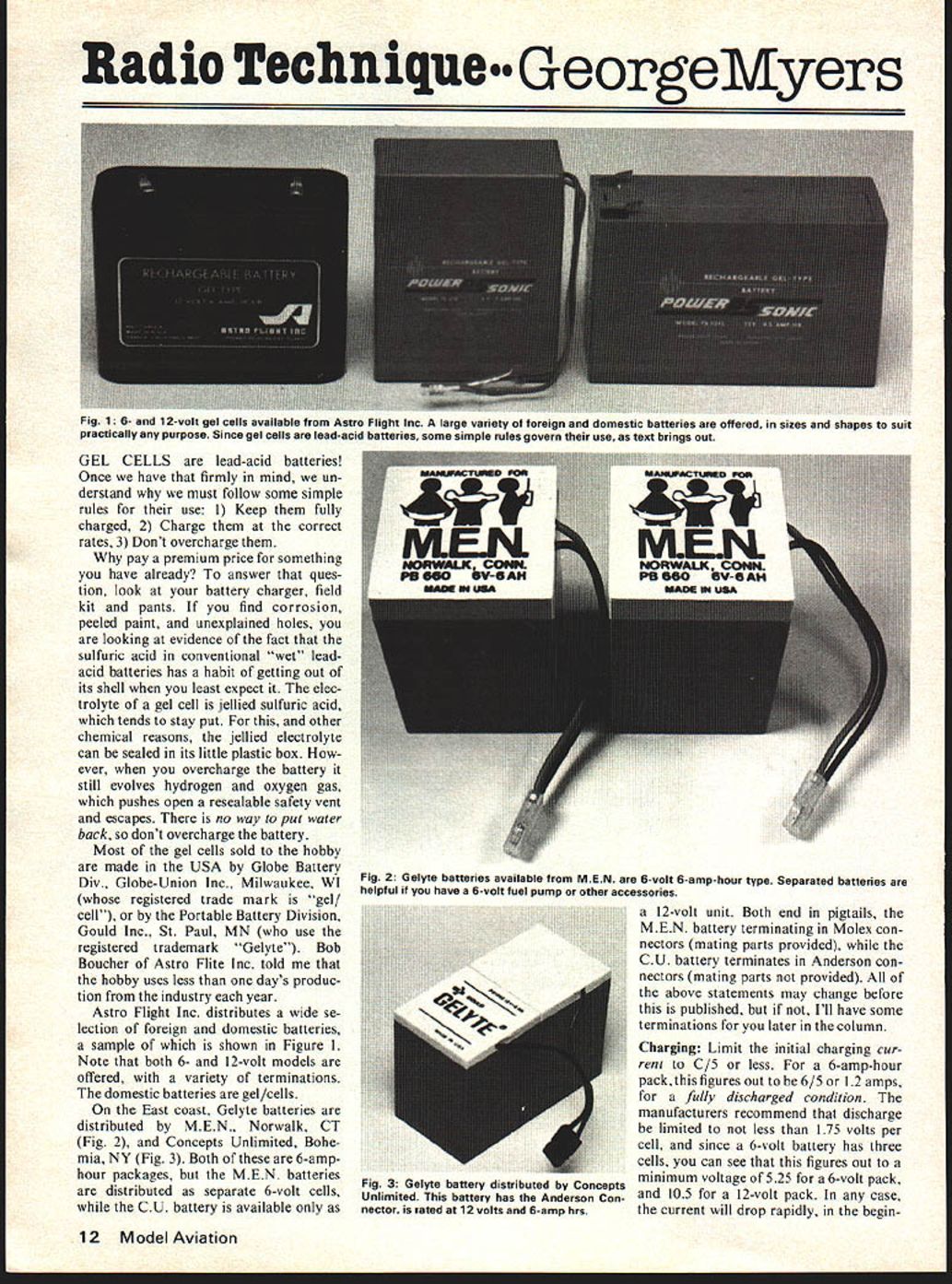
Astro Flight Inc. distributes a wide selection of foreign and domestic batteries, a sample of which is shown in Figure 1. Note that both 6- and 12-volt models are offered, with a variety of terminations. The domestic batteries are gel cells.
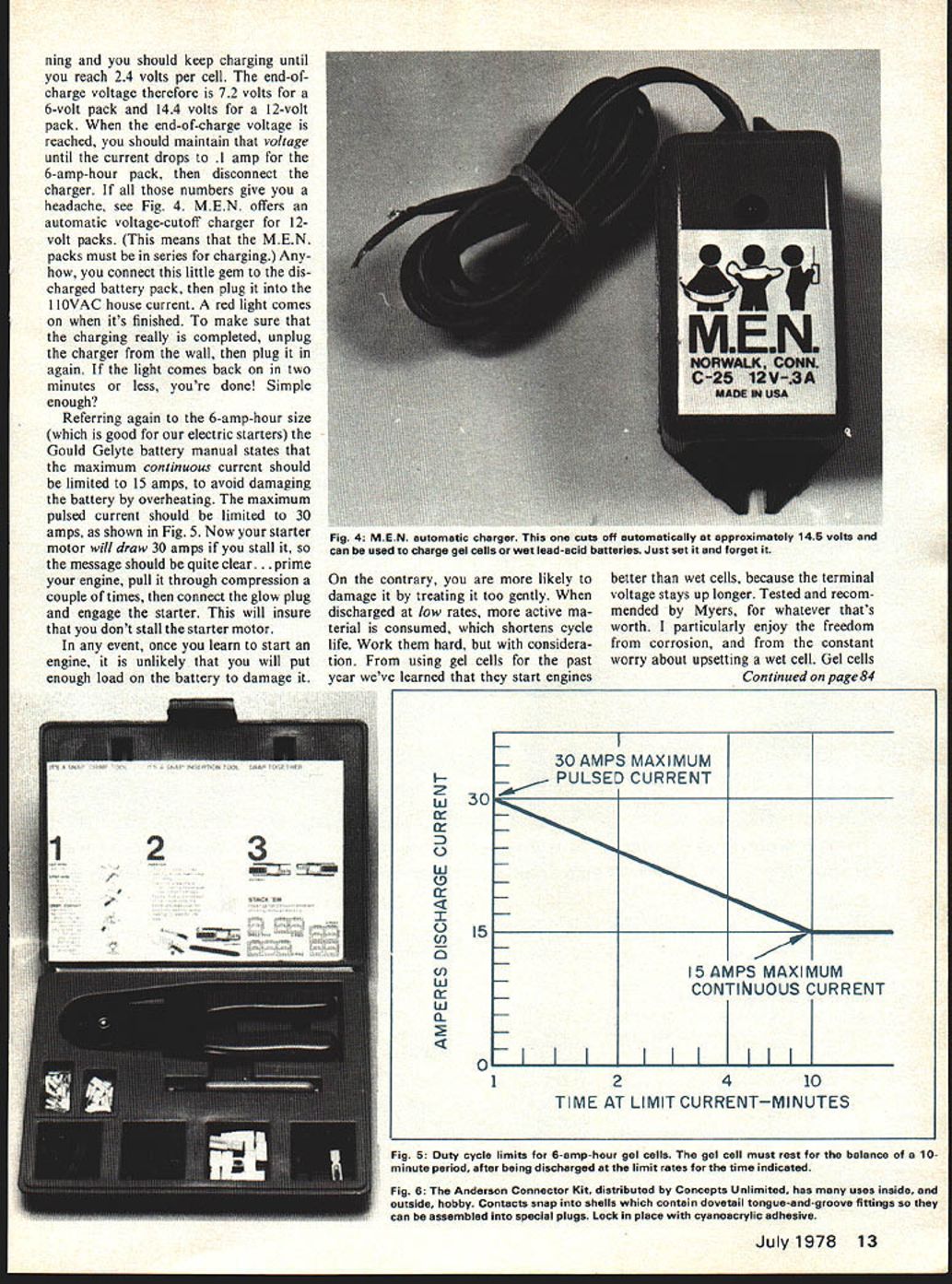
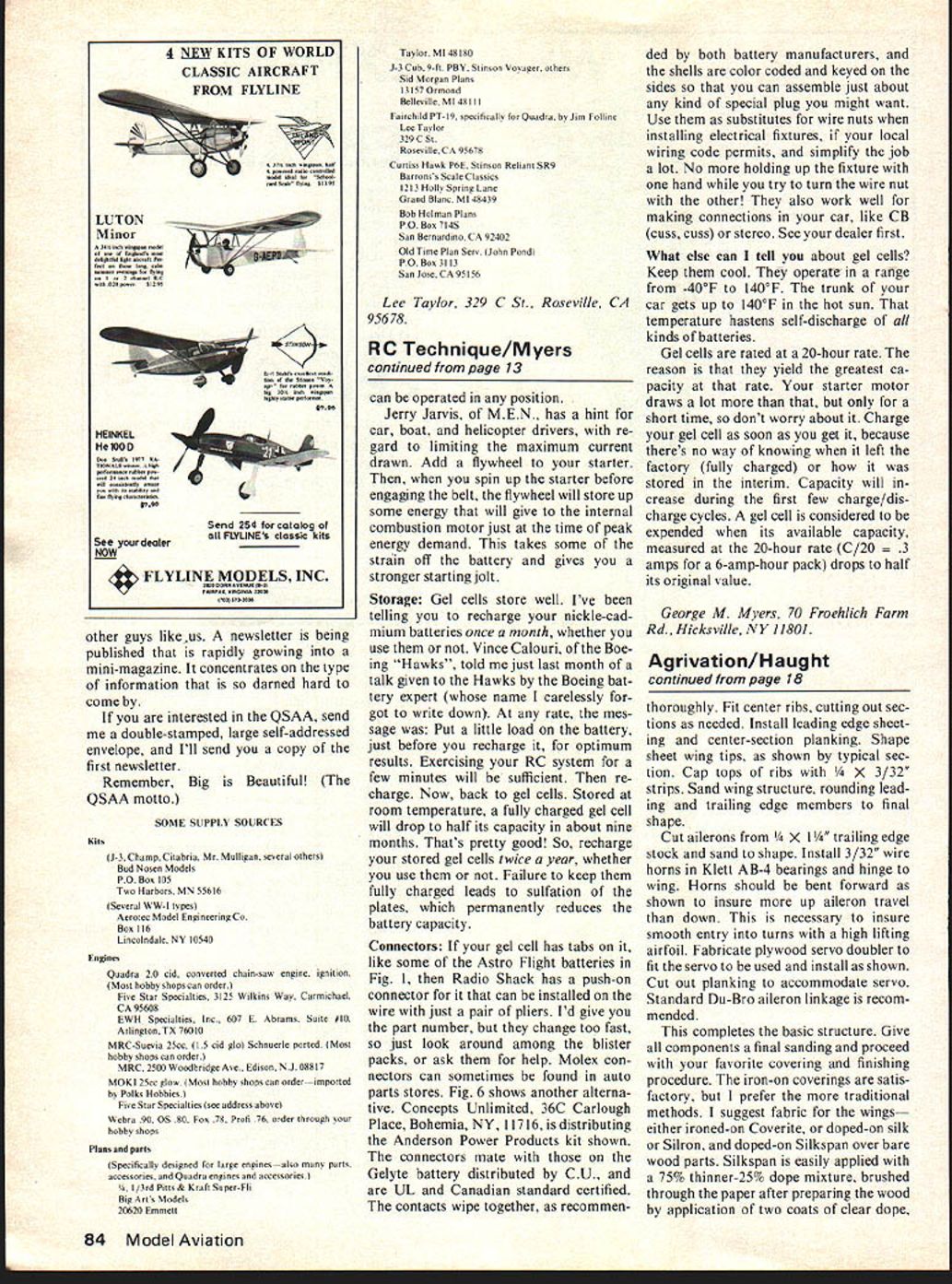
On the East coast, Gelyte batteries are distributed by M.E.N., Norwalk, CT (Fig. 2), and Concepts Unlimited, Bohemia, NY (Fig. 3). Both of these are 6-amp-hour packages, but the M.E.N. batteries are distributed as separate 6-volt cells, while the C.U. battery is available only as a 12-volt unit. Both end in pigtails, the M.E.N. battery terminating in Molex connectors (mating parts provided), while the C.U. battery terminates in Anderson connectors (mating parts not provided). All of the above statements may change before this is published, but if not, I'll have some terminations for you later in the column.
Charging: Limit the initial charging current to C/5 or less. For a 6-amp-hour pack, this figures out to be 6/5 or 1.2 amps, for a fully discharged condition. The manufacturers recommend that discharge be limited to not less than 1.75 volts per cell, and since a 6-volt battery has three cells, you can see that this figures out to a minimum voltage of 5.25 for a 6-volt pack, and 10.5 for a 12-volt pack. In any case, the current will drop rapidly in the beginning.
The end-of-charge voltage should be 2.4 volts per cell; therefore the end-of-charge voltage for a 6-volt pack is 7.2 volts and for a 12-volt pack is 14.4 volts. When the end-of-charge voltage is reached you should maintain the voltage until the current drops to 1 amp for a 6-amp-hour pack, and then disconnect the charger.
If these numbers give you a headache, see Fig. 4. M.E.N. offers an automatic voltage-cutoff charger for 12-volt packs; this means M.E.N. packs must be series charged. Any discharged battery pack can be connected to 110 VAC house current; a red light comes on while charging and goes out when finished. To make sure charging is really completed, unplug the charger from the wall and plug it in again; the light will come back for two minutes or less — then you're done. Simple enough.
Referring again to the 6-amp-hour size used for good electric starters, the Gould Gelyte battery manual states the maximum continuous current should be limited to 15 amps to avoid damaging the battery (overheating). The maximum pulsed current should be limited to 30 amps (see Fig. 5). Now, a starter motor will draw 30 amps at stall, so the message should be: don't stall the starter motor. Prime the engine, pull through compression a couple of times, connect the glow plug and engage the starter; this will ensure you don't stall the starter. Once you learn to start the engine, you are unlikely to put enough load on the battery to damage it. Contrary to treating the battery too gently, low-rate discharges consume active material and shorten cycle life.
From our experience over the past year using gel cells, we've learned that wet cells will start engines better because their terminal voltage stays up longer. Tested and recommended? Myers — whatever that's worth. I particularly enjoy the freedom from corrosion and the constant worry about upsetting a wet cell. Gel cells can be operated in any position.
Jerry Jarvis, of M.E.N., has a hint for car, boat, and helicopter drivers, with regard to limiting the maximum current drawn. Add a flywheel to your starter. Then, when you spin up the starter before engaging the belt, the flywheel will store up some energy that will give to the internal combustion motor just at the time of peak energy demand. This takes some of the strain off the battery and gives you a stronger starting jolt.
Storage: Gel cells store well. I've been telling you to recharge your nickel-cadmium batteries once a month, whether you use them or not. Vince Calouri, of the Boeing "Hawks", told me just last month of a talk given to the Hawks by the Boeing battery expert (whose name I carelessly forgot to write down). At any rate, the message was: Put a little load on the battery, just before you recharge it, for optimum results. Exercising your RC system for a few minutes will be sufficient. Then recharge. Now, back to gel cells. Stored at room temperature, a fully charged gel cell will drop to half its capacity in about nine months. That's pretty good! So, recharge your stored gel cells twice a year, whether you use them or not. Failure to keep them fully charged leads to sulfation of the plates, which permanently reduces the battery capacity.
Connectors: If your gel cell has tabs on it, like some of the Astro Flight batteries in Fig. 1, then Radio Shack has a push-on connector for it that can be installed on the wire with just a pair of pliers. I'd give you the part number, but they change too fast, so just look around among the blister packs, or ask them for help. Molex connectors can sometimes be found in auto parts stores. Fig. 6 shows another alternative. Concepts Unlimited, 36C Carlough Place, Bohemia, NY, 11716, is distributing the Anderson Power Products kit shown. The connectors mate with those on the Gelyte battery distributed by C.U., and are UL and Canadian standard certified. The contacts wipe together, as recommended by both battery manufacturers, and the shells are color coded and keyed on the sides so that you can assemble just about any kind of special plug you might want. Use them as substitutes for wire nuts when installing electrical fixtures, if your local wiring code permits, and simplify the job a lot. No more holding up the fixture with one hand while you try to turn the wire nut with the other! They also work well for making connections in your car, like CB or stereo. See your dealer first.
What else can I tell you about gel cells? Keep them cool. They operate in a range from -40°F to 140°F. The trunk of your car gets up to 140°F in the hot sun. That temperature hastens self-discharge of all kinds of batteries.
Gel cells are rated at a 20-hour rate. The reason is that they yield the greatest capacity at that rate. Your starter motor draws a lot more than that, but only for a short time, so don't worry about it. Charge your gel cell as soon as you get it, because there's no way of knowing when it left the factory (fully charged) or how it was stored in the interim. Capacity will increase during the first few charge/discharge cycles. A gel cell is considered to be expended when its available capacity, measured at the 20-hour rate (C/20 = .3 amps for a 6-amp-hour pack) drops to half its original value.
George M. Myers, 70 Froehlich Farm Rd., Hicksville, NY 11801.
Transcribed from original scans by AI. Minor OCR errors may remain.

