
Radio Technique--George Myers
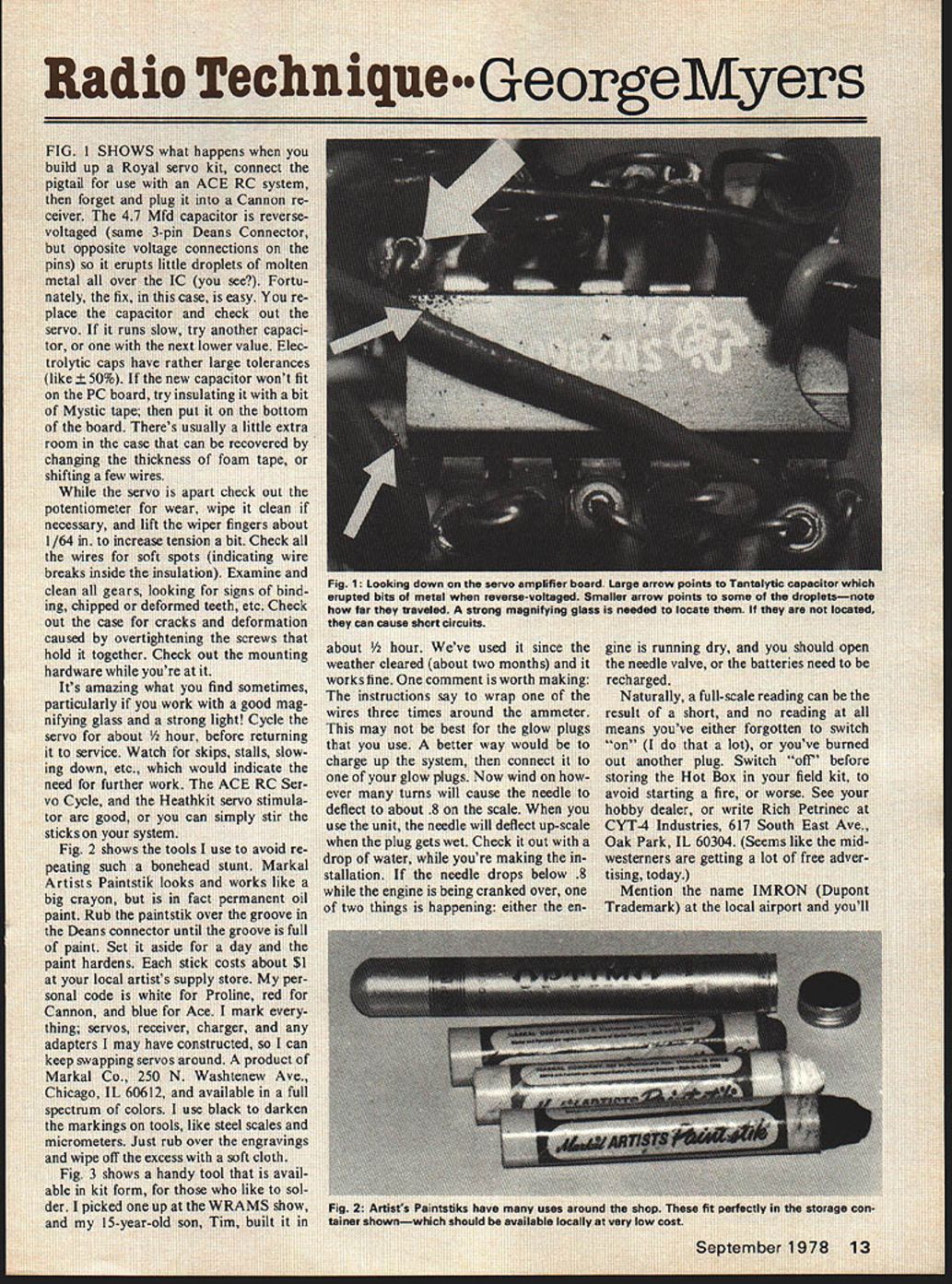
FIG. 1 SHOWS what happens when you build up a Royal servo kit, connect the pigtail for use with an ACE RC system, then forget and plug it into a Cannon receiver. The 4.7 Mfd capacitor is reverse‑voltaged (same 3‑pin Deans Connector, but opposite voltage connections on the pins) so it erupts little droplets of molten metal all over the IC (you see?). Fortunately, the fix, in this case, is easy. You replace the capacitor and check out the servo. If it runs slow, try another capacitor, or one with the next lower value. Electrolytic caps have rather large tolerances (like ±50%). If the new capacitor won't fit on the PC board, try insulating it with a bit of Mystic tape; then put it on the bottom of the board. There's usually a little extra room in the case that can be recovered by changing the thickness of foam tape, or shifting a few wires.
While the servo is apart check out the potentiometer for wear, wipe it clean if necessary, and lift the wiper fingers about 1/64 in. to increase tension a bit. Check all the wires for soft spots (indicating wire breaks inside the insulation). Examine and clean all gears, looking for signs of binding, chipped or deformed teeth, etc. Check out the case for cracks and deformation caused by overtightening the screws that hold it together. Check out the mounting hardware while you're at it.
It's amazing what you find sometimes, particularly if you work with a good magnifying glass and a strong light! Cycle the servo for about ½ hour, before returning it to service. Watch for skips, stalls, slowing down, etc., which would indicate the need for further work. The ACE RC Servo Cycle, and the Heathkit servo stimulator are good, or you can simply stir the sticks on your system.
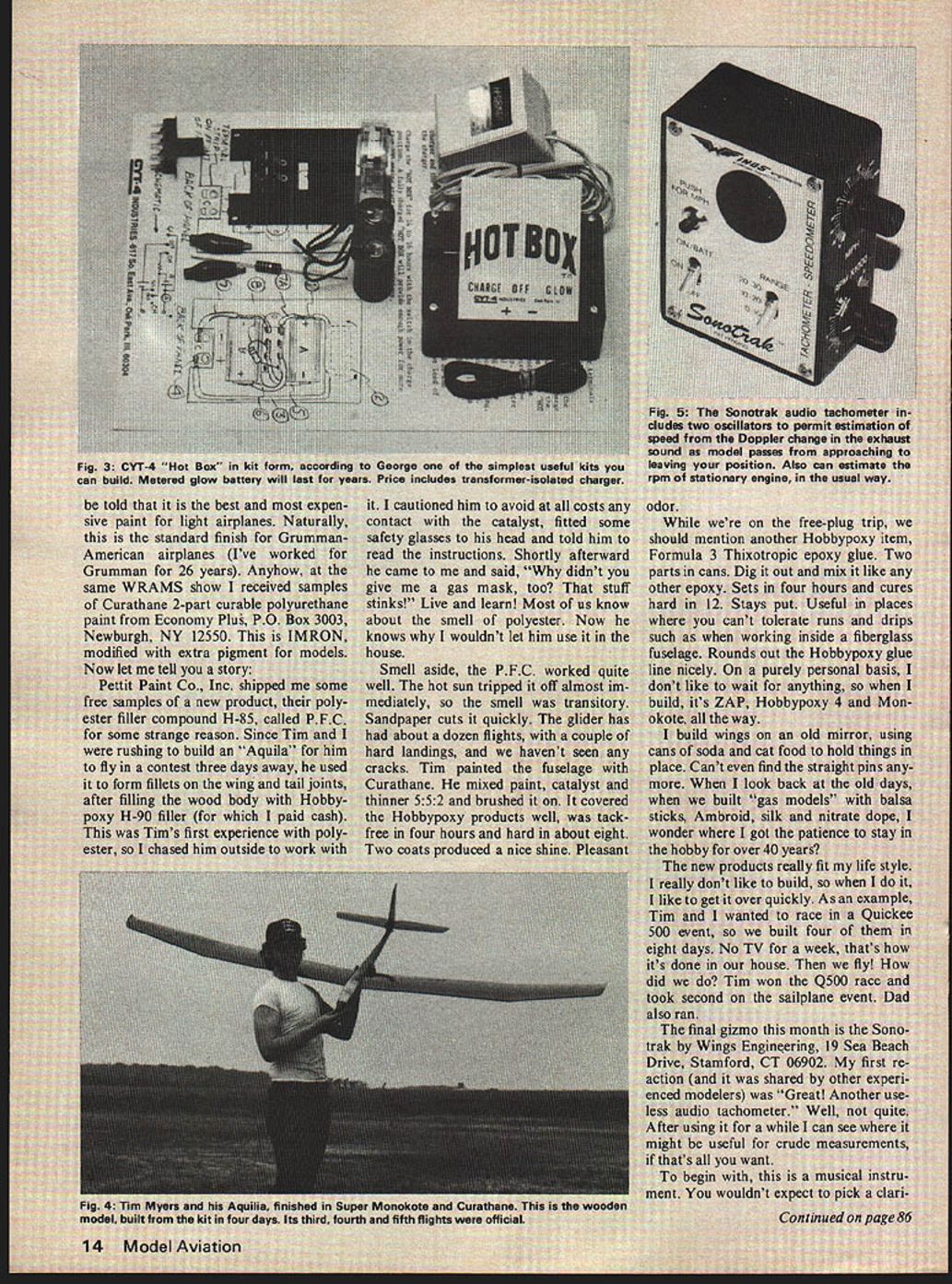
Fig. 2 shows the tools I use to avoid repeating such a bonehead stunt. Markal Artist's Paintstik looks and works like a big crayon, but is in fact permanent oil paint. Rub the paintstik over the groove in the Deans connector until the groove is full of paint. Set it aside for a day and the paint hardens. Each stick costs about $1 at your local artist's supply store. My personal code is white for Proline, red for Cannon, and blue for Ace. I mark everything: servos, receiver, charger, and any adapters I may have constructed, so I can keep swapping servos around. A product of Markal Co., 250 N. Washtenaw Ave., Chicago, IL 60612, and available in a full spectrum of colors. I use black to darken the markings on tools, like steel scales and micrometers. Just rub over the engravings and wipe off the excess with a soft cloth.
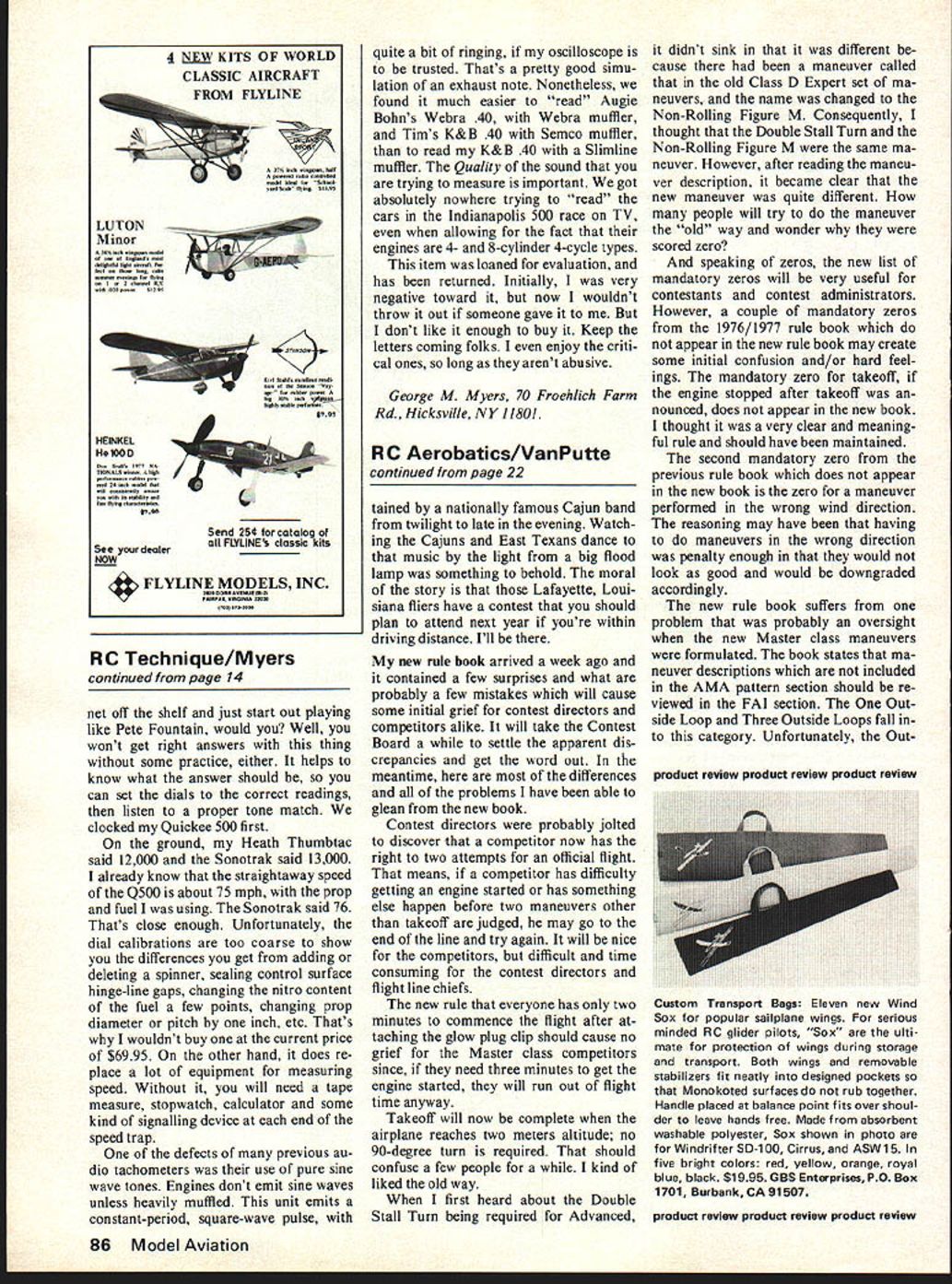
Fig. 3 shows a handy tool that is available in kit form, for those who like to solder. I picked one up at the WRAMS show, and my 15‑year‑old son, Tim, built it in about ½ hour. We've used it since the weather cleared (about two months) and it works fine. One comment is worth making: The instructions say to wrap one of the wires three times around the ammeter. This may not be best for the glow plugs that you use. A better way would be to charge up the system, then connect it to one of your glow plugs. Now wind on however many turns will cause the needle to deflect to about .8 on the scale. When you use the unit, the needle will deflect up‑scale when the plug gets wet. Check it out with a drop of water, while you're making the installation. If the needle drops below .8 while the engine is being cranked over, one of two things is happening: either the engine is running dry, and you should open the needle valve, or the batteries need to be recharged.
Naturally, a full‑scale reading can be the result of a short, and no reading at all means you've either forgotten to switch "on" (I do that a lot), or you've burned out another plug. Switch "off" before storing the Hot Box in your field kit, to avoid starting a fire, or worse. See your hobby dealer, or write Rich Petrince at CYT‑4 Industries, 617 South East Ave., Oak Park, IL 60304. (Seems like the midwesterners are getting a lot of free advertising, today.) be told that it is the best and most expensive paint for light airplanes. Naturally, this is the standard finish for Grumman‑American airplanes (I've worked for Grumman for 26 years). Anyhow, at the same WRAMS show I received samples of Curathane 2‑part curable polyurethane paint from Economy Plus, P.O. Box 3003, Newburgh, NY 12550. This is IMRON, modified with extra pigment for models.
Now let me tell you a story: Pettit Paint Co., Inc. shipped me some free samples of a new product, their polyester filler compound H‑85, called P.F.C. for some strange reason. Since Tim and I were rushing to build an "Aquila" for him to fly in a contest three days away, he used it to form fillets on the wing and tail joints, after filling the wood body with Hobbypoxy H‑90 filler (for which I paid cash). This was Tim's first experience with polyester, so I chased him outside to work with it. I cautioned him to avoid at all costs any contact with the catalyst, fitted some safety glasses to his head and told him to read the instructions. Shortly afterward he came to me and said, "Why didn't you give me a gas mask, too? That stuff stinks!" Live and learn! Most of us know about the smell of polyester. Now he knows why I wouldn't let him use it in the house.
Smell aside, the P.F.C. worked quite well. The hot sun tripped it off almost immediately, so the smell was transitory. Sandpaper cuts it quickly. The glider has had about a dozen flights, with a couple of hard landings, and we haven't seen any cracks. Tim painted the fuselage with Curathane. He mixed paint, catalyst and thinner 5:5:2 and brushed it on. It covered the Hobbypoxy products well, was tack‑free in four hours and hard in about eight. Two coats produced a nice shine. Pleasant odor.
While we're on the free‑plug trip, we should mention another Hobbypoxy item, Formula 3 Thixotropic epoxy glue. Two parts in cans. Dig it out and mix it like any other epoxy. Sets in four hours and cures hard in 12. Stays put. Useful in places where you can't tolerate runs and drips such as when working inside a fiberglass fuselage. Rounds out the Hobbypoxy glue line nicely. On a purely personal basis, I don't like to wait for anything, so when I build, it's ZAP, Hobbypoxy 4 and Monokote, all the way.
I build wings on an old mirror, using cans of soda and cat food to hold things in place. Can't even find the straight pins anymore. When I look back at the old days, when we built "gas models" with balsa sticks, Ambroid, silk and nitrate dope, I wonder where I got the patience to stay in the hobby for over 40 years?
The new products really fit my life style. I really don't like to build, so when I do it, I like to get it over quickly. As an example, Tim and I wanted to race in a Quickee 500 event, so we built four of them in eight days. No TV for a week, that's how it's done in our house. Then we fly! How did we do? Tim won the Q500 race and took second on the sailplane event. Dad also ran.
The final gizmo this month is the Sonotrak by Wings Engineering, 19 Sea Beach Drive, Stamford, CT 06902. My first reaction (and it was shared by other experienced modelers) was "Great! Another useless audio tachometer." Well, not quite. After using it for a while I can see where it might be useful for crude measurements, if that's all you want.
To begin with, this is a musical instrument. You wouldn't expect to pick a clari-
Radio Technique
net off the shelf and just start out playing like Pete Fountain, would you? Well, you won't get right answers with this thing without some practice, either. It helps to know what the answer should be, so you can set the dials to the correct readings, then listen to a proper tone match. We clocked my Quickee 500 first.
On the ground, my Heath Thumbtac said 12,000 and the Sonotrak said 13,000. I already know that the straightaway speed of the Q500 is about 75 mph, with the prop and fuel I was using. The Sonotrak said 76. That's close enough. Unfortunately, the dial calibrations are too coarse to show you the differences you get from adding or deleting a spinner, sealing control surface hinge-line gaps, changing the nitro content of the fuel a few points, changing prop diameter or pitch by one inch, etc. That's why I wouldn't buy one at the current price of $69.95. On the other hand, it does replace a lot of equipment for measuring speed. Without it, you will need a tape measure, stopwatch, calculator and some kind of signalling device at each end of the speed trap.
One of the defects of many previous audio tachometers was their use of pure sine wave tones. Engines don't emit sine waves unless heavily muffled. This unit emits a constant-period, square-wave pulse, with quite a bit of ringing, if my oscilloscope is to be trusted. That's a pretty good simulation of an exhaust note. Nonetheless, we found it much easier to "read" Augie Bohn's Webra .40, with Webra muffler, and Tim's K&B .40 with Semco muffler, than to read my K&B .40 with a Slimline muffler. The quality of the sound that you are trying to measure is important. We got absolutely nowhere trying to "read" the cars in the Indianapolis 500 race on TV, even when allowing for the fact that their engines are 4- and 8-cylinder 4-cycle types.
This item was loaned for evaluation, and has been returned. Initially, I was very negative toward it, but now I wouldn't throw it out if someone gave it to me. But I don't like it enough to buy it. Keep the letters coming folks. I even enjoy the critical ones, so long as they aren't abusive.
George M. Myers, 70 Froehlich Farm Rd., Hicksville, NY 11801
Transcribed from original scans by AI. Minor OCR errors may remain.

