
Radio Technique — George Myers
NOTICE to RC Airmen: Hot Weather Discharges Your Batteries!
When you store your batteries in the trunk of your car, then park it in the hot sun for several hours before flying, expect the batteries to be discharged. This warning is particularly directed to working fellows like me, who like to stop off at the field on the way home from the job in order to get in some flying. We charge the batteries overnight (about 9 hours), store the planes in the car all day long (about 9 hours), then suffer the consequences in the evening. It gets worse when you manage to sneak in a couple of flights at lunchtime and forget to recharge the batteries one night.
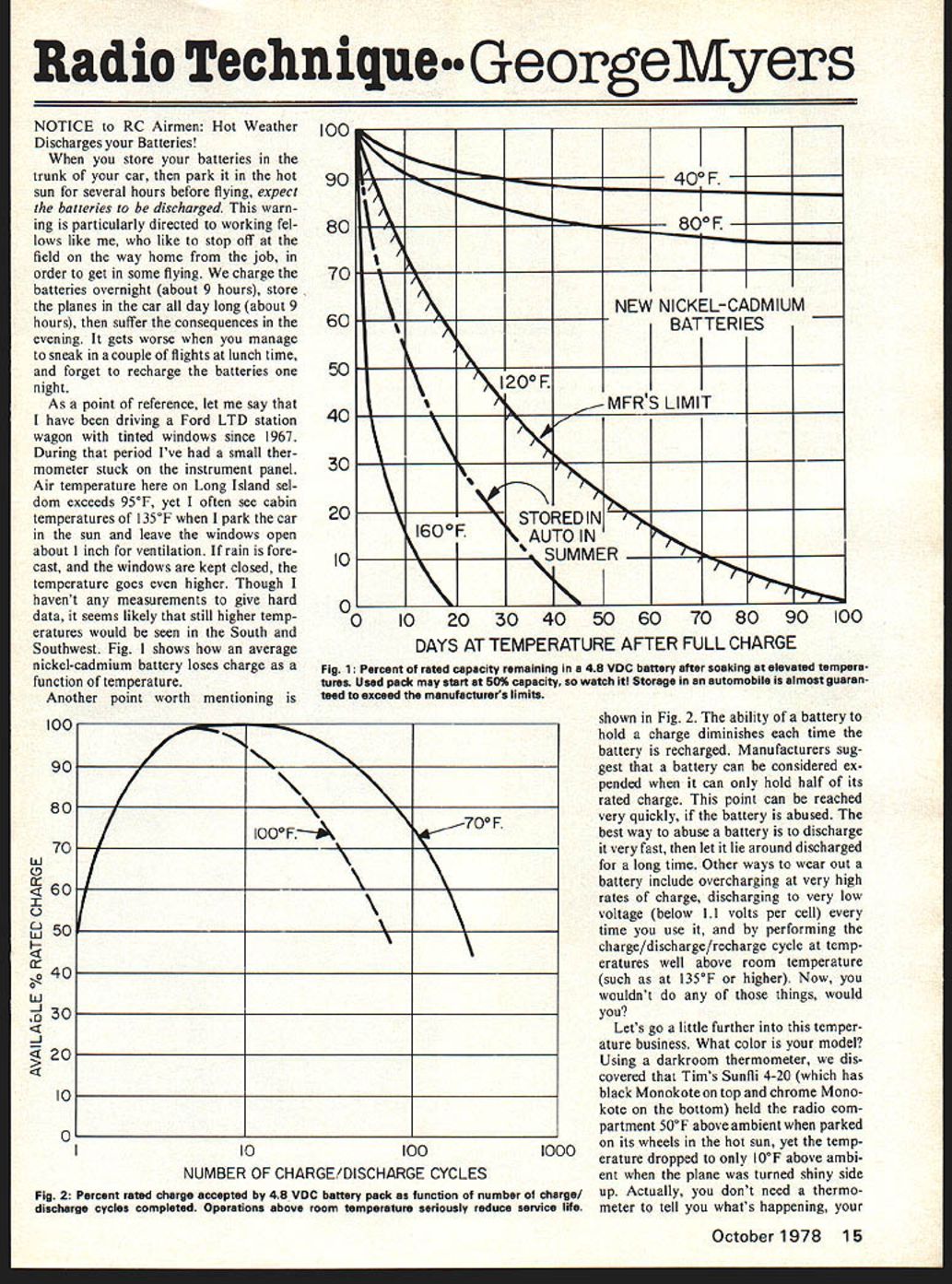
As a point of reference, I have been driving a Ford LTD station wagon with tinted windows since 1967. During that period I've kept a small thermometer on the instrument panel. Air temperature here on Long Island seldom exceeds 95°F, yet I often see cabin temperatures of 135°F when I park the car in the sun and leave the windows open about 1 inch for ventilation. If rain is forecast and the windows are kept closed, the temperature goes even higher. Though I haven't any measurements to give hard data, it seems likely that still higher temperatures would be seen in the South and Southwest. Fig. 1 shows how an average nickel-cadmium battery loses charge as a function of temperature.
Battery Aging and Abuse
The ability of a battery to hold a charge diminishes each time the battery is recharged. Manufacturers suggest that a battery can be considered expended when it can only hold half of its rated charge. This point can be reached very quickly if the battery is abused. The best way to abuse a battery is to discharge it very fast, then let it lie around discharged for a long time. Other ways to wear out a battery include:
- Overcharging at very high rates.
- Discharging to very low voltage (below 1.1 volts per cell) every time you use it.
- Performing the charge/discharge/recharge cycle at temperatures well above room temperature (such as at 135°F or higher).
Please replace old batteries promptly — the cost is much less than the plane they're in or the damage a crash can cause.
Color, Placement, and Heat
What color is your model? Using a darkroom thermometer, we discovered that Tim's Sunflite 4-20 (black Monokote on top and chrome Monokote on the bottom) held the radio compartment 50°F above ambient when parked on its wheels in the hot sun, yet the temperature dropped to only 10°F above ambient when the plane was turned shiny side up. You don't need a thermometer to tell what's happening; your fingers tell right away. Just storing a dark-colored model near a window where the sun can shine on it all day can bake your batteries very quickly.
Batteries wrapped in a foam-rubber insulating blanket hold heat long after the exterior of the model has cooled down. As batteries age, internal resistance builds up. Some can get quite hot, particularly when Rapid Charged. Feeling the pack while charging is a good way to judge whether it's time for replacement.
Transmitter Heat
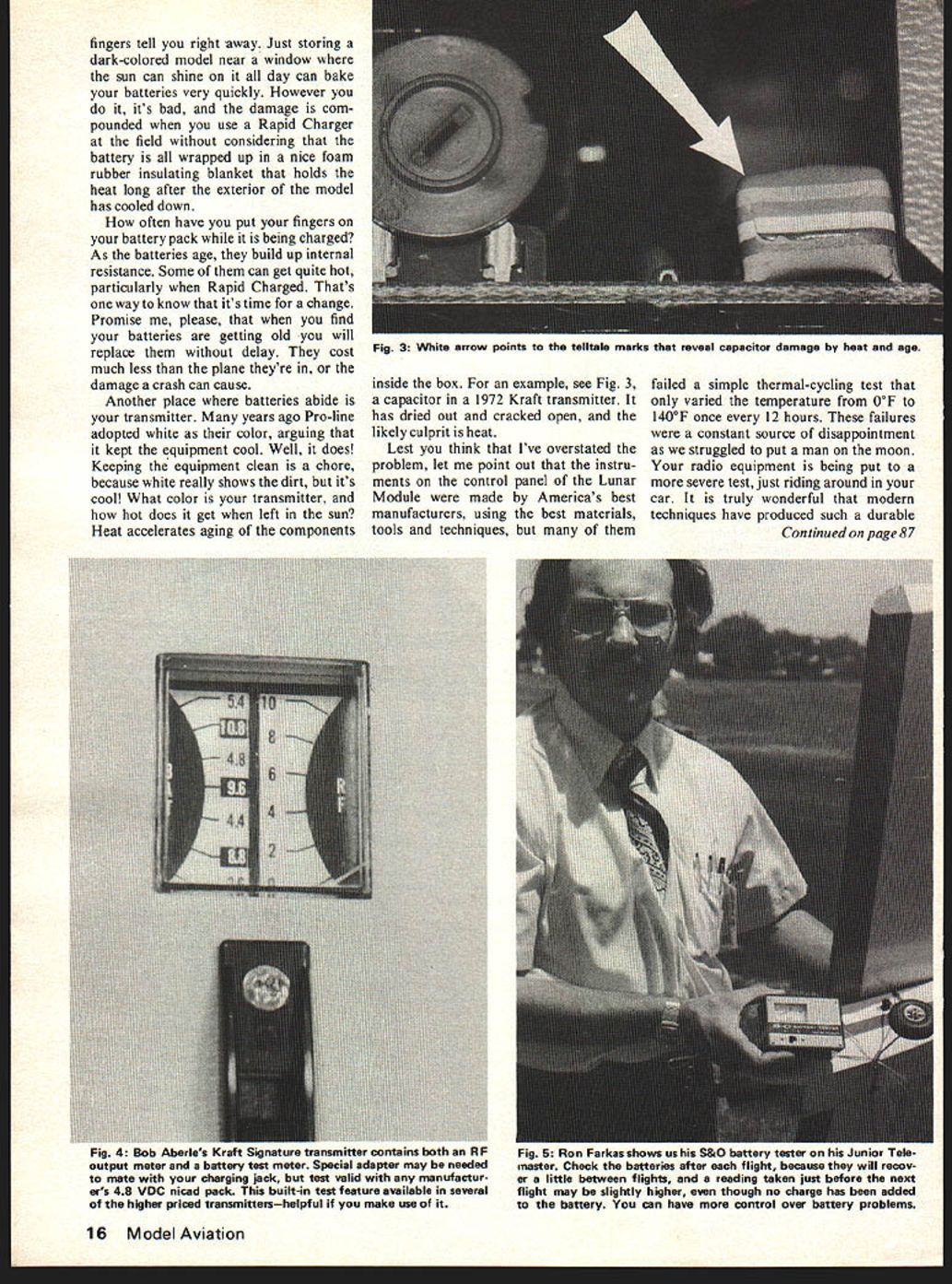
Another place batteries abide is in the transmitter. Years ago Pro-Line adopted white as the color, arguing it kept equipment cool. It does — although keeping it clean is more of a chore because white shows dirt. Heat accelerates aging of the components inside the box. For example, see Fig. 3: a capacitor in a 1972 Kraft transmitter has dried out and cracked open — the likely culprit is heat.
Lest you think this problem is overstated, consider that instruments on the control panel of the Lunar Module, made by America's best manufacturers using the best materials, tools, and techniques, failed a simple thermal-cycling test that varied temperature from 0°F to 140°F once every 12 hours. Failures were a constant source of disappointment as they struggled to put man on the Moon. Your radio equipment is being put to a severe test just riding around in a car. It is truly wonderful that modern techniques have produced such durable components, but is it really wise to treat them so carelessly?
Suggested Solutions
- Park in the shade whenever possible.
- Cover the windows to keep out sunlight. The problem is the "Greenhouse Effect." Sunlight passes through glass to heat the interior. The heated interior tries to radiate its excess heat back out the window, but the glass is "black" to the lower-frequency radiant energy of the warmed interior, so the heat stays in the car and builds up. Opening the windows lets hot air escape.
- If you can't park in shade or cover the windows, take your batteries into the building with you. Keeping them cool is the objective.
- At a minimum, test your batteries before the first flight and after every flight. Several manufacturers now offer built-in battery testers as part of the transmitter.
Fig. 4 shows the Kraft Signature transmitter being used to test the batteries in my Quickee 500. Fig. 5 shows the Bridi expanded-scale voltmeter performing the same service. Similar ESMs are available from Royal Electronics, Kraft Air, E.K. Logictrol, and others. All of these devices place a load on the battery that simulates the load of an operating system.
You can also use the operating system as a load if you use one of the LED low-voltage detectors, such as the Power-Cyc, Flite-Lite, or Corley's CVI, all discussed in this column in the January and April issues of 1976. Whatever you use, test — don't guess. When you test, let the load hang on the batteries for at least 30 seconds. You may find the voltage drops quite rapidly into the danger zone. Batteries recuperate a little when allowed to rest, so a flash reading may be misleading.
Testing, Charging, and Pack Variability
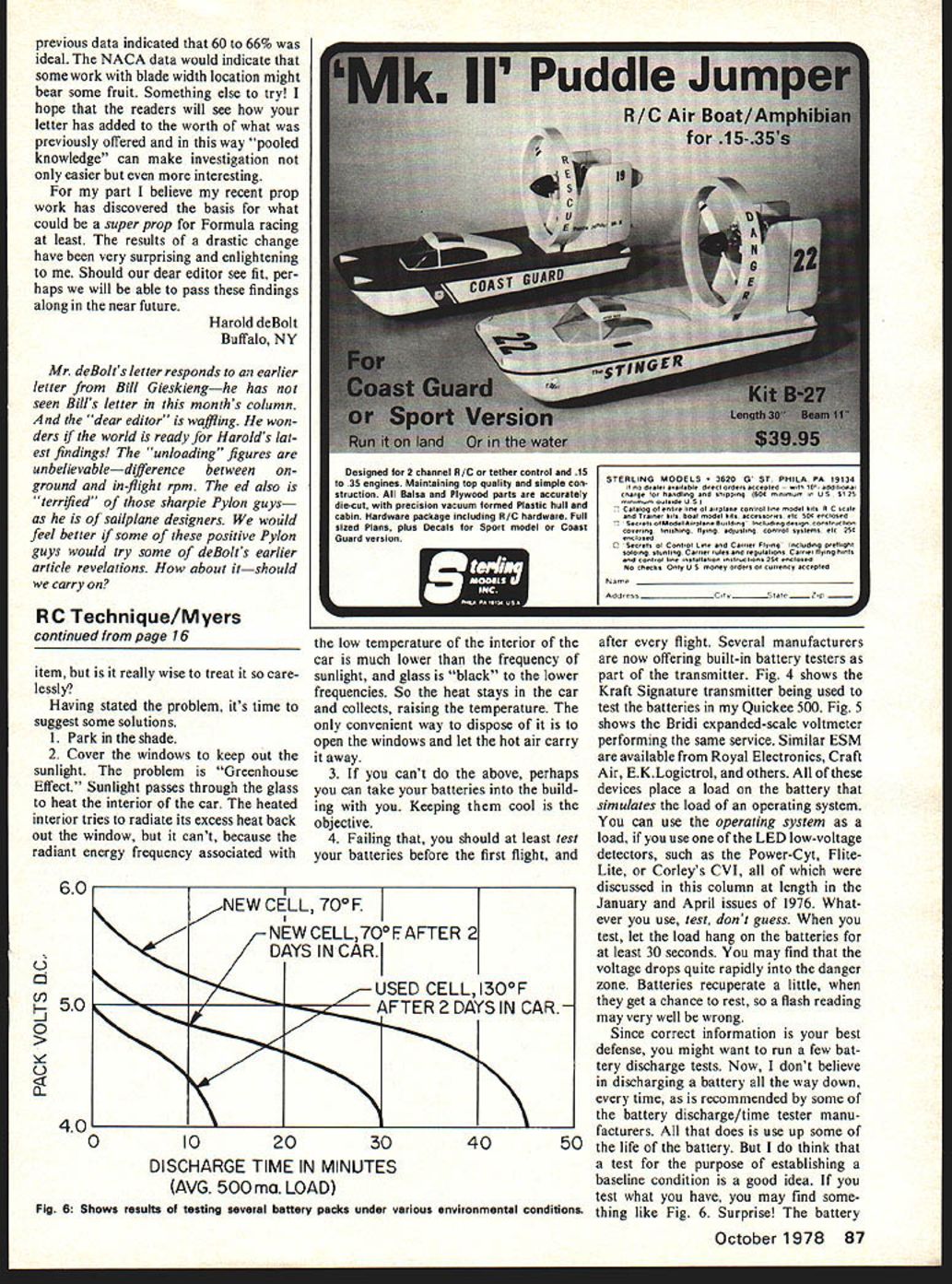
Since correct information is your best defense, run a few battery discharge tests to establish a baseline condition. I don't believe in discharging a battery all the way down every time, as some discharge/time tester manufacturers recommend — that just uses up life. But a baseline test is a good idea. You may find results like Fig. 6: a pack you thought was good for two or more hours of flying turns out to be good for only 30 minutes after age and heat take their toll.
Remember that pack-to-pack performance variance is enormous. Don't assume because one pack gives you thirty minutes that another will do the same. When you buy new packs, check them out right away — not all "new" packs are truly new; some may have deteriorated on the shelf.
One final point about charging: charge at the correct rate. Refer to the battery manufacturer's specifications. Rapid chargers are great for quick turnaround, but they can damage older packs. Slow charging overnight is gentler and often results in longer pack life.
Final Remarks
Well, that's about all I have to say on battery care and heat. Next month we'll talk about antenna placement and trimming the system for better range.
Fig. 6 shows results of testing several battery packs under various environmental conditions.
Please keep the letters coming. Your questions are bothering other people, too!
George M. Myers 70 Froehlich Farm Road, Hicksville, NY 11801.
Transcribed from original scans by AI. Minor OCR errors may remain.

