
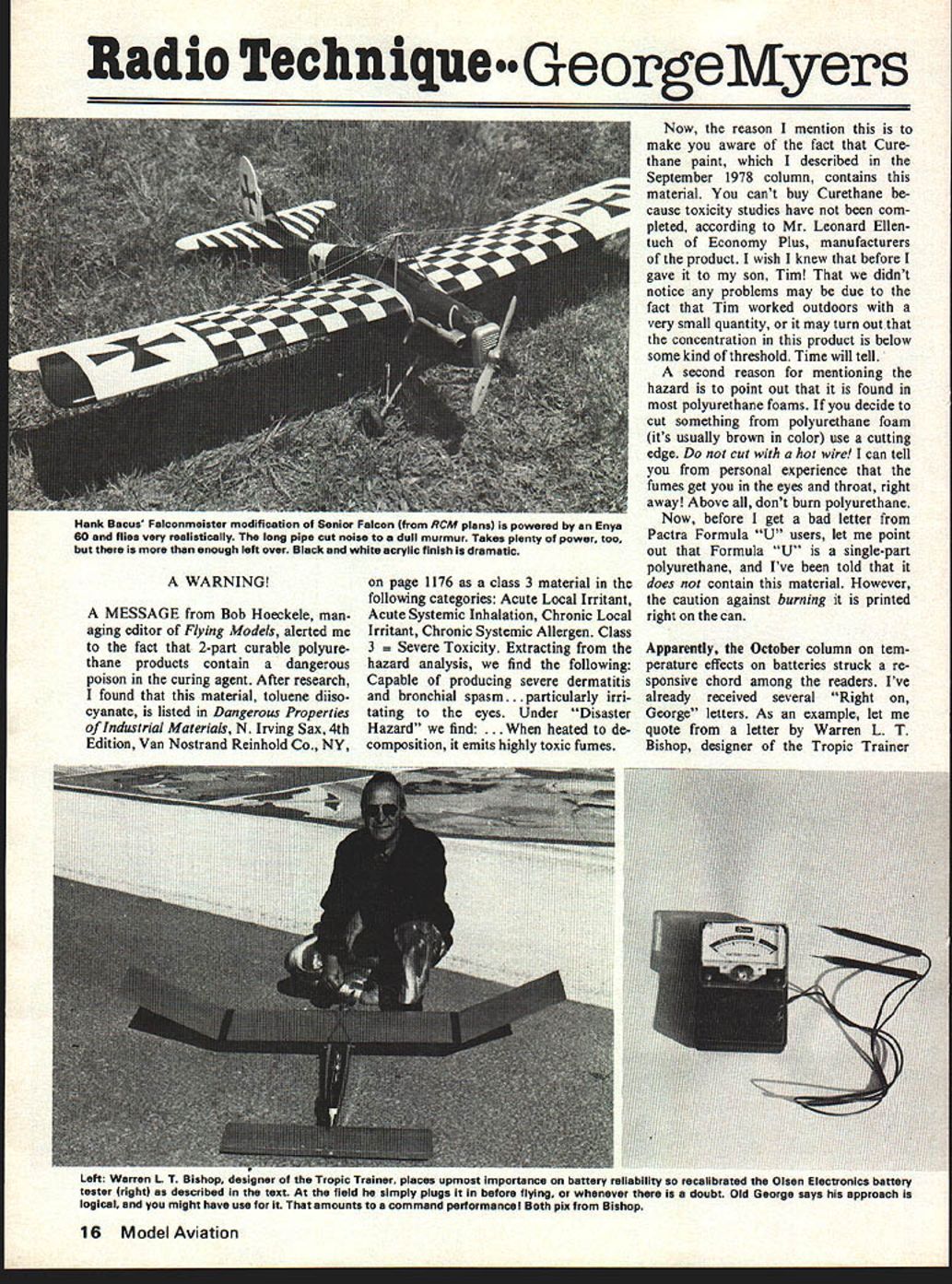
Radio Technique — George Myers
A WARNING!
A message from Bob Hoeckele, managing editor of Flying Models, alerted me to the fact that 2-part curable polyurethane products contain a dangerous poison in the curing agent. After research, I found that this material, toluene diisocyanate, is listed in Dangerous Properties of Industrial Materials, N. Irving Sax, 4th Edition, Van Nostrand Reinhold Co., NY, on page 1176 as a class 3 material in the following categories: Acute Local Irritant, Acute Systemic Inhalation, Chronic Local Irritant, Chronic Systemic Allergen. Class 3 — Severe Toxicity.
Extracting from the hazard analysis, we find the following: capable of producing severe dermatitis and bronchial spasm... particularly irritating to the eyes. Under "Disaster Hazard" we find: when heated to decomposition, it emits highly toxic fumes.
I mention this to make you aware that Curethane paint, which I described in the September 1978 column, contains this material. You can't buy Curethane because toxicity studies have not been completed, according to Mr. Leonard Ellentuch of Economy Plus, manufacturers of the product. I wish I had known that before I gave it to my son, Tim! That we didn't notice any problems may be due to the fact that Tim worked outdoors with a very small quantity, or it may turn out that the concentration in this product is below some kind of threshold. Time will tell.
A second reason for mentioning the hazard is to point out that it is found in most polyurethane foams. If you decide to cut something from polyurethane foam (it's usually brown in color) use a cutting edge. Do not cut with a hot wire! I can tell you from personal experience that the fumes get you in the eyes and throat right away. Above all, don't burn polyurethane.
Before I get a bad letter from Pactra Formula "U" users, let me point out that Formula "U" is a single-part polyurethane, and I've been told that it does not contain this material. However, the caution against burning it is printed right on the can.
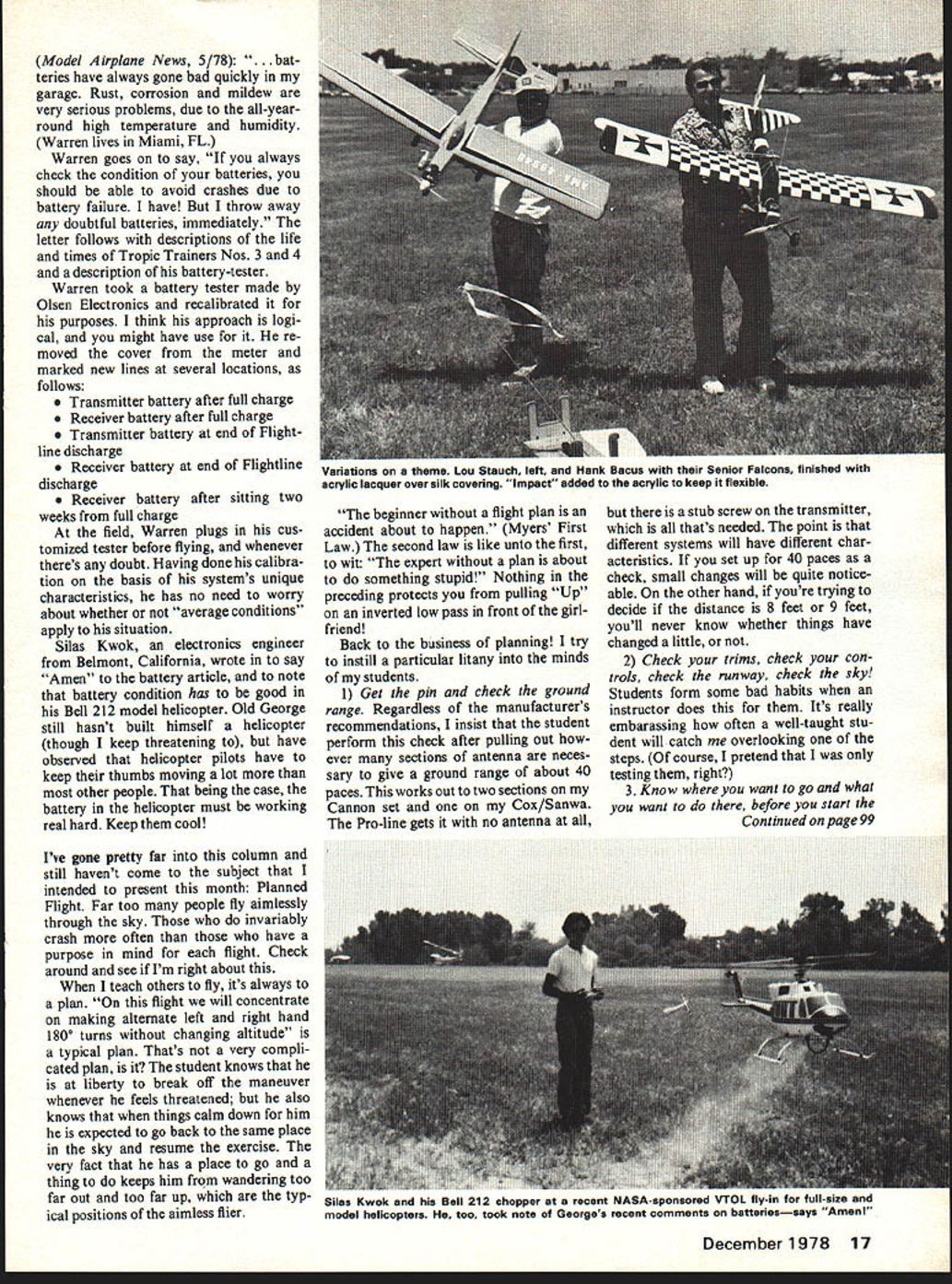
Apparently, the October column on temperature effects on batteries struck a responsive chord among the readers. I've already received several "Right on, George" letters. As an example, let me quote from a letter by Warren L. T. Bishop, designer of the Tropic Trainer (Model Airplane News, 5/78): "Batteries have always gone bad quickly in my garage. Rust, corrosion and mildew are very serious problems, due to the all-year-round high temperature and humidity." (Warren lives in Miami, FL.)
Warren goes on to say, "If you always check the condition of your batteries, you should be able to avoid crashes due to battery failure. I have! But I throw away any doubtful batteries, immediately." The letter follows with descriptions of the life and times of Tropic Trainers Nos. 3 and 4 and a description of his battery tester.
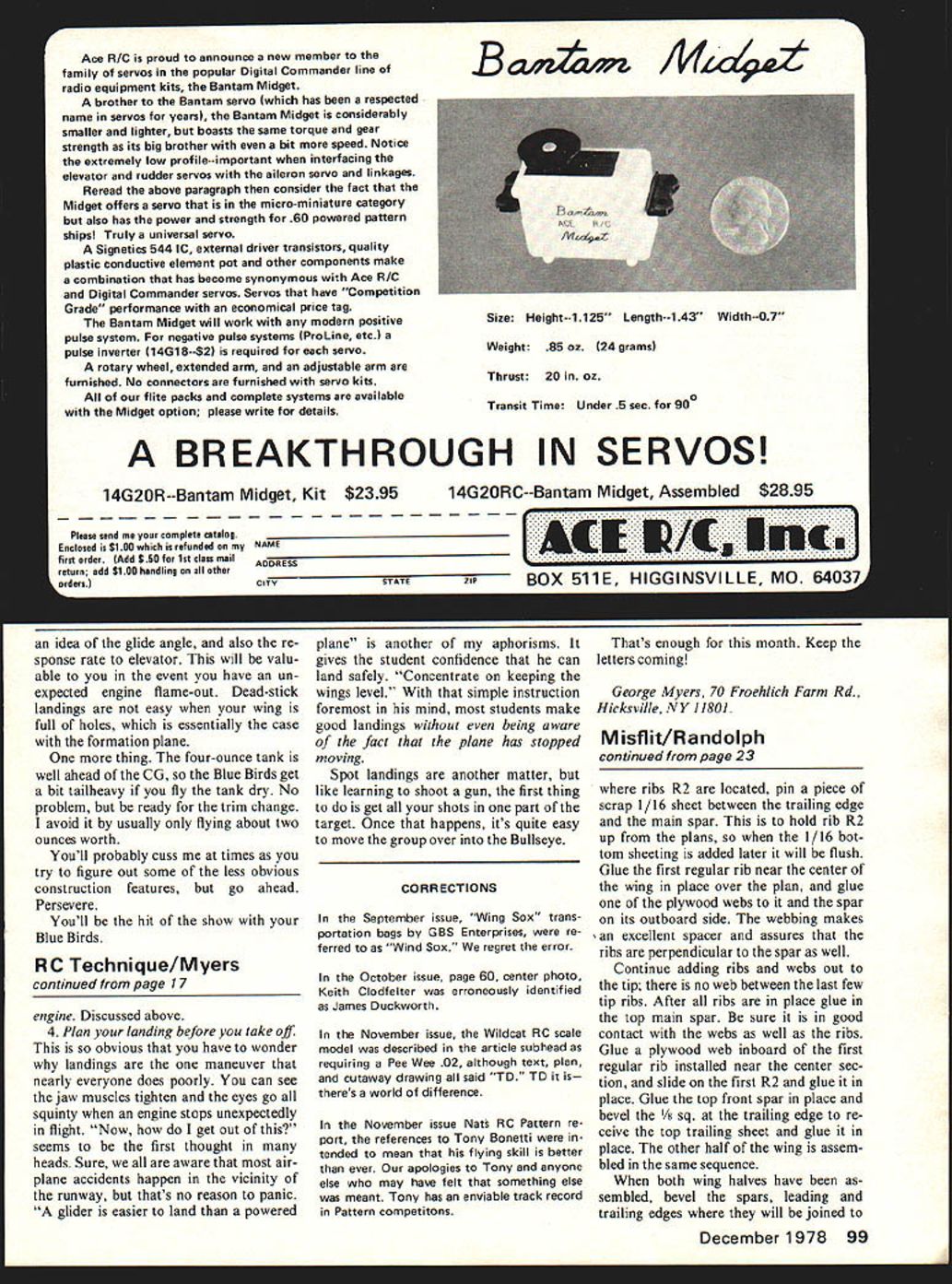
Warren took a battery tester made by Olsen Electronics and recalibrated it for his purposes. I think his approach is logical, and you might have use for it. He removed the cover from the meter and marked new lines at several locations, as follows:
- Transmitter battery after full charge
- Receiver battery after full charge
- Transmitter battery at end of Flightline discharge
- Receiver battery at end of Flightline discharge
- Receiver battery after sitting two weeks from full charge
At the field, Warren plugs in his customized tester before flying, and whenever there's any doubt. Having done his calibration on the basis of his system's unique characteristics, he has no need to worry about whether or not "average conditions" apply to his situation.
Silas Kwok, an electronics engineer from Belmont, California, wrote in to say "Amen" to the battery article, and to note that battery condition has to be good in his Bell 212 model helicopter. Old George still hasn't built himself a helicopter (though I keep threatening to), but I have observed that helicopter pilots have to keep their thumbs moving a lot more than most other people. That being the case, the battery in the helicopter must be working real hard. Keep them cool!
Planned Flight
I've gone pretty far into this column and still haven't come to the subject that I intended to present this month: planned flight. Far too many people fly aimlessly through the sky. Those who do invariably crash more often than those who have a purpose in mind for each flight. Check around and see if I'm right about this.
When I teach others to fly, it's always to a plan. "On this flight we will concentrate on making alternate left and right hand 180° turns without changing altitude" is a typical plan. That's not a very complicated plan, is it? The student knows that he is at liberty to break off the maneuver whenever he feels threatened; but he also knows that when things calm down for him he is expected to go back to the same place in the sky and resume the exercise. The very fact that he has a place to go and a thing to do keeps him from wandering too far out and too far up, which are the typical positions of the aimless flier.
"The beginner without a flight plan is an accident about to happen." (Myers' First Law.) "The second law is like unto the first, to wit: 'The expert without a plan is about to do something stupid!'" Nothing in the preceding protects you from pulling "Up" on an inverted low pass in front of the girlfriend!
Back to the business of planning! I try to instill a particular litany into the minds of my students.
- Get the pin and check the ground range. Regardless of the manufacturer's recommendations, I insist that the student perform this check after pulling out however many sections of antenna are necessary to give a ground range of about 40 paces. This works out to two sections on my Cannon set and one on my Cox/Sanwa. The Pro-line gets it with no antenna at all, but there is a stub screw on the transmitter, which is all that's needed. The point is that different systems will have different characteristics. If you set up for 40 paces as a check, small changes will be quite noticeable. On the other hand, if you're trying to decide if the distance is 8 feet or 9 feet, you'll never know whether things have changed a little, or not.
- Check your trims, check your controls, check the runway, check the sky! Students form some bad habits when an instructor does this for them. It's really embarrassing how often a well-taught student will catch me overlooking one of the steps. (Of course, I pretend that I was only testing them, right?)
- Know where you want to go and what you want to do there before you start the engine. Get an idea of the glide angle and also the response rate to elevator. This will be valuable to you in the event you have an unexpected engine flame-out. Dead-stick landings are not easy when your wing is full of holes, which is essentially the case with the formation plane.
One more thing. The four-ounce tank is well ahead of the CG, so the Blue Birds get a bit tailheavy if you fly the tank dry. No problem, but be ready for the trim change. I avoid it by usually only flying about two ounces worth. You'll probably cuss me at times as you try to figure out some of the less obvious construction features, but go ahead. Persevere. You'll be the hit of the show with your Blue Birds.
- Plan your landing before you take off. This is so obvious that you have to wonder why landings are the one maneuver that nearly everyone does poorly. You can see the jaw muscles tighten and the eyes go all squinty when an engine stops unexpectedly in flight. "Now, how do I get out of this?" seems to be the first thought in many heads. Sure, we all are aware that most airplane accidents happen in the vicinity of the runway, but that's no reason to panic. "A glider is easier to land than a powered plane" is another of my aphorisms. It gives the student confidence that he can land safely. "Concentrate on keeping the wings level." With that simple instruction foremost in his mind, most students make good landings without even being aware of the fact that the plane has stopped moving.
Spot landings are another matter, but like learning to shoot a gun, the first thing to do is get all your shots in one part of the target. Once that happens, it's quite easy to move the group over into the bullseye.
CORRECTIONS
- In the September issue, "Wing Sox" transportation bags by GBS Enterprises were referred to as "Wind Sox." We regret the error.
- In the October issue, page 60, center photo, Keith Clodfelter was erroneously identified as James Duckworth.
- In the November issue, the Wildcat RC scale model was described in the article subhead as requiring a Pee Wee .02, although text, plan, and cutaway drawing all said "TD." TD it is — there's a world of difference.
- In the November issue Nats RC Pattern report, the references to Tony Bonetti were intended to mean that his flying skill is better than ever. Our apologies to Tony and anyone else who may have felt that something else was meant. Tony has an enviable track record in Pattern competitions.
That's enough for this month. Keep the letters coming!
George Myers, 70 Froehlich Farm Rd., Hicksville, NY 11801.
Transcribed from original scans by AI. Minor OCR errors may remain.

