
Radio Technique
George Myers
Tim and I did a lot of flying this summer (as usual), but we also spent some time with the RC boat crowd, which was unusual. We found a peculiar situation: boaters are abnormally congregated on a few specific frequencies.
- 72.160 MHz
- 72.320 MHz
- 72.960 MHz
Boaters generally need only two channels of control: either rudder and sail or rudder and throttle. Futaba makes a couple of dry-battery systems with two or three channels. They are inexpensive and work well, so they are very popular with boaters. One of their features is interchangeable crystals on the five lower frequencies (72.08 through 72.400 MHz). Boaters use this feature to work out their frequency conflicts.
We noticed that the NAMBA and AMYA meets we attended were run by people who scrupulously avoided the use of aircraft frequencies. Sport sailors, however, will use any frequency the hobby dealer has to sell them.
At any rate, boaters in this area seldom use either the 27 MHz CB frequencies or the 53 MHz Amateur frequencies. The few that do seem to operate without difficulty. It would seem that the boat people might relieve some of their frequency-allocation problems by moving off the PRS band.
We who fly model airplanes do not have that option. We can't safely use the CB band, and the PRS band is fast becoming another disaster area because the Feds are licensing 300-watt voice transmitters directly on "our" frequencies in the PRS all over the United States. The newsletters I receive from Washington, Texas and Louisiana are full of horror stories about people who were shot down by the EPA or by shrimp-boat captains and oil-rig operators in the Gulf of Mexico.
John Worth and the AMA frequency committee, under the guidance of John Strong, have been busy trying to do something about this situation. You folks out there who never have to deal with the bureaucracy in Washington have no idea how hard the AMA must work to make any impression. The fact that things move slowly is not their fault. You should go out of your way to thank them for their efforts every time you see them. The glacier of Washington progress moves exceedingly slowly, but it does move! (Editor: Spell it: Big Government.)
Progress in the 6-Meter Amateur Band
The first bit of progress is an agreement to identify additional frequencies in the 6-meter Amateur band. Hams seldom use frequencies above 53 MHz in order to avoid generating neighborhood complaints about TVI (television interference). Therefore, the ARRL (American Radio Relay League) has presented no objection to adding channels at:
- 53.6 MHz
- 53.7 MHz
- 53.8 MHz
- 53.9 MHz
This was suggested by AMA Frequency Committee member Bob Aberle, W2QPP. The work isn't completed yet, so what I say now is just an opinion. The additional channels may be identified by Blue, Violet, Gray and White ribbons, respectively, with a black ribbon identifying the 6-meter band. The existing assignments of Light Blue and Violet to 51.20 MHz and 52.04 MHz may be dropped as superregenerative identifiers, because there are no commercial sets on those frequencies, and if there are any Hams using them, they haven't been seen at any contests recently.
You may not agree that assigning new frequencies in a band you can't use is progress, but you're wrong. You can get a Technician's license, and future columns will tell you how. Permission to use these frequencies has always been there, since any Ham can use them for any purpose. The same applies to the previous channels at 53.1–53.5 MHz. There never has been any guarantee of non-interference, nor any law prohibiting use of them for something like a computer link or Amateur color television. From a practical standpoint, Bob Aberle reports that he hasn't had a single case of interference in 20 years of RC flying. Conflict with other Hams who want to fly on the same channels does occur, but not often enough to be a problem.
AMA Petition to the FCC
AMA, with the help of legal counsel Jeremiah Courtney, has been preparing a petition to the FCC for additional channels in the PRS and other bands. I won't list any of them here, so as not to lead anyone to jump the gun and spoil it for everyone. Believe me when I say that the work has been going on for over a year, and it has been done very carefully. If you see a new set of frequencies appear for your use one day soon, you'll know who to thank. Make sure that you do thank them!
Cross-Pollination
Another facet of boating which should interest RC airmen is the boater's need for very large and powerful servos to control the rudder of 60-powered or twin-60-powered deep-V and mono hydroplanes. The Kraft KPS-16H servo has become very popular as a boat rudder servo. Builders of the quarter-scale monsters may want to look into this servo, which has been added to the Kraft catalog in the form of a proportional servo as well as the previously listed 180-degree retract mechanism.
Another servo which may prove interesting to the monster aircraft crowd is the Futaba S-14. This servo requires a separate power supply to operate the motor, which drives the output arm with a torque of 167 inch-ounces.
We saw systems from:
- Kraft
- Proline
- EK-Logictrol
- MRC
...in use on boats. We were surprised that we didn't see any sets using dual-rate or exponential control schemes. It would seem to be an ideal control mode for a boat: the rudder must have large angles of deflection at low speed (±45°), yet the boat is so sensitive at high speed that over-control is a noticeable problem. Some alert radio manufacturer should put a dual-rate switch on a two- or three-channel system and corner the RC boat market!
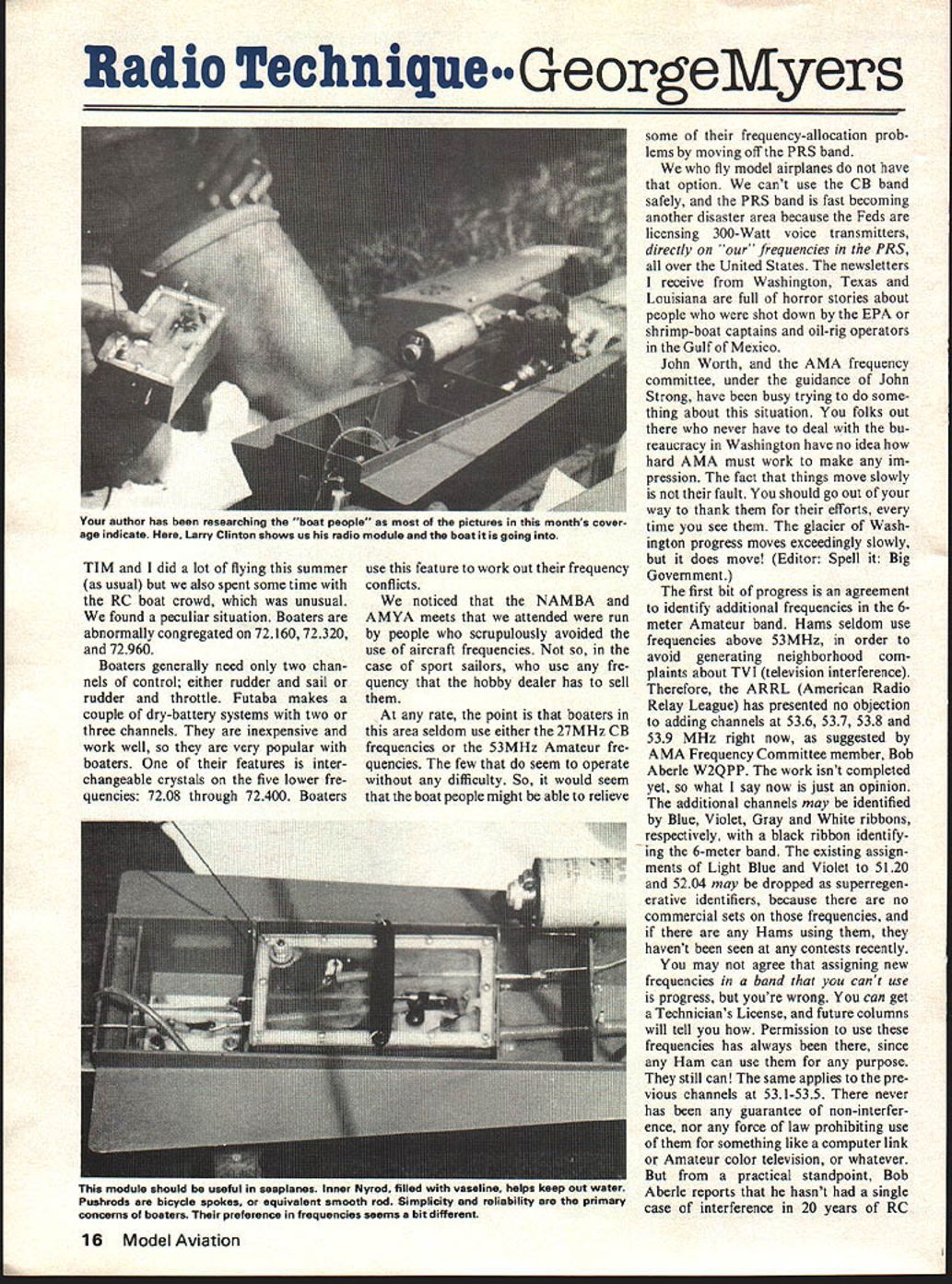
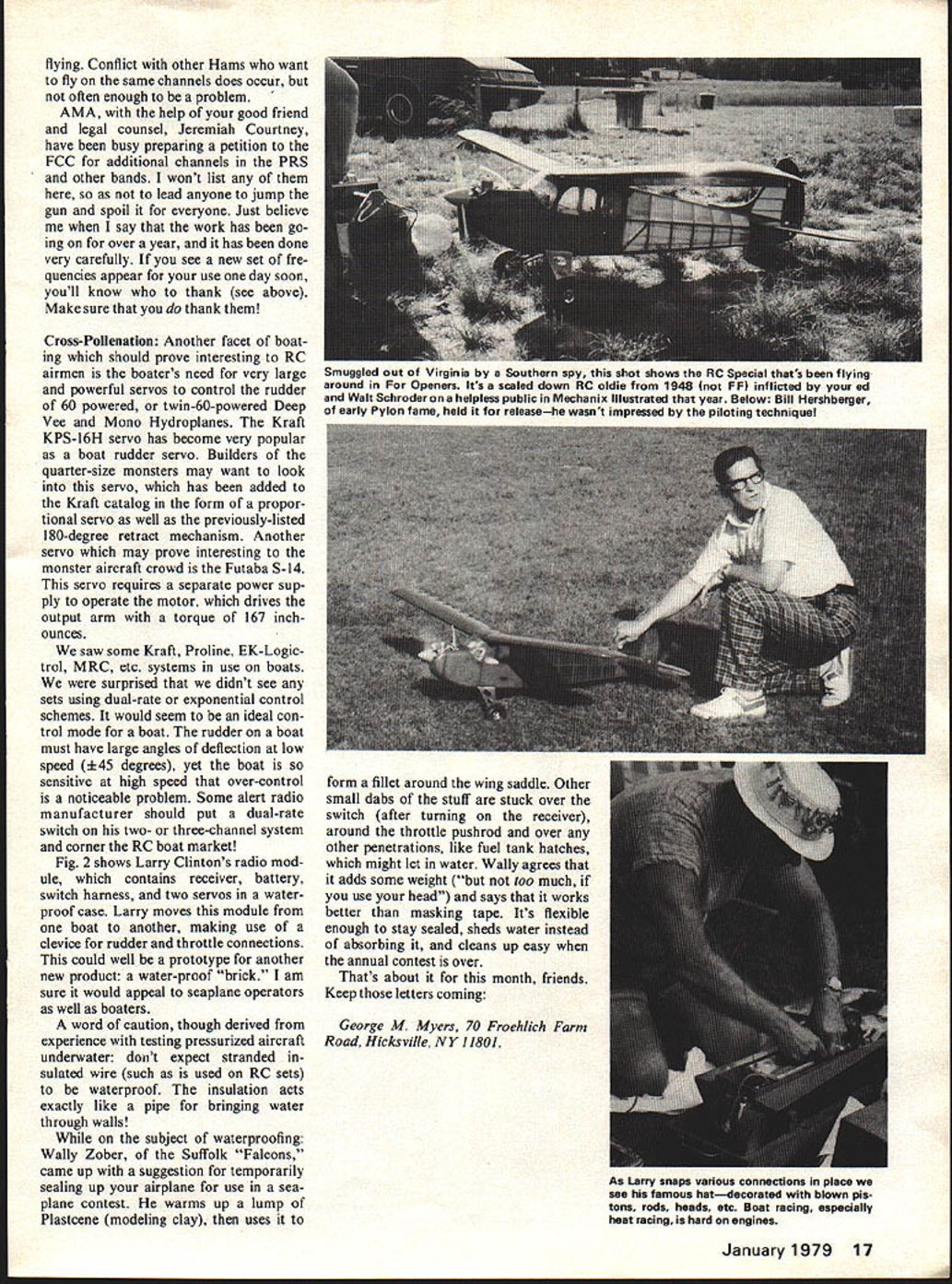
Fig. 2 shows Larry Clinton's radio module, which contains receiver, battery, switch harness and two servos in a waterproof case. Larry moves this module from one boat to another, making use of a clevis for rudder and throttle connections. This could well be a prototype for another new product: a waterproof "brick." I am sure it would appeal to seaplane operators as well as boaters.
A word of caution, derived from experience with testing pressurized aircraft underwater: don't expect stranded insulated wire (such as is used on RC sets) to be waterproof. The insulation acts exactly like a pipe for bringing water through walls!
Waterproofing Tips for Seaplanes
While on the subject of waterproofing, Wally Zober of the Suffolk "Falcons" came up with a suggestion for temporarily sealing your airplane for use in a seaplane contest. He warms up a lump of Plastocene (modeling clay), then uses it to form a fillet around the wing saddle. Other small dabs of the stuff are stuck over the switch (after turning on the receiver), around the throttle pushrod and over any other penetrations, like fuel tank hatches, which might let in water. Wally agrees that it adds some weight ("but not too much, if you use your head") and says that it works better than masking tape. It's flexible enough to stay sealed, sheds water instead of absorbing it, and cleans up easily when the annual contest is over.
That's about it for this month. Keep those letters coming.
George M. Myers 70 Froehlich Farm Road Hicksville, NY 11801
Transcribed from original scans by AI. Minor OCR errors may remain.

