
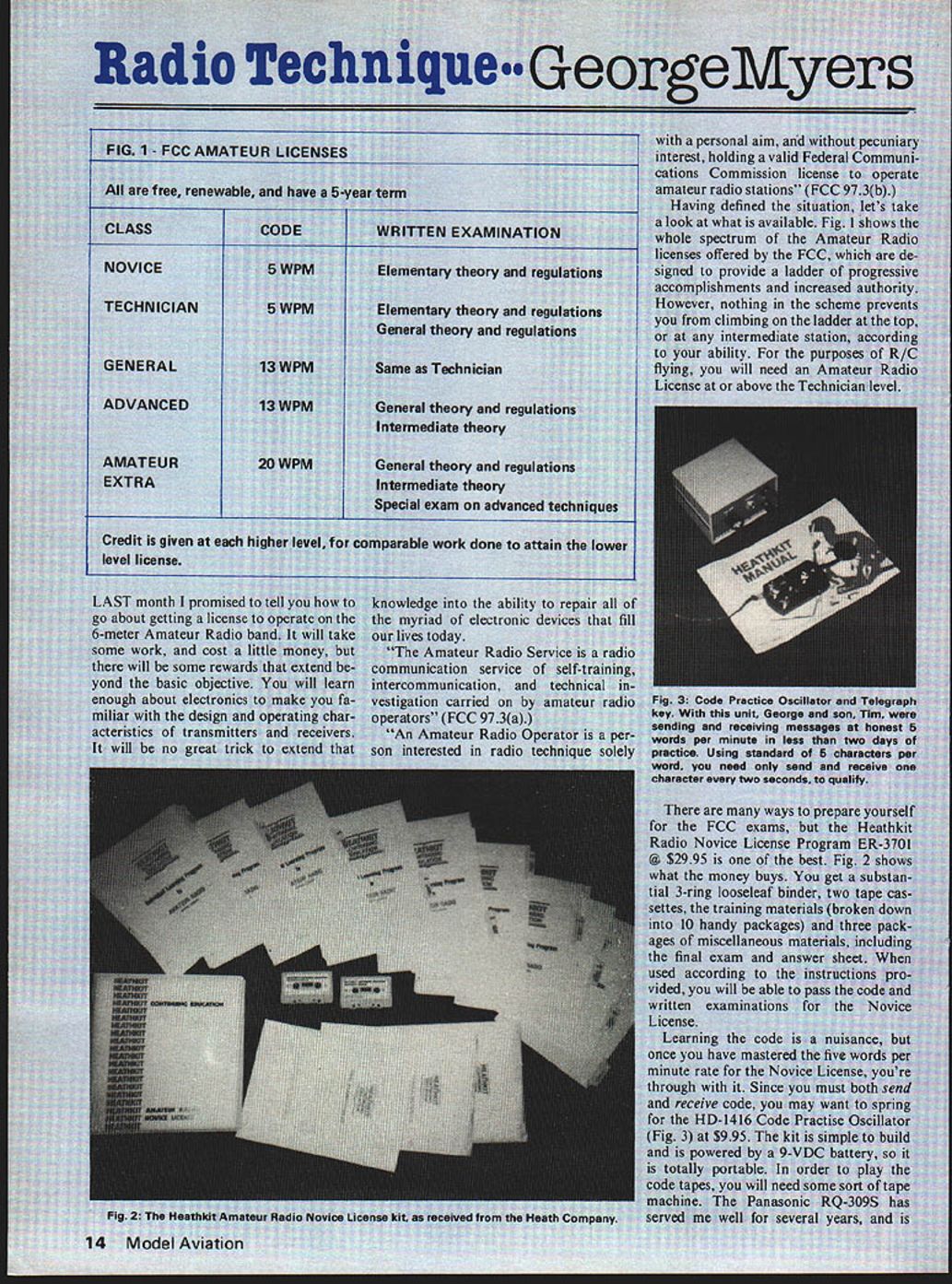
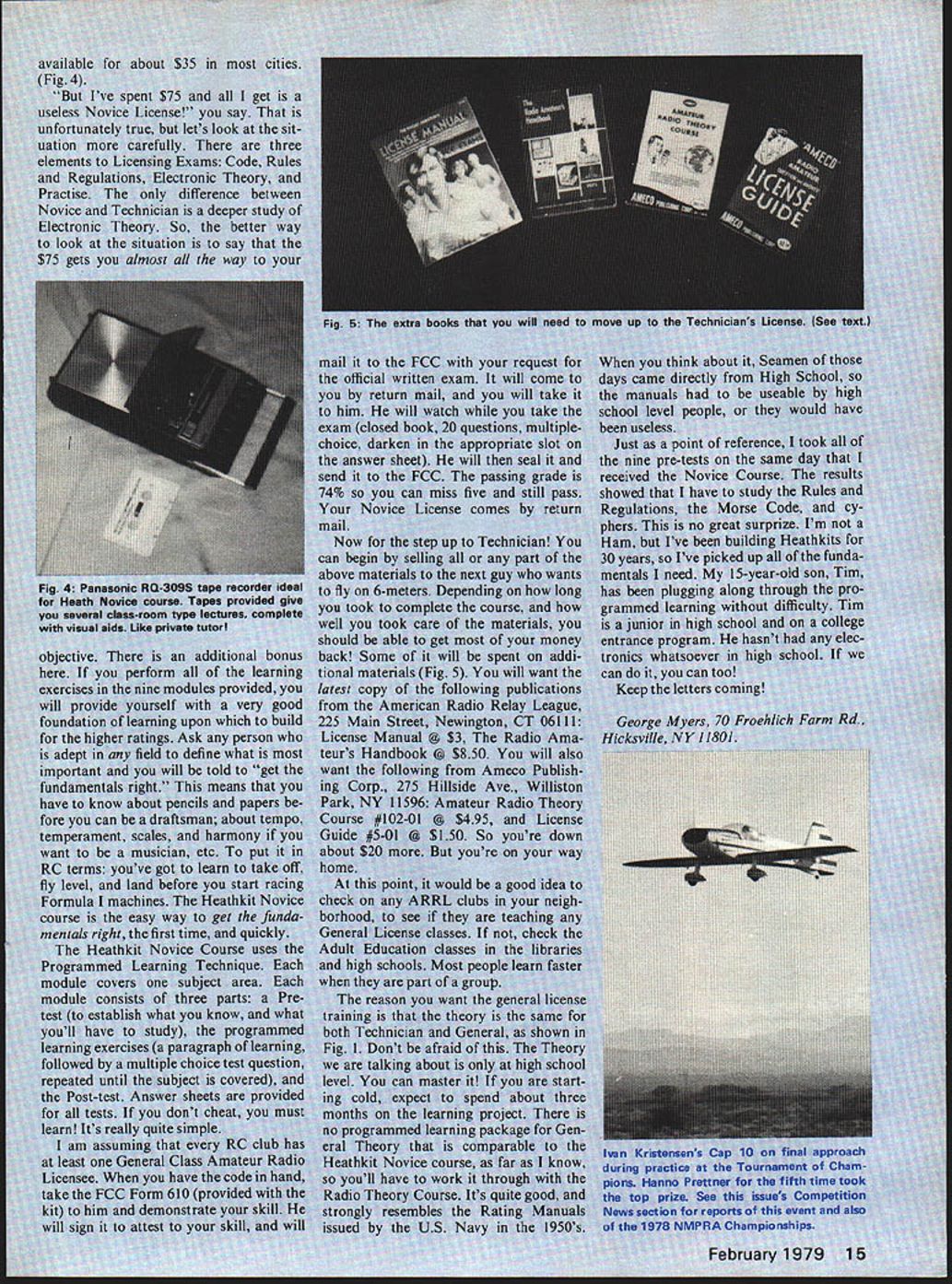
Radio Technique
George Myers
Last month I promised to tell you how to go about getting a license to operate on the 6-meter Amateur Radio band. It will take some work, and cost a little money, but there will be rewards that extend beyond the basic objective. You will learn enough about electronics to become familiar with the design and operating characteristics of transmitters and receivers. It will be no great trick to extend that knowledge into the ability to repair many of the electronic devices that fill our lives today.
"The Amateur Radio Service is a radio communication service of self-training, intercommunication, and technical investigation carried on by amateur radio operators" (FCC 97.3(a)).
"An Amateur Radio Operator is a person interested in radio technique solely with a personal aim, and without pecuniary interest, holding a valid Federal Communications Commission license to operate amateur radio stations" (FCC 97.3(b)).
Having defined the situation, let's take a look at what is available. Fig. 1 shows the whole spectrum of the Amateur Radio licenses offered by the FCC, which are designed to provide a ladder of progressive accomplishments and increased authority. However, nothing in the scheme prevents you from climbing on the ladder at the top or at any intermediate station, according to your ability. For the purposes of R/C flying, you will need an Amateur Radio license at or above the Technician level.
There are many ways to prepare for the FCC exams, but the Heathkit Radio Novice License Program ER-3701 at $29.95 is one of the best. Fig. 2 shows what the money buys. You get:
- a substantial 3-ring looseleaf binder
- two tape cassettes
- the training materials (broken down into 10 handy packages)
- three packages of miscellaneous materials, including the final exam and answer sheet
When used according to the instructions provided, you will be able to pass the code and written examinations for the Novice license.
Learning the code is a nuisance, but once you have mastered the five words-per-minute rate for the Novice license, you're through with it. Since you must both send and receive code, you may want to spring for the HD-1416 Code Practice Oscillator (Fig. 3) at $9.95. The kit is simple to build and is powered by a 9-VDC battery, so it is totally portable. In order to play the code tapes, you will need some sort of tape machine. The Panasonic RQ-309S has served me well for several years, and is available for about $35 in most cities (Fig. 4).
"But I've spent $75 and all I get is a useless Novice license!" you say. That is unfortunately true, but let's look at the situation more carefully. There are three elements to the licensing exams: code; rules and regulations; and electronics theory and practice. The only difference between Novice and Technician is a deeper study of electronics theory. So, the better way to look at the situation is to say that the $75 gets you almost all the way to your objective.
There is an additional bonus here. If you perform all of the learning exercises in the nine modules provided, you will provide yourself with a very good foundation upon which to build for the higher ratings. Ask any person who is adept in any field to define what is most important and you will be told to "get the fundamentals right." This means that you have to know about pencils and paper before you can be a draftsman; about tempo, temperament, scales, and harmony if you want to be a musician; etc. To put it in R/C terms: you've got to learn to take off, fly level, and land before you start racing Formula I machines. The Heathkit Novice course is the easy way to get the fundamentals right, the first time, and quickly.
The Heathkit Novice Course uses the programmed learning technique. Each module covers one subject area and consists of three parts:
- a pre-test (to establish what you know and what you'll have to study),
- the programmed learning exercises (a paragraph of learning followed by a multiple-choice test question, repeated until the subject is covered), and
- a post-test.
Answer sheets are provided for all tests. If you don't cheat, you must learn. It's really quite simple.
I am assuming that every R/C club has at least one General Class Amateur Radio licensee. When you have the code in hand, take the FCC Form 610 (provided with the kit) to him and demonstrate your skill. He will sign it to attest to your skill, and will mail it to the FCC with your request for the official written exam. It will come to you by return mail, and you will take it to him. He will watch while you take the exam (closed book, 20 questions, multiple choice, darken the appropriate slot on the answer sheet). He will then seal it and send it to the FCC. The passing grade is 74% so you can miss five and still pass. Your Novice license comes by return mail.
Now for the step up to Technician. You can begin by selling all or any part of the above materials to the next person who wants to fly on 6 meters. Depending on how long you took to complete the course, and how well you took care of the materials, you should be able to get most of your money back. Some of it will be spent on additional materials (Fig. 5). You will want the latest copy of the following publications from the American Radio Relay League, 225 Main Street, Newington, CT 06111:
- License Manual — $3.00
- The Radio Amateur's Handbook — $8.50
You will also want the following from Ameco Publishing Corp., 275 Hillside Ave., Williston Park, NY 11596:
- Amateur Radio Theory Course #102-01 — $4.95
- License Guide #5-01 — $1.50
So you're down about $20 more, but you're on your way home.
At this point, it would be a good idea to check on any ARRL clubs in your neighborhood to see if they are teaching any General License classes. If not, check the adult education classes in the libraries and high schools. Most people learn faster when they are part of a group.
The reason you want General license training is that the theory is the same for both Technician and General, as shown in Fig. 1. Don't be afraid of this. The theory we are talking about is only at high school level. You can master it! If you are starting cold, expect to spend about three months on the learning project. There is no programmed learning package for General theory comparable to the Heathkit Novice course, as far as I know, so you'll have to work through it with the Radio Theory Course. It's quite good, and strongly resembles the rating manuals issued by the U.S. Navy in the 1950s.
When you think about it, seamen of those days came directly from high school, so the manuals had to be usable by high school–level people or they would have been useless.
Just as a point of reference, I took all of the nine pre-tests on the same day that I received the Novice course. The results showed that I had to study the rules and regulations, the Morse code, and ciphers. This is no great surprise. I'm not a ham, but I've been building Heathkits for 30 years, so I've picked up all of the fundamentals I need. My 15-year-old son, Tim, has been plugging along through the programmed learning without difficulty. Tim is a junior in high school and on a college entrance program. He hasn't had any electronics whatsoever in high school. If we can do it, you can too!
Keep the letters coming!
George Myers 70 Froehlich Farm Rd. Hicksville, NY 11801
Transcribed from original scans by AI. Minor OCR errors may remain.

