
Radio Technique — George Myers
MRC 772 modification
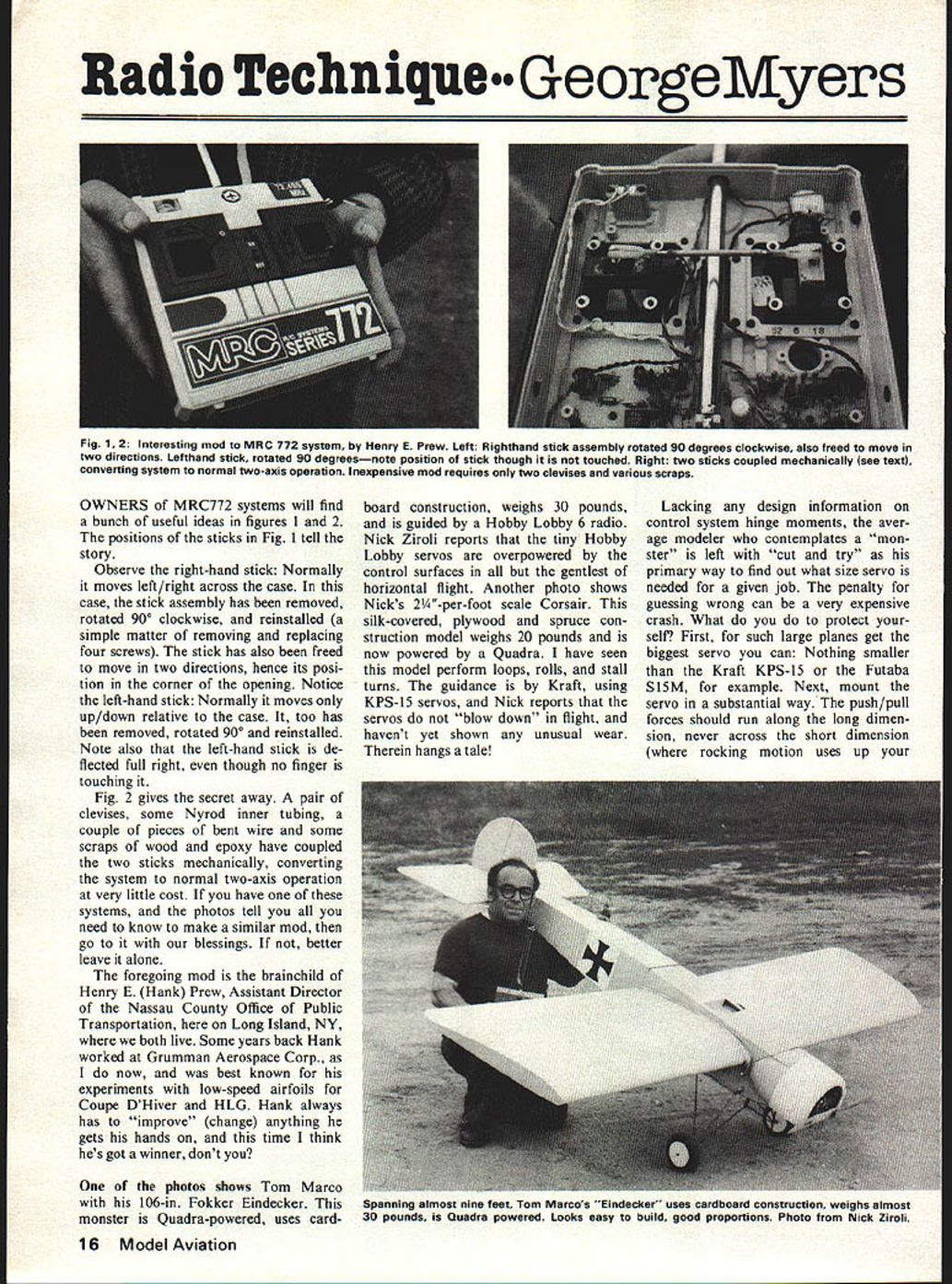
Owners of MRC 772 systems will find a bunch of useful ideas in Figures 1 and 2. The positions of the sticks in Fig. 1 tell the story.
Observe the right-hand stick: normally it moves left/right across the case. In this instance the stick assembly has been removed, rotated 90° clockwise, and reinstalled (a simple matter of removing and replacing four screws). The stick has also been freed to move in two directions, hence its position in the corner of the opening.
Notice the left-hand stick: normally it moves only up/down relative to the case. It, too, has been removed, rotated 90° and reinstalled. Note also that the left-hand stick is deflected full right, even though no finger is touching it.
Fig. 2 gives the secret away. A pair of clevises, some Nyrod inner tubing, a couple of pieces of bent wire and some scraps of wood and epoxy have coupled the two sticks mechanically, converting the system to normal two-axis operation at very little cost. If you have one of these systems and the photos tell you all you need to know to make a similar mod, then go to it with our blessings. If not, better leave it alone.
The foregoing mod is the brainchild of Henry E. (Hank) Prew, Assistant Director of the Nassau County Office of Public Transportation, here on Long Island, NY, where we both live. Some years back Hank worked at Grumman Aerospace Corp., as I do now, and was best known for his experiments with low-speed airfoils for Coupe d'Hiver and HLG. Hank always has to "improve" (change) anything he gets his hands on, and this time I think he's got a winner, don't you?
Recent models and servo observations
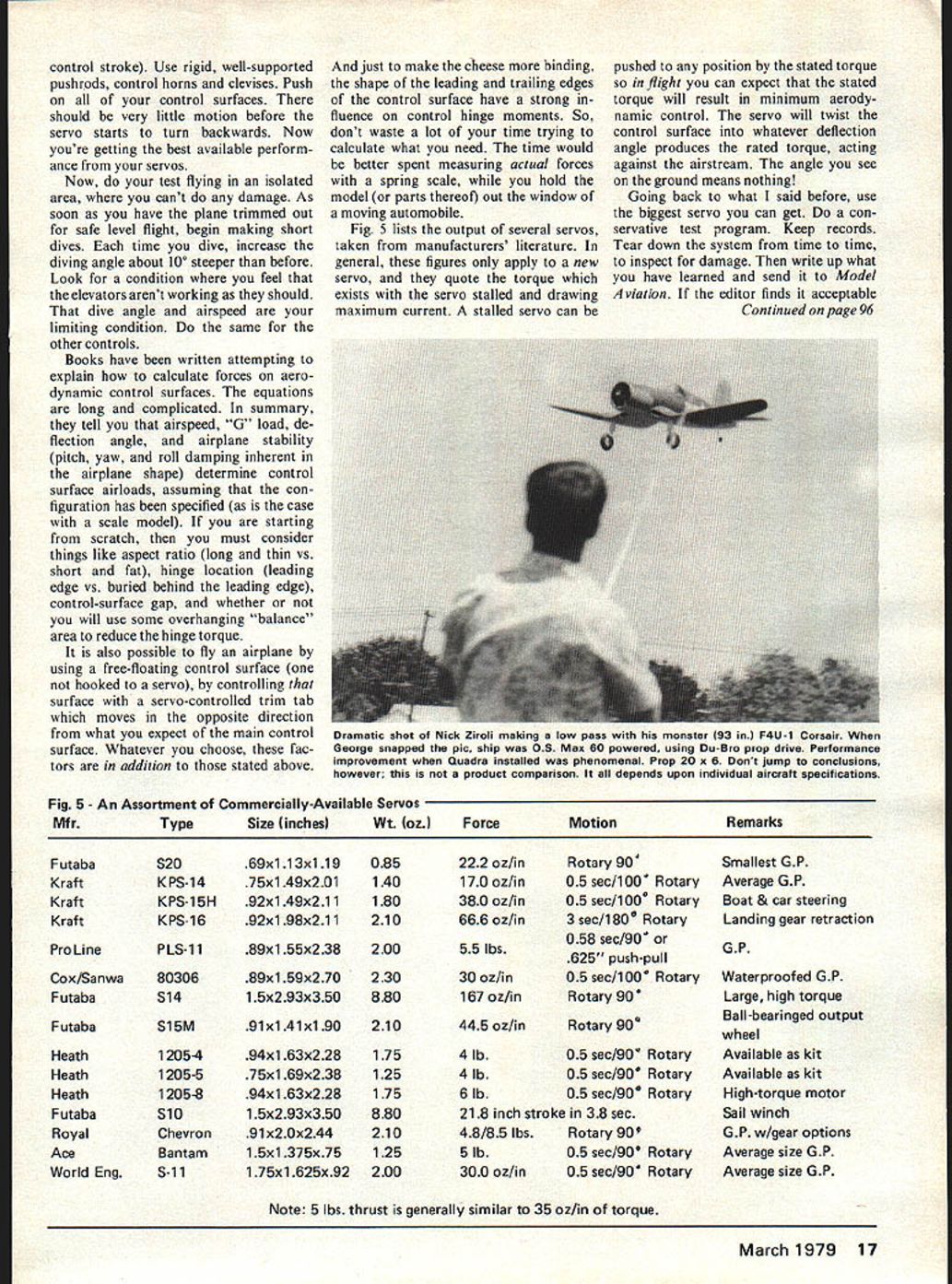
One of the photos shows Tom Marco with his 106-in. Fokker Eindecker. This monster is Quadra-powered, uses cardboard construction, weighs 30 pounds, and is guided by a Hobby Lobby 6 radio. Nick Ziroli reports that the tiny Hobby Lobby servos are overpowered by the control surfaces in all but the gentlest of horizontal flight.
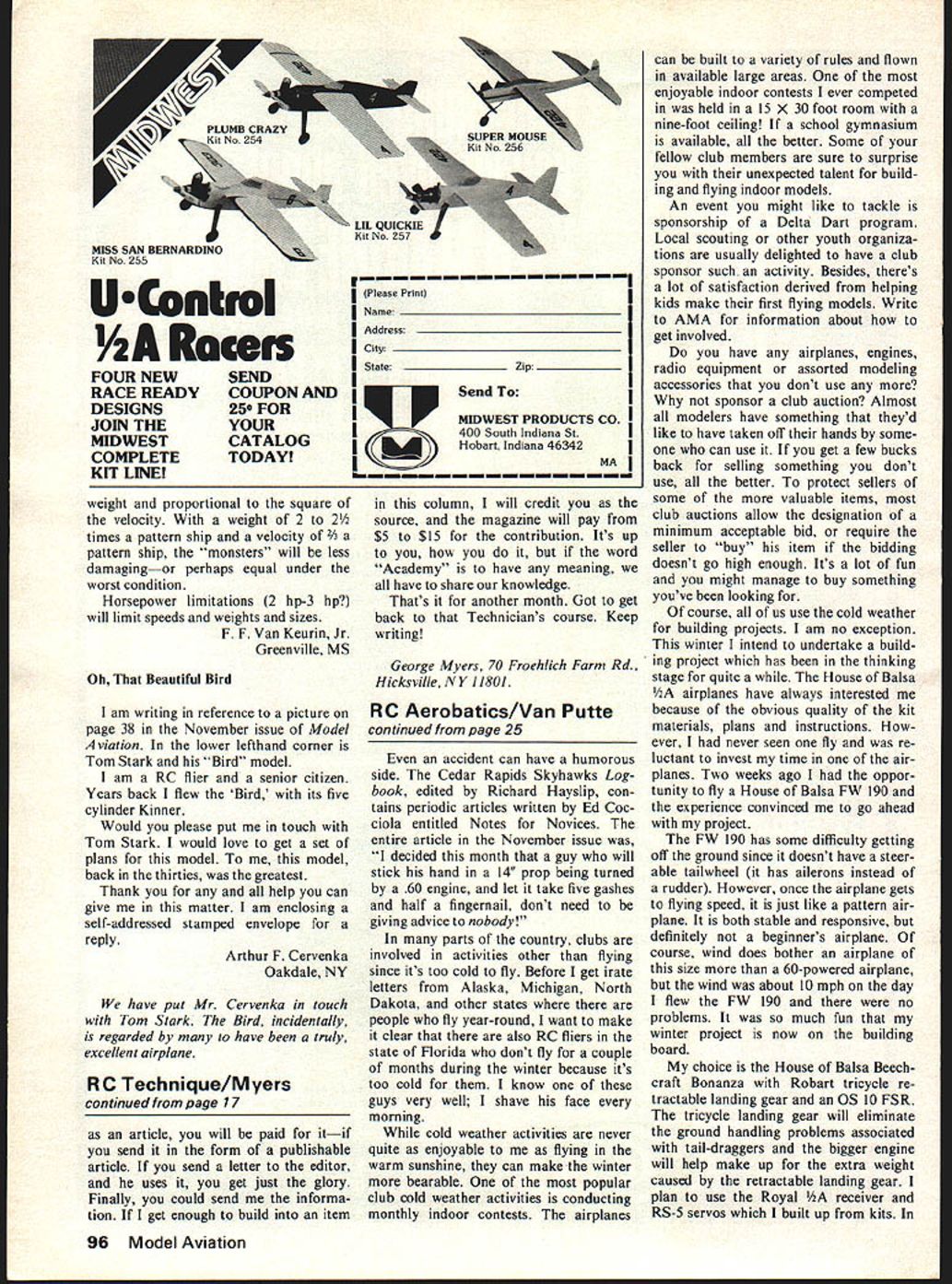
Another photo shows Nick's 2¼-per-foot scale Corsair. This silk-covered, plywood and spruce construction model weighs 20 pounds and is now powered by a Quadra. I have seen this model perform loops, rolls, and stall turns. The guidance is by Kraft, using KPS-15 servos, and Nick reports that the servos do not "blow down" in flight and haven't yet shown any unusual wear. Therein hangs a tale!
Choosing servos for large models
Lacking any design information on control-system hinge moments, the average modeler who contemplates a "monster" is left with "cut and try" as his primary way to find out what size servo is needed for a given job. The penalty for guessing wrong can be a very expensive crash. What do you do to protect yourself?
- For such large planes get the biggest servo you can: nothing smaller than the Kraft KPS-15 or the Futaba S15M, for example.
- Mount the servo in a substantial way. The push/pull forces should run along the long dimension, never across the short dimension (where rocking motion uses up your control stroke).
- Use rigid, well-supported pushrods and control horns.
- Push control surfaces should have very little motion before the servo starts to turn backwards.
Now you're getting the best available performance from servos.
Test program
Now test fly in an isolated area where you can't do damage. As soon as you have the plane trimmed out for safe level flight, begin making short dives. Each time increase the diving angle about 10°—steeper before you look for the condition. If you feel the elevators aren't working, the plane should be put into a dive at an angle where airspeed is limiting the elevators; the same applies for other controls.
Factors affecting control-surface hinge moments
Books have been written attempting to explain or calculate the forces on aerodynamic control surfaces—equations long and complicated. In summary:
- Airspeed, control-surface load and deflection angle;
- Airplane stability (pitch, yaw, roll);
- Damping inherent in the airplane shape;
These determine control-surface airloads.
Assuming the configuration has been specified, in the case of a scale model starting from scratch you must consider things like:
- Aspect ratio (long thin vs. short fat);
- Hinge location (leading edge vs. buried behind leading edge);
- Control-surface gap;
- Whether you will use some overhanging balance area to reduce hinge torque.
It is also possible to fly an airplane using a free-floating control surface hooked to the servo by a proxy surface; a servo-controlled trim tab that moves opposite to what you expect the main control surface to do is another option. Whatever you choose, the additional factors only make the choice more complex.
And just to make the choices more binding, the shape of the leading and trailing edges of the control surface have a strong influence on control hinge moments. So, don't waste a lot of your time trying to calculate what you need. The time would be better spent measuring actual forces with a spring scale while you hold the control (or parts thereof) out the window of a moving automobile.
Servo performance and notes
Fig. 5 lists the output of several servos, taken from manufacturers' literature. In general, these figures only apply to a new servo, and they quote the torque which exists with the servo stalled and drawing maximum current. A stalled servo can be pushed to any position by the stated torque so in flight you can expect that the stated torque will result in minimum aerodynamic control. The servo will twist the control surface into whatever deflection angle produces the rated torque, acting against the airstream. The angle you see on the ground means nothing!
Going back to what I said before: use the biggest servo you can get. Do a conservative test program. Keep records. Tear down the system from time to time to inspect for damage. Then write up what you have learned and send it to Model Aviation. If the editor finds it acceptable, as an article you will be paid for it—if you send it in the form of a publishable article. If you send a letter to the editor and he uses it, you get just the glory. Finally, you could send me the information. If I get enough to build into an item in this column, I will credit you as the source, and the magazine will pay from $5 to $15 for the contribution. It's up to you how you do it, but if the word "Academy" is to have any meaning, we all have to share our knowledge.
Fig. 5 — An assortment of commercially-available servos
- Futaba S20 — Size: .69 x 1.13 x 1.19 in; Wt: 0.85 oz; Force: 22.2 oz/in; Motion: Rotary 90°; Remarks: Smallest G.P.
- Kraft KPS-14 — Size: .75 x 1.49 x 2.01 in; Wt: 1.40 oz; Force: 17.0 oz/in; Motion: 0.5 sec/100° Rotary; Remarks: Average G.P.
- Kraft KPS-15H — Size: .92 x 1.49 x 2.11 in; Wt: 1.80 oz; Force: 38.0 oz/in; Motion: 0.5 sec/100° Rotary; Remarks: Boat & car steering
- Kraft KPS-16 — Size: .92 x 1.98 x 2.11 in; Wt: 2.10 oz; Force: 66.6 oz/in; Motion: 3 sec/180° Rotary; Remarks: Landing gear retraction
- ProLine PLS-11 — Size: .89 x 1.55 x 2.38 in; Wt: 2.00 oz; Force: 5.5 lbs; Motion: 0.58 sec/90°; .625" push-pull; Remarks: G.P.
- Cox/Sanwa 80306 — Size: .89 x 1.59 x 2.70 in; Wt: 2.30 oz; Force: 30 oz/in; Motion: 0.5 sec/100° Rotary; Remarks: Waterproofed G.P.
- Futaba S14 — Size: 1.5 x 2.93 x 3.50 in; Wt: 8.80 oz; Force: 167 oz/in; Motion: Rotary 90°; Remarks: Large, high torque
- Futaba S15M — Size: .91 x 1.41 x 1.90 in; Wt: 2.10 oz; Force: 44.5 oz/in; Motion: Rotary 90°; Remarks: Ball-bearinged output wheel
- Heath 1205-4 — Size: .94 x 1.63 x 2.28 in; Wt: 1.75 oz; Force: 4 lb; Motion: 0.5 sec/90° Rotary; Remarks: Available as kit
- Heath 1205-5 — Size: .75 x 1.69 x 2.38 in; Wt: 1.25 oz; Force: 4 lb; Motion: 0.5 sec/90° Rotary; Remarks: Available as kit
- Heath 1205-8 — Size: .94 x 1.63 x 2.28 in; Wt: 1.75 oz; Force: 6 lb; Motion: 0.5 sec/90° Rotary; Remarks: High-torque motor
- Futaba S10 — Size: 1.5 x 2.93 x 3.50 in; Wt: 8.80 oz; Force: 21.8 inch stroke in 3.8 sec.; Motion: (Sail winch)
- Royal Chevron — Size: .91 x 2.0 x 2.44 in; Wt: 2.10 oz; Force: 4.8/8.5 lbs; Motion: Rotary 90°; Remarks: G.P. w/gear options
- Ace Bantam — Size: 1.5 x 1.375 x .75 in; Wt: 1.25 oz; Force: 5 lb; Motion: 0.5 sec/90° Rotary; Remarks: Average size G.P.
- World Eng. S-11 — Size: 1.75 x 1.625 x 2.92 in; Wt: 2.00 oz; Force: 30.0 oz/in; Motion: 0.5 sec/90° Rotary; Remarks: Average size G.P.
Note: 5 lbs thrust is generally similar to 35 oz/in of torque.
Closing
That's it for another month. Got to get back to that Technician's course. Keep writing!
George Myers 70 Froehlich Farm Rd. Hicksville, NY 11801
Transcribed from original scans by AI. Minor OCR errors may remain.

