
Radio Technique — George Myers
What's New?
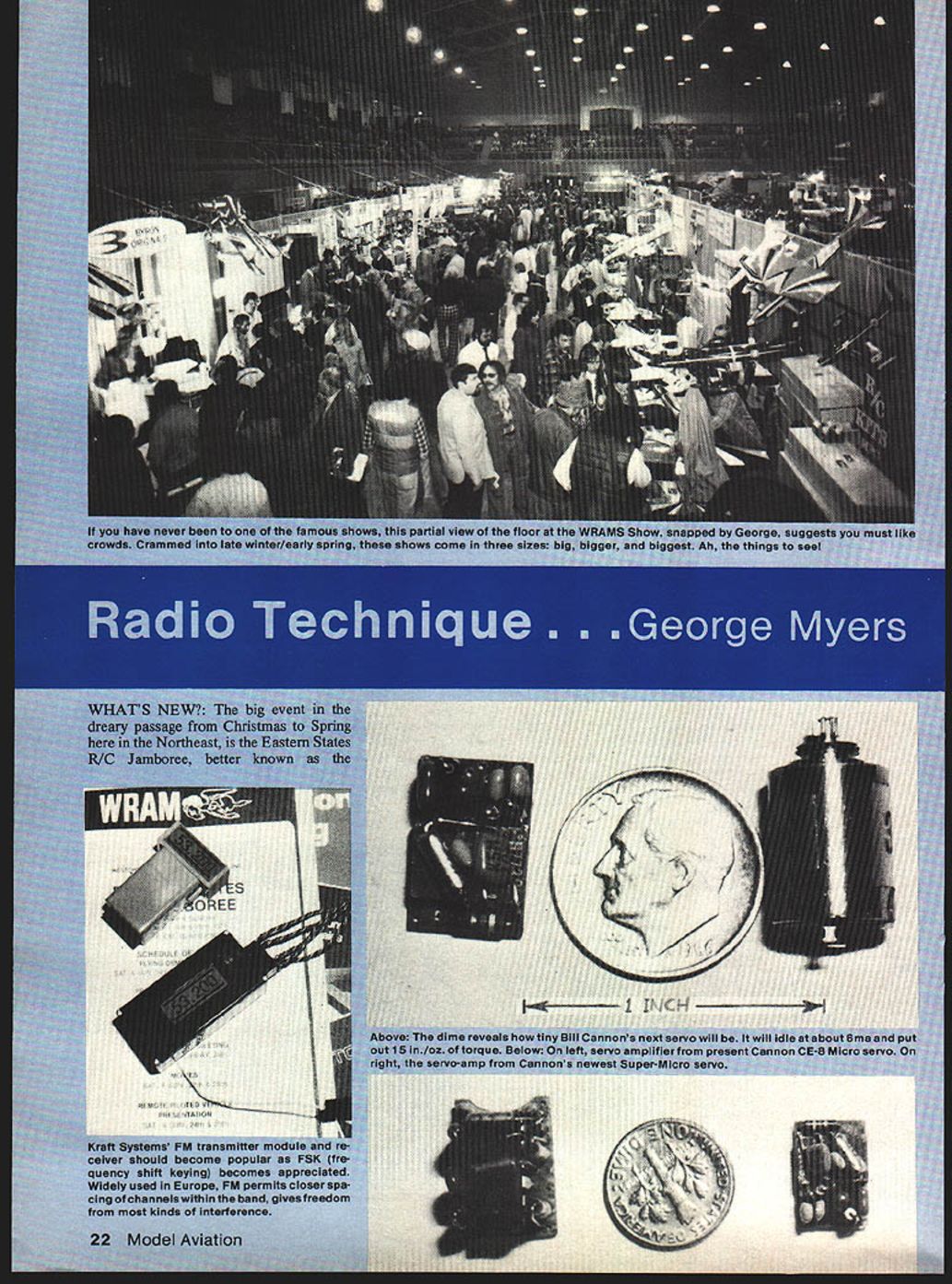
The big event in the dreary passage from Christmas to spring in the Northeast is the Eastern States R/C Jamboree, better known as the WRAM show. Highlights and interesting products seen at the show:
Small receivers / Frequency section
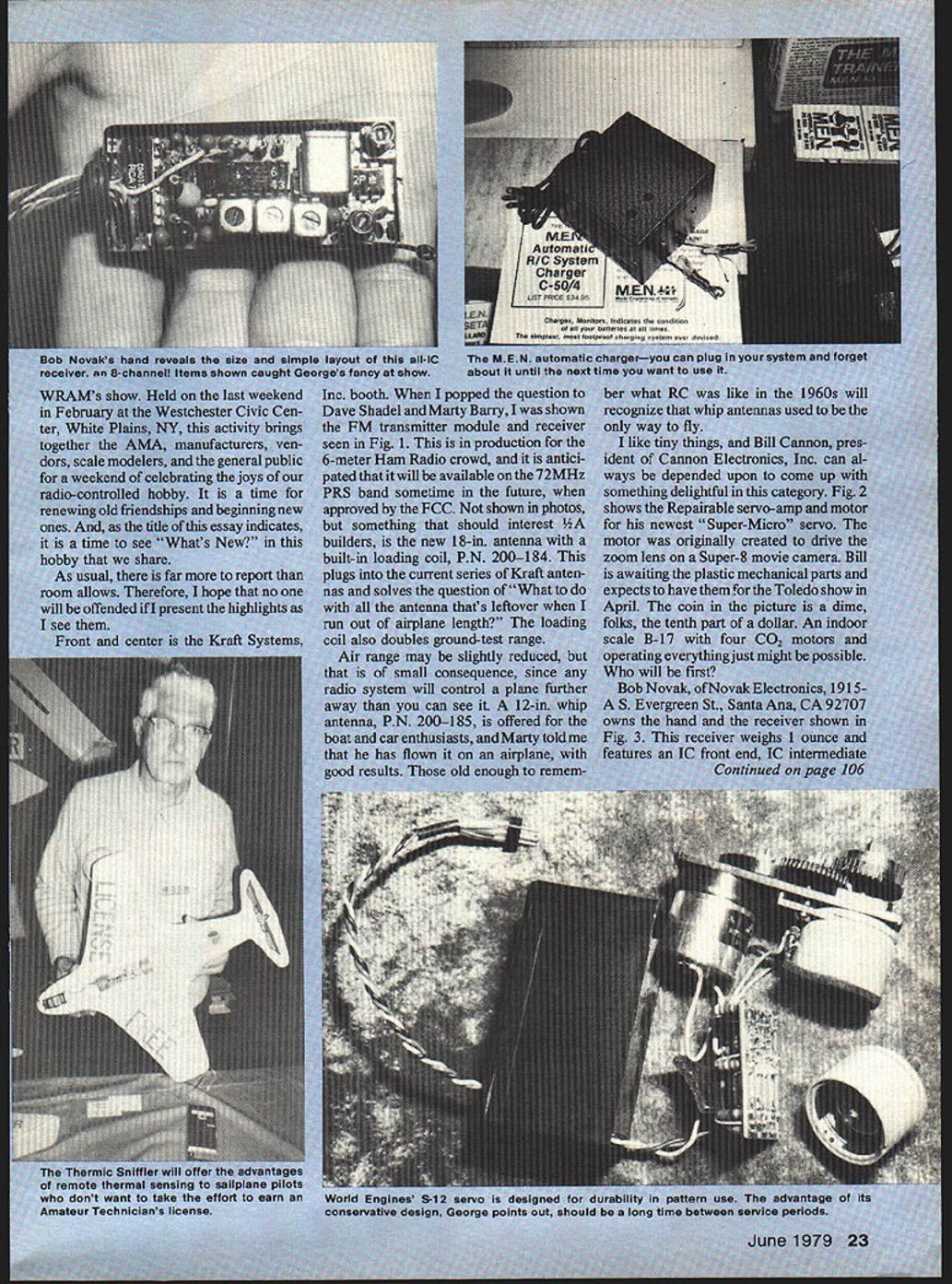
- Novak Electronics receiver (shown at the show): weighs about 1 ounce; features an IC front end, IC intermediate-frequency section, and an IC decoder.
- Crystal: fifth-overtone type (very thin) and shock-mounted between pieces of foam rubber — shock mounting recommended by Formula I fliers from flying experience.
- Mixer: double-balanced mixer that cancels mixing products except the desired intermediate frequency.
- Novak flight packs use this receiver and Bantam Midget servos.
Novak / Bantam Midget servos
- Features: 6 µs deadband, temperature-controlled over 0°–150°F.
- Performance: 21 in./oz. torque, 90° movement in 0.27 seconds.
Kraft Systems / Antennas and FM module
- FM transmitter module and receiver intended for the 6-meter ham crowd; anticipated for the 72 MHz PRS band when FCC-approved.
- New antennas:
- 18‑in. antenna with built-in loading coil (P.N. 200-184) — plugs into current Kraft antennas and reduces excess antenna length on small airframes; loading coil also doubles ground-test range.
- 12‑in. whip antenna (P.N. 200-185) for boats and cars; reportedly flown on airplanes with good results.
Cannon Electronics — Super-Micro servo
- New repairable servo-amp and micro motor originally made for Super‑8 camera zoom lenses.
- Very small (coin in picture was a dime for scale). Plastic mechanical parts expected for the Toledo show in April.
- Potential for very small models or even an indoor scale B-17 with multiple CO2 motors.
M.E.N. Automatic R/C System Charger
- Allows leaving the R/C system connected indefinitely: recharges batteries then drops to a trickle charge as needed.
- Better than not charging at all; recommended during the flying season for improved system service.
- Caveat: most battery manuals discourage continuous trickle charging of nickel-cadmium cells. Verified development of battery “memory” is associated with trickle charging combined with a consistent discharge cycle. Unclear whether continuous winter trickle charging is better than a full recharge once a month.
Servos — the big news
Many manufacturers showed larger servos for scale and 1/4-scale enthusiasts. Highlights:
- Royal Electronics:
- "Chevron" servo and a smaller, cheaper kit servo (around $26.50) using Jomac racing-car mechanicals and Chevron servo amplifier.
- Kraft Systems:
- KPS-16 servo (current) and upcoming KPS-19.
- KPS-19: somewhat larger, metal gears, choice of two operating speeds, up to 160 in./oz. torque.
- Ace R/C, Inc.:
- Developing a large servo using new D&R mechanicals.
- Dunham / D&R:
- Supplying mechanical parts to manufacturers for large servo production.
- Logictrol International Corp. (Bill Haga, Bob Elliot):
- New servo due in April: same size as MM servo, T1544 IC, 24-ohm motor, glass-filled nylon gears manufactured with molybdenum-disulfide to toughen gear teeth and control molding dimensional variations. Designed to resist gear rounding better than current offerings.
- World Engines S-12 (custom for pattern fliers):
- Design intent: extreme durability.
- Uses a drum-shaped potentiometer:
- Longer resistance track for given diameter — better wear resistance and improved resolution for accurate centering.
- Wipers arranged parallel to the potentiometer shaft — better isolation from vibration transmitted by the pushrod, reducing wear.
- Geartrain: three-gear set with an internal first gear for a tighter system than typical four-gear setups.
- Price: $75.
Don Clark — Thermic Sniffer (Soaring Products)
- System for R/C sailplanes to detect thermals:
- Tiny variometer + 49 MHz transmitter mounted in the sailplane.
- Walkie-talkie receiver carried in the pilot’s pocket.
- Emits rising tone for rising air; falling tone for sinking air.
- Important: intended for license-free operation when type-approved by the FCC.
- Note: transmitter frequencies are shared with other users (model racing cars, single-channel Cox airplanes), so interference possibilities exist; sailplanes likely unaffected if conflicts arise.
Final note
Apologies to exhibitors whose products were not mentioned — omission indicates lack of space, not criticism. Keep the letters coming!
WRAMS SHOW NOTES
Engines
- Fox Twin:
- Essentially two .60‑cc engines connected back-to-back.
- Produces over 3 hp at 14,500 rpm.
- Heavy structural parts allow use of large props.
- Adjustment tip from Duke: tune twin carburetors back-to-front and low-to-high.
- Simultaneous opposed firing yields very low vibration.
Transmitters & Controls
- Royal Electronics — Royal Classic transmitter:
- Twin throttle trims.
- Channels 4 & 8 can be tied together electrically for twin-engine operation.
- Throttle levers only operate in the low-throttle position for optimum idle adjustment.
- Switch selects full- and half-linear control or exponential control.
- Four flight controls can be reversed by reversing plugs inside the transmitter.
- Pro-Line:
- New servo underway (PLS-15-3) compatible with positive or negative pulse systems.
- Waterproof, ball-bearing output, uses Geisendanner potentiometer.
Servos & Electronics
- Logictrol International Corp.:
- FM set under development using new Signetics encoder/decoder ICs.
- XM servo for large models: 2.4-ohm motor, glass-filled nylon gears, output ~6 pounds of thrust.
- Cannon Electronics:
- Model 825 system enters the "Under $200 club."
- All‑NiCd system with Bantam servos and Tint transmitter.
- Charlie R/C:
- Featuring the Bantam Midget servo with a new IC servo amplifier.
Transcribed from original scans by AI. Minor OCR errors may remain.

