
Radio Technique
George Myers
As a practical matter, FAA is to model aviation as FCC is to CB radio. Therefore, they would prefer to control AMA while AMA controls model aviation. There is ample precedent for this in the FAA/EAA relationship. For those who don't know, the EAA (Experimental Aircraft Association — people who build man-carrying aircraft from kits, or from scratch) works to keep the FAA from FAR-ing the homebuilder out of the skies. Part of its action is to teach correct principles. Another part of its activity is a certification of plans and kits for suitability. This is just beginning, but it is a reaction to man-killing failures of design and materials.
I have personal knowledge of only a few instances of model airplanes killing or maiming anyone. Most that I know of concerned U-control models that either struck someone, or that came in contact with a high-voltage electric line and electrocuted the pilot. RC pilots have been very fortunate so far. I've never heard any substantiated tale of death, and the injuries have been extremely rare. Professor Sabin's column "You and the Law" in RCM related one of the very few cases of personal injury. But that doesn't mean there is no danger. I've seen more near misses than I want to talk about or remember. So have you!
The term "reliability" I use to describe confidence that something will work. Simple things can be very reliable. A rock makes a very reliable paperweight — say it has reliability 1. A helium-filled balloon has almost no value as a paperweight — say it has reliability 0. A coin usually has two faces; the probability of a coin landing heads up on a time flip is 0.5 unless something improves performance. Some things are known. Complex things can be very reliable. RC systems are very reliable.
So when RC airplanes crash, we can state that about 90% of crashes result from two causes:
- Pilot error
- Poor maintenance
If the airplane flies on the ground and operates correctly under perfect control, what other explanation can we give for loss of control? Surface hinges in flight — there is still the other 10%. Well, remember the recent vertical dive to the ground that scared the tar out of the pilot/owner? The cause was hard to find. Eventually a wire broken inside the large strain relief the manufacturer molded to prevent such failure was discovered.
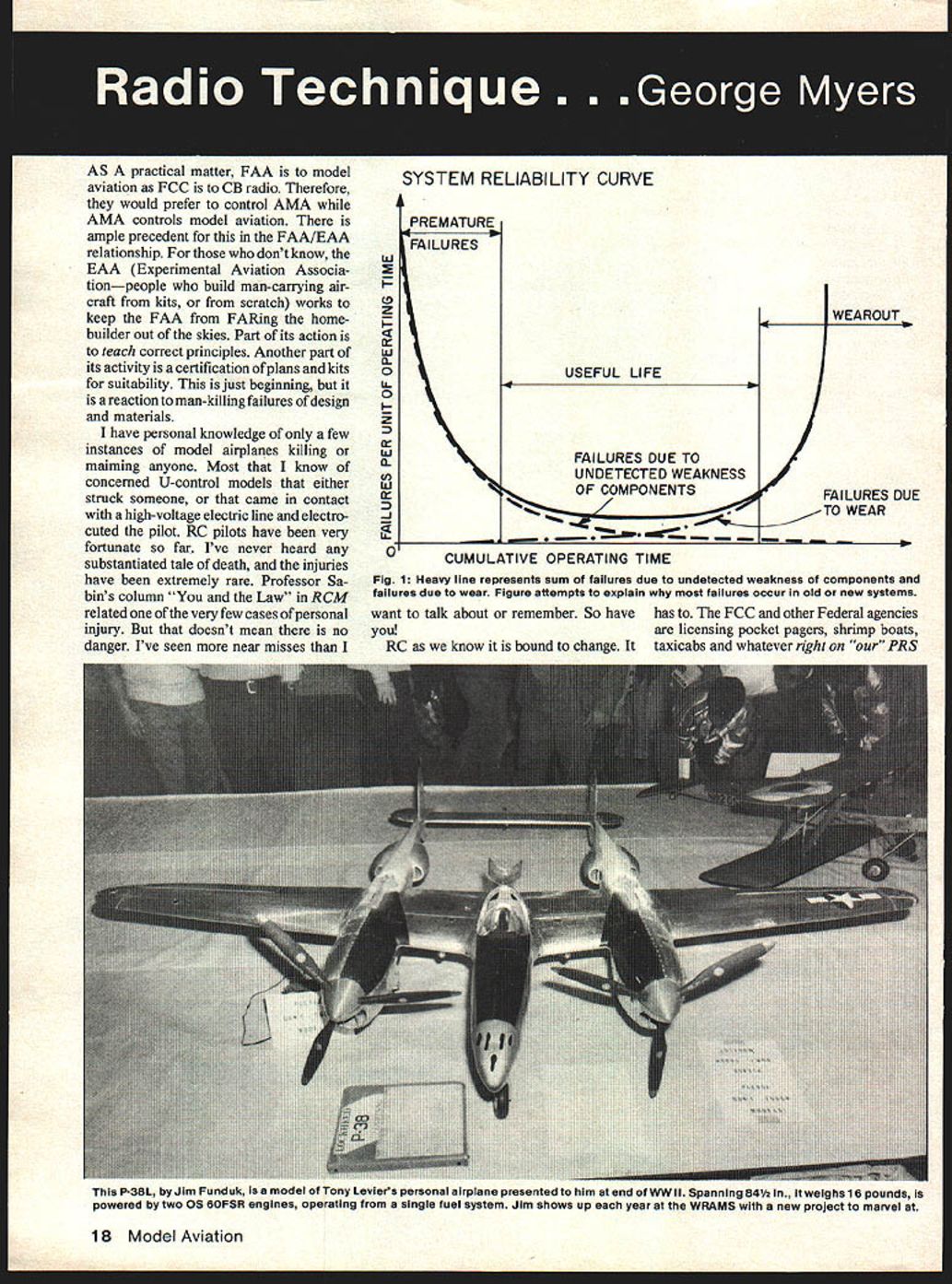
Reliability of complex systems varies during their lifetime. The variation traces back to undetected weaknesses built into the system and to wearout of components, as shown in Fig. 1. A high rate of early failures is usually taken care of by the manufacturer who operates the system before selling. If you build your own parts from a kit, it is a good idea to run the system on a bench before installing it in the plane. How long should you run it? Look at the situation this way: charge-discharge a new battery pack 3-4 times so a form will take hold and they will reach full charge. It would be wise to use charge/discharge cycles to burn in the system.
At the other end of operating time, wearout keeps getting closer as a result of shock, vibration and poor service. Some things to watch:
- Wires break due to excessive bending and straightening; in particular, resist the temptation to twist servo pigtails into a stiffer bundle. Keep them loose.
- Servo motors get sticky, noisy and slow down — usually the result of accumulation of trash on the commutator track. You can sometimes get rid of this by drilling a small hole in the side of the servomotor and spraying TV-tuner cleaner; in other cases you can dismantle the motor for cleaning. If you have enough interest to take them apart I prefer simply to replace the motor.
- Potentiometers are a wear problem. Sometimes you can wipe off the carbon track — assuming you have a fingertip tool to get rid of brass particles that have worn off the wiper. It is always worth trying. If the wiper shows enough wear to make you think the end is near, replace it. If wiping off carbon residue with your finger doesn't help, try washing it with some denatured alcohol, then bend the wiper fingers a little bit to increase the contact pressure. If that doesn't restore "like-new performance," replace it.
- Batteries. Batteries begin with some ability to store charge. Each time you recharge, the ability diminishes. After a couple of hundred cycles, the ability to hold charge will be half of what it was when new. When that happens, replace them. Vibration is bad for batteries. Pack them loosely in foam if you want a long service life. Vibration causes internal short circuits (which reduces range and weakens the output of your servos). It also causes open circuits. Fortunately, open circuits are rare.
- Other components. There is no simple way to explain why a capacitor changes value and/or starts "leaking," just as there is no simple way to predict why an integrated circuit decides to quit. With careful study, the problem can sometimes be traced back to intrusion of atmospheric contaminants; the cumulative effects of high operating temperatures and our old nemesis, vibration.
I tried to leave you with the impression that a few catastrophic failures are inherent to the operation of RC systems. That is true, and the question is, what should we do about it?
Traditionally, model aviation activities have been conducted in remote locations where the public danger is practically non-existent. Remote locations are the thing that has become practically non-existent. We are now flying right in the public's pocket, sometimes. In a very real way, the question has become, "Can we afford a failure?" AMA provides insurance, and in most cases the cost of the insurance, plus Model Aviation, plus all the other benefits of membership (such as nationwide rules of competition and contest coordination, plus representation worldwide in matters affecting model aviation, and representation at a federal level to bureaucracies like FAA and FCC) all comes to less than the dues of your local club. Even so, do we really want to hurt anyone? Of course not.
Our systems are a series of components. If any component fails, the system fails. There are no alternate paths for control.
Two years ago I saw a device offered that consisted of a voltage sensor and a lithium battery. The idea was that, if voltage to the receiver dropped for any reason at all, the backup battery automatically came into service. That was one great idea! I wish now that I had paid more attention. I can't even find the sales literature. This device would have prevented the frightening crash described above. Don't bother writing me about lithium batteries in ELTs — I know about that. It should be no trick at all to make up a similar system using nickel-cadmium batteries. The important points are:
- The backup battery should have a separate electrical path to the receiver, to avoid total failure from a broken wire.
- The backup battery should not operate simultaneously with, and in parallel with, the primary battery.
The backup battery idea should be incorporated in every plane powered by an engine larger than an .049. The larger and heavier the airplane, the more important this protection becomes.
If the wind blows dust in your eyes, the system fails. Our club has only a few rules, but the number one rule is the "Buddy System." Flying alone is asking for trouble. Suppose you have to make a landing and you can't see the kid standing behind you on the runway? Does the situation always leave you enough time to take your eyes off the plane for a quick look?
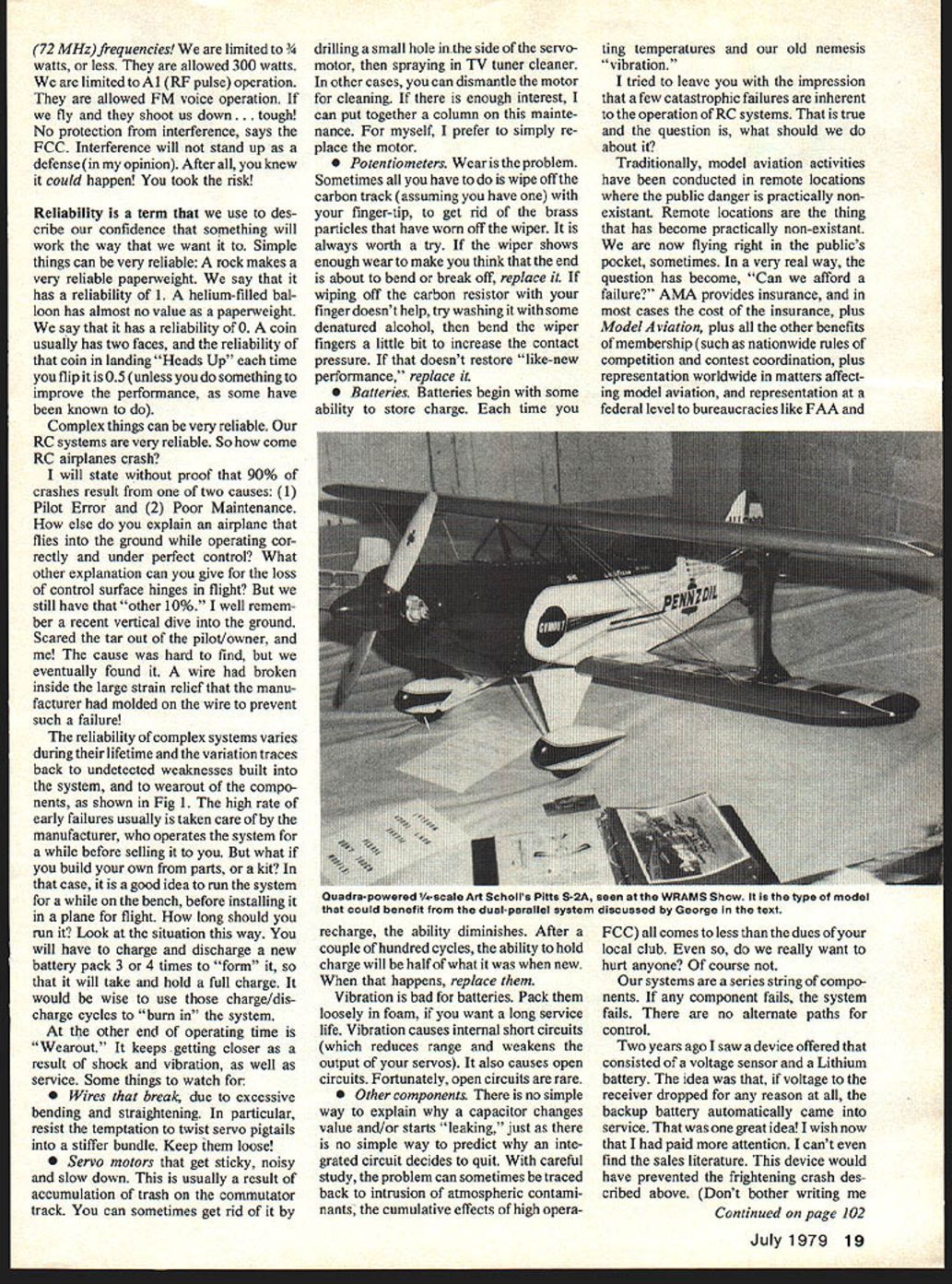
In larger models it is certainly feasible to use two or more parallel and completely independent RC systems for control. No doubt there will be some complaints about "hogging the channels," but increased reliability will be there. Mathematically, if you are operating two parallel systems, each with 0.9 reliability, the system reliability becomes 0.99. If you think that is unnecessarily high, consider the fact that our reliability goal on the Lunar Module was 0.999999, and then try to figure out how we achieved it.
Well, friends, I've run out of column space before I have run out of ideas. If you have read this far, consider this a call for new ideas for increased RC systems reliability. I will publish them all as far as space permits and credit you for presenting them.
George Myers, 70 Froehlich Farm Rd., Hicksville, NY 11801.
Transcribed from original scans by AI. Minor OCR errors may remain.

