
Radio Technique
George Myers
Every so often someone asks, "How can I be sure what current is being fed to my batteries by my charger?" The simple answer is: "Use an ammeter." But nothing is really simple. "What ammeter, and where do we connect it?" are the usual rejoinders.
Where to connect the ammeter
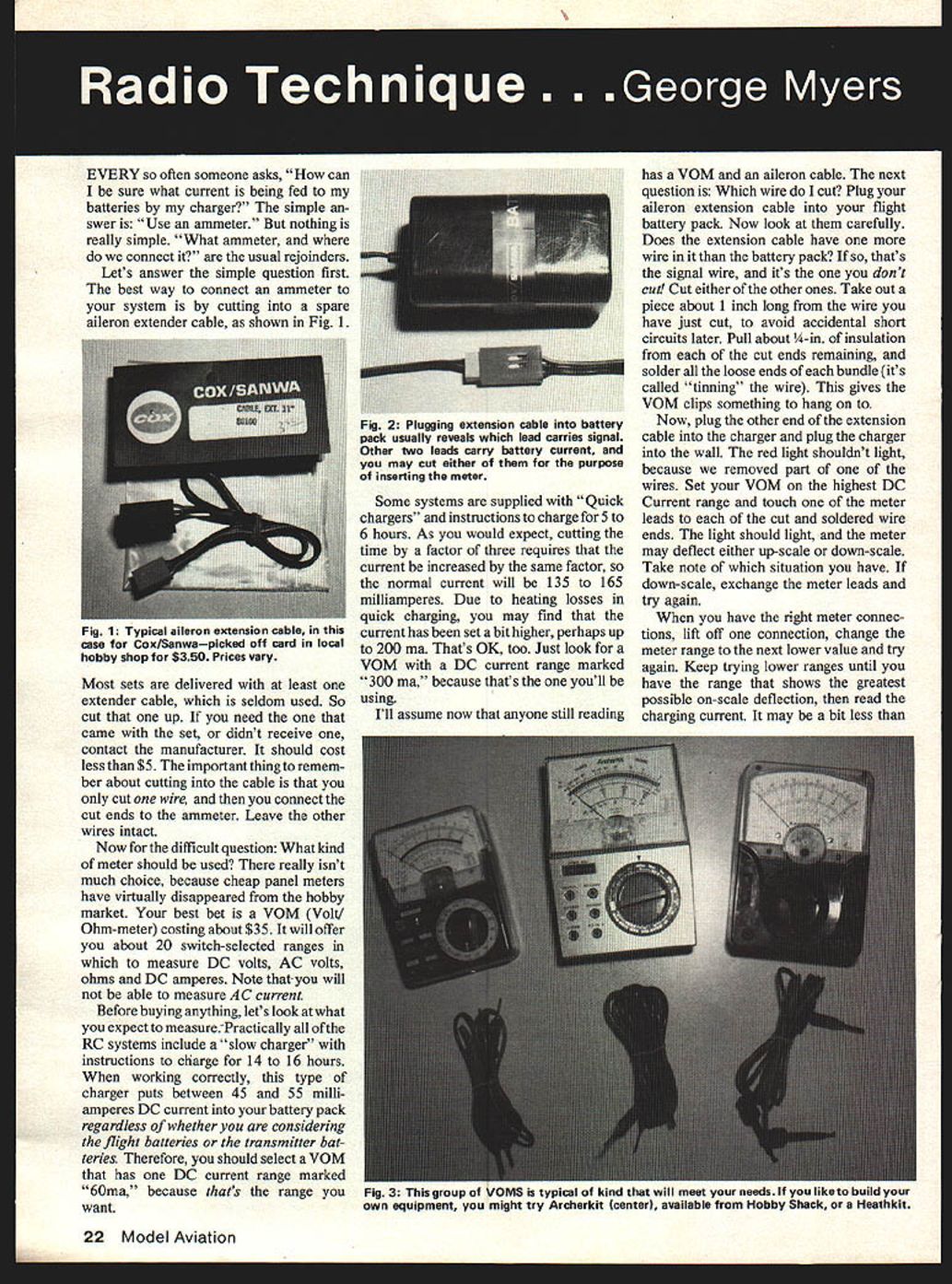
The best way to connect an ammeter to your system is by cutting into a spare aileron extension cable (see Fig. 1). Most sets are delivered with at least one extension cable, which is seldom used. So cut that one up. If you need the one that came with the set, or didn't receive one, contact the manufacturer. It should cost less than $5.
Important: cut only one wire in the cable and connect the cut ends to the ammeter. Leave the other wires intact.
What meter to use
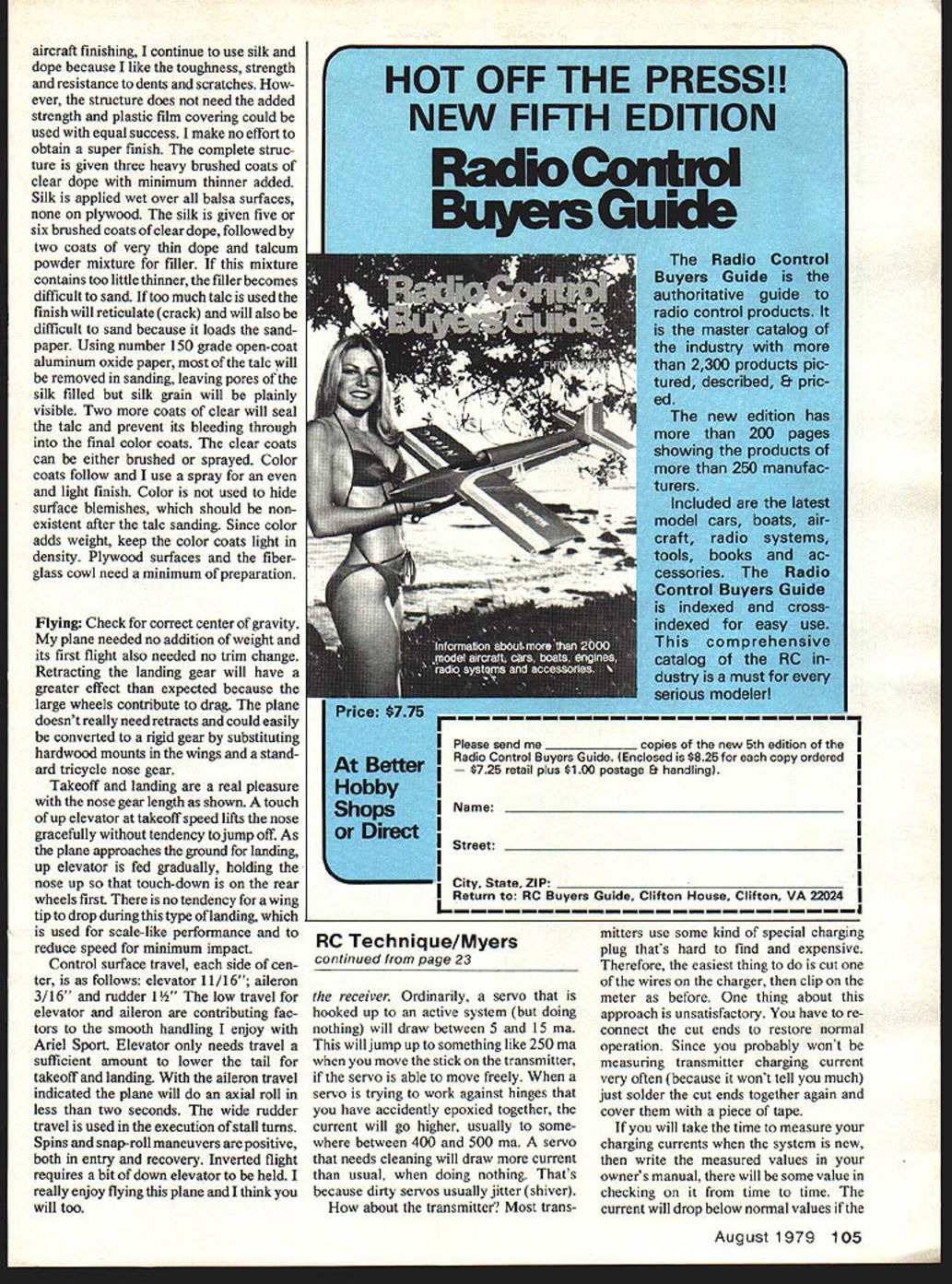
There really isn't much choice, because cheap panel meters have virtually disappeared from the hobby market. Your best bet is a VOM (Volt/Ohm-meter) costing about $35. It will offer about 20 switch-selected ranges in which to measure DC volts, AC volts, ohms and DC amperes. Note that you will not be able to measure AC current directly.
Before buying anything, consider what you expect to measure. Practically all RC systems include a "slow charger" with instructions to charge for 14 to 16 hours. When working correctly, this type of charger puts between 45 and 55 milliamperes (mA) DC into your battery pack. Therefore, select a VOM that has a DC current range marked "60 mA."
Some systems are supplied with "quick chargers" and instructions to charge for 5 to 6 hours. Cutting the time roughly by three requires increasing the current by the same factor, so the normal current will be about 135 to 165 mA. Due to heating losses in quick charging, the current may be set a bit higher, perhaps up to 200 mA. That's OK. Look for a VOM with a DC current range marked "300 mA" for this use.
Preparing the extension cable
Assuming you have a VOM and an aileron extension cable, which wire do you cut?
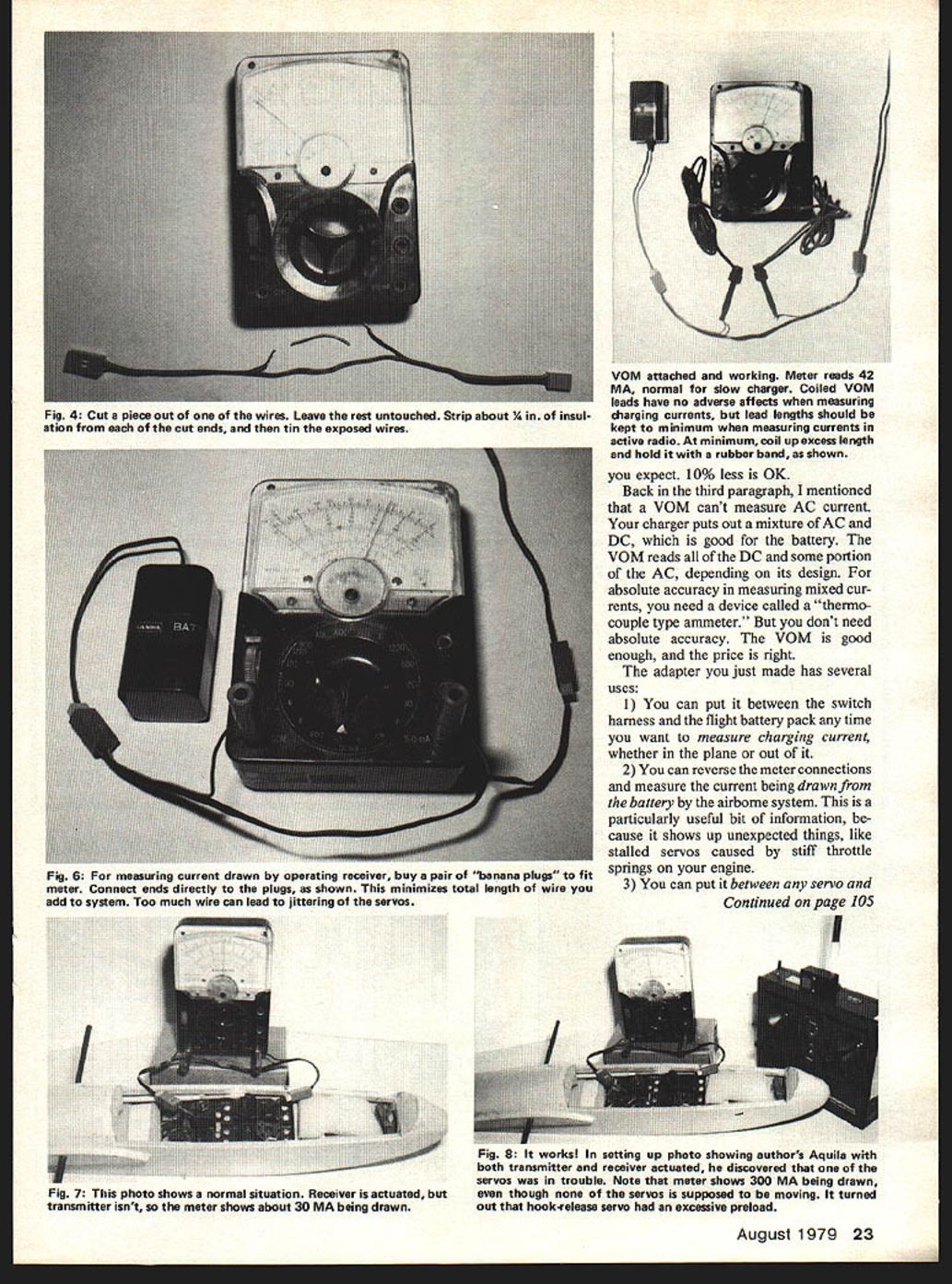
- Plug the extension cable into your flight battery pack and look carefully. If the extension cable has one more wire than the battery pack, that extra wire is the signal wire — do not cut it.
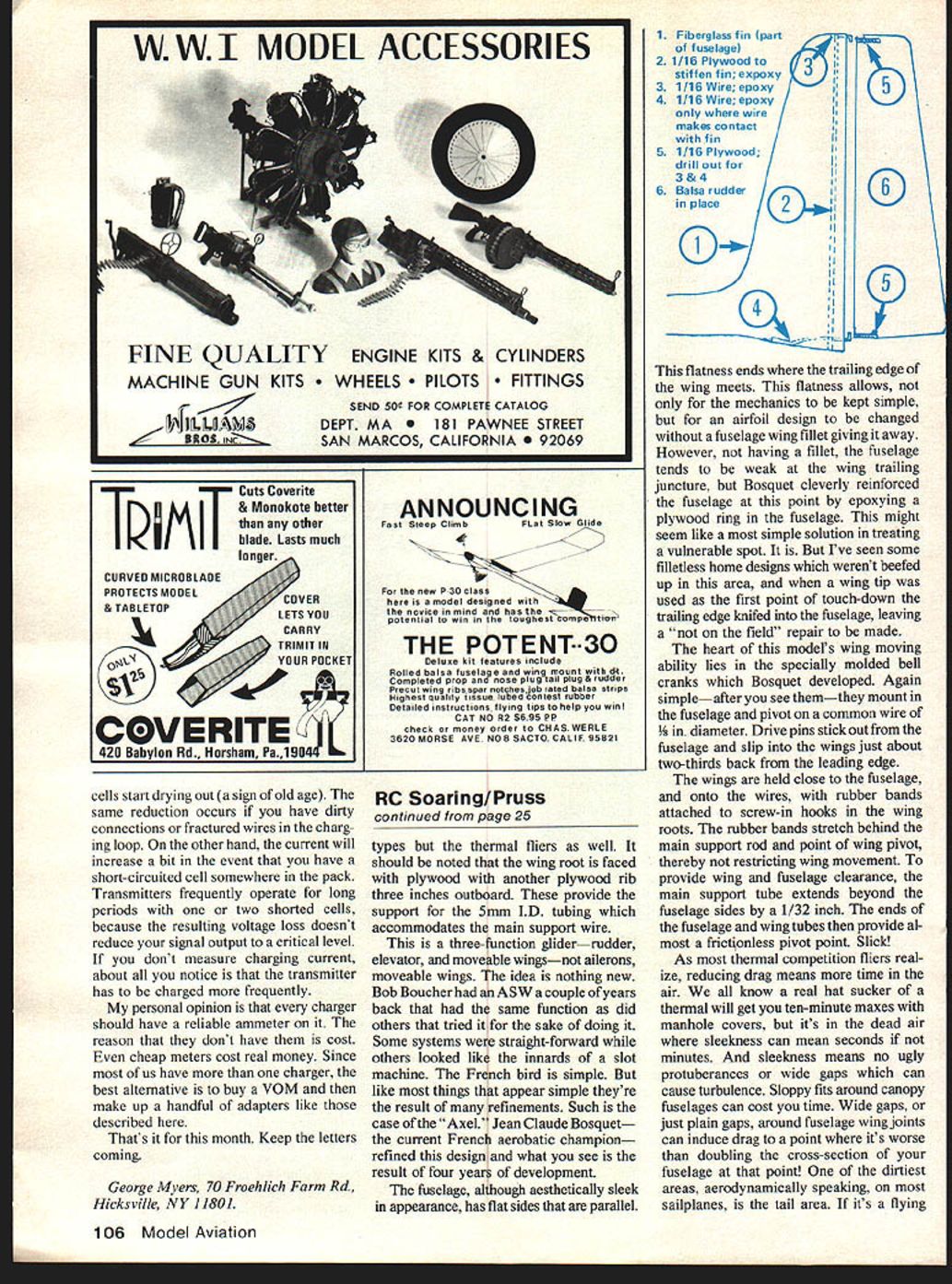
- Cut one of the other wires. Remove a piece about 1 inch long from the wire you cut to avoid accidental short circuits later.
- Pull about 1/4 inch of insulation from each of the cut ends and solder (tin) the loose ends of each bundle. Tinning gives the VOM clips something to hang on to.
Measuring the current
- Plug the other end of the extension cable into the charger and plug the charger into the wall. The red light shouldn't light, since part of one wire was removed.
- Set your VOM on the highest DC current range and touch one meter lead to each of the cut and soldered wire ends. The light should light and the meter may deflect either up-scale or down-scale. Note which happens. If the meter reads down-scale, exchange the meter leads and try again.
- When you have the correct meter connections, lift off one connection, change the meter range to the next lower value, and try again. Keep trying lower ranges until you have the range that shows the greatest possible on-scale deflection, then read the charging current. Readings up to about 10% below expected values are acceptable.
Notes on AC and accuracy
As mentioned earlier, a VOM can't directly measure AC current. Your charger typically puts out a mixture of AC and DC, which is good for the battery. The VOM reads all of the DC and some portion of the AC, depending on its design. For absolute accuracy in measuring mixed currents you need a thermocouple-type ammeter, but for hobby purposes a VOM is good enough and inexpensive.
Uses for the adapter
The adapter you made has several uses:
- You can put it between the switch harness and the flight battery pack any time you want to measure charging current, whether the pack is in the plane or out of it.
- You can reverse the meter connections and measure the current being drawn from the battery by the airborne system. This reveals unexpected problems, such as stalled servos caused by stiff throttle springs.
- You can put it between any servo and the receiver. Ordinarily, a servo hooked up to an active system (but doing nothing) will draw between 5 and 15 mA. This will jump to about 250 mA when you move the transmitter stick, if the servo can move freely. When a servo is working against hinges accidentally epoxied together, the current will rise to roughly 400–500 mA. A servo that needs cleaning will draw more current when idle because dirty servos usually jitter.
Measuring transmitter charging
Most transmitters use special charging plugs that are hard to find and expensive. The easiest thing is to cut one of the wires on the charger and clip on the meter as before. One drawback: you must reconnect the cut ends to restore normal operation. Since you won't likely measure transmitter charging current often (it usually tells you little), just solder the cut ends together again and cover with tape.
Record keeping and troubleshooting
If you measure your charging currents when the system is new and record the values in your owner's manual, there is value in checking them occasionally. The current will drop below normal if cells start drying out (a sign of old age), or if you have dirty connections or fractured wires in the charging loop. Conversely, current will increase slightly if a cell is short-circuited. Transmitters frequently operate with one or two shorted cells because the voltage loss often isn't enough to noticeably reduce signal output. If you don't measure charging current, you may only notice that the transmitter must be charged more frequently.
Conclusion
My opinion is that every charger should have a reliable ammeter on it. The reason they don't is cost. Even cheap meters cost real money. Since most of us have more than one charger, the best alternative is to buy a VOM and make up a handful of adapters like those described here.
That's it for this month. Keep the letters coming.
George Myers 70 Froehlich Farm Rd. Hicksville, NY 11801
Transcribed from original scans by AI. Minor OCR errors may remain.

