
Radio Technique
George Meyers
This column will be a bit different from what usually appears here. First, I bought a flight pack from Novak Electronics (915-A South Evergreen St., Santa Ana, CA 92707), and I want to talk about that. Then I put it in a modified Quickie 500, and guess what?
The Novak Flight Pack
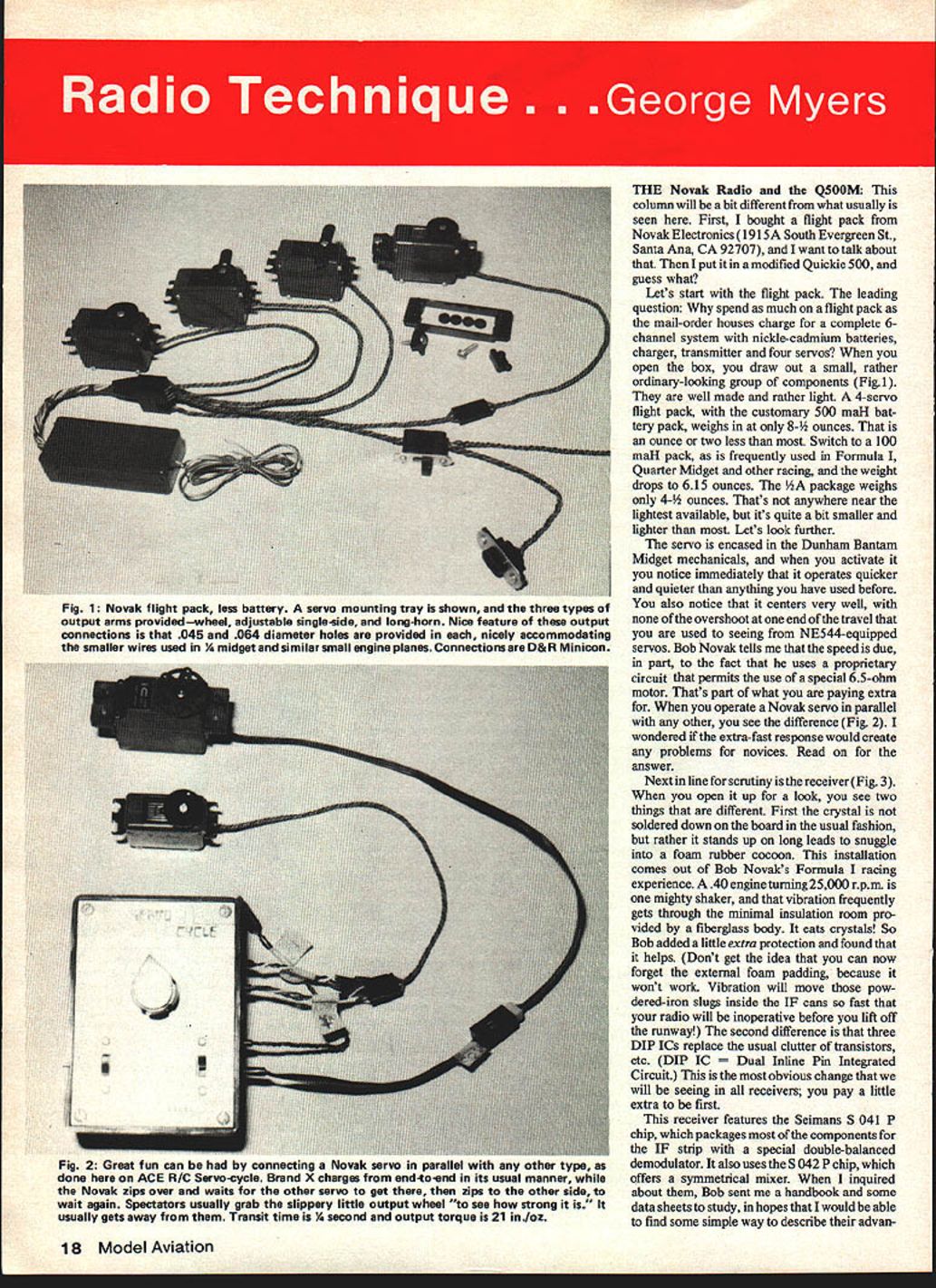
The leading question: why spend as much on a flight pack as the mail-order houses charge for a complete 6-channel system with nickel-cadmium batteries, charger, transmitter and four servos? When you open the box, you draw out a small, rather ordinary-looking group of components (Fig. 1). They are well made and rather light.
- A 4-servo flight pack with the customary 500 mAh battery pack weighs only 8-1/2 ounces — an ounce or two less than most.
- Switch to a 100 mAh pack, as is frequently used in Formula I, Quarter Midget and other racing, and the weight drops to 6.15 ounces.
- The 1/4-A package weighs only 4-1/2 ounces.
That's not the lightest available, but it's quite a bit smaller and lighter than most. Let's look further.
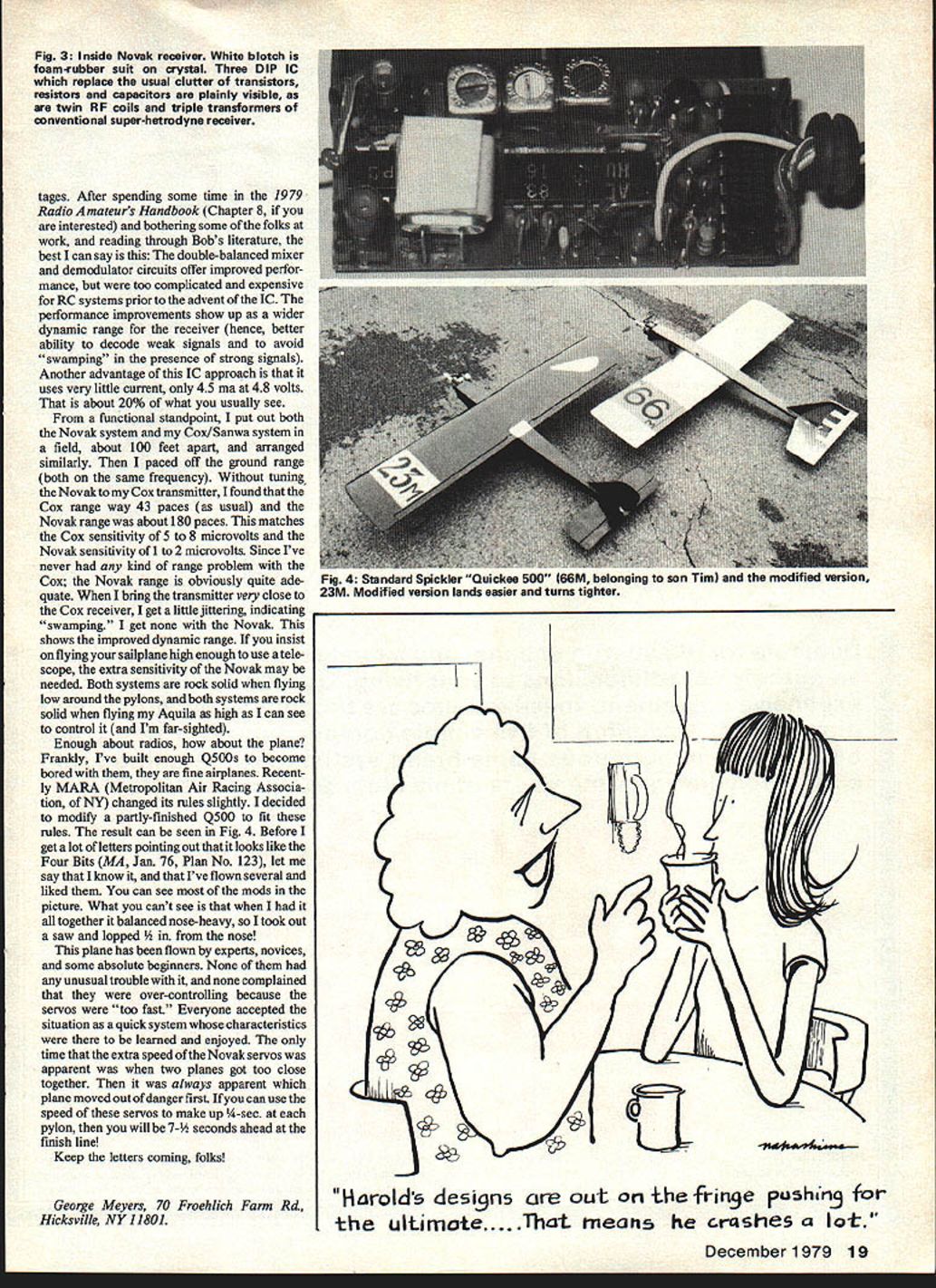
The servo is built around the Dunham Bantam Midget mechanicals, and when you activate it you notice immediately that it operates quicker and quieter than anything you've used before. It also centers very well, with none of the overshoot at one end of the travel that you are used to seeing from NE544-equipped servos. Bob Novak tells me that the speed is due in part to his proprietary circuit that permits the use of a special 6.5-ohm motor. That's part of what you are paying extra for. When you operate a Novak servo in parallel with any other, you see the difference (Fig. 2).
I wondered if the extra-fast response would create any problems for novices. Read on for the answer.
The Receiver
Next in line for scrutiny is the receiver (Fig. 3). When you open it up for a look, you see two things that are different:
- The crystal is not soldered down on the board in the usual fashion, but rather it stands up on long leads to snuggle into a foam rubber cocoon. This installation comes out of Bob Novak's Formula I racing experience. A .40 engine turning 25,000 r.p.m. is one mighty shaker, and that vibration frequently gets through the minimal insulation room provided by a fiberglass body. It eats crystals! So Bob added a little extra protection and found that it helps. (Don't get the idea that you can now forget the external foam padding, because it won't work. Vibration will move those powdered-iron slugs inside the IF cans so fast that your radio will be inoperative before you lift off the runway.)
- Three DIP ICs replace the usual clutter of transistors, etc. (DIP = dual in-line package.) This is the most obvious change that we will be seeing in all receivers; you pay a little extra to be first.
This receiver features the Siemens S041P chip, which packages most of the components for the IF strip with a special double-balanced demodulator. It also uses the S042P chip, which offers a symmetrical mixer. When I inquired about them, Bob sent me a handbook and some data sheets to study in hopes that I would be able to find some simple way to describe their advantages.
After spending some time with the 1979 Radio Amateur's Handbook, Chapter 8, and bothering some folks and reading through Bob's literature, the best I can say is that double-balanced mixer-demodulator circuits offer improved performance — too complicated and expensive for RC systems prior to the advent of ICs. Performance improvements show up as a wider dynamic range for the receiver, hence better ability to decode weak signals and avoid swamping in the presence of strong signals. Another advantage of the IC approach is low current consumption — about 45 mA at 4.8 volts; roughly 20% of what we usually see.
Range Comparison
From a functional standpoint I put the Novak system and the Cox/Sanwa system out in the field about 100 feet apart, arranged similarly, paced off on the ground, and both on the same frequency. Without tuning, the Cox transmitter was found to have a range of only 43 paces; the usual Novak range was about 180 paces. This matches the Cox sensitivity of 5.8 microvolts and the Novak sensitivity into 2 microvolts. Since I've never had a range problem with Cox, the Novak range comparison simply shows the Novak range is obviously quite adequate.
When I bring the transmitter very close to the Cox receiver, I get a little jittering, indicating "swamping." I get none with the Novak. This shows the improved dynamic range. If you insist on flying your sailplane high enough to use a telescopic, the extra sensitivity of the Novak may be needed. Both systems are rock solid when flying low around the pylons, and both systems are rock solid when flying my Aquila as high as I can see to control it (and I'm far-sighted).
The Plane: Modified Quickie 500
Enough about radios — how about the plane? Frankly, I've built enough Q500s to become bored with them; they are fine airplanes. Recently MARA (Metropolitan Air Racing Association, of NY) changed its rules slightly. I decided to modify a partly finished Q500 to fit these rules. The result can be seen in Fig. 4.
Before I get a lot of letters pointing out that it looks like the Four Bits (MA, Jan. 76, Plan No. 123), let me say that I know it, and that I've flown several and liked them. You can see most of the mods in the picture. What you can't see is that when I had it all together it balanced nose-heavy, so I took out a saw and lopped 1/2 in. from the nose!
This plane has been flown by experts, novices, and some absolute beginners. None of them had any unusual trouble with it, and none complained that they were over-controlling because the servos were "too fast." Everyone accepted the situation as a quick system whose characteristics were there to be learned and enjoyed. The only time that the extra speed of the Novak servos was apparent was when two planes got too close together. Then it was always apparent which plane moved out of danger first. If you can use the speed of these servos to make up 1/4 second at each pylon, then you will be 7-1/2 seconds ahead at the finish line!
Keep the letters coming, folks!
George Meyers 70 Froehlich Farm Rd. Hicksville, NY 11801
Transcribed from original scans by AI. Minor OCR errors may remain.

