
Radio Technique
George M. Myers
An Interference Meter
It's always gratifying to discover that someone reads, and acts upon, the advice given in this column. I was pleased to see an article in the October issue of the Sunbeam newsletter of the West Orange Sunfliers Radio Control Club, Inc., John L. Thomas II, editor, of Orlando, Florida. The newsletter was sent to me from AMA HQ, and in it there was an article by Jack Minch showing how he had picked up on my discussion of how to use an ammeter (Oct. '79 MA, p. 21) and had extended it.
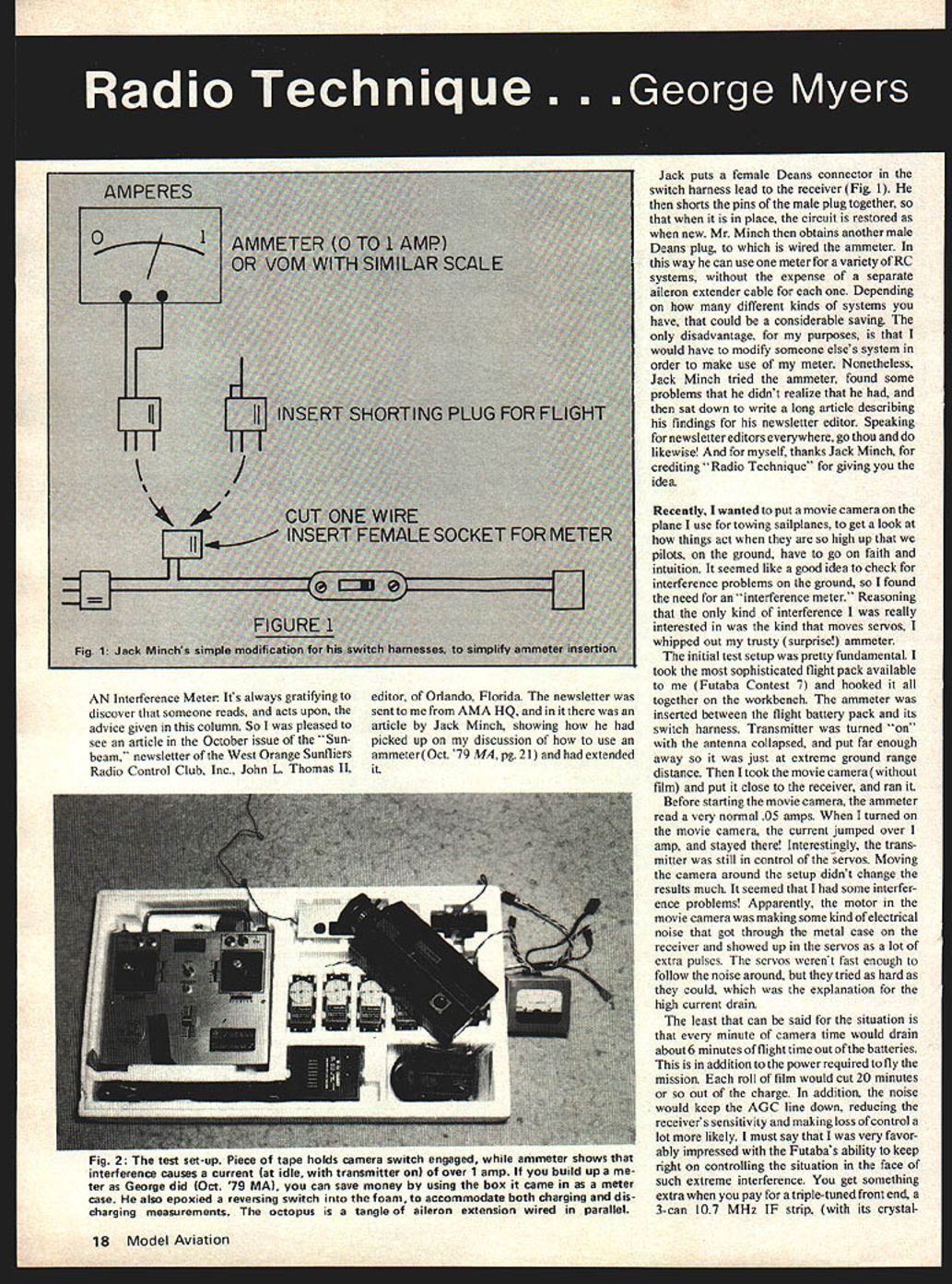
Jack puts a female Deans connector in the switch-harness lead to the receiver (Fig. 1). He then shorts the pins of the male plug together, so that when it is in place the circuit is restored as when new. Mr. Minch then obtains another male Deans plug to which he wires the ammeter. In this way he can use one meter for a variety of RC systems, without the expense of a separate aileron-extender cable for each one. Depending on how many different kinds of systems you have, that could be a considerable saving. The only disadvantage, for my purposes, is that I would have to modify someone else's system in order to make use of my meter. Nonetheless, Jack Minch tried the ammeter, found some problems that he didn't realize he had, and then sat down to write a long article describing his findings for his newsletter editor. Speaking for newsletter editors everywhere: go thou and do likewise! And for myself, thanks Jack Minch, for crediting Radio Technique for giving you the idea.
Recently I wanted to put a movie camera on the plane I use for towing sailplanes, to get a look at how things act when they are so high up that we pilots on the ground have to go on faith and intuition. It seemed like a good idea to check for interference problems on the ground, so I found the need for an "interference meter." Reasoning that the only kind of interference I was really interested in was the kind that moves servos, I whipped out my trusty ammeter.
The initial test setup was pretty fundamental. I took the most sophisticated flight pack available to me (Futaba Contest 7) and hooked it all together on the workbench. The ammeter was inserted between the flight battery pack and its switch-harness. The transmitter was turned on with the antenna collapsed and put far enough away so it was just at extreme ground-range distance. Then I took the movie camera (without film), put it close to the receiver, and ran it.
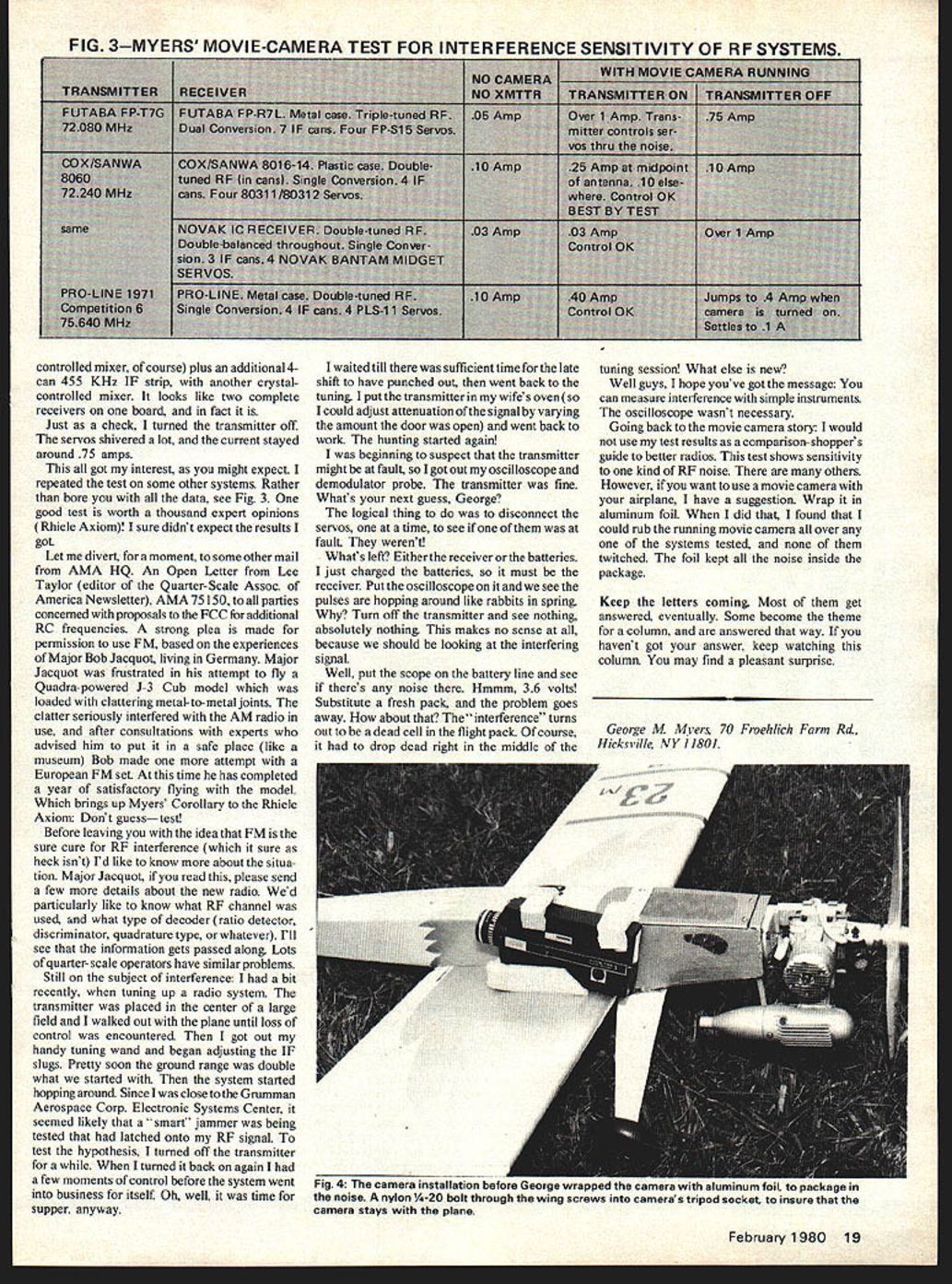
Before starting the movie camera, the ammeter read a very normal 0.05 amps. When I turned on the movie camera, the current jumped over 1 amp and stayed there! Interestingly, the transmitter was still in control of the servos. Moving the camera around the setup didn't change the results much. It seemed that I had some interference problems. Apparently the motor in the movie camera was making some kind of electrical noise that got through the metal case on the receiver and showed up in the servos as a lot of extra pulses. The servos weren't fast enough to follow the noise around, but they tried as hard as they could, which was the explanation for the high current drain.
The least that can be said for the situation is that every minute of camera time would drain about six minutes of flight time out of the batteries. This is in addition to the power required to fly the mission. Each roll of film would cut 20 minutes or so out of the charge. In addition, the noise would keep the AGC line down, reducing the receiver's sensitivity and making loss of control a lot more likely. I must say that I was very favorably impressed with the Futaba's ability to keep right on controlling the situation in the face of such extreme interference. You do get something extra when you pay for a triple-tuned front end: a 3-can 10.7 MHz IF strip (with its crystal-controlled mixer, of course), plus an additional 4-can 455 kHz IF strip with another crystal-controlled mixer. It looks like two complete receivers on one board, and in fact it is.
Just as a check, I turned the transmitter off. The servos shivered a lot, and the current stayed around 0.75 amps.
This all got my interest, as you might expect. I repeated the test on some other systems. Rather than bore you with all the data, see Fig. 3. One good test is worth a thousand expert opinions (Rhiele Axiom). I sure didn't expect the results I got.
Let me divert for a moment to some other mail from AMA HQ. An open letter from Lee Taylor (editor of the Quarter-Scale Association of America Newsletter), AMA 75150, to all parties concerned with proposals to the FCC for additional RC frequencies makes a strong plea for permission to use FM, based on the experiences of Major Bob Jacquot, living in Germany. Major Jacquot was frustrated in his attempt to fly a Quadra-powered J-3 Cub model which was loaded with clattering metal-to-metal joints. The clatter seriously interfered with the AM radio in use, and after consultations with experts who advised him to put it in a safe place (like a museum), Bob made one more attempt with a European FM set. At this time he has completed a year of satisfactory flying with the model. Which brings up Myers' Corollary to the Rhiele Axiom: Don't guess—test!
Before leaving you with the idea that FM is the sure cure for RF interference (which it sure as heck isn't), I'd like to know more about the situation. Major Jacquot, if you read this, please send a few more details about the new radio. We'd particularly like to know what RF channel was used and what type of decoder (ratio detector, discriminator, quadrature type, or whatever). I'll see that the information gets passed along. Lots of quarter-scale operators have similar problems.
Still on the subject of interference: I had a bit of trouble recently when tuning up a radio system. The transmitter was placed in the center of a large field and I walked out with the plane until loss of control was encountered. Then I got out my handy tuning wand and began adjusting the IF slugs. Pretty soon the ground range was double what we started with. The system started hopping around. Since I was close to the Grumman Aerospace Corp. Electronic Systems Center, it seemed likely that a "smart" jammer was being tested that had latched onto my RF signal. To test the hypothesis, I turned off the transmitter for a while. When I turned it back on again I had a few moments of control before the system went into business for itself. Oh, well, it was time for supper, anyway.
I waited till there was sufficient time for the late shift to have punched out, then went back to the tuning. I put the transmitter in my wife's oven (so I could adjust attenuation of the signal by varying the amount the door was open) and went back to work. The hunting started again!
I was beginning to suspect that the transmitter might be at fault, so I got out my oscilloscope and demodulator probe. The transmitter was fine. What's your next guess, George?
The logical thing to do was to disconnect the servos, one at a time, to see if one of them was at fault. They weren't.
What's left? Either the receiver or the batteries. I had just charged the batteries, so it must be the receiver. Put the oscilloscope on it and we saw the pulses hopping around like rabbits in spring. Why? Turn off the transmitter and see nothing, absolutely nothing. This made no sense at all, because we should be looking at the interfering signal.
Well, put the scope on the battery line and see if there's any noise. Hmmm — 3.6 volts! Substitute a fresh pack, and the problem goes away. How about that? The "interference" turned out to be a dead cell in the flight pack. Of course, it had to drop dead right in the middle of a tuning session! What else is new?
Well guys, I hope you've got the message: you can measure interference with simple instruments. The oscilloscope wasn't necessary.
Going back to the movie camera story: I would not use my test results as a comparison-shopper's guide to better radios. This test shows sensitivity to one kind of RF noise. There are many others. However, if you want to use a movie camera with your airplane, I have a suggestion: wrap it in aluminum foil. When I did that, I found that I could rub the running movie camera all over any one of the systems tested, and none of them twitched. The foil kept all the noise inside the package.
Keep the letters coming. Most of them get answered eventually. Some become the theme for a column, and are answered that way. If you haven't got your answer, keep watching this column. You may find a pleasant surprise.
George M. Myers 70 Froehlich Farm Rd. Hicksville, NY 11801
Transcribed from original scans by AI. Minor OCR errors may remain.

