
Radio Technique
George M. Myers
Glow-plug drivers
A glow-plug is an electrical resistance that gets hot when you run current through it. Most are designed to reach about 1,200°F when installed in a dry engine and powered by a 1.5 VDC battery. A few are designed for a 2 VDC lead/acid battery.
Without a glow, your engine won't go. Any engine will run if it has fuel, air, compression and a point of ignition. Miss one of these requirements and it won't run.
There are three ways to light a glow-plug:
- Constant voltage
- Constant current
- Pulsed current (glow-plug drivers)
Three ways to light a glow-plug
- Constant-voltage devices
- The familiar NiCad and clip-leads setup is a constant-voltage device. A dry plug draws about 1.5 amps; if you "flood" it with fuel or oil, the current may increase to about 5 amps. The current varies according to the power taken from the glowing element by its environment.
- Constant-current devices
- Putting a power resistor in series with a 12 VDC starter battery creates a constant-current device. The glow-plug current remains at a preselected value regardless of flooding. Constant-current devices take longer to burn off a flooded condition because they cannot supply the large currents sometimes needed.
- Pulsed-current devices (glow-plug drivers)
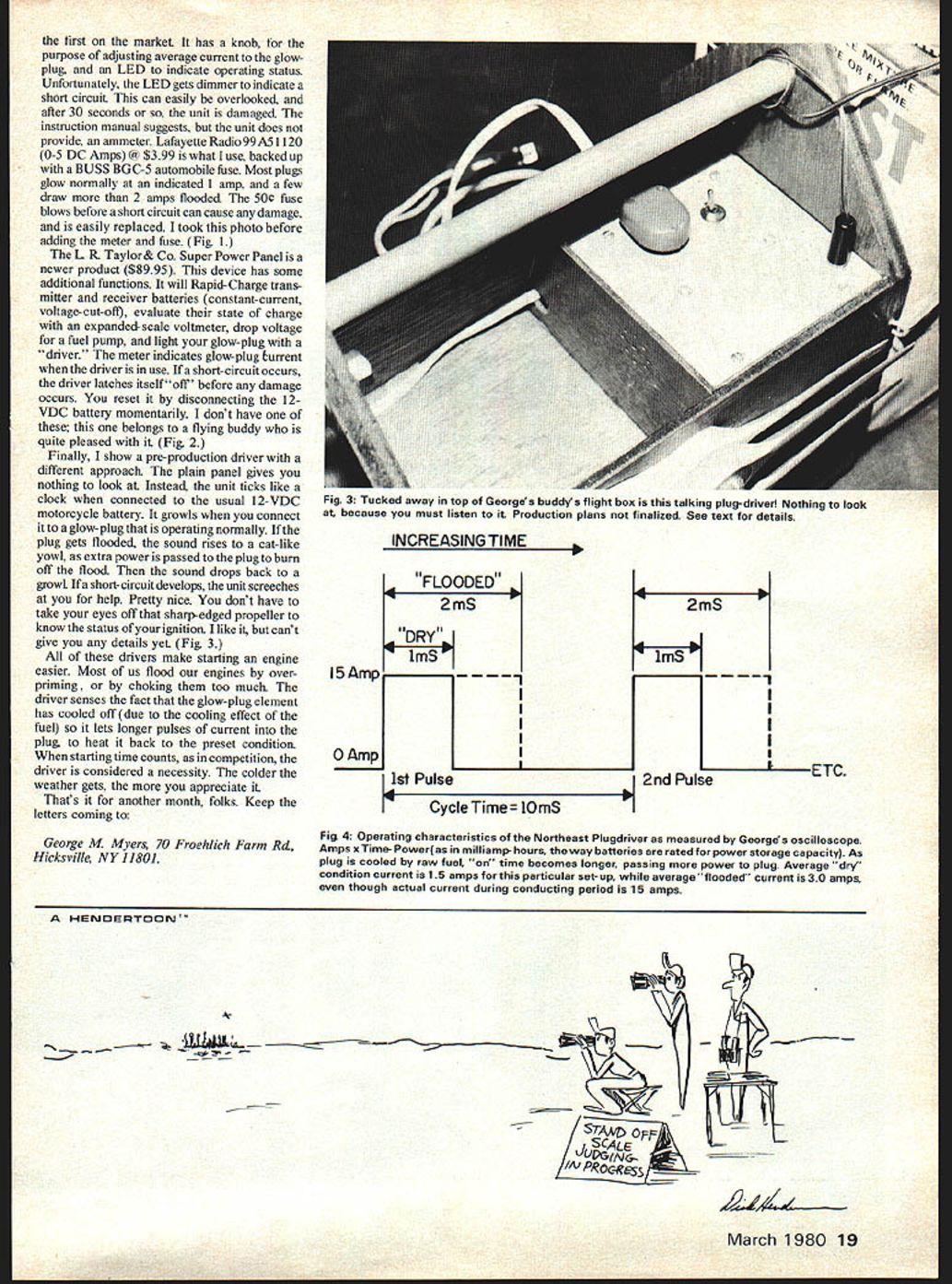
- These work by applying short spurts of high current (about 20 amps) driven by a higher voltage (usually around 6 VDC). If this current were continuous the plug would burn out immediately. The on-off time ratio is adjusted electronically so that the average current through a dry plug is in the familiar 1.5–5 amp range. The time-ratio variation gives a glow driver its major advantage: the ability to burn off flooded conditions automatically and rapidly. (Fig. 4.)
Connections and troubleshooting
All of the above require clean, solid connections to work correctly.
- On constant-voltage or constant-current devices, dirty connections usually mean the plug won't light.
- On pulsed-current devices, dirty connections can be more severe: the higher available voltage and automatic current-adjusting capability may cause the plug to burn out when contact is finally established.
I like to see a meter on any kind of glow-plug igniter. If the current reads zero, either we have a bad connection, the battery is dead, or the plug has failed. It doesn't take long to find which is the culprit.
- If the current is normal and the engine still won't run, the trouble is fuel. Prime the engine and check.
- If the current is too high, suspect a short circuit, a flooded plug, or a damaged plug.
Representative glow-plug drivers
- Northeast Engineering Plugdriver
- Kit price: $28.50; Assembled: $34.95.
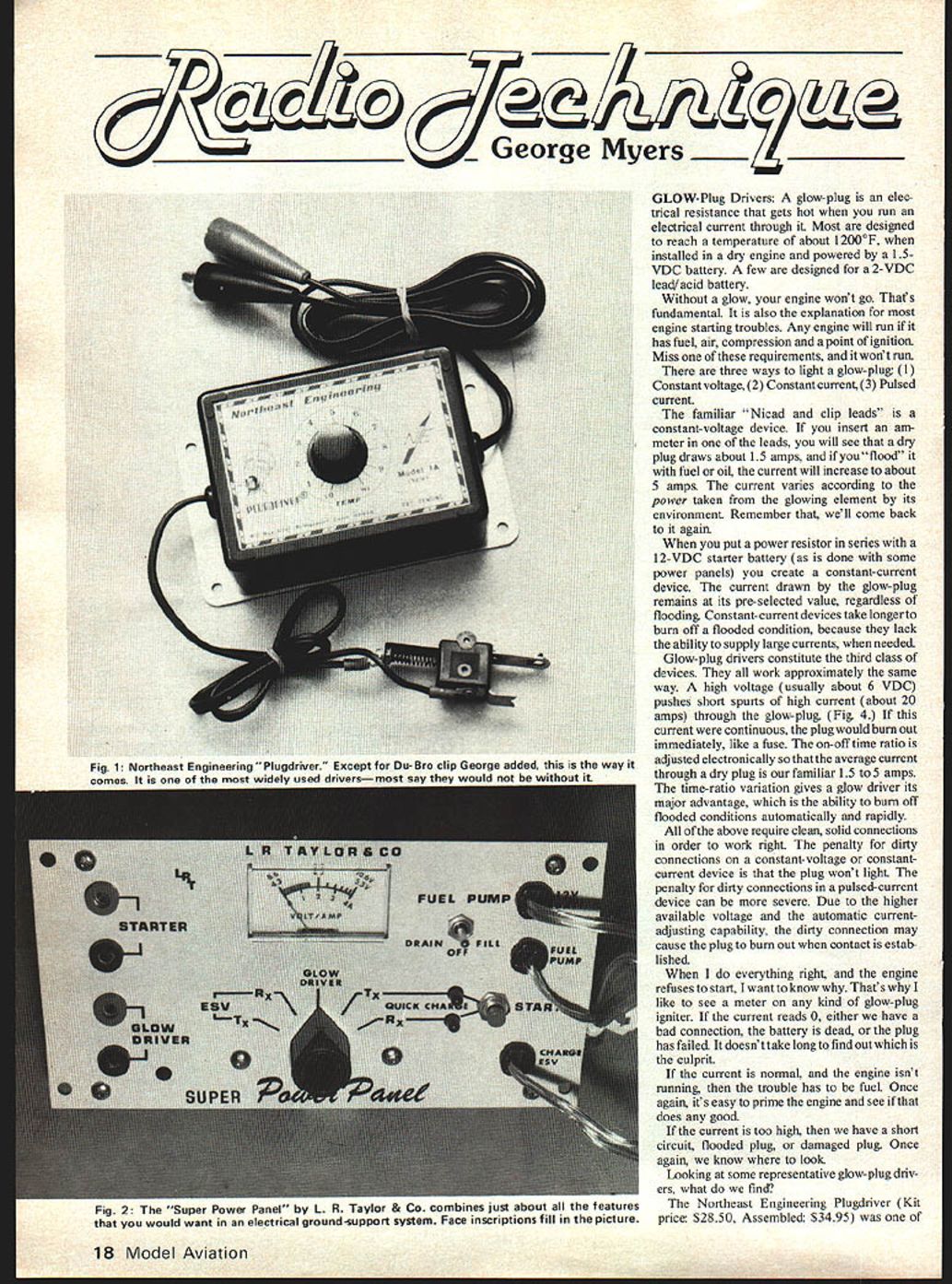
- Has a knob to adjust average current and an LED to indicate operating status. Unfortunately, the LED gets dimmer to indicate a short circuit, which is easy to overlook; after about 30 seconds the unit can be damaged.
- The manual suggests an ammeter, but the unit does not provide one. I use a Lafayette Radio 99 AS1120 (0–5 DC Amps) @ $3.99, backed up with a BUSS BGC-5 automobile fuse. Most plugs glow normally at an indicated 1 amp; a few draw more than 2 amps when flooded. The inexpensive fuse blows before a short can cause damage and is easily replaced. (Fig. 1)
- L. R. Taylor & Co. Super Power Panel
- Price: $89.95.
- Includes additional functions: rapid-charge for transmitter and receiver batteries (constant-current, voltage cutoff), an expanded-scale voltmeter to evaluate state of charge, a voltage drop for a fuel pump, and a glow-plug driver.
- The meter indicates glow-plug current when the driver is in use. If a short circuit occurs, the driver latches itself off before any damage occurs; you reset it by momentarily disconnecting the 12 VDC battery. I don't own one of these—this unit belongs to a flying buddy who is quite pleased with it. (Fig. 2)
- Pre-production sound-feedback driver
- A different approach: the plain panel gives you nothing to look at, but the unit makes sounds to indicate status. It ticks like a clock when connected to a 12 V motorcycle battery, growls when a glow-plug is operating normally, rises to a cat-like yowl when the plug is flooded (as extra power is applied to burn off the flood), then drops back to a growl. If a short develops, the unit screeches. This lets you monitor ignition status without taking your eyes off the propeller. I like it, but can't give full details yet. (Fig. 3)
Starting advantages and final notes
All of these drivers make starting an engine easier. Most of us flood engines by overpriming or by choking them too much. The driver senses that the glow-plug element has cooled (due to the cooling effect of fuel) and provides longer pulses to restore the preset temperature. In competition or cold weather, a glow-plug driver is often a necessity.
That's it for another month, folks. Keep the letters coming to:
George M. Myers 70 Froehlich Farm Rd. Hicksville, NY 11801
Transcribed from original scans by AI. Minor OCR errors may remain.

