
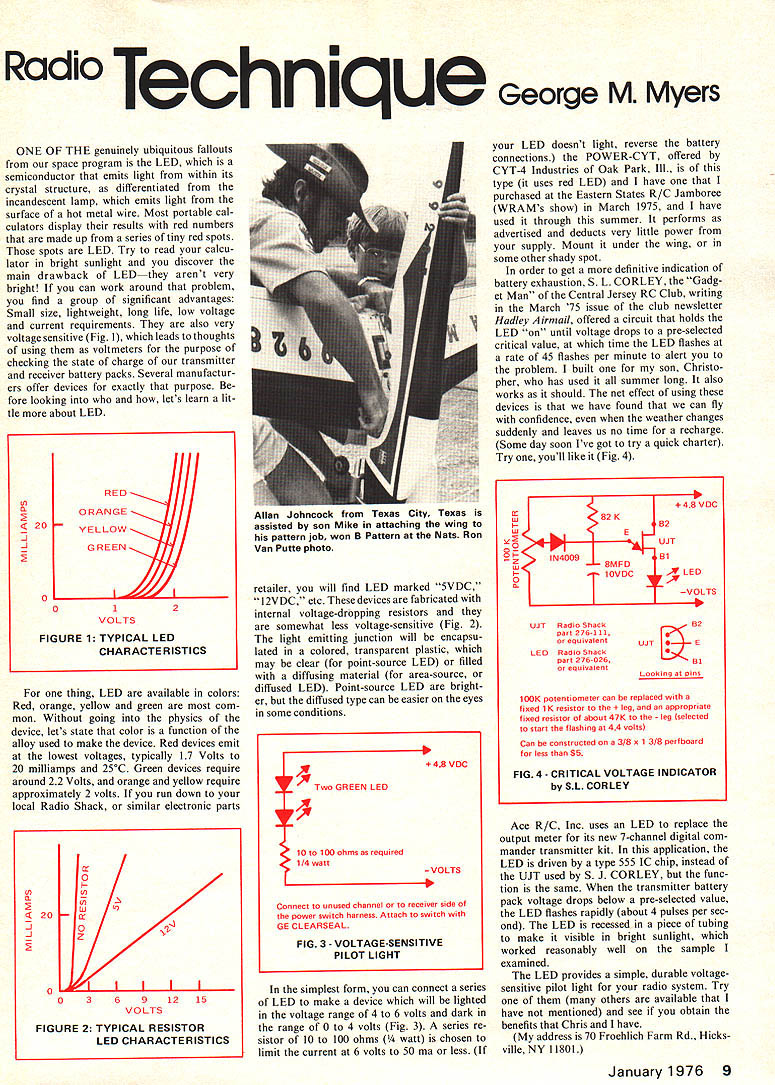
Radio Technique
George M. Myers
ONE OF THE genuinely ubiquitous fallouts from our space program is the LED, which is a semiconductor that emits light from within its crystal structure, as differentiated from the incandescent lamp, which emits light from the surface of a hot metal wire. Most portable calculators display their results with red numbers that are made up from a series of tiny red spots. Those spots are LED. Try to read your calculator in bright sunlight and you discover the main drawback of LED—they aren't very bright! If you can work around that problem, you find a group of significant advantages: Small size, lightweight, long life, low voltage and current requirements. They are also very voltage sensitive (Fig. 1), which leads to thoughts of using them as voltmeters for the purpose of checking the state of charge of our transmitter and receiver battery packs. Several manufacturers offer devices for exactly that purpose. Before looking into who and how, let's learn a little more about LED.
For one thing, LED are available in colors: Red, orange, yellow and green are most common. Without going into the physics of the device, let's state that color is a function of the alloy used to make the device. Red devices emit at the lowest voltages, typically 1.7 Volts at 20 milliamps and 25°C. Green devices require around 2.2 Volts, and orange and yellow require approximately 2.0 Volts. If you run down to your local Radio Shack, or similar electronic parts retailer, you will find LED marked "5VDC," "12VDC," etc. These devices are fabricated with internal voltage-dropping resistors and they are somewhat less voltage-sensitive (Fig. 2). The light-emitting junction will be encapsulated in a colored, transparent plastic, which may be clear (for point-source LED) or filled with a diffusing material (for area-source, or diffused LED). Point-source LED are brighter, but the diffused type can be easier on the eyes in some conditions.
In the simplest form, you can connect a series of LED to make a device which will be lighted in the voltage range of 4 to 6 volts and dark in the range of 0 to 4 volts (Fig. 3). A series resistor of 10 to 100 ohms (1/4 watt) is chosen to limit the current at 6 volts to 50 ma or less. (If your LED doesn't light, reverse the battery connections.) The POWER-CYT, offered by CYT-4 Industries of Oak Park, Ill., is of this type (it uses red LED) and I have one that I purchased at the Eastern States R/C Jamboree (WRAM'S show) in March 1975, and I have used it through this summer. It performs as advertised and deducts very little power from your supply. Mount it under the wing, or in some other shady spot.
In order to get a more definitive indication of battery exhaustion, S. L. Corley, the "Gadget Man" of the Central Jersey RC Club, writing in the March '75 issue of the club newsletter "Hadley Airmail," offered a circuit that holds the LED "on" until voltage drops to a pre-selected critical value, at which time the LED flashes at a rate of 45 flashes per minute to alert you to the problem. I built one for my son, Christopher, who has used it all summer long. It also works as it should. The net effect of using these devices is that we found we can fly with confidence, even when the weather changes suddenly and leaves us no time for a recharge. (Some day soon I've got to try a quick charger.) Try one, you'll like it (Fig. 4).
Ace R/C, Inc. uses an LED to replace the output meter for its new 7-channel digital commander transmitter kit. In this application, the LED is driven by a type 555 IC, instead of the UJT used by S. L. Corley, but the function is the same. When the transmitter battery pack voltage drops below a pre-selected value, the LED flashes rapidly (about 4 pulses per second). The LED is recessed in a piece of tubing to make it visible in bright sunlight, which worked reasonably well on the sample I examined.
The LED provides a simple, durable voltage-sensitive pilot light for your radio system. Try one of them (many others are available that I have not mentioned) and see if you obtain the benefits that Chris and I have. My address is 70 Froehlich Farm Rd., Hicksville, NY 11801.
Transcribed from original scans by AI. Minor OCR errors may remain.

