
Radio Technique
George Myers
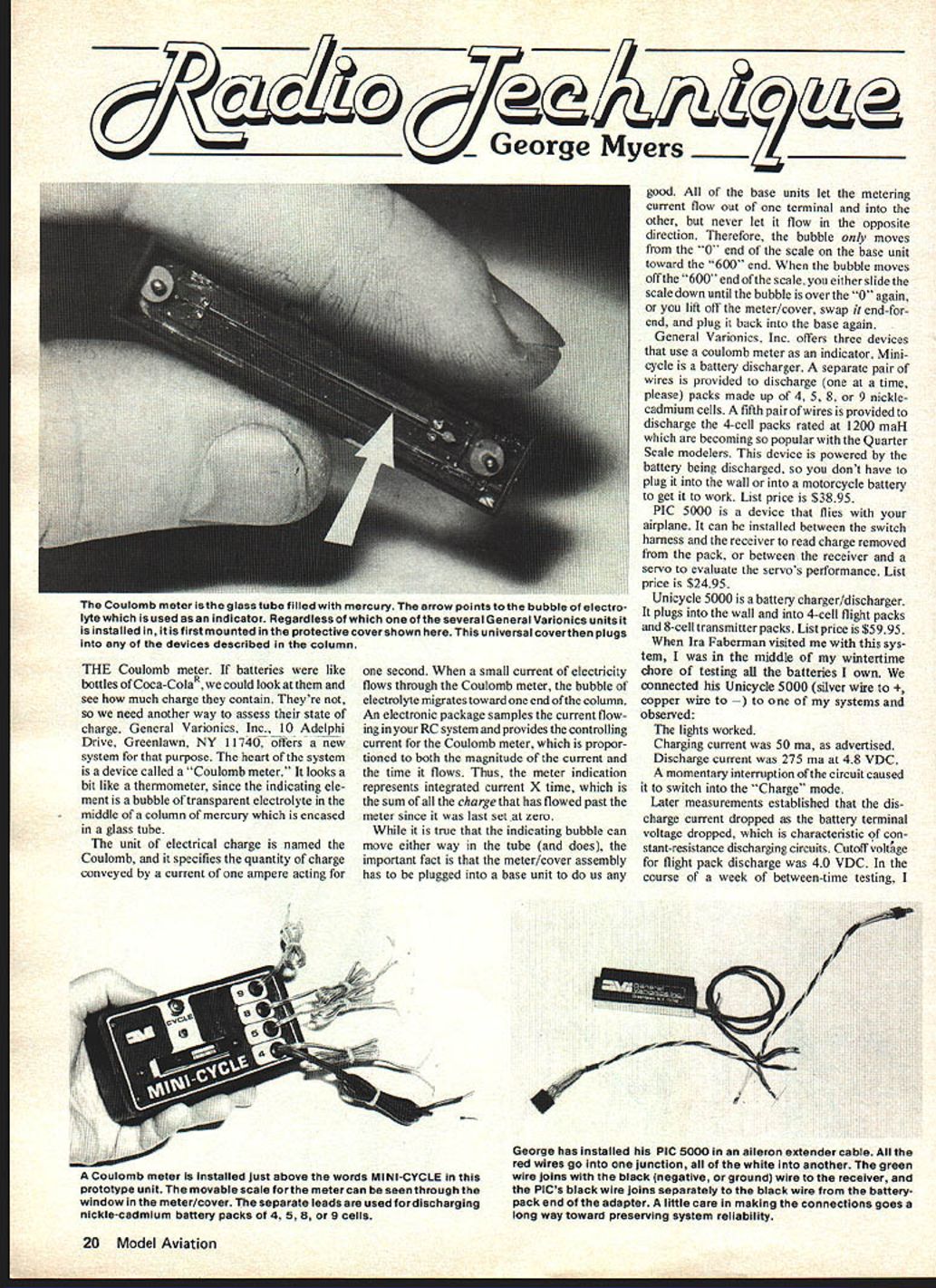
The Coulomb meter. If batteries were like bottles of Coca‑Cola, we could look at them and see how much charge they contain. They're not, so we need another way to assess their state of charge. General Varionics, Inc., 10 Adelphi Drive, Greenlawn, NY 11740, offers a new system for that purpose. The heart of the system is a device called a "Coulomb meter." It looks a bit like a thermometer, since the indicating element is a bubble of transparent electrolyte in the middle of a column of mercury which is encased in a glass tube.
The unit of electrical charge is named the Coulomb, and it specifies the quantity of charge conveyed by a current of one ampere acting for one second. When a small current of electricity flows through the Coulomb meter, the bubble of electrolyte migrates toward one end of the column. An electronic package samples the current flowing in your RC system and provides the controlling current for the Coulomb meter, which is proportioned to both the magnitude of the current and the time it flows. Thus, the meter indication represents integrated current × time, which is the sum of all the charge that has flowed past the meter since it was last set at zero.
While it is true that the indicating bubble can move either way in the tube (and does), the important fact is that the meter/cover assembly has to be plugged into a base unit to do us any good. All of the base units let the metering current flow out of one terminal and into the other, but never let it flow in the opposite direction. Therefore, the bubble only moves from the "0" end of the scale on the base unit toward the "600" end. When the bubble moves off the "600" end of the scale, you either slide the scale down until the bubble is over the "0" again, or you lift off the meter/cover, swap it end‑for‑end, and plug it back into the base again.
General Varionics, Inc. offers three devices that use a Coulomb meter as an indicator:
- Minicycle is a battery discharger. A separate pair of wires is provided to discharge (one at a time, please) packs made up of 4, 5, 8, or 9 nickel‑cadmium cells. A fifth pair of wires is provided to discharge the 4‑cell packs rated at 1200 mAh which are becoming so popular with the Quarter Scale modelers. This device is powered by the battery being discharged, so you don't have to plug it into the wall or into a motorcycle battery to get it to work. List price is $38.95.
- PIC 5000 is a device that flies with your airplane. It can be installed between the switch harness and the receiver to read charge removed from the pack, or between the receiver and a servo to evaluate the servo's performance. List price is $24.95.
- Unicycle 5000 is a battery charger/discharger. It plugs into the wall and into 4‑cell flight packs and 8‑cell transmitter packs. List price is $59.95.
When Ira Faberman visited me with this system, I was in the middle of my wintertime chore of testing all the batteries I own. We connected his Unicycle 5000 (silver wire to +, copper wire to −) to one of my systems and observed:
- The lights worked.
- Charging current was 50 mA, as advertised.
- Discharge current was 275 mA at 4.8 VDC.
- A momentary interruption of the circuit caused it to switch into the "Charge" mode.
Later measurements established that the discharge current dropped as the battery terminal voltage dropped, which is characteristic of constant‑resistance discharging circuits. Cutoff voltage for flight pack discharge was 4.0 VDC. In the course of a week of between‑time testing, I managed to test every flight pack my sons and I have, and to put adhesive labels on each one showing the date of test and the results. This is a good time for you to do the same with your equipment.
Next, we turned our attention to transmitter packs. Unicycle 5000 is set up to discharge 8‑cell packs, normally, though modifications to test 9‑cell packs (as in Cox/Sanwa, for instance) are available on special order. The one I was using was set up for 8‑cell packs and cut off at 8.0 VDC. I used it on the Cox/Sanwa transmitters anyway. The cutoff at 0.88 VDC per cell isn't likely to cause any trouble, and the increase in measured capacity is negligible. The calibration of the meter remains valid. Discharge current is 320 mA instead of 280 mA, and the change isn't large enough to damage anything. I found some bad cells with this test, but I don't think it makes sense to fully discharge your set every time you prepare to recharge it; occasional testing is definitely worthwhile.
At any rate, I tested all my battery packs, replaced batteries where necessary, stuck labels on the packs indicating the final test results and date, brought every pack up to full charge, and put things in storage. I'll recharge them once a month throughout the winter season. You should, too.
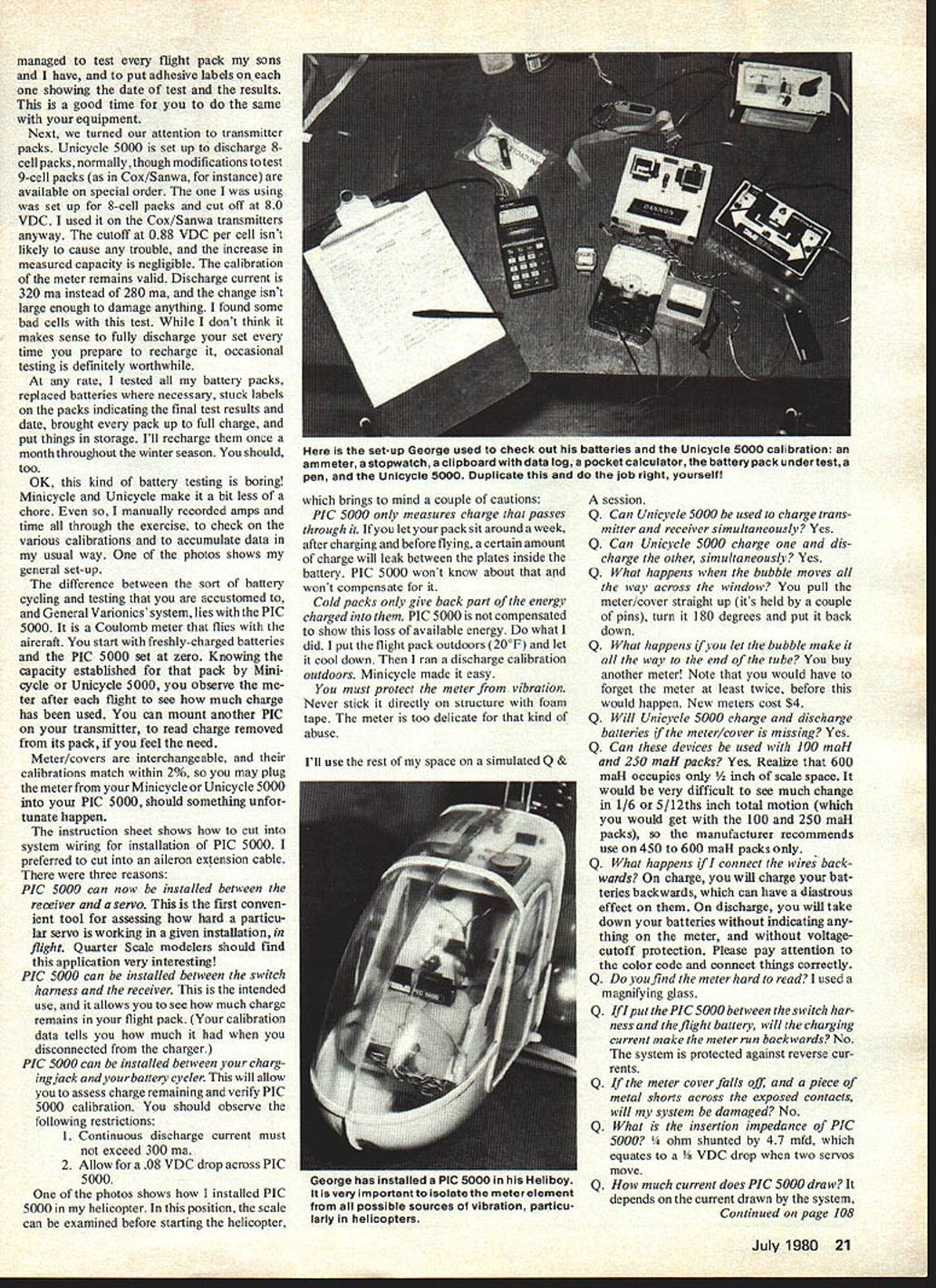
OK, this kind of battery testing is boring! Minicycle and Unicycle make it a bit less of a chore. Even so, I manually recorded amps and time all through the exercise, to check on the various calibrations and to accumulate data in my usual way. One of the photos shows my general set‑up.
The difference between the sort of battery cycling and testing that you are accustomed to, and General Varionics' system, lies with the PIC 5000. It is a Coulomb meter that flies with the aircraft. You start with freshly charged batteries and the PIC 5000 set at zero. Knowing the capacity established for that pack by Minicycle or Unicycle 5000, you observe the meter after each flight to see how much charge has been used. You can mount another PIC on your transmitter, to read charge removed from its pack, if you feel the need.
Meter/covers are interchangeable, and their calibrations match within 2%, so you may plug the meter from your Minicycle or Unicycle 5000 into your PIC 5000, should something unfortunate happen.
The instruction sheet shows how to cut into system wiring for installation of PIC 5000. I preferred to cut into an aileron extension cable. There were three reasons:
- PIC 5000 can now be installed between the receiver and a servo. This is the first convenient tool for assessing how hard a particular servo is working in a given installation, in flight. Quarter Scale modelers should find this application very interesting!
- PIC 5000 can be installed between the switch harness and the receiver. This is the intended use, and it allows you to see how much charge remains in your flight pack. (Your calibration data tells you how much it had when you disconnected from the charger.)
- PIC 5000 can be installed between your charging jack and your battery charger. This will allow you to assess charge remaining and verify PIC 5000 calibration.
You should observe the following restrictions:
- Continuous discharge current must not exceed 300 mA.
- Allow for a 0.08 VDC drop across PIC 5000.
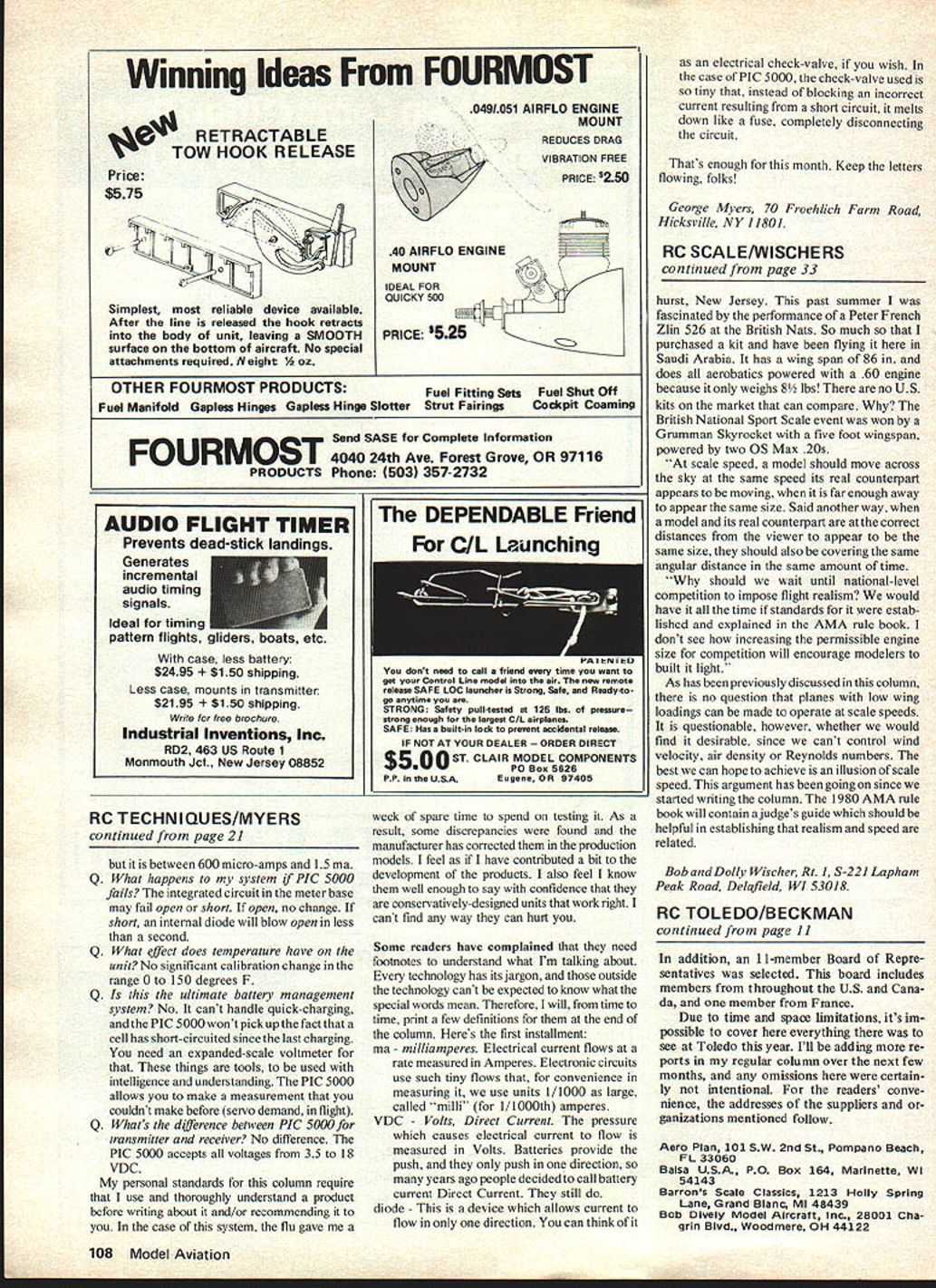
One of the photos shows how I installed PIC 5000 in my helicopter. In this position, the scale can be examined before starting the helicopter, which brings to mind a couple of cautions:
- PIC 5000 only measures charge that passes through it. If you let your pack sit around a week after charging and before flying, a certain amount of charge will leak between the plates inside the battery. PIC 5000 won't know about that and won't compensate for it.
- Cold packs only give back part of the energy charged into them. PIC 5000 is not compensated to show this loss of available energy. Do what I do: I put the flight pack outdoors (20°F) and let it cool down. Then I ran a discharge calibration outdoors. Minicycle made it easy.
- You must protect the meter from vibration. Never stick it directly on structure with foam tape. The meter is too delicate for that kind of abuse.
Q & A
- Q. Can Unicycle 5000 be used to charge transmitter and receiver simultaneously?
A. Yes.
- Q. Can Unicycle 5000 charge one and discharge the other, simultaneously?
A. Yes.
- Q. What happens when the bubble moves all the way across the window?
A. You pull the meter/cover straight up (it's held by a couple of pins), turn it 180 degrees and put it back down.
- Q. What happens if you let the bubble make it all the way to the end of the tube?
A. You buy another meter! Note that you would have to forget the meter at least twice before this would happen. New meters cost $4.
- Q. Will Unicycle 5000 charge and discharge batteries if the meter/cover is missing?
A. Yes.
- Q. Can these devices be used with 100 mAh and 250 mAh packs?
A. Yes. Realize that 600 mAh occupies only 1/2 inch of scale space. It would be very difficult to see much change in 1/6 or 5/12‑inch total motion (which you would get with the 100 and 250 mAh packs), so the manufacturer recommends use on 450 to 600 mAh packs only.
- Q. What happens if I connect the wires backwards?
A. On charge, you will charge your batteries backwards, which can have a disastrous effect on them. On discharge, you will take down your batteries without indicating anything on the meter, and without voltage‑cutoff protection. Please pay attention to the color code and connect things correctly.
- Q. Do you find the meter hard to read?
A. I used a magnifying glass.
- Q. If I put the PIC 5000 between the switch harness and the flight battery, will the charging current make the meter run backwards?
A. No. The system is protected against reverse currents.
- Q. If the meter cover falls off, and a piece of metal shorts across the exposed contacts, will my system be damaged?
A. No.
- Q. What is the insertion impedance of PIC 5000?
A. 1/4 ohm shunted by 4.7 µF, which equates to a 0.125 VDC drop when two servos move.
- Q. How much current does PIC 5000 draw?
A. It depends on the current drawn by the system, but it is between 600 microamps and 1.5 mA.
- Q. What happens to my system if PIC 5000 fails?
A. The integrated circuit in the meter base may fail open or short. If open, no change. If short, an internal diode will blow open in less than a second.
- Q. What effect does temperature have on the unit?
A. No significant calibration change in the range 0 to 150°F.
- Q. Is this the ultimate battery management system?
A. No. It can't handle quick‑charging, and the PIC 5000 won't pick up the fact that a cell has short‑circuited since the last charging. You need an expanded‑scale voltmeter for that. These things are tools, to be used with intelligence and understanding. The PIC 5000 allows you to make a measurement that you couldn't make before (servo demand, in flight).
- Q. What's the difference between PIC 5000 for transmitter and receiver?
A. No difference. The PIC 5000 accepts all voltages from 3.5 to 18 VDC.
My personal standards for this column require that I use and thoroughly understand a product before writing about it and/or recommending it to you. In the case of this system, the flu gave me a week of spare time to spend on testing it. As a result, some discrepancies were found and the manufacturer has corrected them in the production models. I feel as if I have contributed a bit to the development of the products. I also feel I know them well enough to say with confidence that they are conservatively designed units that work right. I can't find any way they can hurt you.
Some readers have complained that they need footnotes to understand what I'm talking about. Every technology has its jargon, and those outside the technology can't be expected to know what the special words mean. Therefore, I will, from time to time, print a few definitions for them at the end of the column. Here's the first installment:
Definitions
- ma / mA — milliamperes. Electrical current flows at a rate measured in amperes. Electronic circuits use such tiny flows that, for convenience in measuring, we use units 1/1,000 as large, called "milli" (for 1/1,000th) amperes.
- VDC — Volts, Direct Current. The pressure which causes electrical current to flow is measured in volts. Batteries provide the push, and they only push in one direction, so many years ago people decided to call it Direct Current.
- diode — This is a device which allows current to flow in only one direction. You can think of it as an electrical check‑valve, if you wish. In the case of PIC 5000, the check‑valve used is so tiny that, instead of blocking an incorrect current resulting from a short circuit, it melts down like a fuse, completely disconnecting the circuit.
That's enough for this month. Keep the letters flowing, folks!
George Myers 70 Froehlich Farm Road Hicksville, NY 11801
Transcribed from original scans by AI. Minor OCR errors may remain.

