
Radio Technique
George M. Myers
ANOTHER KIND of battery charger. Life is full of changes. They happen all around us and we adapt to them. The question for today is, "How do you react when you realize that you hold a piece of the future in your hands?" I didn't realize that I was doing it while Mr. Gerry Jarvis of M.E.N. (Model Engineering of Norwalk, 54 Chestnut Hill, Norwalk, CT 06851) was extolling the virtues of his new pulse-charger at the 1980 WRAMS show. Gerry could see that I was interested, but not enough to lay my money down. "Let me send you one, so you can convince yourself."
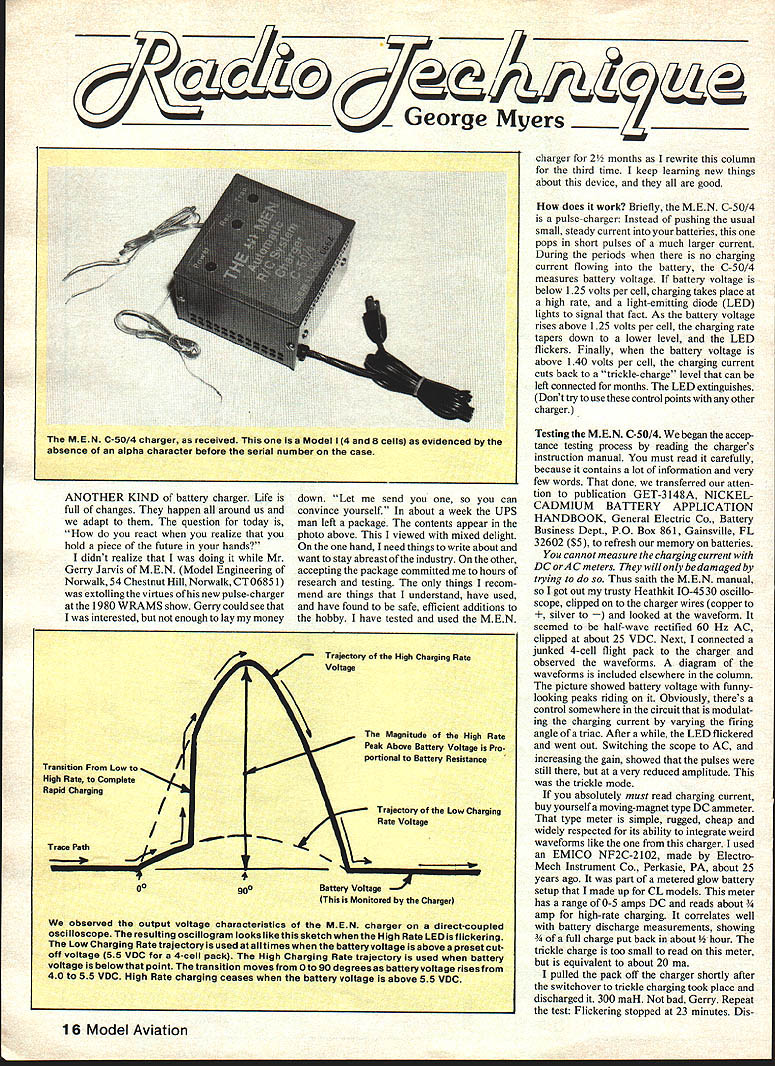
In about a week the UPS man left a package. The contents appear in the photo above. This I viewed with mixed delight. On the one hand, I need things to write about and want to stay abreast of the industry. On the other, accepting the package committed me to hours of research and testing. The only things I recommend are things that I understand, have used, and have found to be safe, efficient additions to the hobby. I have tested and used the M.E.N. charger for 2½ months as I rewrite this column for the third time. I keep learning new things about this device, and they all are good.
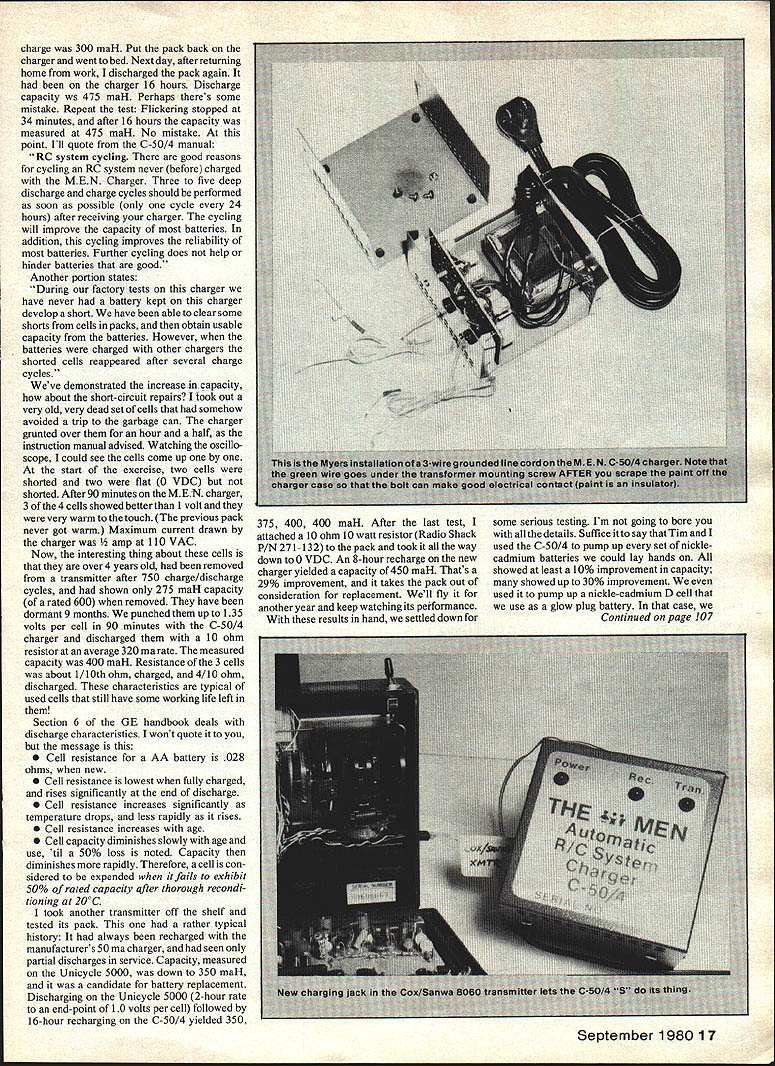
We observed the output-voltage characteristics of the M.E.N. charger on a direct-coupled oscilloscope. The resulting oscillogram looks like a sketch when the High Rate LED is flickering. The Low Charging Rate trajectory is used at all times when the battery voltage is above a preset cut-off voltage (5.5 VDC for a 4-cell pack). The High Charging Rate trajectory is used when battery voltage is below that point. The transition moves from 0 to 90 degrees as battery voltage rises from 4.0 to 5.5 VDC. High Rate charging ceases when the battery voltage is above 5.5 VDC.
How does it work?
Briefly, the M.E.N. C-50/4 is a pulse-charger. Instead of pushing the usual small, steady current into your batteries, this one pops in short pulses of a much larger current. During the periods when there is no charging current flowing into the battery, the C-50/4 measures battery voltage. If battery voltage is below 1.25 volts per cell, charging takes place at a high rate, and a light-emitting diode (LED) lights to signal that fact. As the battery voltage rises above 1.25 volts per cell, the charging rate tapers down to a lower level, and the LED flickers. Finally, when the battery voltage is above 1.40 volts per cell, the charging current cuts back to a "trickle-charge" level that can be left connected for months. The LED extinguishes. (Don't try to use these control points with any other charger.)
Testing the M.E.N. C-50/4
We began the acceptance testing process by reading the charger's instruction manual. You must read it carefully, because it contains a lot of information and very few words. That done, we transferred our attention to publication GET-3148A, NICKEL-CADMIUM BATTERY APPLICATION HANDBOOK, General Electric Co., Battery Business Dept., P.O. Box 861, Gainesville, FL 32602 ($5), to refresh our memory on batteries.
You cannot measure the charging current with DC or AC meters. They will be damaged by trying to do so. Thus saith the M.E.N. manual. So I got out my trusty Heathkit IO-45 oscilloscope, clipped on to the charger wires and looked at the waveform. It seemed to be half-wave rectified 60 Hz AC clipped about 25 VDC. Next I connected a junked 4-cell flight pack to the charger and observed the waveforms. The picture showed battery voltage with funny-looking peaks riding on it. Obviously there's a control somewhere in the circuit that is modulating the charging current by varying the firing angle of a triac. After the LED flickered and went out, switching the scope to AC and increasing the gain showed that pulses were still present but at a very reduced amplitude. This was the trickle mode.
If you absolutely must read charging current, buy yourself a moving-magnet type DC ammeter. That type meter is simple, rugged, cheap and widely respected for its ability to integrate weird waveforms like the one from this charger. I used an EMICO NF2C-2 102, made by Electro-Mechanical Instrument Co., Perkasie, PA, about 25 years ago. It was part of a metered glow-battery setup that I made up for C/L models. This meter has a range of 0–5 amps DC and reads about 3/4 amp for high-rate charging. It correlates well with battery discharge measurements, showing 3/4 of a full charge put back in about 1/2 hour. The trickle charge is too small to read on this meter, but is equivalent to about 20 mA.
I pulled the pack off the charger shortly after the switchover to trickle charging took place and discharged it 300 mAh. Not bad, Gerry. Repeat the test: flickering stopped at 23 minutes.
I put the pack back on the charger and went to bed. Next day, after returning home from work, I discharged the pack again. It had been on the charger 16 hours. Discharge capacity was 475 mAh. Perhaps there's some mistake. Repeat the test: flickering stopped at 34 minutes, and after 16 hours the capacity was measured at 475 mAh. No mistake.
At this point, I'll quote from the C-50/4 manual:
R/C system cycling. There are good reasons for cycling an R/C system never before charged with the M.E.N. Charger. Three to five deep discharge and charge cycles should be performed as soon as possible (only one cycle every 24 hours) after receiving your charger. The cycling will improve the capacity of most batteries. In addition, this cycling improves the reliability of most batteries. Further cycling does not help or hinder batteries that are good.
Another portion states:
"During our factory tests on this charger we have never had a battery kept on this charger develop a short. We have been able to clear some shorts from cells in packs, and then obtain usable capacity from the batteries. However, when the batteries were charged with other chargers the shorted cells reappeared after several charge cycles."
We've demonstrated the increase in capacity; how about the short-circuit repairs? I took out a very old, very dead set of cells that had somehow avoided a trip to the garbage can. The charger grounded over them for an hour and a half, as the instruction manual advised. Watching the oscilloscope, I could see the cells come up one by one. At the start of the exercise, two cells were flat (0 VDC) but not shorted. After 90 minutes on the M.E.N. charger, 3 of the 4 cells showed better than 1 volt and they were very warm to the touch. (The previous pack never got warm.) Maximum current drawn by the charger was 16 amps at 110 VAC.
The interesting thing about these cells is that they are over 4 years old, had been removed from a transmitter after 750 charge/discharge cycles, and had shown only 275 mAh capacity (or a rated 600) when removed. They had been dormant 9 months. We punched them up to 1.35 volts per cell in 90 minutes with the C-50/4 charger and discharged them with a 10 ohm resistor at an average 320 mA rate. The measured capacity was 400 mAh. Resistance of the 3 cells was about 0.1 ohm charged, and 0.4 ohm discharged. These characteristics are typical of used cells that still have some working life left in them!
Section 6 of the GE handbook deals with discharge characteristics. I won't quote it to you, but the message is this:
- Cell resistance for an AA battery is 0.028 ohm when new.
- Cell resistance is lowest when fully charged, and rises significantly at the end of discharge.
- Cell resistance increases significantly as temperature drops, and less rapidly as it rises.
- Cell resistance increases with age.
- Cell capacity diminishes slowly with age and use until a 50% loss is noted. Capacity then diminishes more rapidly. Therefore, a cell is considered to be expendable when it fails to exhibit 50% of rated capacity after thorough reconditioning at 20°C.
I took another transmitter off the shelf and tested its pack. This one had a rather typical history: it had always been recharged with the manufacturer's 50 mA charger, and had seen only partial discharges in service. Capacity, measured on the Unicyle 5000, was down to 350 mAh, and it was a candidate for battery replacement. Discharging on the Unicyle 5000 (2-hour rate to an end-point of 1.0 volt per cell) followed by 16-hour recharging on the C-50/4 yielded 350, 375, 400, 400 mAh. After the last test, I attached a 10 ohm 10 watt resistor (Radio Shack PN 271-132) to the pack and took it all the way down to 0 VDC. An 8-hour recharge on the new charger yielded a capacity of 450 mAh. That's a 29% improvement, and it takes the pack out of consideration for replacement. We'll fly it for another year and keep watching its performance.
With these results in hand, we settled down for some serious testing. I used the C-50/4 to pump up every set of nickel-cadmium batteries we could lay hands on. All showed at least a 10% improvement in capacity; many showed up to 30% improvement. We even used it to pump up a nickel-cadmium D cell that we use as a glow-plug battery. In that case, we knew that the shift to low rate would never take place so we used a time clock to shut off the charger after 5 hours (4 amp-hours = 3/4 amp × 5 hrs). It worked just fine. We don't know what the long-term results will be, but we expect them to be good.
When I queried Gerry about long-term effects he told me that all he could offer was the fact that his 6-year-old World Engines transmitter has been attached to the prototype charger for 18 months, with occasional time out for flying and battery testing. The batteries are the original Gould AA, and they still test at 113 minutes on his Flite-Life.
If you now think that Pulse Charging is for you, then pay attention: The C-50/4 is available in five models and the coding is a little obscure:
- Model I (Serial No. preceded by a blank space) is for charging 4 and 8 cell systems. This is the most common combination.
- Model II (Serial No. preceded by an "H") is for charging 4 and 5 cell systems (Kraft Sport series—modification required).
- Model III (Serial No. preceded by an "X") is for charging 4 and 10 cell systems (Old Kraft Signature and World Engines).
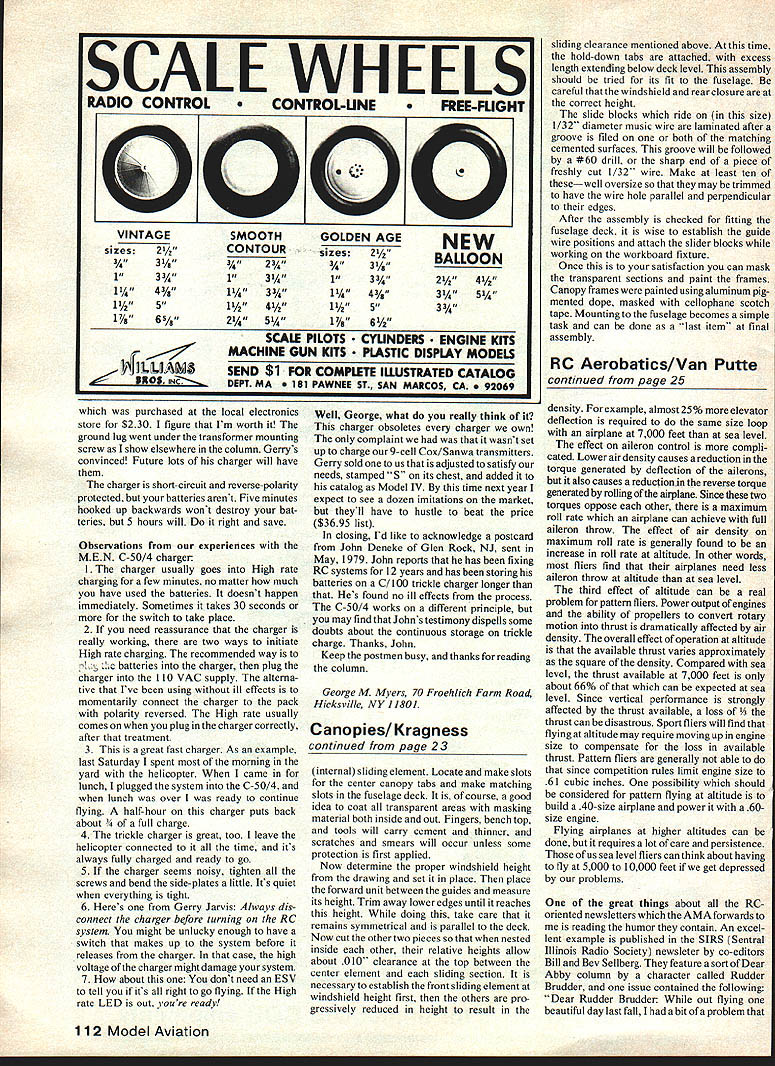
- Model IV (Serial No. preceded by an "S") is for charging 4 and 9 cell systems (Cox/Sanwa—modification required).
- Model V (Serial No. preceded by an "R") is for charging two 4-cell flight packs.
The reason for all this concern about numbers of cells is this: the charger shifts from High to Low rate strictly on the basis of voltage. That's why you are instructed to check back in 90 minutes after your initial charging. If the High-rate LED is still on, you either have shorted the pack, used the wrong charger, or have a shorted cell in the pack that the C-50/4 can't fix.
What happens if you forget to check back, and the High-rate LED stays on? First, you continue charging at High rate and the batteries get hot (as my old ones did). Next, pressure builds up in the cells, so the vents open. Eventually, the cells dry out and the charging current ceases to flow. According to Mr. Jarvis, he has charged 20 packs to destruction this way and none of them exploded or got hot enough to do any damage by heat. But none of them were usable, either. Users of the C-50/4 will have to learn to check on it.
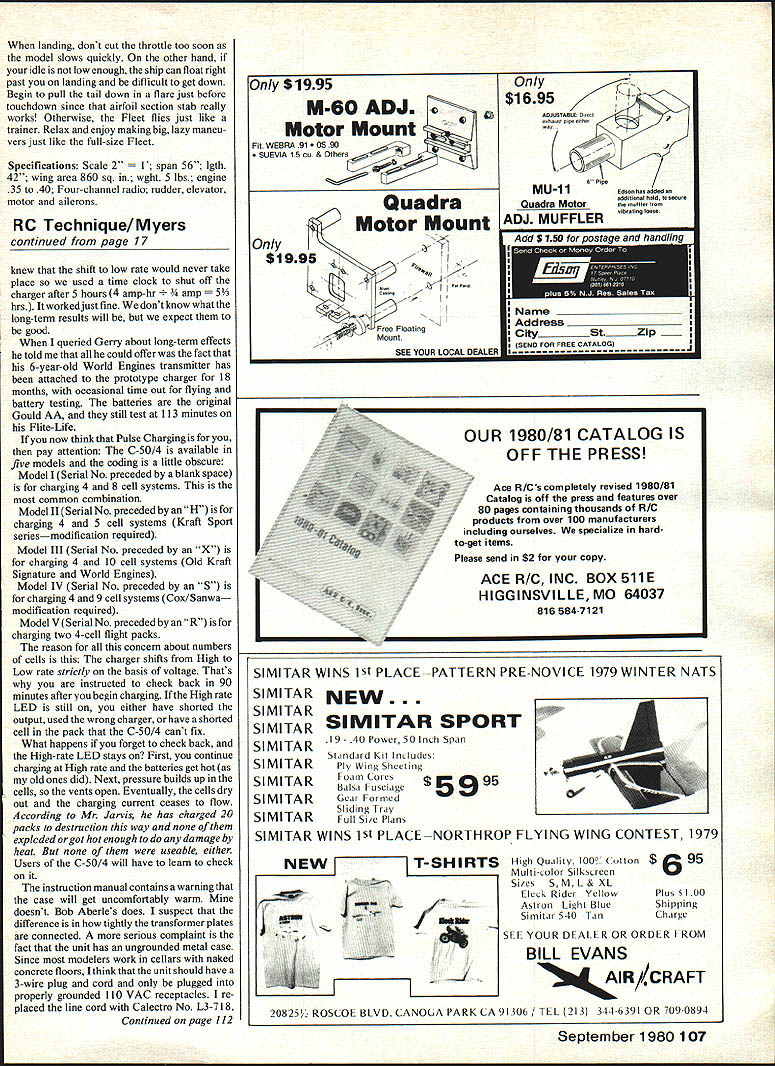
The instruction manual contains a warning that the case will get uncomfortably warm. Mine doesn't. Bob Aberle's does. I suspect that the difference is in how tightly the transformer plates are connected. A more serious complaint is the fact that the unit has an ungrounded metal case. Since most modelers work in cellars with naked concrete floors, I think that the unit should have a 3-wire plug and cord and only be plugged into properly grounded 110 VAC receptacles. I replaced the line cord with Calectro No. L3-718, which I purchased at the local electronics store for $2.30. I figure that I'm worth it! The ground lug went under the transformer mounting screw as I show elsewhere in the column. Gerry's convinced! Future looks of his charger will have connectorized leads.
The charger is short-circuit and reverse-polarity protected, but your batteries aren't. Five minutes hooked up backwards won't destroy your batteries, but 5 hours will. Do it right and save.
Observations from our experiences with the M.E.N. C-50/4 charger
- The charger usually goes into High rate charging for a few minutes, no matter how much you have used the batteries. It doesn't happen immediately. Sometimes it takes 30 seconds or more for the switch to take place.
- If you need reassurance that the charger is really working, there are two ways to initiate High rate charging. The recommended way is to dip the batteries into the charger, then plug the charger into the 110 VAC supply. The alternative that I've been using without ill effects is to momentarily reverse the charger to the pack with polarity reversed. The High rate usually comes on when you plug in the charger correctly, after that treatment.
- This is a great fast charger. As an example, last Saturday I spent most of the morning in the yard with the helicopter. When I came in for lunch, I plugged the system into the C-50/4, and when lunch was over I was ready to continue flying. A half-hour on this charger puts back about 3/4 of a full charge.
- The trickle charger is great, too. I leave the helicopter connected to it all the time, and it's always fully charged and ready to go.
- If the charger seems noisy, tighten all the screws and bend the side-plates a little. It's quiet when everything is tight.
- Here's one from Gerry Jarvis: always disconnect the charger before turning on the RC system. This might be unlucky enough to have a switch that makes up to the system before it releases from the charger. In that case, the high voltage of the charger might damage your system.
- How about this one? You don't need an ESV to tell you if it's all right to go flying. If the High rate LED is on, you're ready!
Well, George, what do you really think of it? This charger obsoletes every charger we own! The only complaint we had was that it wasn't set up to charge our 9-cell Cox/Sanwa transmitters. Gerry sold one to us that is adjusted to satisfy our needs, stamped "S" on its chest, and added to his catalog as Model IV. By this time next year I expect to see a dozen imitations on the market, but they'll have to hustle to beat the price ($36.95 list).
In closing, I'd like to acknowledge a postcard from John Deneke of Glen Rock, NJ, sent in May, 1979. John reports that he has been fixing RC systems for 12 years and has been storing his batteries on a C/100 trickle charge longer than that. He's found no ill effects from the process. The C-50/4 works on a different principle, but you may find that John's testimony dispels some doubts about the continuous storage on trickle charge. Thanks, John.
Keep the postmen busy, and thanks for reading the column.
George M. Myers 70 Froehlich Farm Road, Hicksville, NY 11801.
Transcribed from original scans by AI. Minor OCR errors may remain.

