
Radio Technique
George Myers
Exponential control (XPO) — an introduction
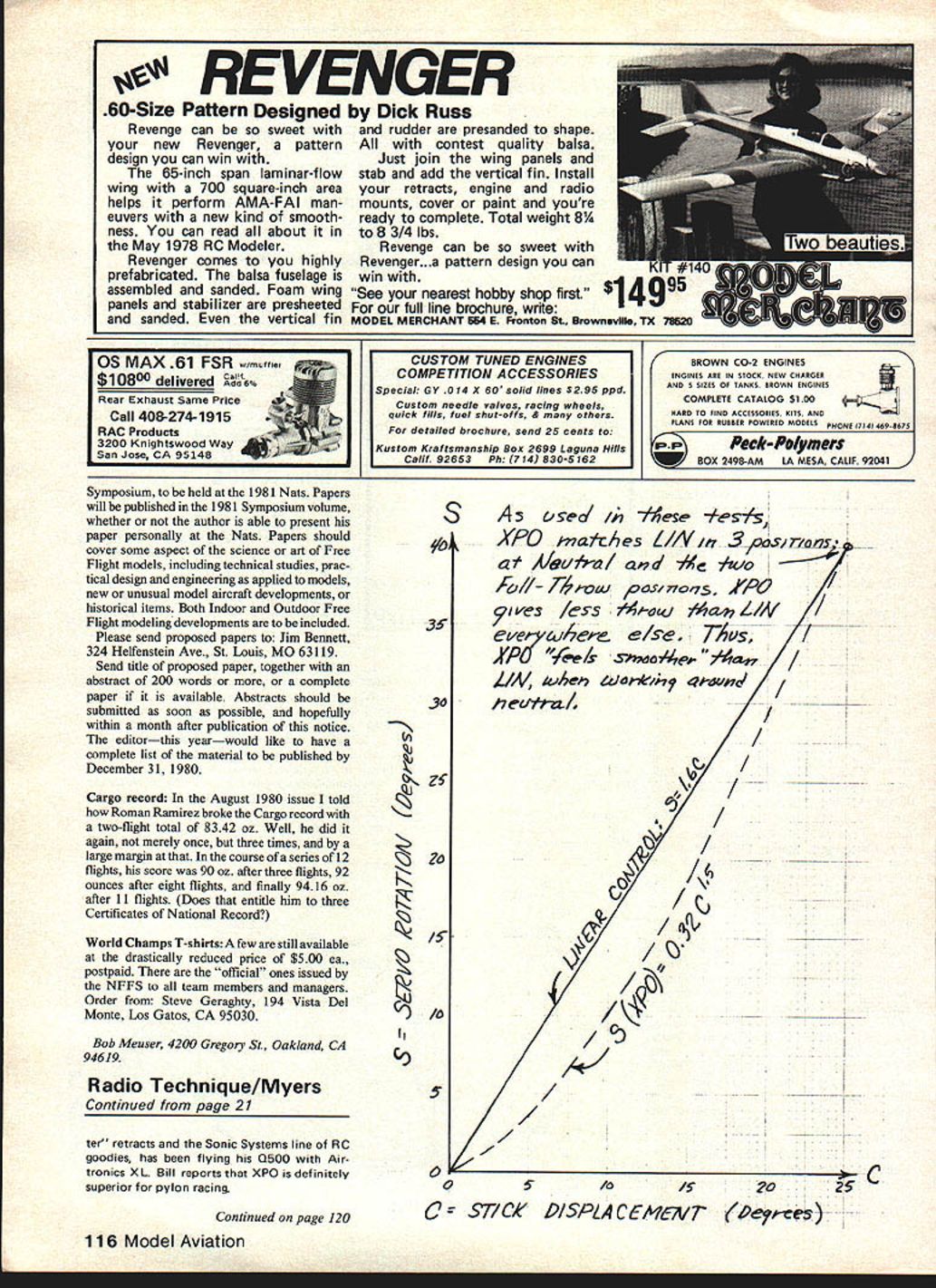
Let's talk about exponential control (I call it XPO). Much has been written about XPO and you've seen the control vs. stick curves. By now, it's time to move from theory to practical experience. Over the last two months I tested people's reactions to XPO. These are the results.
Tests
#### Test No. 1 I added a pushbutton to the side of my Ace RC Silver Seven transmitter to switch between XPO and LIN (normal linear control). You couldn't tell by looking which mode was in use.
I set up my Aquila sailplane with the maximum possible control throws and an aft CG, which made it a very sensitive flyer. We took this rig to four different flying fields on Long Island, NY and asked for volunteer pilots.
Procedure:
- Each guest pilot was handed the transmitter after I had the glider up and trimmed for level flight.
- He was asked to stand the plane on a wingtip and pull through the tightest possible turn, then concentrate on how difficult it was to get back to slow, level flight.
- After recovery, he repeated the exercise in the opposite direction.
- I then switched modes and asked for two more steep turns and recoveries.
- While the plane was still in the air I asked for immediate feedback and his preference.
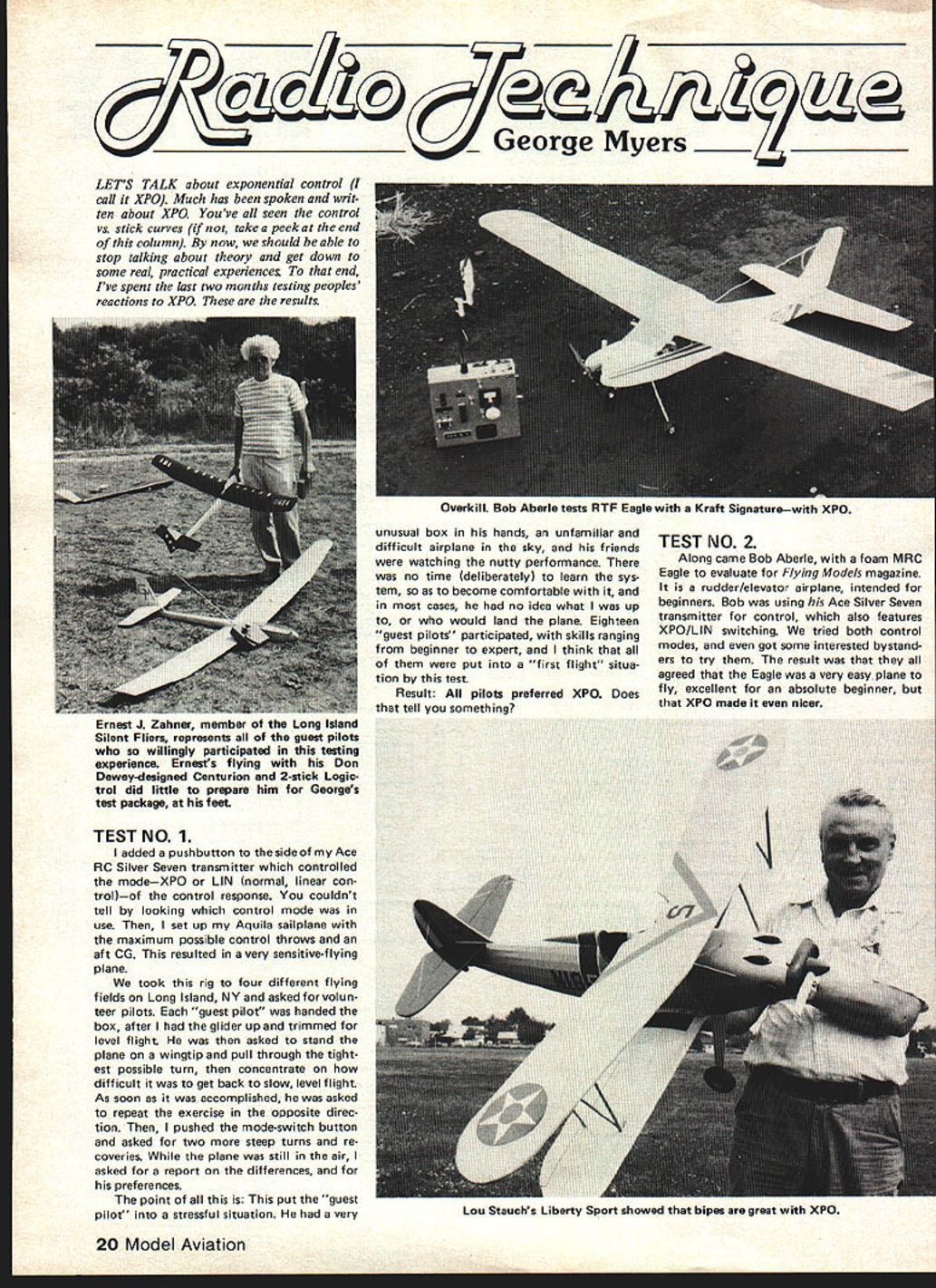
The test put the guest pilot into a stressful, first-flight situation: an unusual transmitter, an unfamiliar sensitive airplane, friends watching, and no time to learn the system. Eighteen guest pilots participated, from beginner to expert. Result: all pilots preferred XPO.
#### Test No. 2 Bob Aberle brought a foam MRC Eagle (a rudder/elevator trainer intended for beginners) to evaluate for Flying Models magazine. He used his Ace Silver Seven transmitter with XPO/LIN switching. We tried both modes and also let some bystanders try. Everyone agreed the Eagle was very easy to fly and that XPO made it even nicer for an absolute beginner.
#### Test No. 3 Lou Stauch's Liberty Sport biplane is a very stable flyer. I set the control throws so wide the plane would snap roll or spin like a Pitts. XPO acted like automatic dual-rate switching: the plane flew very steadily in level flight and on landing when using only half the stick range, yet became very aerobatic with full deflection. XPO is especially good for biplanes.
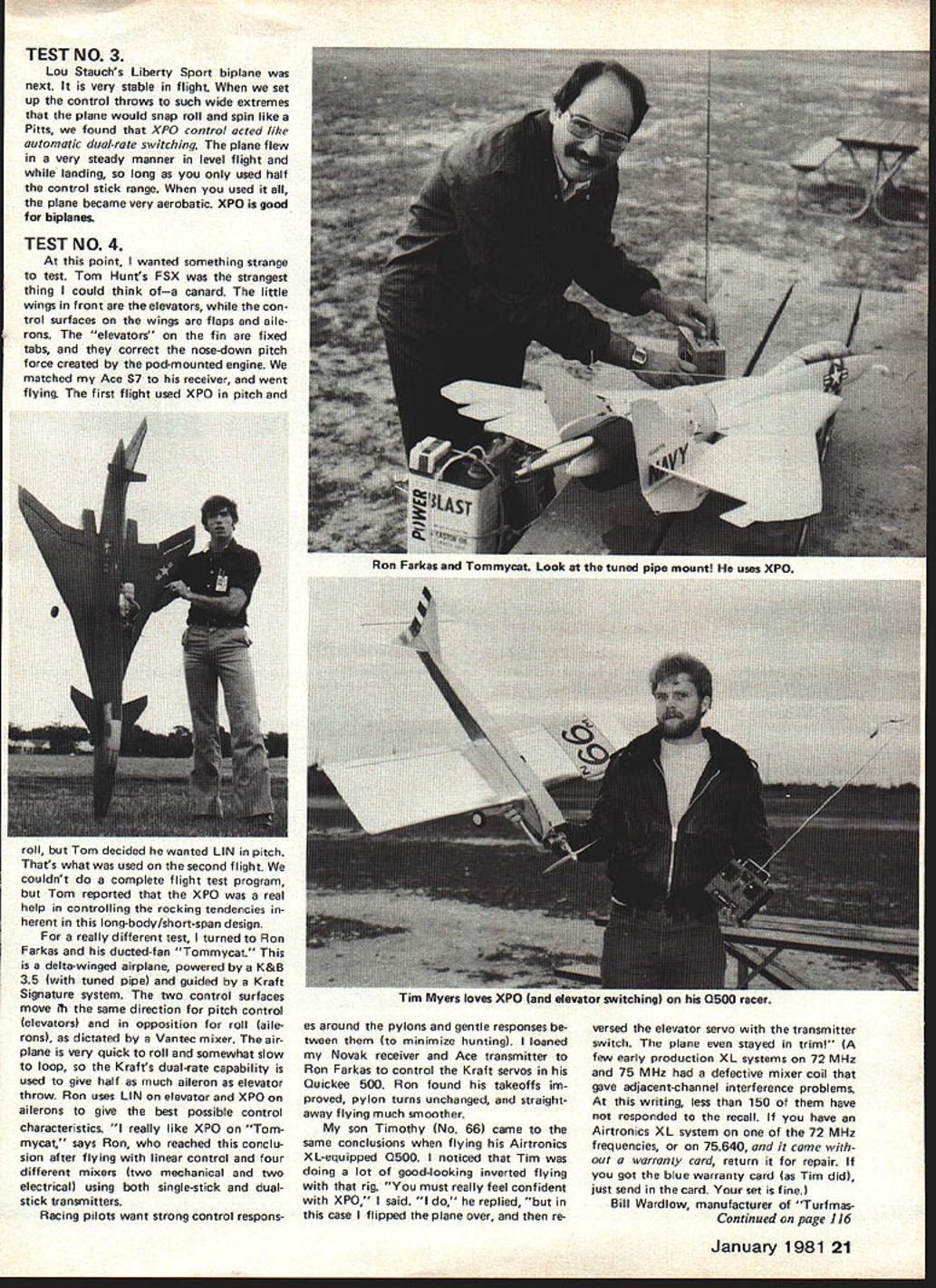
#### Test No. 4 Tom Hunt's FSX (a canard with elevators on the front control surfaces, flaps, ailerons, and a fixed fin tab to correct a nose-down pitch from the pod-mounted engine) was the strangest test subject. I fitted an Ace S7 receiver and flew it with XPO on both pitch and roll the first flight. Tom preferred LIN on pitch for the second flight. He reported that XPO helped control the rocking tendencies inherent in the long-body/short-span design.
Next was Ron Farkas' ducted-fan Tommycat, a delta-wing powered by a K&B .35 with a tuned pipe. Using a Kraft Signature system and a Vantec mixer, the airplane had quick roll and a somewhat slow loop. Kraft's dual-rate was used to reduce throw. Ron uses LIN on the elevator and XPO on the ailerons for the best control characteristics and said he really liked XPO.
Racing pilots want strong control response around pylons and gentle response between pylons to minimize hunting. I loaned a Novak receiver to an Ace transmitter and Ron flew a Quickee 500 with Kraft servos. He found takeoffs improved, pylon turns were unchanged, and straight-away flying was much smoother. His son Timothy reached the same conclusions flying an Airtronics XL–equipped Q500; I noticed Tim doing a lot of clean inverted flying.
"You must really feel confident with XPO," I said. "I do," he replied, "but in this case I flipped the plane over and then reversed the elevator servo with the transmitter switch. The plane even stayed in trim!"
Note: A few early-production Airtronics XL systems on 72 MHz and 75 MHz had a defective mixer coil causing adjacent-channel interference. At this writing, fewer than 150 sets have not responded to the recall. If you have an Airtronics XL system on one of the 72 MHz frequencies, or on 75.640 MHz, and it came without a warranty card, return it for repair. If you received the blue warranty card, your set is fine.
The Ultimate Test
For me, the real test is how I feel about XPO when flying my own models. XPO is a definite help on pitch and roll with the Heliboy — I'm still a beginner in helicopters and prone to overcontrol. XPO on the ailerons of the Curare helps harmonize the controls while leaving LIN on everything else. By "harmonize" I mean "make all the controls feel alike." The plane is heavily damped in pitch and yaw but not in roll; XPO compensates for that difference.
Summary
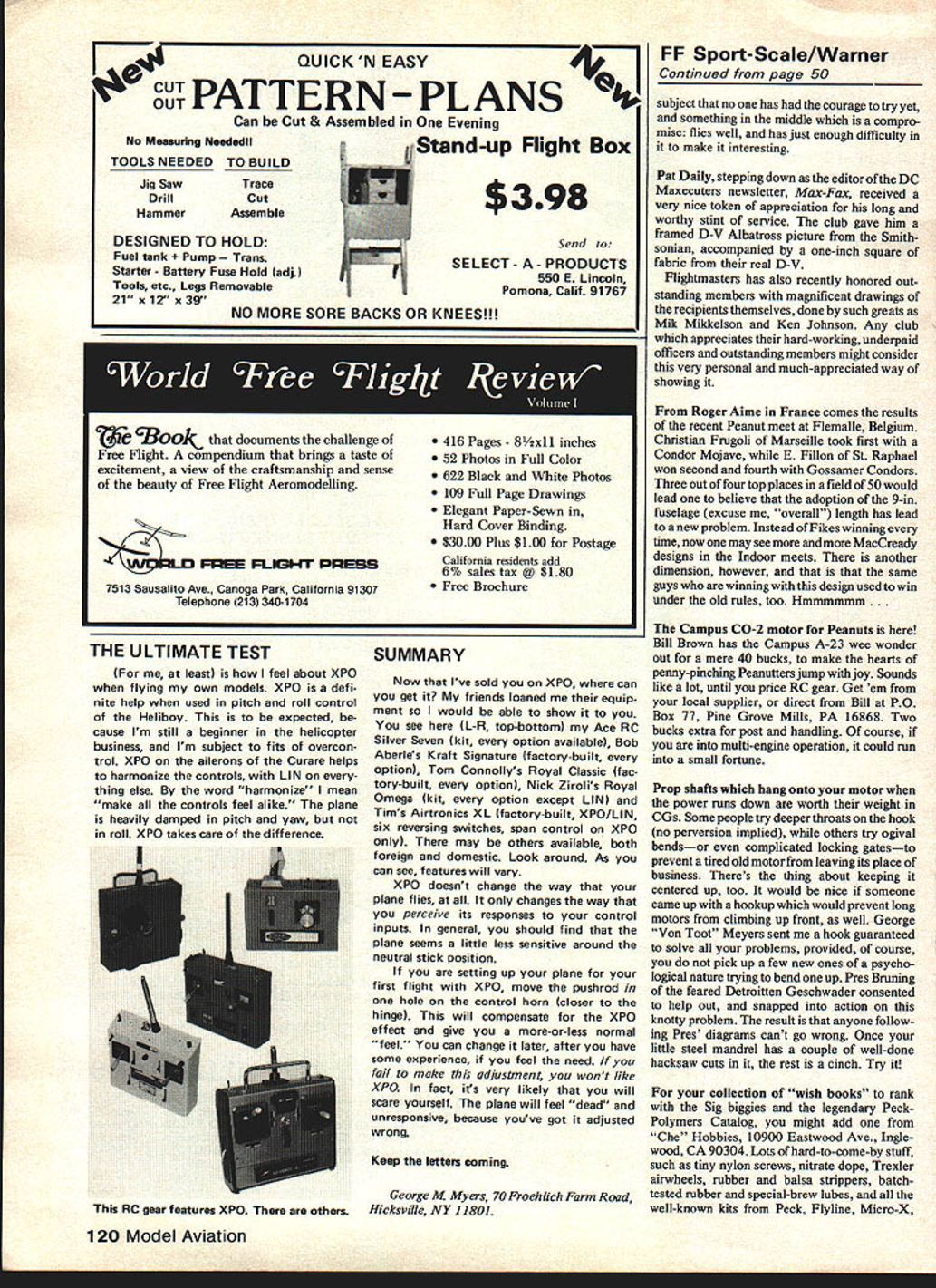
Now that you're sold on XPO, where can you get it? My friends loaned me equipment so I could demonstrate it. The sets I used include (left to right, top to bottom): my Ace RC Silver Seven (kit, every option), Bob Aberle's Kraft Signature (factory-built, every option), Tom Connolly's Royal Classic (factory-built, every option), Nick Ziroli's Royal Omega (kit, every option except LIN), and Tim's Airtronics XL (factory-built, XPO/LIN, six reversing switches, span control on XPO only). There may be other systems available, both foreign and domestic; features will vary.
A few final points:
- XPO doesn't change the way your plane flies; it only changes how you perceive the response to your control inputs.
- In general, the plane will seem less sensitive around the neutral stick position.
- If you're setting up a plane for its first flight with XPO, move the pushrod one hole closer to the hinge on the control horn. This compensates for the XPO effect and gives a more normal feel.
- You can change that adjustment later with experience. If you fail to make this adjustment initially, you may find XPO unpleasant — the plane will feel dead and unresponsive and you may scare yourself.
Keep the letters coming.
George M. Myers 70 Froehlich Farm Road Hicksville, NY 11801
Transcribed from original scans by AI. Minor OCR errors may remain.

