
Radio Technique
George M. Myers
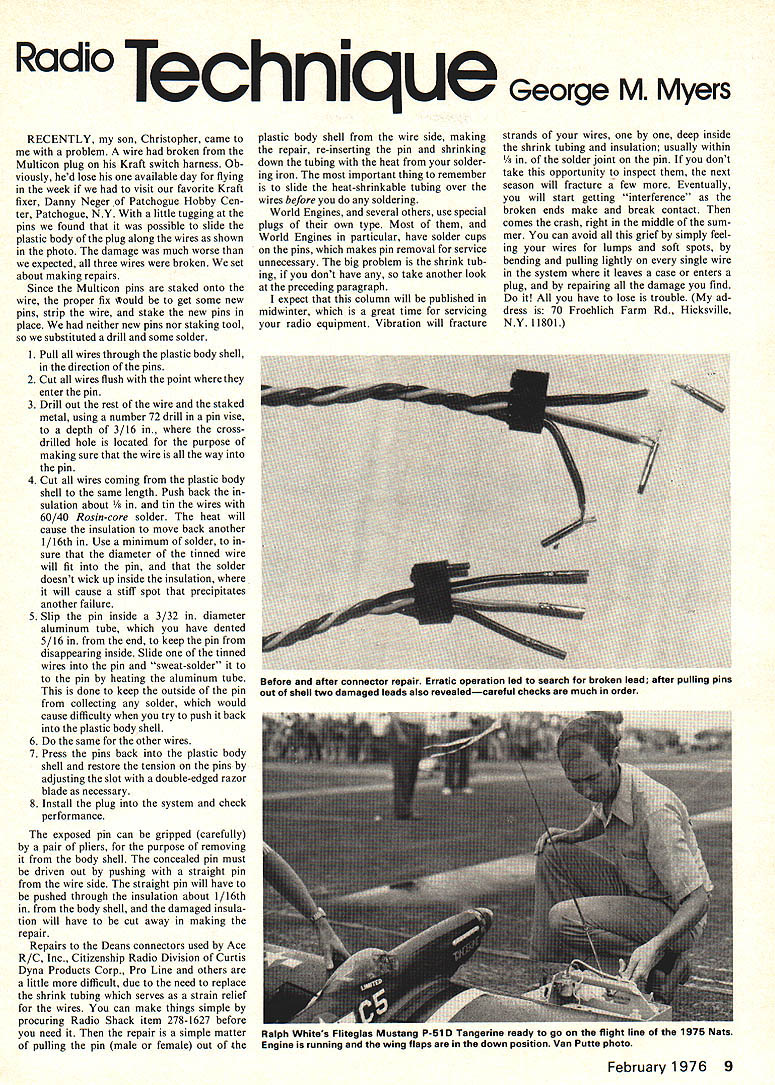
RECENTLY, my son, Christopher, came to me with a problem. A wire had broken from the Multicon plug on his Kraft switch harness. Obviously, he'd lose his one available day for flying in the week we had to visit our favorite Kraft fixer, Danny Neger of Patchogue Hobby Center, Patchogue, N.Y. With a little tugging at the pins we found that it was possible to slide the plastic body of the plug along the wires as shown in the photo. The damage was much worse than we expected, all three wires were broken. We set about making repairs.
Since the Multicon pins are staked onto the wire, the proper fix would be to get some new pins, strip the wire, and stake the new pins in place. We had neither new pins nor staking tool, so we substituted a drill and some solder.
- Pull all wires through the plastic body shell, in the direction of the pins.
- Cut all wires flush with the point where they enter the pin.
- Drill out the rest of the wire and the staked metal, using a number 72 drill in a pin vise, to a depth of 3/16 in., where the cross-drilled hole is located for the purpose of making sure that the wire is all the way into the pin.
- Cut all wires coming from the plastic body shell to the same length. Push back the insulation about 1/8 in. and tin the wires with 60/40 Rosin-core solder. The heat will cause the insulation to move back another 1/16 in. Use a minimum of solder, to insure that the diameter of the tinned wire will fit into the pin, and that the solder doesn't wick up inside the insulation, where it will cause a stiff spot that precipitates another failure.
- Slip the pin inside a 3/32 in. diameter aluminum tube, which you have dented 5/16 in. from the end, to keep the pin from disappearing inside. Slide one of the tinned wires into the pin and "sweat-solder" it to the pin by heating the aluminum tube. This is done to keep the outside of the pin from collecting any solder, which would cause difficulty when you try to push it back into the plastic body shell.
- Do the same for the other wires.
- Press the pins back into the plastic body shell and restore the tension on the pins by adjusting the slot with a double-edged razor blade as necessary.
- Install the plug into the system and check performance.
The exposed pin can be gripped (carefully) by a pair of pliers, for the purpose of removing it from the body shell. The concealed pin must be driven out by pushing with a straight pin from the wire side. The straight pin will have to be pushed through the insulation about 1/16 in. from the body shell, and the damaged insulation will have to be cut away in making the repair.
Repairs to the Deans connectors used by Ace R/C, Inc., Citizenship Radio Division of Curtis Dyna Products Corp., Pro Line and others are a little more difficult, due to the need to replace the shrink tubing which serves as a strain relief for the wires. You can make things simple by procuring Radio Shack item 278-1627 before you need it. The repair is a simple matter of pulling the pin (male or female) out of the plastic body shell from the wire side, making the repair, re-inserting the pin and shrinking down the tubing with the heat from your soldering iron. The most important thing to remember is to slide the heat-shrinkable tubing over the wires before you do any soldering.
World Engines, and several others, use special plugs of their own type. Most of them, and World Engines in particular, have solder cups on the pins, which makes pin removal for service unnecessary. The big problem is the shrink tubing, if you don't have any, so take another look at the preceding paragraph.
I expect that this column will be published in midwinter, which is a great time for servicing your radio equipment. Vibration will fracture strands of your wires, one by one, deep inside the shrink tubing and insulation; usually within 1/8 in. of the solder joint on the pin. If you don't take this opportunity to inspect them, the next season will fracture a few more. Eventually, you will start getting "interference" as the broken ends make and break contact. Then comes the crash, right in the middle of the summer. You can avoid all this grief by simply feeling your wires for lumps and soft spots, by bending and pulling lightly on every single wire in the system where it leaves a case or enters a plug, and by repairing all the damage you find. Do it! All you have to lose is trouble. (My address is: 70 Froehlich Farm Rd., Hicksville, N.Y. 11801.)
Transcribed from original scans by AI. Minor OCR errors may remain.

