
Radio Technique
George M. Myers
Everyone wants to use the cheapest, lightest battery pack possible! So, how do you figure what size pack to choose?
There is the classical method (invented by rubber-motor experts). You know the drill: wind it 'til it breaks—then back off a turn or two. The counterpart in RC is the guy who "uses what he has" until the crash, then buys the next larger size to replace it. It's an exciting way to separate the good stuff from the trash, but a little hard on the model.
The mathematician knows that "All you have to do is multiply your average operating current by your desired operating time to find necessary battery capacity." The problem is finding out what your average operating current is.
Estimating operating current
In a typical RC situation, the operating system consists of a 500 mAh battery pack, a receiver and switch harness, and four servos of the same type. In most cases, the receiver idles at about 20 mA, and the servos idle at 5 to 15 mA, run free at about 120 mA, and stall at 450 mA.
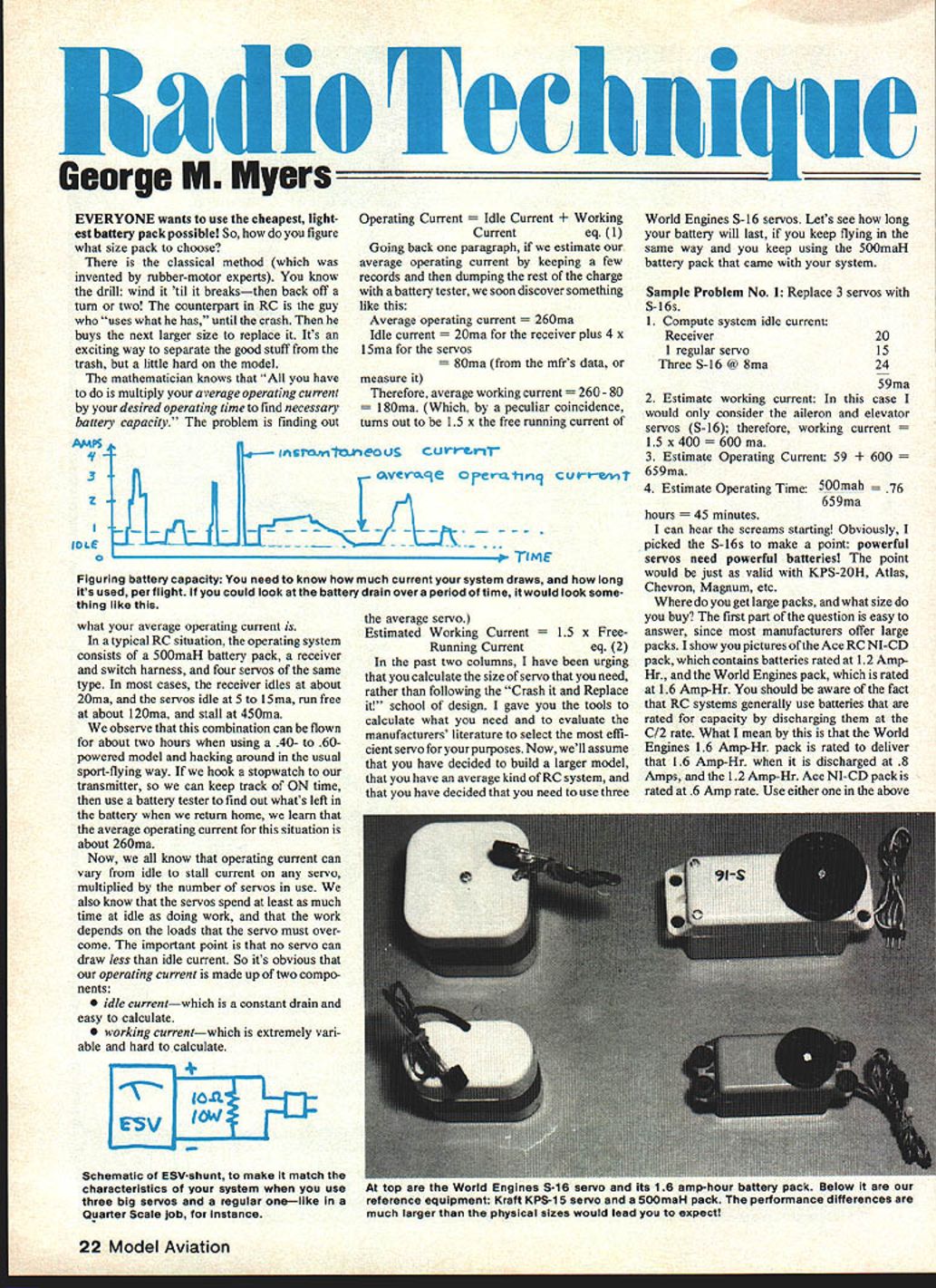
We observe that this combination can be flown for about two hours when using a .40–.60-powered model and hacking around in the usual sport-flying way. If we hook a stopwatch to our transmitter so we can keep track of ON time, then use a battery tester to find out what's left in the battery when we return home, we learn that the average operating current for this situation is about 260 mA.
Operating current can vary from idle to stall current on any servo, multiplied by the number of servos in use. Servos spend at least as much time at idle as doing work, and the work depends on the loads the servo must overcome. The important point is that no servo can draw less than idle current. So it's obvious that our operating current is made up of two components:
- Idle current — a constant drain and easy to calculate.
- Working current — extremely variable and hard to calculate.
Operating Current = Idle Current + Working Current (eq. 1)
Going back one paragraph, if we estimate our average operating current by keeping a few records and then dumping the rest of the charge with a battery tester, we soon discover something like this:
Average operating current = 260 mA Idle current = 20 mA for the receiver plus 4 × 15 mA for the servos = 80 mA (from the manufacturer's data or measure it)
Therefore, average working current = 260 − 80 = 180 mA. (Which, by a peculiar coincidence, turns out to be 1.5 × the free-running current of the average servo.)
Estimated Working Current = 1.5 × Free-Running Current (eq. 2)
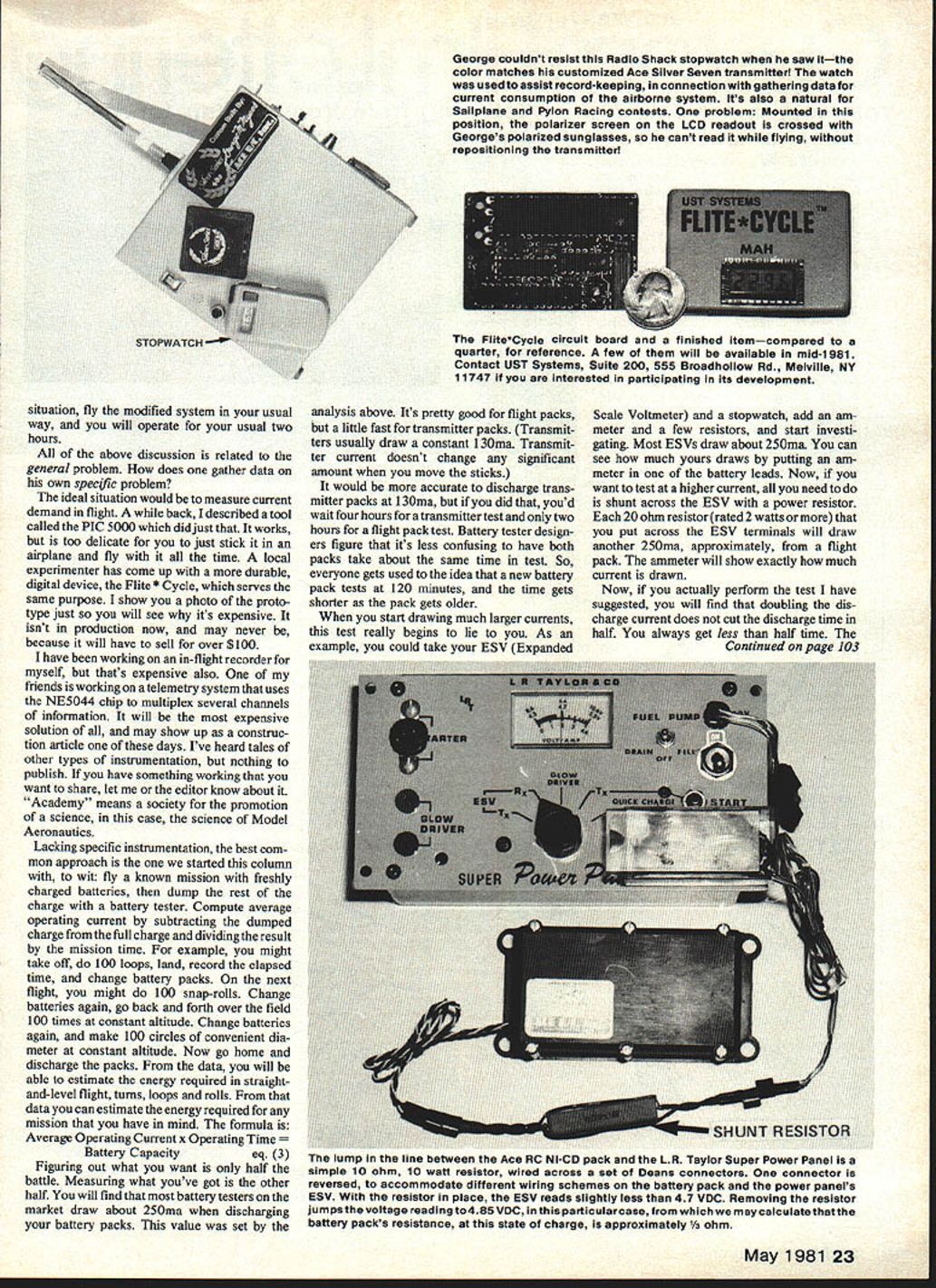
In past columns I have urged that you calculate the size of servo you need, rather than following the "Crash it and Replace it" school of design. I gave you the tools to calculate what you need and to evaluate the manufacturers' literature to select the most efficient servo for your purposes. Now, we'll assume you have decided to build a larger model, that you have an average kind of RC system, and that you have decided to use three World Engines S-16 servos. Let's see how long your battery will last if you keep flying in the same way and keep using the 500 mAh battery pack that came with your system.
Sample Problem No. 1: Replace 3 servos with S-16s
- Compute system idle current:
- Receiver ...................................... 20 mA
- 1 regular servo ............................... 15 mA
- Three S-16 @ 8 mA ............................. 24 mA
- ............................................... 59 mA
- Estimate working current: In this case I would only consider the aileron and elevator servos (S-16); therefore, working current = 1.5 × 400 = 600 mA.
- Estimate operating current: 59 + 600 = 659 mA.
- Estimate operating time: 500 mAh ÷ 659 mA = 0.76 hours = 45 minutes.
I can hear the screams starting! Obviously, I picked the S-16s to make a point: powerful servos need powerful batteries. The point would be just as valid with KPS-20H, Atlas, Chevron, Magnum, etc.
Where to get larger packs and how they're rated
Most manufacturers offer large packs. For example, the Ace RC Ni-Cd pack contains batteries rated at 1.2 Amp-hour (1.2 Ah) and the World Engines pack is rated at 1.6 Amp-hour (1.6 Ah). RC systems generally use batteries rated for capacity by discharging them at the C/2 rate. That means the World Engines 1.6 Ah pack is rated to deliver that 1.6 Ah when discharged at 0.8 A, and the 1.2 Ah Ace Ni-Cd pack is rated at a 0.6 A rate.
Use either one in the above situation, fly the modified system in your usual way, and you will operate for your usual two hours.
Measuring current in flight and instrumentation
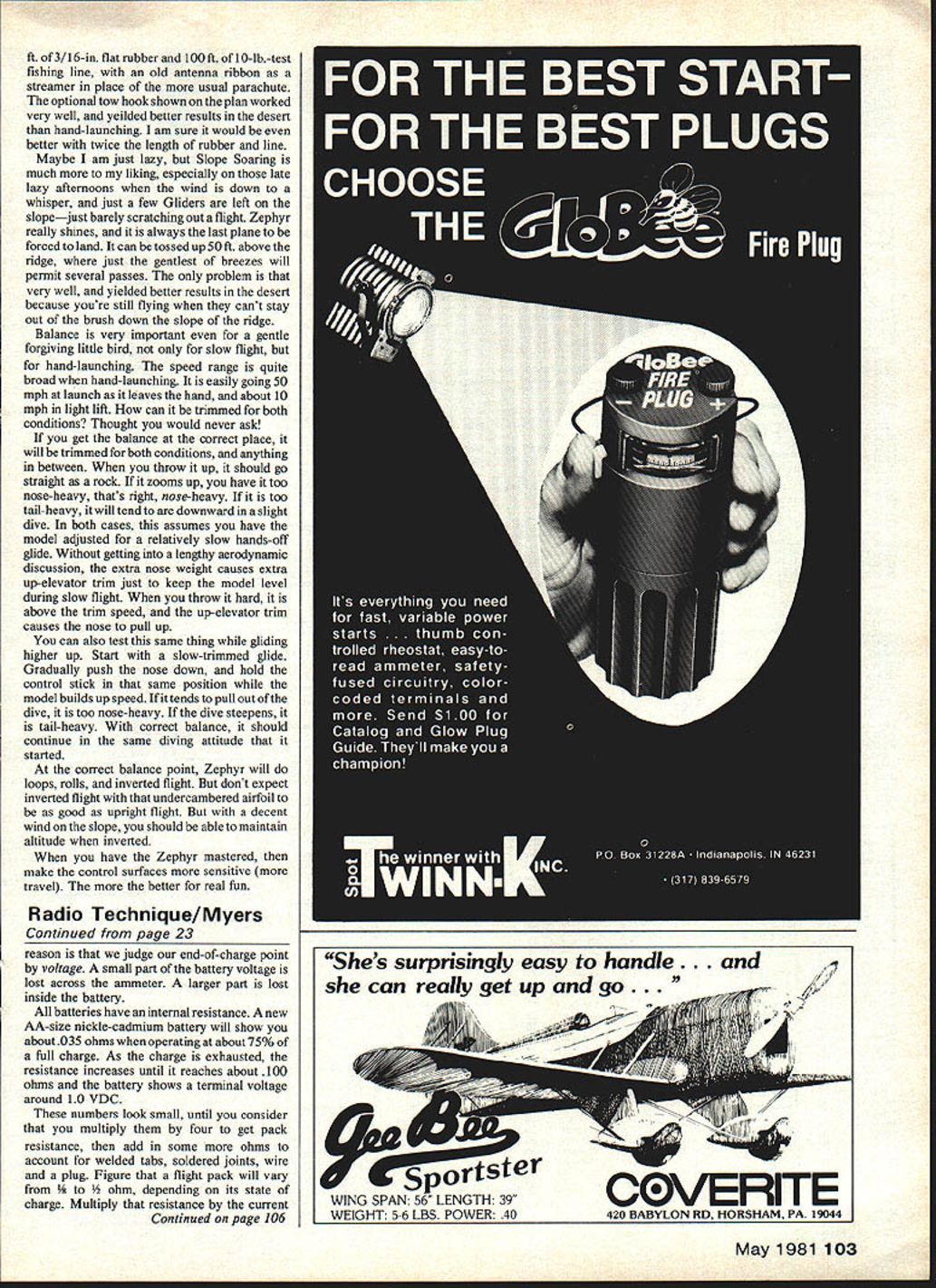
The ideal situation would be to measure current demand in flight. A while back I described a tool called the PIC 5000 which did just that. It works, but is too delicate to stick in an airplane and fly with all the time. A local experimenter has come up with a more durable digital device, the Flite*Cycle, which serves the same purpose. The prototype is expensive; it isn't in production now and may never be, because it will have to sell for over $100.
I have been working on an in-flight recorder for myself, but that's expensive also. One of my friends is working on a telemetry system that uses the NE5044 chip to multiplex several channels of information. It will be the most expensive solution of all and may show up as a construction article one of these days. I've heard tales of other types of instrumentation, but nothing yet to publish. If you have something working that you want to share, let me or the editor know about it.
Lacking specific instrumentation, the best common approach is the one we started this column with: fly a known mission with freshly charged batteries, then dump the rest of the charge with a battery tester. Compute average operating current by subtracting the dumped charge from the full charge and dividing the result by the mission time.
For example, you might take off, do 100 loops, land, record the elapsed time, and change battery packs. On the next flight do 100 snap-rolls, change batteries, go back and forth over the field 100 times at constant altitude, change batteries again, and make 100 circles of convenient diameter. Now go home and discharge the packs. From the data you will be able to estimate the energy required in straight-and-level flight, turns, loops and rolls. From that data you can estimate the energy required for any mission you have in mind.
Average Operating Current × Operating Time = Battery Capacity (eq. 3)
Battery testing and internal resistance
Figuring out what you want is only half the battle. Measuring what you've got is the other half. Most battery testers on the market draw about 250 mA when discharging flight battery packs. This value was set by the analysis above. It's pretty good for flight packs, but a little fast for transmitter packs. (Transmitters usually draw a constant ~130 mA; transmitter current doesn't change any significant amount when you move the sticks.)
It would be more accurate to discharge transmitter packs at 130 mA, but if you did that you'd wait four hours for a transmitter test and only two hours for a flight pack test. Battery tester designers figure it's less confusing to have both packs take about the same time in test. So everyone gets used to the idea that a new battery pack tests at about 120 minutes, and the time gets shorter as the pack gets older.
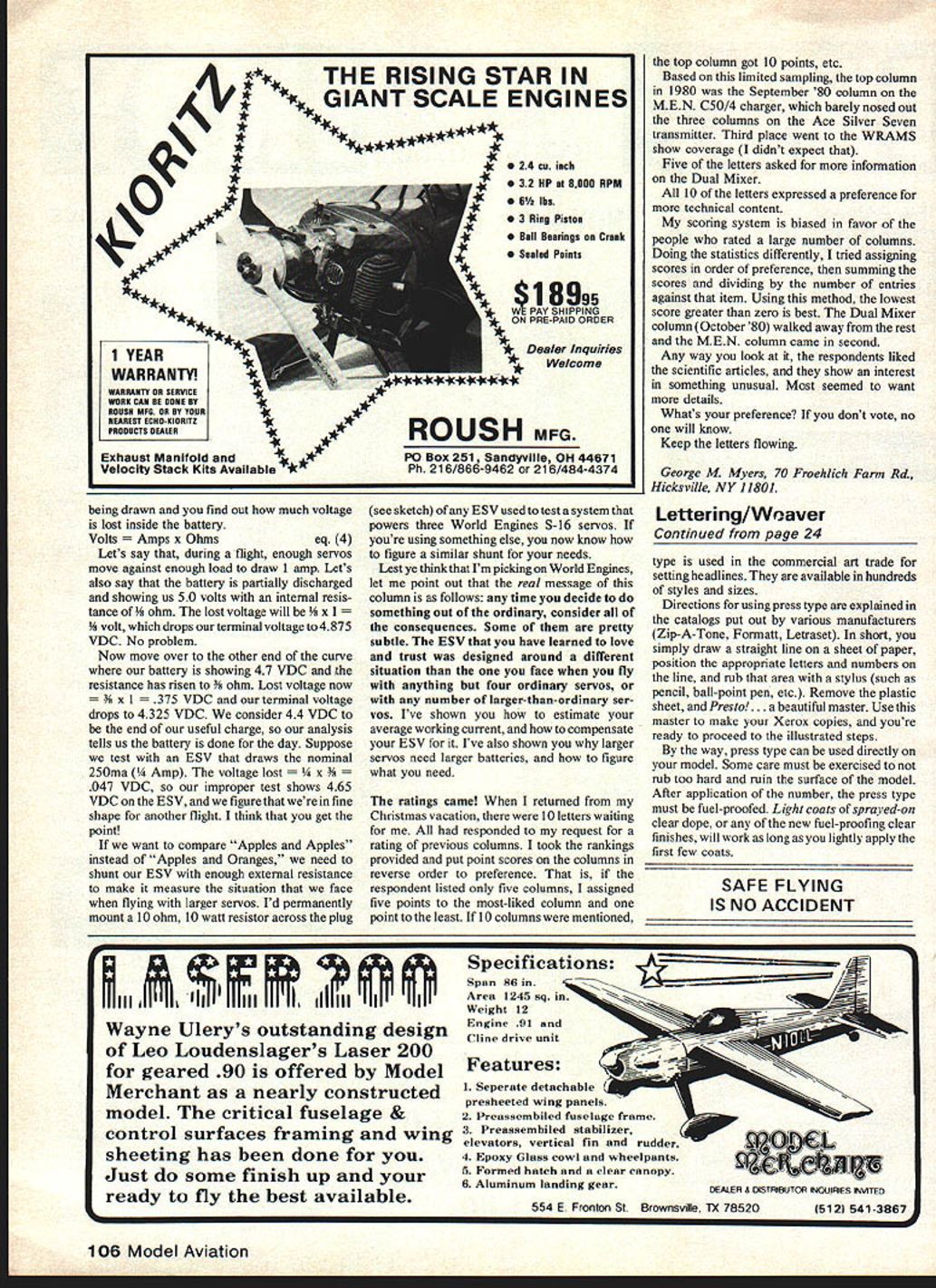
When you start drawing much larger currents, this test begins to lie to you. You could take your ESV (Expanded Scale Voltmeter) and a stopwatch, add an ammeter and a few resistors, and investigate. Most ESVs draw about 250 mA. You can see how much yours draws by putting an ammeter in one of the battery leads. If you want to test at a higher current, shunt across the ESV with a power resistor. Each 20 ohm resistor (rated 2 watts or more) that you put across the ESV terminals will draw approximately another 250 mA from a flight pack. The ammeter will show exactly how much current is drawn.
If you actually perform the test suggested, you will find that doubling the discharge current does not cut the discharge time in half. You always get less than half the time.
The reason is that we judge our end-of-charge point by voltage. A small part of the battery voltage is lost across the ammeter. A larger part is lost inside the battery.
All batteries have an internal resistance. A new AA-size nickel-cadmium cell will show about 0.035 ohms when operating at about 75% of a full charge. As the charge is exhausted, the resistance increases until it reaches about 0.100 ohms and the cell shows a terminal voltage around 1.0 VDC.
These numbers look small until you consider that you multiply them by four to get pack resistance, then add some more ohms to account for welded tabs, soldered joints, wire and a plug. Figure that a flight pack will vary from about 3/16 to 1/2 ohm, depending on its state of charge. Multiply that resistance by the current being drawn and you find how much voltage is lost inside the battery.
Volts = Amps × Ohms (eq. 4)
Example: During a flight, enough servos move against enough load to draw 1 amp. If the battery is partially discharged and showing 5.0 volts with an internal resistance of 3/8 ohm, the lost voltage will be 3/8 × 1 = 0.375 V, which drops the terminal voltage to 4.625 VDC. No problem.
Now move over to the other end of the curve where the battery is showing 4.7 VDC and the resistance has risen to 3/4 ohm. Lost voltage now = 3/4 × 1 = 0.75 V and the terminal voltage drops to 3.975 VDC. We consider 4.4 VDC to be the end of our useful charge, so our analysis tells us the battery is done for the day. Suppose we test with an ESV that draws the nominal 250 mA (0.25 A). The voltage lost = 3/4 × 1/4 = 0.1875 V, so our improper test shows about 4.65 VDC on the ESV, and we figure that we're in fine shape for another flight.
If we want to compare "apples to apples" instead of "apples to oranges," we need to shunt our ESV with enough external resistance to make it measure the situation we face when flying with larger servos. I'd permanently mount a 10 ohm, 10 watt resistor across the plug of any ESV used to test a system that powers three World Engines S-16 servos. If you're using something else, you now know how to figure a similar shunt for your needs.
Lest ye think I'm picking on World Engines, the real message is this: any time you decide to do something out of the ordinary, consider all the consequences. Some of them are pretty subtle. The ESV you have learned to love and trust was designed around a different situation than the one you face when you fly with anything but four ordinary servos, or with any number of larger-than-ordinary servos. I've shown you how to estimate your average working current and how to compensate your ESV for it. I've also shown you why larger servos need larger batteries and how to figure what you need.
Reader feedback and column ratings
The ratings came! When I returned from my Christmas vacation there were 10 letters waiting for me. All had responded to my request for a rating of previous columns. I took the rankings provided and put point scores on the columns in reverse order of preference. That is, if the respondent listed only five columns, I assigned five points to the most-liked column and one point to the least. If 10 columns were mentioned, the top column got 10 points, etc.
Based on this limited sampling, the top column in 1980 was the September '80 column on the M.E.N. C50/4 charger, which barely nosed out the three columns on the Ace Silver Seven transmitter. Third place went to the WRAMS show coverage (I didn't expect that).
Five of the letters asked for more information on the Dual Mixer. All 10 of the letters expressed a preference for more technical content.
My scoring system is biased in favor of the people who rated a large number of columns. Doing the statistics differently, I tried assigning scores in order of preference, then summing the scores and dividing by the number of entries against that item. Using this method, the lowest score greater than zero is best. The Dual Mixer column (October '80) walked away from the rest and the M.E.N. column came in second.
Any way you look at it, the respondents liked the scientific articles and showed an interest in something unusual. Most seemed to want more details.
What's your preference? If you don't vote, no one will know. Keep the letters flowing.
George M. Myers 70 Froehlich Farm Rd. Hicksville, NY 11801
Transcribed from original scans by AI. Minor OCR errors may remain.

