
Radio Technique
George M. Myers
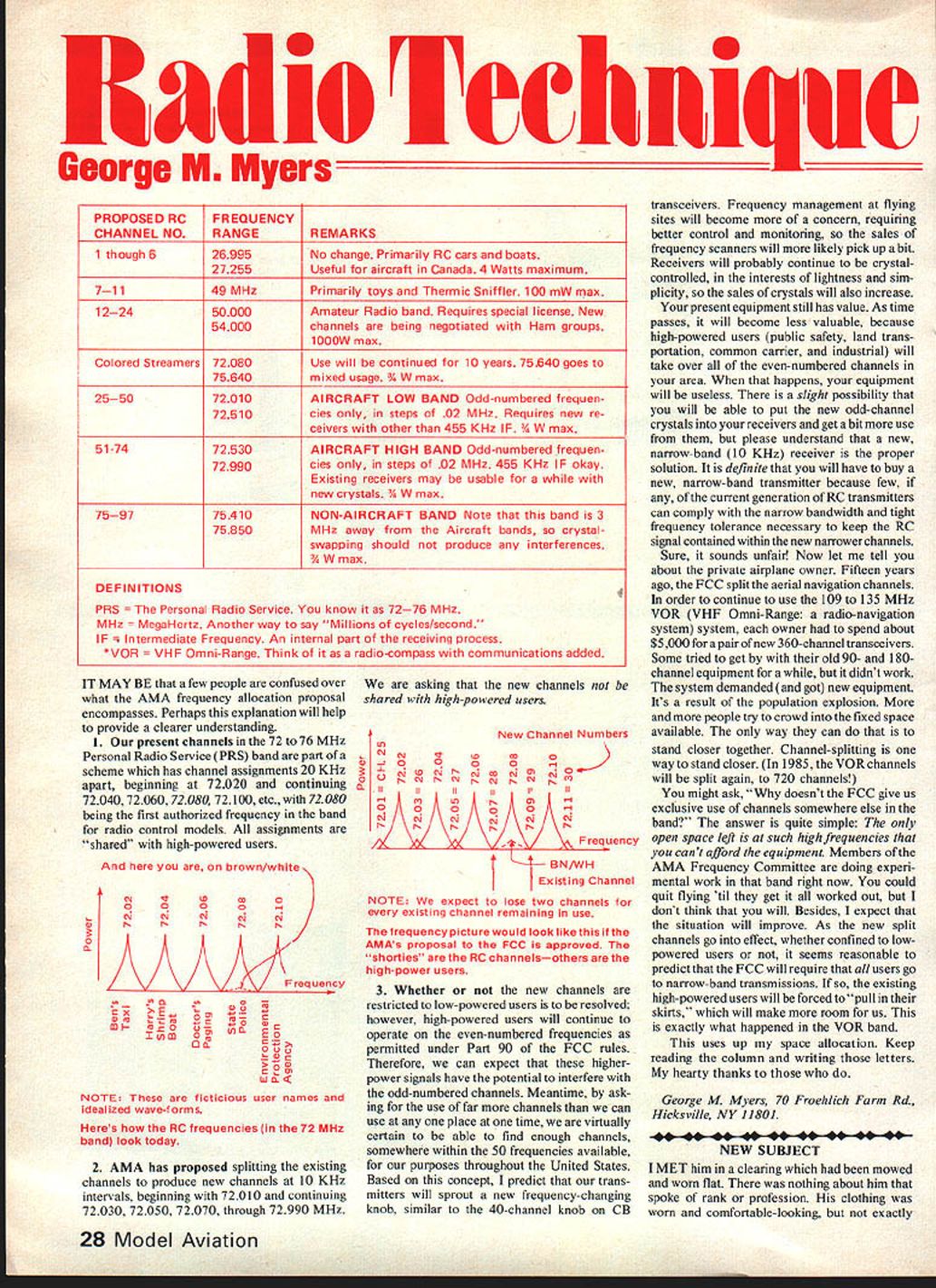
Proposed RC Channel Allocations
- 1 through 6 — 26.995–27.255 MHz
No change. Primarily RC cars and boats. Useful for aircraft in Canada. 4 W max.
- 7–11 — 49 MHz
Primarily toys and Thermic Sniffler. 100 mW max.
- 12–24 — 50.000–54.000 MHz
Amateur Radio band. Requires special license. New channels are being negotiated with ham groups. 1000 W max.
- Colored Streamers — 72.080–75.640 MHz
Use will be continued for 10 years. 75.640 MHz goes to mixed usage. 0.75 W max.
- 25–50 — 72.010–72.510 MHz (Aircraft low band)
Odd-numbered frequencies only, in steps of 0.02 MHz. Requires new receivers with an IF other than 455 kHz. 0.75 W max.
- 51–74 — 72.530–72.990 MHz (Aircraft high band)
Odd-numbered frequencies only, in steps of 0.02 MHz. 455 kHz IF okay. Existing receivers may be usable for a while with new crystals. 0.75 W max.
- 75–97 — 75.410–75.850 MHz (Non-aircraft band)
This band is 3 MHz away from the aircraft bands, so crystal-swapping should not produce interference. 0.75 W max.
Definitions
- PRS = Personal Radio Service (72–76 MHz)
- MHz = megahertz (millions of cycles per second)
- IF = intermediate frequency (an internal part of the receiving process)
- VOR = VHF Omnidirectional Range (radio-navigation system)
Explanation of the AMA Frequency-Allocation Proposal
It may be that a few people are confused over what the AMA frequency-allocation proposal encompasses. Perhaps this explanation will help provide a clearer understanding.
- Our present channels in the 72–76 MHz Personal Radio Service (PRS) band are part of a scheme that has channel assignments 20 kHz apart, beginning at 72.020 and continuing 72.040, 72.060, 72.080, 72.100, etc. 72.080 is the first authorized frequency for model radio-control assignments; these channels are shared with high-powered users.
- AMA has proposed splitting the existing channels to produce new channels 10 kHz apart, beginning 72.010 and continuing 72.030, 72.050, 72.070 through 72.990 MHz. We are asking that the new channels not be shared with high-powered users.
- NOTE: We expect to lose two channels for every existing channel remaining in use.
- Whether the new channels will be restricted to low-powered users has not yet been resolved; however, high-powered users will continue to operate on even-numbered frequencies as permitted under Part 90 of the FCC rules. Therefore, higher-power signals have the potential to interfere with the odd-numbered channels. By asking for far more channels than we can use at any one place at one time, we are virtually certain to be able to find enough channels somewhere within the roughly 50 frequencies available for our purposes throughout the United States.
Based on this concept, I predict that our transmitters will sprout a new frequency-changing knob, similar to the 40-channel knob on CB transceivers. Frequency management at flying sites will become more of a concern, requiring better control and monitoring, so sales of frequency scanners will likely pick up. Receivers will probably continue to be crystal-controlled for lightness and simplicity, so sales of crystals will also increase.
Your present equipment still has value. As time passes it will become less valuable, because high-powered users (public safety, land transportation, common carrier, and industrial) will take over all of the even-numbered channels in your area. When that happens, your equipment will be useless. There is a slight possibility you will be able to put the new odd-channel crystals into your receivers and get a bit more use, but please understand that a new, narrow-band (10 kHz) receiver is the proper solution. It is definite that you will have to buy a new narrow-band transmitter because few, if any, of the current generation of RC transmitters can comply with the narrow bandwidth and tight frequency tolerance necessary to keep the RC signal contained within the new narrower channels.
Sure, it sounds unfair! Now a word about the private airplane owner. Fifteen years ago the FCC split the aerial-navigation channels in order to continue use of the 109–135 MHz VOR (VHF Omnidirectional Range) radio-navigation system; each owner had to spend about $5,000 for a pair of new 360-channel transceivers. Some tried to get by with their old 90- and 180-channel equipment for a while, but it didn't work. The system demanded (and got) new equipment. It's a result of population growth: more and more people try to crowd into the fixed space available. The only way they can do that is to stand closer together. Channel-splitting is one way to stand closer. (In 1985, the VOR channels will be split again, to 720 channels.)
You might ask, "Why doesn't the FCC give us exclusive use of channels somewhere else in the band?" The answer is simple: the only exclusive set is at such high frequencies that you can't afford the equipment. Members of the AMA Frequency Committee are doing experimental work right in that band right now. You could quit flying until they get it all worked out, but I don't think that you will.
As the new split channels go into effect, whether confined to low-powered users or not, it seems reasonable to predict that the FCC will require all users to go to narrow-band transmissions. If so, the existing high-powered users will be forced to "pull in their skirts," which will make more room for us. This is exactly what happened in the VOR band.
Keep reading the column and writing those letters. My hearty thanks to those who do.
George M. Myers 70 Froehlich Farm Rd., Hicksville, NY 11801.
Transcribed from original scans by AI. Minor OCR errors may remain.

